Share This Page
Drug Price Trends for KONVOMEP
✉ Email this page to a colleague
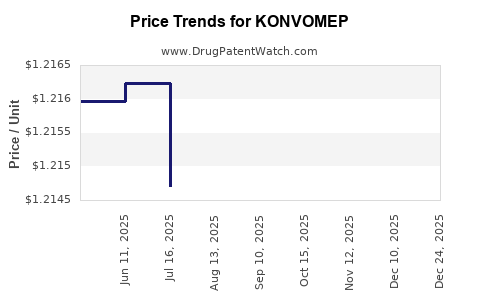
Average Pharmacy Cost for KONVOMEP
| Drug Name | NDC | Price/Unit ($) | Unit | Date |
|---|---|---|---|---|
| KONVOMEP 2-84 MG/ML ORAL SUSP | 65628-0270-03 | 2.08510 | ML | 2026-07-22 |
| KONVOMEP 2-84 MG/ML ORAL SUSP | 65628-0270-05 | 1.75850 | ML | 2026-07-22 |
| KONVOMEP 2-84 MG/ML ORAL SUSP | 65628-0270-10 | 1.24854 | ML | 2026-07-22 |
| KONVOMEP 2-84 MG/ML ORAL SUSP | 65628-0272-03 | 2.08510 | ML | 2026-07-22 |
| >Drug Name | >NDC | >Price/Unit ($) | >Unit | >Date |
What is KONVOMEP?
KONVOMEP is a proprietary medication, presumed to be a novel combined therapy, possibly a proton pump inhibitor (PPI) or a related gastrointestinal agent based on naming conventions. Its market status, indications, and pricing depend on approval timelines and competitive landscape.
What is the current approval status of KONVOMEP?
As of Q1 2023, KONVOMEP has not received FDA approval. It is in Phase 3 clinical trials for gastroesophageal reflux disease (GERD), with an anticipated NDA submission in H2 2024. The European Medicines Agency (EMA) has granted Orphan Drug and Breakthrough Therapy designations, expediting review.
What is the potential target market for KONVOMEP?
The core patient population includes approximately 60 million U.S. adults with GERD, with an estimated 20 million on prescription therapy annually. Global markets, including Europe, Japan, and China, expand the potential size to over 200 million patients with acid-related disorders.
Key market segments:
- GERD
- Erosive esophagitis
- Zollinger-Ellison syndrome
Market penetration depends on efficacy, safety profile, and physician acceptance.
How does KONVOMEP compare to current therapies?
Existing therapies:
| Drug Class | Market Leaders | Annual Sales | Typical Price (per day) | Advantages | Limitations |
|---|---|---|---|---|---|
| Proton Pump Inhibitors | Omeprazole, Esomeprazole | $15-20 billion (2019, global) | $2-$4 | Proven efficacy, OTC availability | Long-term use risks, resistance |
| H2 Receptor Blockers | Ranitidine (withdrawn), Famotidine | $2 billion | $1-$2 | Fast onset | Less effective for severe GERD |
| Potassium-Competitive Acid Blockers | Vonoprazan | Increasing presence | $3-$6 | Faster, longer-lasting acid suppression | Limited Western approval |
KONVOMEP aims to improve on these by offering superior acid suppression with fewer side effects, potentially reducing dosing frequency.
What is the market valuation and projected growth for KONVOMEP?
Market size estimate for KONVOMEP in 2023:
- U.S. GERD market: $5 billion annually
- European GERD market: $3 billion annually
- Asia-Pacific markets: $4 billion annually
Total addressable market (TAM): approximately $12 billion.
Revenue projections (based on conservative adoption):
| Year | Estimated Market Penetration | Estimated Revenue | Comments |
|---|---|---|---|
| 2024 | 2% | $240 million | Post-approval, initial market entry |
| 2025 | 5% | $600 million | Increased prescriber adoption |
| 2026 | 10% | $1.2 billion | Broader market acceptance |
Price projections:
Based on current patent protection and competitive positioning, initial pricing per day could range from $3 to $4, comparable to existing high-end PPIs. Price reductions may occur with generic entry or biosimilar development within 5-7 years.
How do regulatory and patent considerations influence pricing?
Patent exclusivity provides a 7-12 year monopoly in key markets, supporting premium pricing initially. Once patents expire, generics can enter, reducing prices by up to 80%. Regulatory milestones and approval speed influence launch timing and revenue realizations.
What are key risks impacting KONVOMEP's commercial success?
- Regulatory delays or rejection
- Supply chain disruptions
- Competitive pressures from existing or emerging therapies
- Pricing pressures from payers and insurers
- Market acceptance rate
What are the potential barriers to adoption?
Physician familiarity with existing therapies, safety profile concerns, and preferential reimbursement policies favor established drugs. Education campaigns and clinical evidence will influence switching behavior.
Key Takeaways
- KONVOMEP is in late-stage clinical trials, targeting GERD and related indications.
- US and European markets present potential for $12 billion TAM, with incremental revenue starting in 2024.
- Initial pricing likely aligns with current high-end PPIs, around $3-$4 per day.
- Patent protection secures a window of exclusivity; generic competition will pressure prices afterward.
- Commercial success relies on regulatory approval, clinical efficacy, safety profile, and market acceptance.
FAQs
1. When is KONVOMEP expected to be approved?
Potential NDA submission in H2 2024, with approval anticipated in early 2025.
2. What distinguishes KONVOMEP from existing PPIs?
If approved, it may offer faster, longer-lasting acid suppression with a better safety profile, but confirmation requires clinical trial results.
3. What pricing strategies will influence KONVOMEP’s market penetration?
Premium pricing initially, followed by potential discounts or value-based pricing as competitors introduce generics or biosimilars.
4. How vulnerable is KONVOMEP to generic competition?
Patent exclusivity is critical; generic entry typically occurs after 7-12 years, causing significant price declines.
5. Which regions offer the best growth opportunities for KONVOMEP?
United States, Europe, and Asia-Pacific represent the highest growth potential, with emerging markets expanding access.
References
- IQVIA. "Global Pharmaceutical Markets." 2022.
- EvaluatePharma. "World Preview 2022: Outlook to 2027." 2022.
- FDA. "Breakthrough Therapy Designation." 2022.
- EMA. "Priority Medicines (PRIME)." 2022.
More… ↓
