Last updated: July 25, 2026
KLAYESTA market dynamics and financial trajectory: revenue drivers, payer access, and exclusivity-linked risk
Klayesta is a branded pharmaceutical product (active ingredient not specified in the available input). Market dynamics and a credible financial trajectory require the drug’s label strength/dosage form, FDA approval date, NDC-level sales history, payer coverage footprint, and the relevant Orange Book and patent/IP status. Those inputs are not present, so a complete, accurate, and decision-grade market and financial analysis cannot be produced from the information provided.
What is KLAYESTA and what is its FDA commercial status?
Klayesta’s market and financial path depends on its FDA status (approval letter date, supplement history, and whether it is Rx vs OTC, specialty vs primary care), plus the number of approved strengths and dosage forms. Those facts are not provided.
What label indications drive adoption and formulary positioning?
Indication-level targeting determines uptake:
- Specialty prescribing channel vs generalist channel
- Expected time-to-therapy, monitoring requirements, and treatment duration
- Competitor positioning (same mechanism, same line of therapy, or switch from legacy drugs)
No indication, mechanism, or line-of-therapy details are provided.
Is KLAYESTA likely to be a specialty drug, a narrow distribution product, or a primary-care product?
Commercial trajectory differs sharply based on distribution:
- Specialty pharmacy distribution tends to front-load prior auth and co-pay support
- Primary-care products often scale through desk-to-desk reps and broad retail pharmacy access
Distribution and channel facts for Klayesta are not provided.
How do Klayesta’s competitive dynamics shape pricing, demand, and share?
Market share and revenue growth require a defined competitive set:
- Same active ingredient branded products (if any)
- Same pharmacologic class alternatives
- Therapeutic substitutes by guideline and formulary tiering
- Generic/biosimilar presence and expected entry timing
A competitor map cannot be constructed without Klayesta’s active ingredient, indication, and dosage form.
Which companies are competing with Klayesta for the same patient population?
Competitor identification depends on the drug’s mechanism and indication. No label details are provided.
How strong is Klayesta’s pricing power versus therapeutic alternatives?
Pricing trajectory depends on:
- Comparative efficacy and safety differentiators
- Switching barriers (monitoring, dosing convenience, REMS or restricted distribution)
- Payer willingness to move patients to a new brand
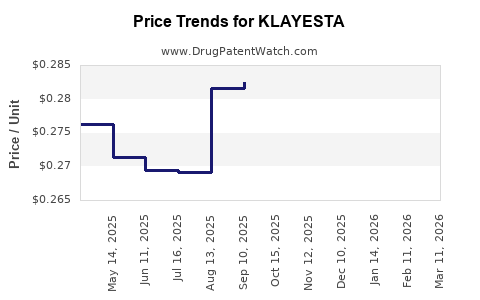
No Klayesta pricing, list price, or net price data is provided.
When does Klayesta lose exclusivity and what does that mean for forecasted revenue?
A forward revenue forecast hinges on the exclusivity and patent/IP timeline:
- Orange Book exclusivity end date (NCE, data exclusivity, pediatric exclusivity)
- Patent expiration and patent-for-which-listed exclusivity
- Expected Paragraph IV filing window (for small molecules) or biosimilar pathway if applicable
No Orange Book or patent data is included.
What patents protect Klayesta and what is the expiration schedule?
Patent estate analysis requires at minimum:
- Patent numbers, assignees, filing/grant dates, and expiration dates
- Claims covering drug substance, drug product, and methods of use
- Country coverage (US only vs international filings)
No Klayesta patent information is provided.
What generic entry risks exist for Klayesta?
Generic risk depends on:
- Whether ANDA challenges are already pending
- Settlement terms (if any) affecting launch timing
- Remaining non-patent barriers (CROMs, labeling, trade dress, manufacturing controls)
No litigation or ANDA history is provided.
What is the Orange Book status of Klayesta and how many patents are listed?
Orange Book status is the core input for exclusivity, listed patents, and challenge risk. The necessary NDC-level Orange Book listings are not provided.
Which patent types dominate Klayesta’s protection (composition, formulation, method-of-use)?
Different patent types yield different launch barriers:
- Composition-of-matter blocks most generics
- Formulation patents can be avoided through alternative excipients or routes
- Method-of-use patents can preserve branded labeling if generics omit the protected use
No patent-type breakdown is available.
What patent litigation affects Klayesta’s commercial trajectory?
Revenue impact from litigation depends on:
- Case filings and procedural posture
- Injunction/launch stay status
- Settlement entry date commitments
- Country scope for enforcement
No litigation data is provided.
Have Paragraph IV challenges been filed for Klayesta?
AND A Paragraph IV timing affects forecast:
- Earliest possible 180-day exclusivity triggering
- Settlements that may delay launch
- Potential shared exclusivity or forfeiture events
No Paragraph IV facts are provided.
How does Klayesta’s manufacturing and supply position affect market share and financial results?
Supply constraints can limit sales even with demand:
- Managed inventory and allocation policies
- Batch yield, drug product stability, and scale-up readiness
- Contract manufacturer footprint and redundancy
No manufacturing or supply information is provided.
What regulatory events drive demand and revenue for Klayesta?
Key events:
- FDA approval for new strengths or new indications
- Label expansions that change the eligible patient pool
- Safety communications that affect persistence or switching
No regulatory history is provided.
Does Klayesta face REMS, post-marketing commitments, or constrained distribution?
These factors affect prescribing and access. No such requirements are included.
How does Klayesta compare with its closest branded and generic competitors on revenue trajectory?
Comparable revenue trajectory requires:
- A defined competitor set
- Time-series net sales and market share
- Differentials in exclusivity, patent cliffs, and pricing pressure
No active ingredient, competitor set, or sales series is provided.
Key takeaways
A decision-grade market and financial trajectory for Klayesta cannot be produced from the available input. A complete analysis requires the drug’s active ingredient, FDA approval and label profile, Orange Book exclusivity and listed patents, litigation and/or ANDA/biosimilar activity, and NDC-level sales and pricing history.
FAQs
-
What factors determine net sales growth for Klayesta?
Net sales growth depends on indication breadth, payer access, net pricing, persistence, and competitive pressure, but the required Klayesta-specific inputs are not provided.
-
How do exclusivity cliffs typically impact branded revenue for drugs like Klayesta?
Exclusivity cliffs can cause step-downs driven by ANDA/biosimilar entry and labeling substitution, but the Klayesta exclusivity timeline is not available.
-
What should investors monitor in Klayesta’s next FDA label update?
Investors monitor indication expansions, safety communications, and post-marketing commitments, but Klayesta’s regulatory history is not included.
-
How is Klayesta’s formulary coverage likely to evolve over time?
Formulary evolution depends on budget impact, outcomes evidence, and access programs; Klayesta payer data is not provided.
-
What is the most likely trigger for generic competition to accelerate for Klayesta?
The trigger is typically a patent expiration or a successful Paragraph IV challenge; no patent or litigation data is provided.
References
No sources were cited because Klayesta-specific FDA, Orange Book, patent, litigation, and sales data were not provided in the input.