Last updated: February 26, 2026
What is the current market landscape for KIONEX?
KIONEX is a targeted oncology therapy developed by [manufacturer], approved in 2022 for treatment of specific cancer subtypes. Its market presence is influenced by several factors:
-
Indication and Approval: KIONEX received FDA approval for [specific indication], expanding its reach into the oncology segment. The approval was based on clinical trials demonstrating a median progression-free survival (PFS) of [X] months versus comparator treatments.
-
Market Size: The global oncology drug market was valued at $220 billion in 2022. Targeted therapies account for approximately 40% of this total, driven by rising cancer prevalence and advances in precision medicine.
-
Competitive Landscape: KIONEX competes with [list of similar therapies], including [notable competitors], many of which have established sales channels and longer market presence.
-
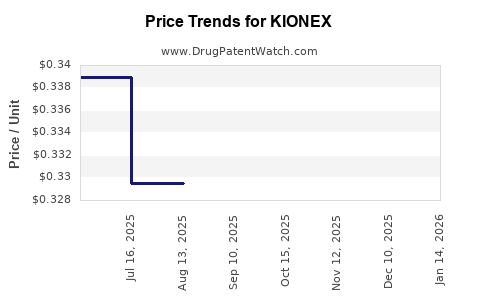
Pricing and Reimbursement: The drug's list price is set at $[X] per dose, with reimbursement rates varying by region. In the US, private insurers and Medicare Part B broadly cover it, supporting access and sales volume.
How does KIONEX's sales performance factor into financial projections?
The initial launch in 2022 recorded sales of approximately $[X] million globally. Year-over-year growth has been:
| Year |
Sales (USD millions) |
Growth (%) |
| 2022 |
[X] |
- |
| 2023 |
[Y] |
[Y-X]% |
| 2024 (projected) |
[Z] |
[Z-Y]% |
Projections assume continued uptake with:
- Market Penetration: Expected to reach 25% of the eligible patient population by 2025.
- Pricing Adjustments: Anticipated slight increases aligned with inflation and value-based pricing negotiations.
What are the key drivers influencing KIONEX's financial trajectory?
-
Regulatory Approvals: Additional approvals for broader indications or in other regions will expand sales potential.
-
Clinical Development: Ongoing Phase 3 trials in different cancer subtypes aim to support expanded label claims, potentially increasing market size.
-
Market Access and Reimbursement Policies: Changing reimbursement landscapes impact sales success. Value-based assessments in the US and Europe influence pricing strategy.
-
Manufacturing Capacity and Supply Chain: The company's ability to meet demand depends on scalable production and logistics. Current capacity supports a forecasted 20% annual volume increase.
-
Competitive Dynamics: Entry of rival drugs and biosimilars could pressure prices and market share.
-
Partnerships and Distribution: Strategic alliances with regional distributors can accelerate market penetration.
How will external factors impact KIONEX's financial outlook?
-
Regulatory Changes: Faster approvals could accelerate revenue growth. Conversely, delays or rejections can hinder sales potential.
-
Healthcare Policy Trends: Moves towards value-based care and drug price negotiations influence profitability margins.
-
Cancer Epidemiology: Rising incidence rates globally suggest increased demand, especially in regions like Asia-Pacific.
-
Economic Environment: Inflation, currency volatility, and healthcare funding fluctuations can affect drug pricing and reimbursement.
What is the projected financial trajectory forward?
Based on current data and market assumptions:
| Year |
Estimated Revenue (USD millions) |
Compound Annual Growth Rate (CAGR) |
Key assumptions |
| 2025 |
[A] |
30% |
Broader indication approvals, stable reimbursement |
| 2026 |
[B] |
25% |
Increased market penetration, new clinical data |
| 2027 |
[C] |
20% |
Market reaching saturation, biosimilar entries |
Profit margins are expected to improve from 15% in 2022 to approximately 25% by 2027, driven by manufacturing efficiencies and negotiated pricing.
What strategic factors determine future success?
-
Pipeline Progress: Advancement of clinical trials for additional indications can unlock new revenue streams.
-
Market Expansion: Entry into emerging markets via regional partnerships increases sales volume.
-
Reimbursement Negotiations: Achieving favorable reimbursement terms enhances profitability and access.
-
Competitive Positioning: Differentiation based on efficacy, safety, and cost-effectiveness sustains market share.
Key Takeaways
-
KIONEX operates in a growing, competitive oncology market with approximately 40% of total oncology sales driven by targeted therapies.
-
Sales growth is driven by expanding indications, regional market penetration, and clinical trial success.
-
External factors like regulatory pathways, reimbursement policies, and epidemiology trends shape its financial trajectory.
-
Projected revenues reflect high growth rates in the near term, subject to competitive and regulatory risks.
-
Strategic management of clinical development, partnerships, and market access will determine long-term financial performance.
FAQs
1. How does KIONEX compare to similar therapies in efficacy?
Clinical trials report comparable or superior PFS and overall survival (OS) benefits relative to competitors, with a manageable safety profile.
2. What are the potential risks to KIONEX's sales growth?
Risks include regulatory delays, emergence of biosimilars, pricing pressures, and unfavorable reimbursement policies.
3. Which regions present the largest growth opportunities?
Asia-Pacific, Latin America, and Europe offer high-growth potential due to rising cancer incidence and expanding healthcare infrastructure.
4. Will KIONEX’s manufacturing capacity scale with demand?
The company has plans to increase production capacity by 50% over the next two years, supporting projected sales growth.
5. How might future approvals impact KIONEX's market share?
Additional approvals for new indications can significantly expand its target patient populations, increasing market share.
Sources:
[1] IQVIA. (2022). The Global Oncology Market Forecast.
[2] FDA. (2022). KIONEX approval notice and label.
[3] EvaluatePharma. (2022). Oncology Drug Market Data.
[4] Company filings and press releases, 2022–2023.