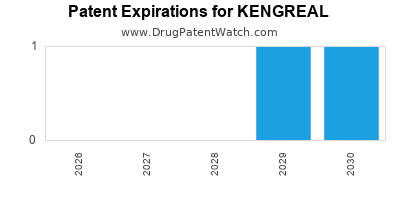
Last Updated: November 16, 2026

KENGREAL Drug Patent Profile

« Back to Dashboard


When do Kengreal patents expire, and when can generic versions of Kengreal launch?

Kengreal is a drug marketed by Chiesi and is included in one NDA. There are seven patents protecting this drug and one Paragraph IV challenge.

The generic ingredient in KENGREAL is cangrelor. There is one drug master file entry for this compound. Two suppliers are listed for this compound. Additional details are available on the cangrelor profile page.

DrugPatentWatch® Litigation and Generic Entry Outlook for Kengreal

A generic version of KENGREAL was approved as cangrelor by GLAND on August 11th, 2025.

  Start Trial

AI Deep Research
Questions you can ask:
  • What is the 5 year forecast for KENGREAL?
  • What are the global sales for KENGREAL?
  • What is Average Wholesale Price for KENGREAL?
Recent Clinical Trials for KENGREAL

Identify potential brand extensions & 505(b)(2) entrants

SponsorPhase
Scott R. MacKenzie FoundationPhase 4
Scott R MacKenzie FoundationPhase 4
University of FloridaPhase 4

See all KENGREAL clinical trials

Pharmacology for KENGREAL
Paragraph IV (Patent) Challenges for KENGREAL
Tradename Dosage Ingredient Strength NDA ANDAs Submitted Submissiondate
KENGREAL For Injection cangrelor 50 mg/vial 204958 2 2019-06-24

US Patents and Regulatory Information for KENGREAL

KENGREAL is protected by seven US patents.

Applicant Tradename Generic Name Dosage NDA Approval Date TE Type RLD RS Patent No. Patent Expiration Product Substance Delist Req. Exclusivity Expiration
Chiesi KENGREAL cangrelor POWDER;INTRAVENOUS 204958-001 Jun 22, 2015 AP RX Yes Yes 10,039,780 ⤷  Start Trial ⤷  Start Trial
Chiesi KENGREAL cangrelor POWDER;INTRAVENOUS 204958-001 Jun 22, 2015 AP RX Yes Yes 9,295,687 ⤷  Start Trial Y ⤷  Start Trial
Chiesi KENGREAL cangrelor POWDER;INTRAVENOUS 204958-001 Jun 22, 2015 AP RX Yes Yes 8,680,052 ⤷  Start Trial ⤷  Start Trial
Chiesi KENGREAL cangrelor POWDER;INTRAVENOUS 204958-001 Jun 22, 2015 AP RX Yes Yes 9,925,265 ⤷  Start Trial ⤷  Start Trial
Chiesi KENGREAL cangrelor POWDER;INTRAVENOUS 204958-001 Jun 22, 2015 AP RX Yes Yes 9,427,448 ⤷  Start Trial ⤷  Start Trial
Chiesi KENGREAL cangrelor POWDER;INTRAVENOUS 204958-001 Jun 22, 2015 AP RX Yes Yes 9,700,575 ⤷  Start Trial Y ⤷  Start Trial
>Applicant >Tradename >Generic Name >Dosage >NDA >Approval Date >TE >Type >RLD >RS >Patent No. >Patent Expiration >Product >Substance >Delist Req. >Exclusivity Expiration

EU/EMA Drug Approvals for KENGREAL

Company Drugname Inn Product Number / Indication Status Generic Biosimilar Orphan Marketing Authorisation Marketing Refusal
Chiesi Farmaceutici S.p.A. Kengrexal cangrelor EMEA/H/C/003773Kengrexal, co-administered with acetylsalicylic acid (ASA), is indicated for the reduction of thrombotic cardiovascular events in adult patients with coronary artery disease undergoing percutaneous coronary intervention (PCI) who have not received an oral P2Y12 inhibitor prior to the PCI procedure and in whom oral therapy with P2Y12 inhibitors is not feasible or desirable. Authorised no no no 2015-03-23
>Company >Drugname >Inn >Product Number / Indication >Status >Generic >Biosimilar >Orphan >Marketing Authorisation >Marketing Refusal

International Patents for KENGREAL

When does loss-of-exclusivity occur for KENGREAL?

Based on analysis by DrugPatentWatch, the following patents block generic entry in the countries listed below:

Brazil

Patent: 2017014996
Patent: formulações farmacêuticas e recipientes selados
Estimated Expiration: ⤷  Start Trial

Canada

Patent: 71868
Patent: FORMULATIONS PHARMACEUTIQUES COMPRENANT DU CANGRELOR DE HAUTE PURETE ET LEURS PROCEDES DE PREPARATION ET D'UTILISATION (PHARMACEUTICAL FORMULATIONS COMPRISING HIGH PURITY CANGRELOR AND METHODS FOR PREPARING AND USING THE SAME)
Estimated Expiration: ⤷  Start Trial

Chile

Patent: 17001840
Patent: Formulaciones farmacéuticas que comprenden cangrelor de alta pureza y métodos para preparar y usar las mismas.
Estimated Expiration: ⤷  Start Trial

China

Patent: 7206014
Patent: 包含高纯度坎格雷洛的药物制剂以及制备和使用它们的方法 (Pharmaceutical formulations comprising high purity cangrelor and methods for preparing and using the same)
Estimated Expiration: ⤷  Start Trial

Patent: 5990138
Patent: 包含高纯度坎格雷洛的药物制剂以及制备和使用它们的方法 (Pharmaceutical formulations comprising high purity cangrelor and methods of making and using same)
Estimated Expiration: ⤷  Start Trial

Colombia

Patent: 17006958
Patent: Formulaciones farmacéuticas que comprenden cangrelor de alta pureza y métodos para la preparación y uso de los mismos
Estimated Expiration: ⤷  Start Trial

Croatia

Patent: 0261024
Estimated Expiration: ⤷  Start Trial

Denmark

Patent: 44900
Estimated Expiration: ⤷  Start Trial

European Patent Office

Patent: 44900
Patent: FORMULATIONS PHARMACEUTIQUES COMPRENANT DU CANGRELOR DE HAUTE PURETÉ ET LEURS PROCÉDÉS DE PRÉPARATION ET D'UTILISATION (PHARMACEUTICAL FORMULATIONS COMPRISING HIGH PURITY CANGRELOR AND METHODS FOR PREPARING AND USING THE SAME)
Estimated Expiration: ⤷  Start Trial

Patent: 96110
Estimated Expiration: ⤷  Start Trial

Finland

Patent: 44900
Estimated Expiration: ⤷  Start Trial

Lithuania

Patent: 44900
Estimated Expiration: ⤷  Start Trial

Mexico

Patent: 1152
Patent: FORMULACIONES FARMACEUTICAS QUE COMPRENDEN CANGRELOR DE ALTA PUREZA Y METODOS PARA PREPARAR Y UTILIZAR LAS MISMAS. (PHARMACEUTICAL FORMULATIONS COMPRISING HIGH PURITY CANGRELOR AND METHODS FOR PREPARING AND USING THE SAME)
Estimated Expiration: ⤷  Start Trial

Patent: 17009289
Patent: FORMULACIONES FARMACEUTICAS QUE COMPRENDEN CANGRELOR DE ALTA PUREZA Y METODOS PARA PREPARAR Y UTILIZAR LAS MISMAS. (PHARMACEUTICAL FORMULATIONS COMPRISING HIGH PURITY CANGRELOR AND METHODS FOR PREPARING AND USING THE SAME.)
Estimated Expiration: ⤷  Start Trial

Morocco

Patent: 326
Patent: FORMULATIONS PHARMACEUTIQUES COMPRENANT DU CANGRELOR DE HAUTE PURETÉ ET LEURS PROCÉDÉS DE PRÉPARATION ET D'UTILISATION (Pharmaceutical formulations comprising high-purity cangrelor and their methods of preparation and use)
Estimated Expiration: ⤷  Start Trial

Peru

Patent: 171246
Patent: FORMULACIONES FARMACEUTICAS QUE COMPRENDEN CANGRELOR DE ALTA PUREZA Y METODOS PARA LA PREPARACION Y USO DE LOS MISMOS
Estimated Expiration: ⤷  Start Trial

Patent: 221170
Patent: FORMULACIONES FARMACEUTICAS QUE COMPRENDEN CANGRELOR DE ALTA PUREZA Y METODOS PARA LA PREPARACION Y USO DE LOS MISMOS
Estimated Expiration: ⤷  Start Trial

Poland

Patent: 44900
Estimated Expiration: ⤷  Start Trial

Portugal

Patent: 44900
Estimated Expiration: ⤷  Start Trial

Russian Federation

Patent: 33409
Patent: PHARMACEUTICAL COMPOSITIONS CONTAINING HIGH-PURITY CANGRELOR, AND METHODS FOR PRODUCTION AND USE THEREOF
Estimated Expiration: ⤷  Start Trial

Patent: 17127531
Patent: ФАРМАЦЕВТИЧЕСКИЕ СОСТАВЫ, ВКЛЮЧАЮЩИЕ КАНГРЕЛОР ВЫСОКОЙ ЧИСТОТЫ, И СПОСОБЫ ИХ ПОЛУЧЕНИЯ И ПРИМЕНЕНИЯ (PHARMACEUTICAL COMPOSITIONS CONTAINING HIGH-PURITY CANGRELOR, AND METHODS FOR PRODUCTION AND USE THEREOF)
Estimated Expiration: ⤷  Start Trial

San Marino

Patent: 02600322
Estimated Expiration: ⤷  Start Trial

Serbia

Patent: 387
Patent: FARMACEUTSKE FORMULACIJE KOJE SADRŽE KANGRELOR VISOKE ČISTOĆE I POSTUPCI ZA NJEGOVU PRIPREMU I UPOTREBU (PHARMACEUTICAL FORMULATIONS COMPRISING HIGH PURITY CANGRELOR AND METHODS FOR PREPARING AND USING THE SAME)
Estimated Expiration: ⤷  Start Trial

Slovenia

Patent: 44900
Estimated Expiration: ⤷  Start Trial

South Korea

Patent: 2440847
Estimated Expiration: ⤷  Start Trial

Patent: 170103848
Patent: 고순도의 칸그렐러를 포함하는 약제학적 제제, 및 이들의 제조 및 사용 방법
Estimated Expiration: ⤷  Start Trial

Spain

Patent: 76659
Estimated Expiration: ⤷  Start Trial

Generics may enter earlier, or later, based on new patent filings, patent extensions, patent invalidation, early generic licensing, generic entry preferences, and other factors.

See the table below for additional patents covering KENGREAL around the world.

Country Patent Number Title Estimated Expiration
Brazil 112017014996 ⤷  Start Trial
Canada 2971868 ⤷  Start Trial
Chile 2017001840 ⤷  Start Trial
China 107206014 ⤷  Start Trial
China 115990138 ⤷  Start Trial
Colombia 2017006958 ⤷  Start Trial
>Country >Patent Number >Title >Estimated Expiration

Supplementary Protection Certificates for KENGREAL

Patent Number Supplementary Protection Certificate SPC Country SPC Expiration SPC Description
1007094 15C0060 France ⤷  Start Trial PRODUCT NAME: CANGRELOR OU UN SEL PHARMACEUTIQUEMENT ACCEPTABLE,NOTAMMENT UN SEL TETRASODIQUE; REGISTRATION NO/DATE: EU/1/15/994/001 20150323
>Patent Number >Supplementary Protection Certificate >SPC Country >SPC Expiration >SPC Description

Kengreal Market Dynamics, Financial Trajectory, Patents, and Generic Entry Risk

Last updated: October 29, 2026

Kengreal, the branded form of intravenous cangrelor, is a hospital-only antiplatelet drug marketed by Chiesi USA. FDA approval in 2015 created a niche product for rapid platelet inhibition during percutaneous coronary intervention (PCI). Its commercial value depends on procedural use, hospital protocols, oral P2Y12 pretreatment rates, inventory economics, and the limited clinical situations in which an intravenous agent is preferred.

Public company filings indicate that Kengreal generated low tens of millions of dollars in annual net sales before The Medicines Company transferred the product to Chiesi. Chiesi does not generally disclose Kengreal sales as a separate line item, preventing a verified current revenue series. The product remains commercially relevant but is not a material driver of Chiesi's consolidated revenue.

What is Kengreal and how does it work?

Kengreal is cangrelor for injection, a direct-acting, reversible P2Y12 platelet inhibitor. It is administered intravenously as a bolus followed by continuous infusion.

The FDA-approved indication is reduction of thrombotic cardiovascular events in adults undergoing PCI who have not been pretreated with a P2Y12 platelet inhibitor and who are not receiving a glycoprotein IIb/IIIa inhibitor.[1]

Product attribute Kengreal
Active ingredient Cangrelor
Dosage form Intravenous powder for solution
Drug class Reversible P2Y12 inhibitor
Primary setting Hospital-based PCI
FDA approval June 22, 2015
Original developer The Medicines Company
Current commercial owner Chiesi Farmaceutici / Chiesi USA
Standard administration 30 mcg/kg IV bolus, followed by 4 mcg/kg/min infusion
Key advantage Immediate onset and rapid offset of platelet inhibition
Main alternatives Clopidogrel, prasugrel, ticagrelor, glycoprotein IIb/IIIa inhibitors

Cangrelor has a short plasma half-life and platelet function generally returns toward baseline within approximately one hour after discontinuation. That profile supports use when oral absorption is delayed, oral therapy cannot be administered, or urgent platelet inhibition is required.[1]

When did Kengreal receive FDA approval and regulatory exclusivity?

Kengreal received FDA approval in 2015 under a standard new drug application. Its five-year new chemical entity exclusivity expired in 2020, assuming the standard NCE period applied from the approval date. Any pediatric exclusivity or other regulatory extensions would require confirmation in the FDA Orange Book and related FDA records.

The principal regulatory milestones are:

Date Event
June 22, 2015 FDA approval of Kengreal for adults undergoing PCI
2015-2019 Five-year NCE exclusivity period generally associated with approval
2016 Chiesi obtained commercial rights from The Medicines Company
2020 onward Regulatory exclusivity no longer provides the principal barrier to an ANDA
Through 2023 No biosimilar pathway applies because cangrelor is a small-molecule drug

FDA approval did not establish Kengreal as a broad chronic antiplatelet replacement. Its label limits use to the PCI setting, which narrows the addressable volume compared with oral agents prescribed after acute coronary syndrome or coronary stenting.

What is the financial trajectory of Kengreal?

Kengreal's sales trajectory has been characterized by an initial launch phase, gradual hospital adoption, and limited public visibility after the Chiesi transaction.

The Medicines Company reported Kengreal revenue in its public filings during the period after launch. Those disclosures placed annual sales in the low tens of millions of dollars, with year-over-year growth as hospitals gained experience with the product. Chiesi's subsequent reporting has not generally provided a separate Kengreal revenue line, so a verified post-acquisition annual sales series is unavailable in public consolidated accounts.[2][3]

Period Financial interpretation
2015 Commercial launch year with limited initial revenue
2016-2017 Early adoption and expansion from a small base
2018-2019 More established hospital penetration, but still a niche product
2020-2021 Hospital procedure disruption and procurement pressure created potential volume volatility
2022-2023 Recovery in elective and interventional procedures supported demand, but Chiesi did not separately disclose revenue

Kengreal's economics are better measured by hospital account penetration and doses per PCI center than by consumer prescription volume. Revenue is affected by:

  • PCI procedure volumes.
  • The share of patients receiving an oral P2Y12 inhibitor before catheterization.
  • Use in patients who are intubated, vomiting, unconscious, or unable to absorb oral medication.
  • Hospital pharmacy and cardiology protocol adoption.
  • Wholesaler inventory and contract pricing.
  • Generic or alternative intravenous P2Y12 competition.
  • The cost difference between Kengreal and oral agents.

The product has a favorable strategic profile for Chiesi because it requires specialist hospital selling rather than mass-market promotion. Its revenue base is small, but hospital products with established protocols can produce durable cash flow when switching costs are operational rather than patent-based.

How large is the Kengreal market?

Kengreal competes in a narrow subsegment of the antiplatelet market rather than across all P2Y12 therapy.

Oral clopidogrel remains a low-cost generic standard. Prasugrel and ticagrelor provide oral alternatives with broader use across acute coronary syndrome and post-PCI treatment. Kengreal is most defensible when speed, reversibility, and dependable delivery are more important than acquisition cost.

Competitive factor Kengreal Clopidogrel Prasugrel Ticagrelor
Route IV Oral Oral Oral
Onset Immediate Delayed Relatively rapid Rapid
Reversibility Rapid Longer-lasting Longer-lasting Faster than thienopyridines
Use in patients unable to take oral drugs Strong Poor Poor Poor
Cost position Premium hospital product Low-cost generic Higher-cost oral product Branded/generic competition
Primary commercial setting PCI Broad antiplatelet use ACS/PCI ACS and long-term therapy

Kengreal's addressable population is limited by the FDA label and clinical practice. Many PCI patients receive oral therapy before or during the procedure. Kengreal therefore captures cases in which oral pretreatment is unsuitable or inadequate, rather than replacing standard oral treatment across the entire PCI population.

What patents protect Kengreal?

Kengreal's patent protection is less commercially important than it was during the launch period because FDA regulatory exclusivity has ended and the product is approaching the end of its principal small-molecule patent life.

The relevant patent categories are:

  1. Cangrelor compound and nucleotide-analog patents.
  2. Pharmaceutical composition and formulation claims.
  3. Manufacturing and purification claims.
  4. Method-of-use claims covering platelet inhibition or PCI-related treatment.

The FDA Orange Book is the controlling source for patents listed against the approved NDA. Public product literature and company filings do not provide a reliable basis for treating every historical cangrelor patent as an active Orange Book barrier. Patent expiration dates also depend on terminal disclaimers, patent-term adjustment, patent-term extension, and the scope of any listed claims.

How strong is the Kengreal patent estate?

The estate is commercially moderate rather than strong.

Kengreal's clinical differentiation comes from delivery and pharmacology, but intravenous cangrelor has a relatively straightforward active ingredient and a narrow use case. A generic applicant could potentially challenge composition, formulation, or method-of-use patents through an abbreviated new drug application and Paragraph IV certification. The commercial threat would depend on whether the applicant could obtain approval without infringing valid, unexpired claims.

Formulation and manufacturing patents may delay competition if they cover the marketed injectable presentation. They are less durable than broad composition claims because an applicant can attempt to design around specific excipients, concentrations, container systems, or manufacturing steps.

Are there Paragraph IV challenges to Kengreal?

Kengreal's NCE exclusivity period has expired, making an ANDA pathway legally available. A Paragraph IV challenge would require a generic applicant to certify that a listed patent is invalid, unenforceable, or not infringed.

Publicly prominent Paragraph IV litigation involving Kengreal was not a major feature of the product's disclosed commercial history through 2023. The absence of a high-profile challenge does not establish that no ANDA was filed. FDA approval timing, patent listing status, ANDA litigation, and 180-day exclusivity must be assessed from current FDA and court records.

The practical generic-entry sequence would be:

  1. ANDA filing with Paragraph IV certification.
  2. Notice to the NDA holder and patent owner.
  3. Potential Hatch-Waxman litigation within 45 days.
  4. A potential 30-month stay of approval if statutory conditions are met.
  5. FDA approval after patent and exclusivity barriers expire or are resolved.
  6. Hospital formulary conversion and contracting activity.

What generic entry risks exist for Kengreal?

Generic entry risk is real but not necessarily immediate or economically decisive.

The main risks are:

  • Loss of branded price premium.
  • Hospital contract displacement.
  • Lower net pricing from competitive bidding.
  • Reduced formulary preference.
  • Substitution by generic cangrelor in high-volume PCI centers.
  • Greater use of low-cost oral therapy in borderline cases.

The main countervailing factors are:

  • Small total market size.
  • Specialized sterile injectable manufacturing requirements.
  • Hospital stocking and preparation requirements.
  • Limited number of manufacturers willing to enter a niche injectable market.
  • Need to demonstrate reliable supply and consistent product quality.
  • Physician and pharmacy reluctance to change established emergency protocols.

Manufacturing is therefore a more meaningful barrier than it is for a conventional oral tablet. FDA scrutiny of sterile injectable facilities, aseptic processing, container closure, stability, and supply continuity can affect entry timing and commercial uptake.

What is the biosimilar risk for Kengreal?

Kengreal has no biosimilar risk because cangrelor is a chemically synthesized small molecule, not a biologic. Competition would proceed through the ANDA pathway or, depending on product differences, a 505(b)(2) application.

A 505(b)(2) entrant could seek approval for a modified injectable presentation, concentration, or administration approach while relying partly on existing FDA findings. Such a product could compete without being an identical ANDA generic if it satisfies FDA requirements.

What litigation and settlement agreements affect Kengreal?

No major public patent settlement or reverse-payment agreement involving Kengreal was a central disclosed feature of its commercial history through 2023. The Medicines Company and Chiesi transaction was a commercial rights transfer, not a generic settlement.

The principal transaction was Chiesi's acquisition of rights to Kengreal from The Medicines Company. That deal gave Chiesi a marketed cardiovascular hospital product without requiring it to build the molecule from early-stage development. The arrangement also transferred commercial responsibility during the period when Kengreal was still establishing hospital adoption.[3]

How does Kengreal compare with competing antiplatelet drugs?

Kengreal is strongest where oral administration is unreliable and rapid platelet inhibition is required. It is weakest where cost, outpatient convenience, and long-duration therapy dominate.

Factor Kengreal Oral P2Y12 agents
Delivery reliability during emergency PCI High Variable
Hospital acquisition cost High Generally lower
Outpatient utility Low High
Need for infusion infrastructure Yes No
Strategic differentiation Rapid IV effect and offset Convenience and lower cost
Generic substitution pressure Moderate High for clopidogrel; increasing for others
Dependence on PCI volumes High Moderate

Kengreal does not compete directly with oral agents in every patient. Its commercial role is complementary in selected PCI cases.

What is the outlook for Kengreal revenue?

The base-case outlook is stable but constrained. Revenue growth is more likely to come from deeper penetration of existing PCI centers and protocol expansion than from a large increase in the total treatment population.

Upside drivers include:

  • Higher PCI procedure volumes.
  • Greater use in patients unable to receive oral P2Y12 therapy.
  • Protocol adoption by emergency and high-risk PCI programs.
  • Supply or safety problems affecting competing products.
  • Delayed or limited generic entry.

Downside drivers include:

  • Generic cangrelor approval.
  • Continued preference for oral therapy.
  • Hospital budget pressure.
  • Reduced PCI volumes.
  • Contracting concessions by Chiesi.
  • Improved oral-agent administration in emergency settings.

Chiesi's overall revenue exposure is limited because the company has a broad portfolio spanning respiratory, neonatology, rare disease, and specialty medicines. Kengreal is more important as a focused hospital franchise than as a major consolidated-revenue asset.[4]

Key Takeaways

  • Kengreal is an IV cangrelor product approved for adults undergoing PCI.
  • Its core value is immediate, reversible platelet inhibition when oral therapy is unsuitable.
  • The product generated low tens of millions of dollars annually during The Medicines Company's commercialization period.
  • Chiesi does not separately disclose current Kengreal revenue, limiting precise financial forecasting.
  • FDA NCE exclusivity has expired, and generic entry is legally possible.
  • Kengreal has no biosimilar risk because it is a small molecule.
  • Sterile injectable manufacturing and hospital contracting may delay or moderate generic erosion.
  • Kengreal's commercial outlook is stable but niche, with revenue tied closely to PCI volume and protocol adoption.
  • The product's strategic value exceeds its likely contribution to Chiesi's consolidated revenue.

FAQs

Is Kengreal still commercially available?

Yes. Kengreal remains a marketed cangrelor product for hospital use in the United States under Chiesi's commercial portfolio.

Is cangrelor the same drug as Kengreal?

Yes. Kengreal is the branded injectable formulation of cangrelor.

Can Kengreal be used instead of ticagrelor?

Kengreal can be used in selected PCI patients when rapid intravenous platelet inhibition is needed, but it is not a universal substitute for ticagrelor or other oral P2Y12 inhibitors.

Does Kengreal have orphan-drug exclusivity?

Kengreal was approved for a PCI indication, not an orphan indication. Its regulatory position was based on standard NDA approval and NCE exclusivity rather than orphan exclusivity.

What is the main investment risk for Kengreal?

The main investment risk is commercial erosion from generic cangrelor or alternative hospital protocols after the expiration of regulatory exclusivity and the weakening of patent barriers.

References

  1. U.S. Food and Drug Administration. (2023). Kengreal (cangrelor) prescribing information. FDA.

  2. The Medicines Company. (2019). Annual report pursuant to Section 13 or 15(d) of the Securities Exchange Act of 1934. U.S. Securities and Exchange Commission.

  3. Chiesi Farmaceutici S.p.A. (2016). Chiesi acquires U.S. rights to Kengreal from The Medicines Company. Chiesi Farmaceutici.

  4. Chiesi Farmaceutici S.p.A. (2023). Annual report and consolidated financial statements. Chiesi Farmaceutici.

More… ↓

⤷  Start Trial

Make Better Decisions: Try a trial or see plans & pricing

Drugs may be covered by multiple patents or regulatory protections. All trademarks and applicant names are the property of their respective owners or licensors. Although great care is taken in the proper and correct provision of this service, thinkBiotech LLC does not accept any responsibility for possible consequences of errors or omissions in the provided data. The data presented herein is for information purposes only. There is no warranty that the data contained herein is error free. We do not provide individual investment advice. This service is not registered with any financial regulatory agency. The information we publish is educational only and based on our opinions plus our models. By using DrugPatentWatch you acknowledge that we do not provide personalized recommendations or advice. thinkBiotech performs no independent verification of facts as provided by public sources nor are attempts made to provide legal or investing advice. Any reliance on data provided herein is done solely at the discretion of the user. Users of this service are advised to seek professional advice and independent confirmation before considering acting on any of the provided information. thinkBiotech LLC reserves the right to amend, extend or withdraw any part or all of the offered service without notice.