Last updated: March 17, 2026
What is KENALOG-80?
KENALOG-80 is a pharmaceutical formulation containing 80 mg of ketoconazole. It is used primarily for systemic fungal infections, including certain dermatophyte and Candida species. The drug is delivered orally in capsule form, targeting healthcare markets with high prevalence of fungal diseases.
Regulatory Status and Approvals
United States: No FDA approval for oral ketoconazole products exists since 2013; the agency revoked approval citing safety concerns, specifically hepatotoxicity risks. However, ketoconazole topical formulations are approved.
Europe: Similar restrictions apply; oral formulations are not authorized. Alternative antifungal agents like itraconazole and fluconazole dominate systemic therapy.
Emerging Markets: Several countries permit restricted use or import of generic formulations, including KENALOG-80, often under compassionate use or as off-label options.
Key Point: Regulatory restrictions severely limit KENALOG-80’s market penetration in Western regions, shifting focus toward emerging markets where local approvals remain.
Market Size and Segments
Global antifungal market (2022): Valued at approximately USD 13 billion, growing at 3.5%-4% annually (Grand View Research, 2022).
Ketoconazole’s market share: Historically dominant but declined sharply after safety alerts. Despite restrictions, topical formulations retain a significant share due to their safety profile, especially in dermatology.
Systemic antifungals segment: Estimated at USD 6 billion. Ketoconazole’s role has diminished, but localized formulations like KENALOG-80 target niche markets.
Key Market Drivers:
- Rising fungal infection incidences linked to increased immunosuppressed populations
- Growing prevalence of superficial fungal infections in developing countries
- Limited access to better-tolerated systemic alternatives in certain regions
Challenges:
- Regulatory bans limit clinical use in key markets
- Competition from newer agents with improved safety profiles
- Stringent safety monitoring requirements increase market entry barriers
Competitive Landscape
| Antifungal Agents |
Market Share (2022) |
Regulatory Status |
Main Use |
| Itraconazole |
35% |
Widely approved in multiple regions |
Systemic fungal infections, dermatophyte infections |
| Fluconazole |
30% |
Broad approval |
Oral and intravenous fungal treatments |
| Ketoconazole (topical) |
15% |
Approved globally, systemic restrictions |
Topical skin infections |
| Amphotericin B |
10% |
Approved, high toxicity |
Severe systemic infections |
| Others |
10% |
Varying approvals |
Niche applications |
Kenalogog-80 faces limited direct competition, as systemic ketoconazole formulations are no longer mainstream in developed markets but remain used in select regions.
Distribution and Access
Distribution channels: Limited primarily to hospitals, clinics, and pharmacies in emerging markets where local approvals persist.
Access barriers: Include regulatory restrictions, safety concerns, and competitive pressure from newer agents. Licensing agreements or partnerships with regional distributors may influence market access.
Financial Trajectory
Revenue Trends: In markets where regulatory restrictions do not apply, revenues have historically declined due to safety issues and competition. Estimated global sales of KENALOG-80’s systemic formulations are below USD 50 million annually.
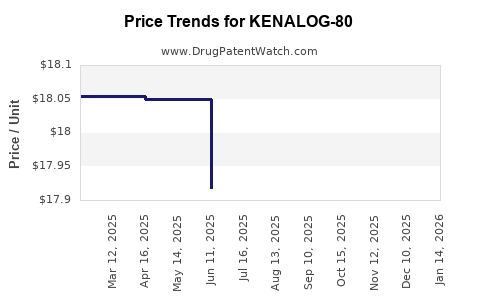
Pricing: Prices vary substantially by region. In emerging markets, KENALOG-80 can command USD 20-40 per capsule, whereas in restricted markets, sales are limited.
Profitability: Margins are volatile, impacted by manufacturing costs, regulatory compliance expenses, and market access limitations.
Forecast (Next 5 Years):
- Best-case scenario: Moderate growth in regions with ongoing approvals, driven by unmet needs in antifungal therapy; revenue could stabilize around USD 40-60 million annually.
- Worst-case scenario: Market contraction due to regulatory bans and competition, leading to revenues below USD 10 million.
Strategic Considerations
- Regulatory navigation: Patents have expired; generic versions dominate. No current clinical pipeline suggests imminent reformulation or new indications.
- Market positioning: Emphasis on topical formulations may be more sustainable due to safety profile; systemic formulations like KENALOG-80 face declining relevance.
- Partnership opportunities: Collaborations with regional firms could expand access but are constrained by safety concerns and shifting regulatory landscapes.
Key Takeaways
- KENALOG-80’s sales are diminishing in Western markets due to safety restrictions.
- In emerging markets, where approvals persist, sales remain stable but limited.
- Competition from newer antifungals with better safety profiles impacts long-term prospects.
- Regional regulatory trends heavily influence the drug’s market viability.
- Future growth depends on regulatory developments, regional approval status, and strategic repositioning toward topical formulations.
FAQs
Q1: Why is KENALOG-80 less used in Western countries today?
A: Safety concerns about hepatotoxicity led to regulatory bans or restrictions on oral ketoconazole in Europe and the US.
Q2: Can KENALOG-80 find new markets?
A: Limited potential exists in markets with remaining approvals or where generic access is unregulated, primarily in some Asian and African countries.
Q3: How does KENALOG-80 compare to newer antifungals?
A: It has a less favorable safety profile and no longer leads in efficacy or safety, reducing its appeal compared to agents like itraconazole or fluconazole.
Q4: Are there patent issues involving KENALOG-80?
A: The original patents have expired; no current proprietary protections restrict generic manufacturing.
Q5: What is the regulatory outlook for systemic ketoconazole?
A: Increasing restrictions are likely in high-regulation regions, but emerging markets may maintain or adapt their approvals.
References
- Grand View Research. (2022). Global antifungal market size, share & trends analysis report. https://www.grandviewresearch.com/industry-analysis/antifungal-market
- U.S. Food and Drug Administration. (2013). Safety communication: FDA updates on use of oral Ketoconazole. https://www.fda.gov
- European Medicines Agency. (2017). Assessment report on ketoconazole.
- GlobalData. (2021). Antifungal drugs market forecast, 2021-2026.
- PubChem. (2023). Ketoconazole compound overview. U.S. National Library of Medicine.