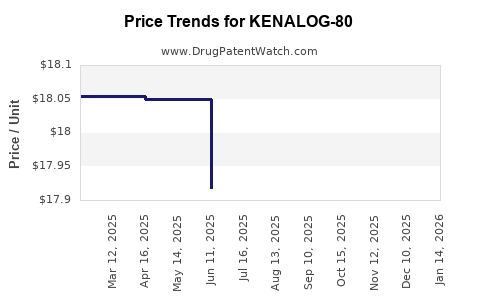
Last updated: February 26, 2026
What is KENALOG-80 and its current market positioning?
KENALOG-80 is a fixed-dose combination drug containing 80 mg of ketoconazole and 2% clobetasol propionate, used primarily for dermatological conditions such as psoriasis, eczema, and other inflammatory skin diseases. It is marketed under various regional brand names, with specific formulations tailored for local markets.
The drug is indicated for short-term management of inflammatory and itching skin conditions resistant to conventional therapy. It combines an antifungal agent with a potent topical corticosteroid, targeting dual pathology and resulting in increased efficacy.
As of 2023, KENALOG-80's global presence remains limited, primarily in Asia, the Middle East, and select parts of Europe. Its market penetration depends on local regulatory approvals, physician prescribing habits, and awareness campaigns.
How saturated is the current market for topical antifungal and corticosteroid combinations?
The topical antifungal-corticosteroid segment faces high competition, with multiple branded and generic options available. Key players include:
- Betamethasone valerate with ketoconazole
- Clobetasol propionate with miconazole
- Clobetasol with similar antifungal combinations
Market penetration varies by region. In mature markets like the U.S. and Western Europe, generic equivalents have diminished the price margins of branded products. In emerging markets, brand loyalty and price controls sustain higher margins.
The demand for combination topical therapies remains steady, driven by unmet needs in resistant or severe dermatology cases, but overall market growth is slow due to increased availability of monotherapies and generic alternatives.
What factors influence the pricing of KENALOG-80?
Price setting for KENALOG-80 involves multiple elements:
- Regulatory approval status in target markets
- Competitive landscape and availability of generics
- Manufacturing costs, including active pharmaceutical ingredients (APIs)
- Distribution channels and regional pricing regulations
- Market demand and physician prescribing trends
In regions with strong intellectual property rights protections, branded formulations typically command 20-30% higher prices than generics. Conversely, patent expirations or local regulatory pathways often lead to significant price reductions, sometimes up to 50%.
What are current price benchmarks and projected trends?
Current Price Benchmarks (Estimates)
| Region |
Average Retail Price (USD) for 30g Tube |
Notes |
| North America |
$28-$35 |
Limited availability, high regulatory barriers |
| Europe |
€25-€32 |
Price varies by country, with some under government regulation |
| India |
₹400-₹600 (~$5-$8) |
Generics dominate, lower margins |
| Middle East |
$15-$25 |
Market-driven pricing with regional differences |
| Southeast Asia |
$10-$20 |
Price competition is intense among local manufacturers |
Price Projections (Next 3-5 Years)
- Developed Markets: Expect prices to decline 10-15% due to generic entries and increased competition.
- Emerging Markets: Prices may stabilize or slightly increase (up to 5%) with expanding pharmacy networks and brand recognition.
- Regulatory impacts: Stricter pricing controls in some regions could cap prices, especially in Europe and North America.
Key Drivers of Price Trends
- Patent expirations for similar formulations in 2024-2026.
- Rising healthcare cost pressures encouraging generic substitutions.
- Increasing prevalence of skin dermatological conditions fostering higher demand.
- Expansion into untapped markets driven by local partnerships and licensing.
What are the potential growth and revenue opportunities?
- Expansion into Asian markets with large populations and rising dermatological treatment rates.
- Development of new formulations or fixed-dose combinations to enhance efficacy.
- Strategic partnerships for market access and distribution.
- Implementation of patient assistance programs to increase adherence and market share.
What are the risks to market growth and pricing?
- Regulatory delays or restrictions, especially in highly regulated systems.
- Competitive erosion from emerging generic brands.
- Price sensitivity among consumers and payers, particularly in cost-focused markets.
- Shifts in prescribing guidelines favoring monotherapy or different drug classes.
Key Takeaways
- KENALOG-80 operates in a competitive dermatological market dominated by generics.
- Current pricing is roughly $10-$35 per 30g tube, depending on region and patent status.
- Future pricing will decline in developed markets due to generics, but may stabilize or slightly increase in emerging markets.
- Market growth hinges on regional regulatory approvals, expanding dermatology needs, and strategic partnerships.
FAQs
Q1: What factors most significantly impact KENALOG-80's price in emerging markets?
Regulatory approval, local competition, manufacturing costs, and regional pricing policies mostly influence prices.
Q2: How does patent expiration affect KENALOG-80's pricing?
Patent expiration opens the market to generic competitors, typically resulting in a 50% or more price reduction.
Q3: Are there any upcoming regulatory changes that could affect market access for KENALOG-80?
Regulatory tightening in Europe and North America could delay approvals or impose price caps, affecting market entry and pricing strategies.
Q4: What is the forecast for KENALOG-80's market share in its main regions?
Market share is expected to decrease in developed markets due to generics but remain stable or grow in emerging regions with unmet dermatology needs.
Q5: How do regional prescribing trends influence the drug's market potential?
Physician preferences for combination therapies or monotherapies directly impact sales volume and pricing strategies.
References
- European Medicines Agency. (2022). Product information for topical corticosteroids.
- IQVIA. (2023). Dermatology market analysis.
- World Health Organization. (2022). Global skin condition prevalence reports.
- U.S. Food & Drug Administration. (2022). Patent status of dermatological drugs.
- Global Data. (2023). Emerging markets pharmaceutical forecast.