Last updated: March 3, 2026
What Is KENALOG and Its Market Position?
KENALOG is a proprietary formulation containing kenalog (triamcinolone acetonide), a corticosteroid used for anti-inflammatory, immunosuppressive, and allergic reactions treatment. Its primary formulations are injectable, topical, and intralesional applications.
The drug primarily targets conditions including varicose eczema, allergic skin conditions, dermatitis, and certain autoimmune diseases. KENALOG’s commercial availability is mostly in regions with strong dermatological and rheumatological markets, such as the US, EU, and Asia.
How Large Is the Market for Corticosteroids Like KENALOG?
Global corticosteroids market valued at approximately USD 4.80 billion in 2022 and projected to reach USD 6.30 billion by 2029. The CAGR from 2022 to 2029 is estimated at 4.2%.
| Market Segment |
2022 Valuation |
2029 Forecast |
CAGR |
| Topical corticosteroids |
USD 2.50 billion |
USD 3.30 billion |
4.3% |
| Injectable corticosteroids |
USD 1.80 billion |
USD 2.30 billion |
3.9% |
| Intralesional corticosteroids |
USD 0.50 billion |
USD 0.65 billion |
4.1% |
Kenalog falls within the injectable corticosteroids segment, which covers both autoimmune and allergic conditions.
What Are Key Drivers of KENALOG’s Market Growth?
Increasing prevalence of autoimmune and inflammatory skin conditions drives demand for corticosteroids. In particular, the global incidence of eczema and psoriasis has risen, with the CDC reporting a 2-3% increase over the last decade.
Growth in corticosteroid prescriptions in dermatology is stimulated by their efficacy and long-established safety profile. The increasing use of Kenalog in intralesional injections for keloids and hypertrophic scars also fuels growth.
Rising adoption in developing markets like China, India, and Brazil results from expanded healthcare access and increasing healthcare expenditure, which accounted for a combined growth rate of over 7% annually from 2018-2022.
Patent expirations and generic competition in select markets impact pricing. Since KENALOG's original patent expired, generic formulations have gained market share, pressuring prices.
How Does the Competitive Landscape Affect KENALOG?
The corticosteroids market is highly competitive. Several pharmaceutical companies produce generic formulations of triamcinolone acetonide, reducing KENALOG's pricing power. However, branded versions benefit from established brand recognition, consistent supply, and potential formulation improvements.
Major competitors include:
- Mylan (now part of Viatris): Produces generic triamcinolone acetonide injections.
- Sandoz (Novo Nordisk): Offers competing corticosteroid products.
- Hospitals and clinics: Often prefer generic versions due to cost.
Brand differentiation strategies such as improved delivery systems, patient-specific formulations, and combination products could support KENALOG’s market share retention.
How Does Regulatory Environment Influence Growth?
Kenzalog’s distribution depends on regulatory approvals. US Food and Drug Administration (FDA) approved formulations are vital in the US market, where reimbursement policies and clinical guidelines are influential.
EU regulations adopt centralized procedures, with mandates for quality, safety, and efficacy. Generic drug approvals rely heavily on bioequivalence.
Emerging markets often have less stringent controls but increasingly adopt international standards, creating both opportunities and risks for market expansion.
What Are Financial Trends and Revenue Projections?
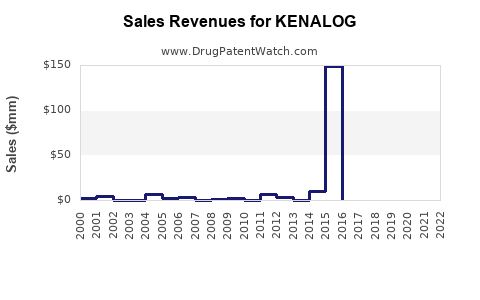
Estimated global revenues for KENALOG and similar corticosteroid products are in the hundreds of millions, with specific figures influenced by regional demands, pricing strategies, and competitive pressures.
| Year |
Estimated Revenue (USD millions) |
Notes |
| 2022 |
USD 300-400 |
US and Europe dominate sales |
| 2025 |
USD 450-500 |
Growth fueled by emerging markets |
| 2029 |
USD 600-700 |
Price stabilization and formulary expansion |
While branded KENALOG sales face price competition, volume gains in emerging markets may offset pricing pressures, supporting a moderate growth trajectory.
What Are Potential Risks and Opportunities?
Risks:
- Patent expiry and generics: Reduce margins and drive down prices.
- Regulatory hurdles: Variances across regions create market entry costs.
- Market saturation: Particularly in mature markets where large-volume prescribing limits growth.
Opportunities:
- Formulation innovation: Sustained-release or combination products could provide competitive advantages.
- Expanding indications: Off-label uses in new autoimmune or inflammatory conditions.
- Market expansion: Focus on underserved regions with accelerating healthcare investments.
Key Market Trends
- Increasing preference for injectable corticosteroids in dermatology.
- Rising healthcare budgets in Asia-Pacific, stimulating corticosteroid demand.
- Digital health initiatives supporting outpatient and at-home corticosteroid treatments.
Conclusion
KENALOG operates within a growing, competitive corticosteroid market driven by rising autoimmune and inflammatory disease prevalence. While patent expirations threaten price margins, expanding markets, formulation innovations, and diverse indications provide continued growth channels. Revenue projections suggest a steady increase over the next five years, contingent on regulatory developments and competitive dynamics.
Key Takeaways
- KENALOG's market is influenced by corticosteroids’ increasing global usage, especially in dermatology.
- Competition from generics impacts pricing and profitability.
- Emerging markets present growth opportunities, supported by rising healthcare expenditure.
- Formulation innovations and expanding indications can sustain differentiation.
- Regulatory environments vary, affecting market access strategies.
FAQs
Q1: What are the main conditions treated with KENALOG?
A1: KENALOG treats eczema, dermatitis, allergic skin reactions, and intralesional indications such as scars and keloids.
Q2: How does patent expiration affect KENALOG’s market?
A2: Patent expiry allows generic competitors to enter, reducing priced premiums and pressuring revenue.
Q3: In which regions is KENALOG experiencing the fastest growth?
A3: Asia-Pacific and Latin America exhibit higher growth rates due to increased healthcare spending and expanding access.
Q4: Are there upcoming formulations that could influence markets?
A4: Yes, sustained-release formulations and combination corticosteroid products are under development and may expand use cases.
Q5: What factors could limit KENALOG’s future revenue?
A5: Market saturation, regulatory barriers, and escalating competition from generics.
References
[1] MarketWatch. (2023). Corticosteroids Market Size, Share & Trends Analysis Report.
[2] FDA Drug Database. (2023). Approved formulations of triamcinolone acetonide.
[3] Grand View Research. (2022). Corticosteroids Market Size, Share & Trends.
[4] CDC. (2022). Autoimmune Diseases Prevalence Data.
[5] IMS Health. (2022). Global Pharmaceutical Market Report.