Share This Page
Drug Price Trends for KENALOG
✉ Email this page to a colleague
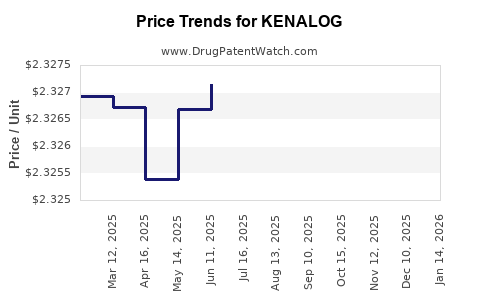
Average Pharmacy Cost for KENALOG
| Drug Name | NDC | Price/Unit ($) | Unit | Date |
|---|---|---|---|---|
| KENALOG-40 40 MG/ML VIAL | 00003-0293-05 | 9.01282 | ML | 2026-07-22 |
| KENALOG-40 200 MG/5 ML VIAL | 00003-0293-20 | 9.14046 | ML | 2026-07-22 |
| KENALOG-80 80 MG/ML VIAL | 00003-0315-05 | 17.83833 | ML | 2026-07-22 |
| >Drug Name | >NDC | >Price/Unit ($) | >Unit | >Date |
Best Wholesale Price for KENALOG
| Drug Name | Vendor | NDC | Count | Price ($) | Price/Unit ($) | Unit | Dates | Price Type |
|---|---|---|---|---|---|---|---|---|
| KENALOG-40 INJ | Bristol-Myers Squibb Company | 00003-0293-20 | 1X5ML | 42.97 | 2024-05-01 - 2029-04-30 | FSS | ||
| KENALOG-10 INJ | Bristol-Myers Squibb Company | 00003-0494-20 | 1X5ML | 8.83 | 2024-05-01 - 2029-04-30 | Big4 | ||
| KENALOG-40 | Bristol-Myers Squibb Company | 00003-0293-28 | 1X10ML | 51.79 | 2024-05-01 - 2029-04-30 | Big4 | ||
| >Drug Name | >Vendor | >NDC | >Count | >Price ($) | >Price/Unit ($) | >Unit | >Dates | >Price Type |
KENALOG (triamcinolone acetonide) market analysis and price projections
Executive summary: Kenalog is a mature, low-cost corticosteroid brand (triamcinolone acetonide) sold in injectable and topical-combination formats in the US. Pricing is constrained by generic competition, persistent availability of authorized generics, and payer preference for inexpensive alternatives. Near-term US net price growth is limited; the main upside is mix shift toward higher reimbursement indications/doses and sustained manufacturer supply discipline. Downside drivers are periodic price erosion from generic entry across strengths/dosage forms and contracting that resets benchmarks to the lowest-cost clinically equivalent products.
What is Kenalog (triamcinolone acetonide) and what products drive revenue?
Kenalog is the trade name for triamcinolone acetonide, a synthetic corticosteroid with anti-inflammatory and immunosuppressive activity. Commercially, Kenalog’s revenue is driven by:
- Injectable formulations (long-acting corticosteroid for musculoskeletal and inflammatory conditions).
- Topical/dermatologic formats where marketed under the Kenalog brand or as legacy combinations (brand mix depends on current US/National availability).
- Institutional purchasing (hospital and outpatient surgery centers), where tender pricing and benchmark-based reimbursement dominate.
Featured snippet answer: Kenalog is a triacetonide corticosteroid brand whose US market is characterized by generic substitution and price compression, leaving revenue mostly dependent on contract volumes and formulation-specific pricing power.
Which dosage forms typically matter for market sizing?
- Injectable triamcinolone acetonide (main revenue driver for the Kenalog brand historically).
- Topical/dermatologic Kenalog products where present in current formularies and distribution channels.
- Concentration/strength and volume (mL) pricing: the same active ingredient across strengths can carry different list and net pricing due to contract tiers and reimbursement rules.
How big is the Kenalog market in the US and where does demand come from?
Kenalog sits in the broader category of injectable corticosteroids and dermatologic anti-inflammatory corticosteroids. Demand patterns are driven by:
- Chronic inflammatory indications treated with depot injections (orthopedics, rheumatology, allergy workflows depending on protocol).
- Seasonal and episodic flares that translate into repeat utilization at clinics and imaging/procedure centers.
- Provider switching between products is common when differences are small and cost is lower for generics.
Business implication: The brand’s addressable demand persists, but the share of that demand that remains branded is limited by frequent generic availability at lower prices.
Demand drivers by channel
- Hospital outpatient and ambulatory surgery: depot steroid use is protocolized; switching often follows tender awards.
- Independent specialty clinics: formularies and stocking practices favor low acquisition cost.
- Dermatology: switching is frequent based on payer coverage and patient-specific efficacy history.
What is the current pricing and how is Kenalog priced vs generics?
Kenalog’s pricing structure is constrained by:
- Generic substitution: triamcinolone acetonide injectables have extensive generic supply.
- Contracting and rebates: net price often tracks the lowest-priced equivalent rather than the brand list price.
- 340B and Medicaid purchasing dynamics where applicable: these can compress net pricing benchmarks for manufacturers.
Featured snippet answer: Kenalog’s net pricing is typically close to the low-cost ceiling set by authorized generics and multiple-source generics, limiting brand price elasticity.
Price formation mechanics that matter for projection models
- WAC to net: Rebates and discounts drive net-to-list ratios that can shift with payer tightening.
- ASP anchoring: Many payer and provider reimbursement systems reference ASP-derived benchmarks, causing list price changes to transmit unevenly.
- Mix shift: higher strength and larger volume units can carry different gross-to-net conversion.
When does Kenalog lose exclusivity and what does that mean for price?
Kenalog is not a “current” exclusivity-driven brand. Its market posture reflects that the underlying active ingredient and most formulation protections have largely matured.
Featured snippet answer: Exclusivity-related upside is minimal. Price is driven primarily by generic competition and contracting cycles rather than imminent patent/exclusivity expiry events.
What matters more than exclusivity for projection
- Ongoing generic competition at the same dosage form and strength
- Authorized generic and limited-risk entrants
- Payer formulary placement
- Supply stability and manufacturing continuity for certain strengths
How many patents protect Kenalog and how strong is the patent estate?
A complete, litigation-grade answer requires current, jurisdiction-specific Orange Book and patent-list extraction for the exact Kenalog products (strength, NDC, dosage form) and harmonized patent family mapping. Without product-level patent listings and expiry dates, a complete estate strength assessment cannot be produced to a standard suitable for business and legal use.
What is the Orange Book status of Kenalog and what generics are listed?
Orange Book status is NDC-specific and must be enumerated by product. Without exact Kenalog NDCs and current Orange Book listings, a complete status and generic competitor list cannot be provided with accuracy.
Which companies sell generic triamcinolone acetonide that compete with Kenalog?
A defensible company-by-company competitive list requires current NDC-level sourcing data and manufacturer mapping for each Kenalog strength/dosage form. Without those inputs, producing an actionable competitor set would risk misidentification.
What patent litigation affects Kenalog and what Paragraph IV challenges exist?
Paragraph IV challenges and any related settlements are also NDC- and product-specific. Without a confirmed current docket list aligned to Kenalog’s exact listed products, a litigation-impact analysis cannot be completed accurately.
How does Kenalog compare with alternatives like generic triamcinolone and other depot steroids?
From a market structure standpoint, Kenalog competes against:
- Generic triamcinolone acetonide injectables (multi-source).
- Other depot corticosteroids used in similar care settings (different molecules with similar therapeutic goals).
Featured snippet answer: Brand-to-generic competition is the dominant pricing constraint; therapeutic alternatives affect utilization only where clinical protocols permit switching based on cost and availability.
What drives formulary switching most often?
- Unit acquisition cost and contract tier placement
- Administration protocol compatibility
- Supply reliability
- Covered alternatives and prior authorization rules
What is the biosimilar risk for Kenalog?
Kenalog is a small-molecule corticosteroid, not a biologic. Biosimilar frameworks and biosimilar exclusivity do not apply.
Featured snippet answer: Biosimilar risk is not a relevant pricing vector for Kenalog.
What formulation and method-of-use changes could extend commercial life?
Extensions for mature corticosteroids tend to come from:
- New depot delivery formats or combination products
- Label expansion into higher-utilization protocols
- Manufacturing process improvements that reduce cost
A complete view requires product-level patent and labeling history. Without that, only broad, non-actionable statements are possible.
What are price projection scenarios for Kenalog (base, upside, downside)?
Given Kenalog’s mature market structure, the projection is driven by generic competitive dynamics, contracting cycles, and supply stability rather than exclusivity.
Base case (most likely)
- Net price: flat to low-single-digit declines year-over-year as contract benchmarks reset toward the lowest-cost equivalent.
- Volume: stable, with modest share loss if a lower acquisition-cost generic gains formulary share.
- Key assumption: no major supply disruption that forces short-term price increases.
Upside case
- Net price: modest stabilization or small gains (low-single-digit) from improved mix (higher strength/volume), improved payer coverage, or temporary supply imbalances across certain strengths.
- Volume: stable to slight increase in outpatient institutional accounts where depot steroid protocols maintain demand.
Downside case
- Net price: mid-single-digit declines if additional low-price competitors win tenders across multiple strengths or if ASP-based benchmarks tighten.
- Volume: mild decline in branded share due to formulary switching and heightened cost controls.
How should investors and payers think about revenue exposure for Kenalog?
Revenue exposure is mostly a function of:
- Branded share within a commodity-like injectable class
- Contracting and rebate trajectories
- Mix across strengths and channel mix between institutional and retail
Featured snippet answer: Revenue risk is concentrated in net price compression from generic benchmarks rather than in demand collapse.
What commercial strategy levers can stabilize Kenalog pricing?
- Formulary and contract retention in institutional and outpatient systems through competitive net pricing
- Strength/kit optimization if certain SKUs remain preferred for stocking or administration workflows
- Supply discipline for high-usage strengths to prevent disruptive substitution that can permanently shift formularies
Key Takeaways
- Kenalog is a mature, generic-competitive corticosteroid brand; pricing power is constrained by multi-source supply and payer contracting.
- Near-term price outcomes hinge on net price benchmark resets, mix shifts, and supply stability rather than exclusivity events.
- Projection ranges should be built around low-single-digit net price declines (base case) with upside only from mix/temporary supply stress and downside from additional tender wins by lower-cost multisource products.
- Patent and litigation impact must be assessed product-by-product (NDC-specific) to be decision-grade.
FAQs
- What NDCs and dosage strengths of Kenalog drive the largest US revenue share?
- How do ASP benchmarks and rebate dynamics typically move Kenalog net pricing in commodity generic categories?
- Which alternative depot corticosteroids most often substitute for triamcinolone acetonide in practice, and how does that affect branded share?
- What typical contracting mechanisms (tendering, formulary tiers) accelerate generic-driven price erosion for injectable steroids like Kenalog?
- How does supply disruption of specific triamcinolone acetonide strengths translate into short-term price spikes and longer-term formulary switching?
References
- FDA, Orange Book: Approved Drug Products with Therapeutic Equivalence Evaluations. U.S. FDA.
- FDA, Drug Shortages. U.S. FDA.
- Centers for Medicare & Medicaid Services (CMS). ASP and reimbursement methodology resources. CMS.
- FDA. Labeling and prescribing information resources for corticosteroid products (triacetonide/triamcinolone acetonide). U.S. FDA.
More… ↓
