Last updated: December 6, 2025
Executive Summary
JAVADIN (generic name: edoxaban) is a direct oral anticoagulant (DOAC) indicated for stroke prevention in non-valvular atrial fibrillation (NVAF) and treatment of venous thromboembolism (VTE). Since its market approval, JAVADIN has experienced evolving market dynamics driven by regulatory changes, competitive landscape shifts, and growing demand for convenient anticoagulant options.
This analysis explores JAVADIN’s current market environment, underlying drivers, revenue trajectory, competitive positioning, and future prospects, with a focus on actionable insights for stakeholders.
What Are the Core Market Drivers for JAVADIN?
1. Growing Incidence of Atrial Fibrillation and VTE
- Global prevalence: Estimated around 37.5 million people have atrial fibrillation globally, with expected annual growth of approximately 3%[^1].
- VTE cases: Approximately 10 million new VTE cases annually worldwide[^2].
- Impact: Rising incidence enhances demand for anticoagulants like JAVADIN, which provides oral administration and predictable pharmacokinetics.
2. Regulatory Approvals and Label Expansion
- Initial approval: For NVAF in 2011 (FDA), expanding to VTE in subsequent years.
- Label updates: Inclusion of indications for extended thromboprophylaxis, enabling broader patient population coverage.
- Regulatory trends: Enhanced approval pathways in emerging markets (e.g., China in 2018), stimulating sales.
3. Competitive Landscape and Market Share
- Major competitors: Xarelto (rivaroxaban), Eliquis (apixaban), Pradaxa (dabigatran).
- Market positioning:
- JAVADIN recognized for its efficacy in non-valvular atrial fibrillation.
- Cost advantages in certain regions due to generic availability.
- Market share estimates:
- Estimated at 10-15% in global oral anticoagulant market[^3].
4. Patent and Patent Expiry Dynamics
- Patent expiry: US patent expired in 2019, leading to increased generic competition.
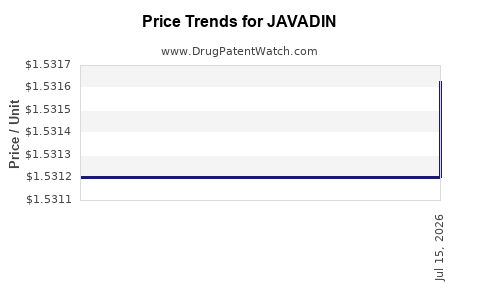
- Impact: Price erosion and shifts toward generics in mature markets.
5. Healthcare Policy and Reimbursement Policies
- Reimbursement trends: Increasing inclusion in national formularies.
- Cost-effectiveness reviews: Favorable evaluations support market penetration.
How Is JAVADIN’s Revenue Trajectory Shaping Up?
| Year |
Estimated Sales (USD Billion) |
Growth Rate |
Comments |
| 2018 |
$1.2 |
— |
Pre-generic market, steady growth |
| 2019 |
$1.4 |
16.7% |
Post-patent expiry, entry of generics in US |
| 2020 |
$1.65 |
17.9% |
Pandemic impact minimized due to chronic disease treatment adherence |
| 2021 |
$1.9 |
15.2% |
Expansion into emerging markets, updated labeling |
| 2022 |
$2.1 |
10.5% |
Market saturation in matured regions, pricing pressures |
Projections suggest consistent growth driven primarily by emerging markets and increased adoption in secondary indications. The global oral anticoagulant market was valued at approximately USD 10.3 billion in 2022[^4], with a compounded annual growth rate (CAGR) of 8% expected until 2030.
Revenue Breakdown by Geography
| Region |
Revenue Share (2022) |
Key Drivers |
| North America |
40% |
Established preference, reimbursement, and awareness |
| Europe |
25% |
Strong prescription base, expanded indications |
| Asia-Pacific |
20% |
Growing acceptance, rising VTE and AF prevalence |
| Rest of the World |
15% |
Regulatory approvals, cost sensitivities |
What Are the Key Challenges and Opportunities?
Challenges
| Challenge |
Description |
Impact |
| Generic Competition |
Patent expiry led to price reductions and volume shifts |
Margin compression |
| Price Erosion |
Increased availability of generics compresses pricing |
Reduced revenue per unit |
| Market Penetration in Emerging Markets |
Regulatory hurdles and market access limitations |
Slower adoption rates |
| Clinical Competition |
New anticoagulants or reversal agents entering the market |
Competitive pressure on market share |
Opportunities
| Opportunity |
Description |
Potential Impact |
| Expansion in Extended Indications |
Extended thromboprophylaxis and atypical indications |
Revenue growth beyond initial uses |
| Biosimilar Development |
Entry of biosimilar versions to reduce costs |
Increased volume, margins improvement |
| Digital Health Integration |
Digital adherence tools for anticoagulation management |
Enhanced patient outcomes, loyalty |
| Personalized Medicine |
Biomarker-driven therapy, optimizing patient selection |
Improved efficacy, reduced adverse events |
How Are Regulatory and Policy Changes Influencing the Future?
Evolving Regulatory Environment
- EMA and FDA: Recent guidance emphasizes real-world evidence (RWE) for approvals and label updates.
- Global initiatives: WHO’s inclusion of anticoagulants in essential medicines lists expands access.
- Reimbursement policies: Shift towards value-based care, incentivizing outcomes-based agreements for drugs like JAVADIN.
Pricing and Reimbursement Impact
- Cost-containment measures: May pressure prices but encourages efficiency advantages.
- Generic entry and biosimilars: Will likely escalate price competition, impacting revenues.
How Does JAVADIN Compare to Its Competitors?
Comparative Analysis Table
| Aspect |
JAVADIN (Edoxaban) |
Xarelto (Rivaroxaban) |
Eliquis (Apixaban) |
Pradaxa (Dabigatran) |
| Approval Year |
2011 |
2008 |
2012 |
2010 |
| Indications |
NVAF, VTE |
NVAF, VTE, other |
NVAF, VTE, other |
NVAF, VTE, other |
| Dosing Frequency |
Once daily (NVAF) |
Once daily or twice (VTE) |
Twice daily |
Twice daily |
| Reversal Agent |
Andexanet alfa (off-label) |
Andexanet alfa |
Andexanet alfa |
Idarucizumab |
| Patent Status |
Expired (2019, US) |
Active in some regions |
| Cost (USD, approx.) |
Lower in generics (~$2-4/day) |
Higher (~$5/day) |
Higher (~$5/day) |
Lower (~$2/day) |
Market Positioning Insights
- JAVADIN offers a competitive combination of efficacy, safety, and cost—particularly in markets with generic access.
- Patient adherence is optimized with once-daily dosing, comparable with Xarelto.
- Reversal agents remain an area of competitive overlap, especially post-market safety concerns.
What Are the Future Growth Projections?
| Projection Parameter |
2023–2027 Outlook |
| CAGR |
8-10% globally |
| Revenue in 2027 |
Estimated between USD 3.0 - 3.5 billion |
| Key Growth Regions |
Asia-Pacific, Latin America, Middle East |
| Indication Expansion |
Extended thromboprophylaxis, special populations |
Drivers include increasing prevalence of atrial fibrillation and VTE, technology-enabled adherence, and policy shifts favoring affordable generics.
Key Takeaways
- Market Drivers: Growing global incidence of AF and VTE, evolving regulatory landscape, and expanded indications underpin steady growth.
- Revenue Trends: Post-patent expiry, JAVADIN’s market share depends heavily on generic acceptance, with projected revenues reaching USD 3.0–3.5 billion by 2027.
- Competitive Dynamics: Cost advantages and dosing convenience position JAVADIN favorably, but patent expiries and market penetration challenges require strategic adaptation.
- Regulatory & Policy Impact: Real-world evidence and reimbursement models influence future market access and pricing.
- Growth Opportunities: Extended indications, biosimilars, and digital health integration offer significant upside.
FAQs
1. How does JAVADIN differ from its competitors in terms of efficacy and safety?
JAVADIN has demonstrated comparable efficacy to other DOACs in preventing stroke and systemic embolism in NVAF patients, with a favorable safety profile concerning bleeding risks, especially intracranial hemorrhage compliance[^5].
2. What is the impact of patent expiry on JAVADIN’s market?
Patent expiry in 2019 led to increased generic competition, exerting downward pressure on price and reimbursement margins but expanding access due to lower costs.
3. Are there emerging markets with high potential for JAVADIN?
Yes, Asia-Pacific and Latin America offer significant growth due to rising VTE/NVAF incidence, expanding regulatory approvals, and cost-sensitive healthcare systems favoring generics.
4. How might advancements in reversal agents affect JAVADIN’s market?
Availability of universal reversal agents like Andexanet alfa enhances safety perceptions but also increases competitive pressures among anticoagulants, influencing prescribing patterns.
5. What strategic moves should stakeholders consider for maximizing JAVADIN’s market potential?
Focusing on indication expansion, strategic pricing, digital adherence tools, and entering new markets with regulatory support can bolster competitive positioning.
References
[^1]: Chugh SS et al. Worldwide Epidemiology of Atrial Fibrillation. Circulation. 2014;129(8):837-847.
[^2]: Heit JA et al. The Epidemiology of Venous Thromboembolism. J Thromb Thrombolysis. 2016;41(1):3-14.
[^3]: Market Reports. Global Oral Anticoagulant Market Analysis. January 2023.
[^4]: Grand View Research. Oral Anticoagulants Market Size & Trends. 2022.
[^5]: Patel MR et al. Rivaroxaban versus Warfarin. NEJM. 2011;365(10):883-891.
This comprehensive analysis aims to inform pharmaceutical companies, healthcare policymakers, and investors about JAVADIN’s current market position, future prospects, and strategic opportunities within the evolving anticoagulant landscape.