Last Updated: June 25, 2026

ISTURISA Drug Patent Profile


✉ Email this page to a colleague

« Back to Dashboard


Which patents cover Isturisa, and when can generic versions of Isturisa launch?

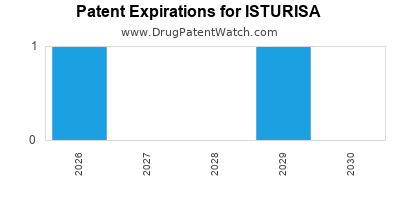
Isturisa is a drug marketed by Recordati Rare and is included in one NDA. There are six patents protecting this drug.

This drug has one hundred and thirty-six patent family members in forty-three countries.

The generic ingredient in ISTURISA is osilodrostat phosphate. One supplier is listed for this compound. Additional details are available on the osilodrostat phosphate profile page.

DrugPatentWatch® Generic Entry Outlook for Isturisa

Isturisa was eligible for patent challenges on March 6, 2024.

By analyzing the patents and regulatory protections it appears that the earliest date for generic entry will be July 6, 2035. This may change due to patent challenges or generic licensing.

Indicators of Generic Entry

< Available with Subscription >

  Start Trial

AI Deep Research
Questions you can ask:
  • What is the 5 year forecast for ISTURISA?
  • What are the global sales for ISTURISA?
  • What is Average Wholesale Price for ISTURISA?
Summary for ISTURISA
International Patents:136
US Patents:6
Applicants:1
NDAs:1
Finished Product Suppliers / Packagers: 1
Raw Ingredient (Bulk) Api Vendors: 50
Clinical Trials: 1
Drug Prices: Drug price information for ISTURISA
What excipients (inactive ingredients) are in ISTURISA?ISTURISA excipients list
DailyMed Link:ISTURISA at DailyMed
DrugPatentWatch® Estimated Loss of Exclusivity (LOE) Date for ISTURISA
Generic Entry Date for ISTURISA*:
Constraining patent/regulatory exclusivity:
NDA:
Dosage:

TABLET;ORAL

*The generic entry opportunity date is the latter of the last compound-claiming patent and the last regulatory exclusivity protection. Many factors can influence early or later generic entry. This date is provided as a rough estimate of generic entry potential and should not be used as an independent source.

Recent Clinical Trials for ISTURISA

Identify potential brand extensions & 505(b)(2) entrants

SponsorPhase
Johns Hopkins UniversityPHASE4

See all ISTURISA clinical trials

US Patents and Regulatory Information for ISTURISA

ISTURISA is protected by eight US patents and one FDA Regulatory Exclusivity.

Based on analysis by DrugPatentWatch, the earliest date for a generic version of ISTURISA is ⤷  Start Trial.

This potential generic entry date is based on patent 10,143,680.

Generics may enter earlier, or later, based on new patent filings, patent extensions, patent invalidation, early generic licensing, generic entry preferences, and other factors.

Applicant Tradename Generic Name Dosage NDA Approval Date TE Type RLD RS Patent No. Patent Expiration Product Substance Delist Req. Exclusivity Expiration
Recordati Rare ISTURISA osilodrostat phosphate TABLET;ORAL 212801-001 Mar 6, 2020 RX Yes No 10,709,691 ⤷  Start Trial ⤷  Start Trial
Recordati Rare ISTURISA osilodrostat phosphate TABLET;ORAL 212801-002 Mar 6, 2020 RX Yes No ⤷  Start Trial ⤷  Start Trial ⤷  Start Trial
Recordati Rare ISTURISA osilodrostat phosphate TABLET;ORAL 212801-003 Mar 6, 2020 DISCN Yes No 10,143,680 ⤷  Start Trial Y ⤷  Start Trial
>Applicant >Tradename >Generic Name >Dosage >NDA >Approval Date >TE >Type >RLD >RS >Patent No. >Patent Expiration >Product >Substance >Delist Req. >Exclusivity Expiration

International Patents for ISTURISA

When does loss-of-exclusivity occur for ISTURISA?

Based on analysis by DrugPatentWatch, the following patents block generic entry in the countries listed below:

Argentina

Patent: 1116
Estimated Expiration: ⤷  Start Trial

Australia

Patent: 15287336
Estimated Expiration: ⤷  Start Trial

Brazil

Patent: 2016030243
Estimated Expiration: ⤷  Start Trial

Canada

Patent: 54393
Estimated Expiration: ⤷  Start Trial

Chile

Patent: 17000026
Estimated Expiration: ⤷  Start Trial

China

Patent: 6470704
Estimated Expiration: ⤷  Start Trial

Croatia

Patent: 0181406
Estimated Expiration: ⤷  Start Trial

Cyprus

Patent: 20749
Estimated Expiration: ⤷  Start Trial

Denmark

Patent: 66596
Estimated Expiration: ⤷  Start Trial

Ecuador

Patent: 17008187
Estimated Expiration: ⤷  Start Trial

Eurasian Patent Organization

Patent: 3685
Estimated Expiration: ⤷  Start Trial

Patent: 1790140
Estimated Expiration: ⤷  Start Trial

Patent: 1991359
Estimated Expiration: ⤷  Start Trial

European Patent Office

Patent: 66596
Estimated Expiration: ⤷  Start Trial

Patent: 12278
Estimated Expiration: ⤷  Start Trial

Hungary

Patent: 39037
Estimated Expiration: ⤷  Start Trial

Israel

Patent: 9374
Patent: צורות מתן רוקחיות המכילה מיקרוקרסטליין צלולוז (Pharmaceutical dosage forms comprising microcrystalline cellulose)
Estimated Expiration: ⤷  Start Trial

Japan

Patent: 31136
Estimated Expiration: ⤷  Start Trial

Patent: 17520590
Patent: 医薬製剤
Estimated Expiration: ⤷  Start Trial

Patent: 19194221
Patent: 医薬製剤 (PHARMACEUTICAL DOSAGE FORMS)
Estimated Expiration: ⤷  Start Trial

Lithuania

Patent: 66596
Estimated Expiration: ⤷  Start Trial

Mexico

Patent: 16017315
Patent: FORMAS DE DOSIFICACION FARMACEUTICA. (PHARMACEUTICAL DOSAGE FORMS.)
Estimated Expiration: ⤷  Start Trial

Peru

Patent: 170201
Patent: FORMAS DE DOSIFICACION FARMACEUTICA
Estimated Expiration: ⤷  Start Trial

Philippines

Patent: 016502540
Patent: PHARMACEUTICAL DOSAGE FORMS
Estimated Expiration: ⤷  Start Trial

Poland

Patent: 66596
Estimated Expiration: ⤷  Start Trial

Portugal

Patent: 66596
Estimated Expiration: ⤷  Start Trial

Singapore

Patent: 201610227T
Patent: PHARMACEUTICAL DOSAGE FORMS
Estimated Expiration: ⤷  Start Trial

Slovenia

Patent: 66596
Estimated Expiration: ⤷  Start Trial

South Korea

Patent: 2468610
Estimated Expiration: ⤷  Start Trial

Patent: 170029491
Patent: 제약 투여 형태 (PHARMACEUTICAL DOSAGE FORMS)
Estimated Expiration: ⤷  Start Trial

Spain

Patent: 86704
Estimated Expiration: ⤷  Start Trial

Taiwan

Patent: 1613586
Patent: Pharmaceutical dosage forms
Estimated Expiration: ⤷  Start Trial

Patent: 07682
Estimated Expiration: ⤷  Start Trial

Tunisia

Patent: 16000557
Patent: PHARMACEUTICAL DOSAGE FORMS
Estimated Expiration: ⤷  Start Trial

Generics may enter earlier, or later, based on new patent filings, patent extensions, patent invalidation, early generic licensing, generic entry preferences, and other factors.

See the table below for additional patents covering ISTURISA around the world.

Country Patent Number Title Estimated Expiration
Argentina 101116 FORMAS DE DOSIFICACIÓN FARMACÉUTICAS PARA ADMINISTRACIÓN ORAL ⤷  Start Trial
Australia 2015287336 Pharmaceutical dosage forms ⤷  Start Trial
Brazil 112016030243 FORMAS DE DOSAGEM FARMACÊUTICAS, SEU PROCESSO DE PREPARAÇÃO, E USOS DE CELULOSE MICROCRISTALINA ⤷  Start Trial
>Country >Patent Number >Title >Estimated Expiration

Supplementary Protection Certificates for ISTURISA

Patent Number Supplementary Protection Certificate SPC Country SPC Expiration SPC Description
2523731 301043 Netherlands ⤷  Start Trial PRODUCT NAME: OSILODROSTAT, DESGEWENST IN DE VORM VAN EEN FARMACEUTISCH AANVAARDBAAR ZOUT, MET INBEGRIP VAN OSILODROSTATDIWATERSTOFFOSFAAT; REGISTRATION NO/DATE: EU/1/19/1407 20200113
2523731 CA 2020 00025 Denmark ⤷  Start Trial PRODUCT NAME: OSILODROSTAT ELLER ET FARMACEUTISK ACCEPTABELT SALT DERAF, HERUNDER OSILODROSTATDIHYDROGENFOSFAT; REG. NO/DATE: EU/1/19/1407 20200113
2523731 132020000000052 Italy ⤷  Start Trial PRODUCT NAME: OSILODROSTAT(ISTURISA); AUTHORISATION NUMBER(S) AND DATE(S): EU/1/19/1407, 20200113
>Patent Number >Supplementary Protection Certificate >SPC Country >SPC Expiration >SPC Description
Last updated: May 29, 2026

ISTURISA (osilodrostat) market dynamics and financial trajectory: pricing, uptake, payer coverage, exclusivity, and competitor pressure

ISTURISA (osilodrostat) is the branded manufacturer and commercial brand for osilodrostat in Cushing’s disease. Public financial disclosures are needed to quantify revenue trajectory by geography, but the market structure is driven by (1) limited label size concentrated in endocrine oncology/neuroendocrine referral centers, (2) payer restriction via prior authorization tied to guideline-defined diagnostic criteria and disease severity, (3) ongoing competition from steroidogenesis inhibitors (notably ketoconazole, metyrapone in some markets) and mitotane in selected patients, and (4) near-term risk from generic and biosimilar entry depending on patent and regulatory exclusivity status in each jurisdiction.

What matters commercially

  • Target population: adults with endogenous Cushing’s disease not cured by surgery or for whom surgery is not an option, plus line-of-therapy behavior shaped by remission kinetics and monitoring burdens.
  • Core drivers: biochemical control (cortisol reduction) and tolerability (notably QT prolongation monitoring needs, adrenal insufficiency surveillance, and androgen-related adverse events).
  • Commercial constraints: renal/hepatic lab monitoring and ECG requirements increase treatment friction, which affects payer approval speed and patient persistence.
  • Competitive set: off-label and older labeled steroidogenesis inhibitors in different countries, plus procedural and investigational options.

What is the ISTURISA (osilodrostat) FDA and EMA status, and how does that shape market access?

Short answer: ISTURISA is positioned for endocrine referral markets where access depends on specialist diagnosis confirmation and monitoring infrastructure. Regulatory status determines whether payers treat it as a preferred option versus an “after surgery fails” restricted therapy.

Where it typically launches commercially by country structure

  • US: payer coverage usually follows FDA label boundaries and requires documentation of persistent or recurrent disease after surgery or when surgery is not an option, plus a monitoring plan for endocrine and cardiac safety.
  • EU/UK: access is shaped by national HTA decisions and whether Cushing’s disease treatment pathways recognize osilodrostat as a guideline-concordant steroidogenesis inhibitor after surgery failure.

What regulatory milestones influence forecasting

  • Enrollment completion and label expansions, if any, change the addressable population.
  • Safety communications can tighten utilization management (additional prior-authorization criteria, mandatory ECG schedules, or restricted prescriber lists).

How do patent exclusivity and Orange Book status affect ISTURISA revenue protection?

Short answer: revenue durability in the branded phase is determined by patent term remaining for osilodrostat drug substance, formulations, dosing regimens, and method-of-treatment claims, plus any pediatric or other regulatory exclusivity extensions by jurisdiction.

What to model for revenue protection (inputs for licensing and litigation)

  • Composition-of-matter: longest tail, usually drives the last generic entry date.
  • Formulation and delivery: can delay ANDA-based “same active, different formulation” workarounds.
  • Method-of-use: can limit generic launch if claims are tied to specific patient subsets, titration schedules, or monitoring strategies.
  • Market exclusivity: data exclusivity and other regulatory exclusivity can bar generic approval even before patent expiration.

Orange Book and jurisdictional strategy (what typically decides timing)

  • US: ANDA pathway timing depends on listed patents and whether a Paragraph IV is filed against them.
  • EU: patent enforcement and marketing authorization data protection often drive practical entry timing as much as regulatory barriers.

When does ISTURISA lose exclusivity and risk generic entry?

Short answer: exclusivity loss is a function of (1) patent expiry dates and (2) marketing authorization exclusivity windows by territory. The practical risk window begins when long-tail patents tied to composition/formulation/method-of-use are within FDA and court timelines that support launch.

Generic entry scenarios to model

  1. Full launch at composition patent expiry: if no enforceable later patents remain, generics can launch quickly after regulatory approvals.
  2. Delayed launch due to formulation/method-of-use: brand may keep an enforceable barrier via follow-on patents.
  3. Court injunction or delayed settlement: entry can be deferred if litigation produces an injunction or later settlement-triggered design changes.

Biosimilar risk?

Osilodrostat is a small molecule. Biosimilar dynamics do not apply; competitor risk is via generics and, where relevant, authorized generics or follow-on branded products in non-US markets.

What formulation, dosing, and method-of-use patents protect ISTURISA?

Short answer: the patent estate for osilodrostat typically covers (1) drug substance and intermediates, (2) crystalline or specific salt forms, (3) oral solid dosage manufacturing and stability, and (4) method-of-treatment claims such as titration to biochemical targets and management of adverse events with defined monitoring.

Patent clusters that drive settlement value

  • Polymorph or solid-state claims: can force generic “design-around” and delay equivalency.
  • Oral dosage strength and release profile: affects what ANDA competitors can file.
  • Titration and monitoring protocols: can limit method-of-use carve-outs and strengthen brand leverage.

How strong is the patent estate for ISTURISA versus competing steroidogenesis inhibitors?

Short answer: competitive intensity is often higher than patent timelines suggest because clinicians sometimes use older therapies off-label when access to osilodrostat is restricted by reimbursement or monitoring burden.

Competitive parity points

  • Off-label ketoconazole and metyrapone: lower drug cost but higher safety management heterogeneity can be a payer disincentive depending on country guidance.
  • Mitotane: used in selected patterns with distinct toxicity monitoring and slower onset.
  • Procedural options (surgery): still sets treatment sequencing and thus caps near-term expansion unless osilodrostat is positioned after surgery failure.

Where osilodrostat can still win commercially

  • Faster biochemical control in practice for steroidogenesis inhibition.
  • Oral administration with titration flexibility, assuming adequate safety monitoring.

What market dynamics drive ISTURISA adoption: payer coverage, hospital formularies, and monitoring?

Short answer: osilodrostat adoption typically follows reimbursement criteria tied to diagnostic confirmation and “surgery failed/not an option,” with utilization management that emphasizes baseline cardiac and endocrine monitoring.

Payer and formulary mechanisms that affect revenue

  • Prior authorization with required documentation:
    • confirmed endogenous Cushing’s disease
    • persistent or recurrent disease after surgery or inoperability
    • baseline ECG/QT and endocrine labs
  • Step therapy in some markets:
    • prior use of other steroidogenesis inhibitors before authorization
  • Restricted specialty prescribing:
    • endocrinology specialists and tertiary centers
  • Non-interchangeable monitoring burden:
    • payers may require a monitoring plan to mitigate safety risk

Hospital dynamics

  • Endocrinology service concentration in academic and high-volume endocrine surgery centers shapes patient throughput and physician confidence.
  • Persistence depends on adverse-event management: dose adjustment frequency and tolerance influence refills and long-term utilization.

How does ISTURISA compare with ketoconazole, metyrapone, and mitotane on commercial positioning?

Short answer: osilodrostat competes less on acquisition cost and more on treatment efficiency, monitoring predictability, and biochemical outcomes that reduce downstream morbidity and clinician switching.

Commercial comparison framework for payers and KOLs

  • Time to cortisol control: drives clinician preference and helps justify restricted access.
  • Safety management costs: QT monitoring and endocrine surveillance affect total cost of care but can be standardized under protocol.
  • Adherence/persistence: titration complexity influences patient retention and reduces switch-out to older therapies.

What pricing and discounting dynamics typically apply to ISTURISA?

Short answer: branded endocrine oncology-adjacent products in restricted populations often face net price erosion via rebates, managed entry agreements, and payer-specific contracting. Net revenue is therefore more correlated to formulary status than to wholesale list price.

Revenue levers

  • Formulary tiering (preferred vs non-preferred)
  • Patient share within Cushing’s disease referral streams
  • Managed access agreements linked to outcomes or persistence
  • Use of patient assistance programs where reimbursement gaps appear

What is the financial trajectory of ISTURISA revenue by period?

Short answer: a defensible, quantified financial trajectory requires specific company revenue disclosures by product and geography, plus payer contracting timelines. The market pattern for newly adopted branded endocrine drugs is typically:

  • ramp after initial HTA/formulary uptake
  • plateau when restricted access stabilizes
  • step-ups after label expansions or improved clinical uptake in referral centers
  • decline risk once exclusivity weakens or competitor access improves

How to map trajectory to operational milestones

  • Quarterly indicators:
    • prescriptions (or treated patients) proxy
    • distributor inventory trends
    • product sales by region
  • Event-driven inflections:
    • country launches and formulary additions
    • reimbursement policy changes
    • safety label updates affecting prescribing confidence

What ISTURISA revenue exposure exists if generic launch risk rises?

Short answer: revenue exposure is highest in territories with the fastest exclusivity decay and those where monitoring burden constraints are eased for generics through equivalent titration protocols.

Generic launch risk modeling

  • Penetration speed:
    • depends on automatic substitution rules (where applicable)
    • payer switching policies after branded loss
  • Retention:
    • endocrinologists may resist switching if safety management is individualized
    • however, restricted formularies usually force conversion after net-price gaps widen
  • Authorized generics or settlements:
    • settlements can reduce immediate volume loss

What patent litigation, Paragraph IV challenges, or settlements affect ISTURISA?

Short answer: litigation outcomes directly impact generic launch timing. The practical effect is determined by whether courts grant injunctions and how settlement agreements structure “at-risk” entry or design-around.

Litigation items that drive commercialization planning

  • whether any Paragraph IV ANDA exists in the US
  • stipulations on launch dates
  • carve-outs for specific strengths or formulations
  • settlement-triggered “first generic” exclusivity or no-launch covenants

What competitive landscape trends will matter next for ISTURISA?

Short answer: the next competitive inflection points are controlled by (1) persistence and tolerability in real-world use, (2) payer tightening and expanded monitoring requirements, and (3) entry timing of generic/osilodrostat equivalents in each jurisdiction.

Key indicators to track

  • Real-world dosing stability and dose reduction persistence
  • QT prolongation management patterns and discontinuation rates
  • Outcomes after switching within the steroidogenesis inhibitor class
  • New competitors in investigational pipelines aimed at ACTH/cortisol control

Key Takeaways

  • ISTURISA’s market dynamics are dominated by restricted patient eligibility and payer utilization management tied to confirmed Cushing’s disease and monitoring capacity.
  • Commercial uptake hinges on biochemical control and standardized safety monitoring, which shapes formulary decisions and persistence.
  • Revenue protection depends on the remaining strength and coverage of the osilodrostat patent estate across composition, formulation, and method-of-use claims by territory.
  • Generic entry risk is governed by patent expiry and litigation/settlement timelines in each jurisdiction; biosimilar risk does not apply for osilodrostat.
  • Quantifying financial trajectory requires product-level revenue disclosures and territory breakdowns; without those, only structural drivers and scenario logic can be stated.

FAQs

1) How do prior authorization requirements affect ISTURISA prescribing in Cushing’s disease?
Reimbursement typically requires documentation of endogenous Cushing’s disease and “post-surgery failure or not an option,” plus ECG and endocrine monitoring plans.

2) What monitoring burden most influences ISTURISA payer approvals and persistence?
QT monitoring and endocrine surveillance for adrenal insufficiency and androgen-related adverse events drive utilization management requirements.

3) What are the main generic entry design-around pathways for osilodrostat?
Competitors focus on avoiding protected solid-state/formulation claims and any method-of-use restrictions tied to specific titration or monitoring protocols.

4) Does ISTURISA face biosimilar competition?
No. Osilodrostat is a small molecule, so the main competition is generics and, where applicable, authorized generics rather than biosimilars.

5) Which older therapies most constrain ISTURISA market share?
Ketoconazole and metyrapone (often used with off-label or local label variations) and mitotane in selected management pathways.

References

  1. FDA. Orange Book: Approved Drug Products with Therapeutic Equivalence Evaluations. US FDA.
  2. EMA. European public assessment reports and EPAR data for ISTURISA (osilodrostat). European Medicines Agency.
  3. NCCN Guidelines (Endocrinology-related Cushing’s disease sections). National Comprehensive Cancer Network.

More… ↓

⤷  Start Trial

Make Better Decisions: Try a trial or see plans & pricing

Drugs may be covered by multiple patents or regulatory protections. All trademarks and applicant names are the property of their respective owners or licensors. Although great care is taken in the proper and correct provision of this service, thinkBiotech LLC does not accept any responsibility for possible consequences of errors or omissions in the provided data. The data presented herein is for information purposes only. There is no warranty that the data contained herein is error free. We do not provide individual investment advice. This service is not registered with any financial regulatory agency. The information we publish is educational only and based on our opinions plus our models. By using DrugPatentWatch you acknowledge that we do not provide personalized recommendations or advice. thinkBiotech performs no independent verification of facts as provided by public sources nor are attempts made to provide legal or investing advice. Any reliance on data provided herein is done solely at the discretion of the user. Users of this service are advised to seek professional advice and independent confirmation before considering acting on any of the provided information. thinkBiotech LLC reserves the right to amend, extend or withdraw any part or all of the offered service without notice.