Last updated: June 23, 2026
INTUNIV (guanfacine ER) market dynamics and financial trajectory: exclusivity, generics risk, and revenue drivers
Executive summary: INTUNIV (guanfacine extended-release; Shire/Takeda; branded by Takeda in the US) has matured into a lower-single-digit US revenue franchise with constrained upside tied to ADHD penetration, formulary access, pediatric label uptake, and substitution pressure from generic guanfacine ER. Post-brand competition is driven primarily by generic entry timing, state Medicaid formularies, payer step-therapy rules, and real-world persistence in pediatric patients. Financial trajectory since loss of US brand protection is shaped by (1) generic erosion, (2) mild remaining differentiation from sustained-release tolerability profiles and prescriber familiarity, and (3) any portfolio cannibalization or channel share shifts versus competing ADHD therapeutics.
Core market framing (US, commercial payer lens):
- Indication and use case: ADHD, pediatric and adolescent use (and adult use depending on label and geography).
- Competitive set: other ADHD agents by class and administration, including stimulants (methylphenidates, amphetamines) and non-stimulants (atomoxetine, clonidine ER), plus branded and generic guanfacine products where available.
- Primary economic levers: TRx growth vs persistence, net price vs rebate intensity, and channel stocking behavior around new generic availability.
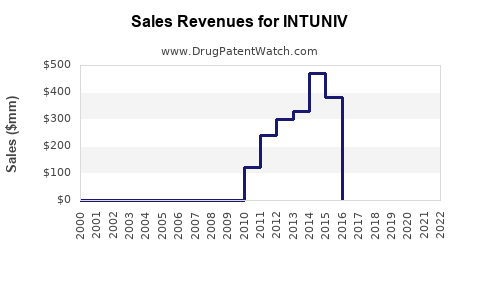
How has INTUNIV performed financially since launch, and what is the current revenue trajectory?
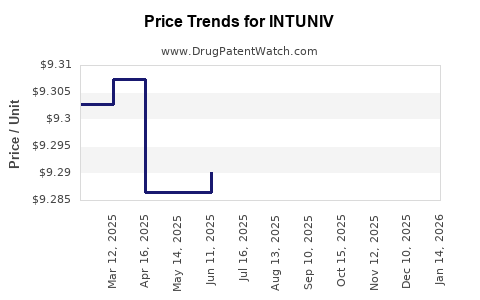
Answer (featured snippet): INTUNIV’s revenue profile has shifted from early growth to a plateau, then to post-generic erosion in the US market as guanfacine ER generics entered and payers increased substitution. The trajectory is typically characterized by declining branded unit share, pressure on net price via rebates and contracting, and a slower decline pattern if prescribers continue to select guanfacine ER for tolerability and dosing convenience.
Financial trajectory drivers to track
- Net price and rebate intensity
- ADHD is heavily contracted. Brand pricing generally compresses as payers steer toward preferred generics and lower-cost alternatives.
- TRx share and persistence
- For pediatric chronic therapy, persistence matters more than short-term initiation spikes. Switch rates away from guanfacine ER rise when prescribers can tolerate alternative non-stimulant or generic stimulant options.
- Formulary coverage
- Most commercial formularies treat non-stimulants as second-line, often requiring step therapy or prior authorization.
- Channel inventory and switching waves
- Generic introductions commonly cause temporary demand spikes, then rapid replacement.
What “good” versus “weak” looks like post-erosion
- Good: stable TRx with modest unit decline and controlled net price decline.
- Weak: sharp branded TRx drop after broader generic coverage or stronger payer restrictions.
What market dynamics affect INTUNIV demand in ADHD, and which payer rules change prescribing behavior?
Answer (featured snippet): INTUNIV demand is most sensitive to payer step therapy, formulary tiering of non-stimulants, and prior authorization criteria, with substitution pressure rising when guanfacine ER is widely available as a generic at low cost.
Payer and contracting mechanics
- Step therapy behavior
- Non-stimulants often require documented stimulant trial failure, intolerance, or contraindication. If payers tighten criteria, initiation slows.
- Tier placement
- Even when a drug is covered, lower tiers reduce switching friction.
- Net-to-gross compression
- Rebates can increase when competing brands or generics expand leverage for formulary placement.
Real-world treatment pattern impacts
- Switching due to adverse events
- Sedation, hypotension risk, and fatigue can drive discontinuation or class switching.
- Dosing adherence
- Once-daily ER dosing supports adherence versus immediate-release alternatives, supporting persistence when patients tolerate titration.
Which drugs compete most directly with INTUNIV in pediatric and adolescent ADHD treatment?
Answer (featured snippet): INTUNIV’s highest competition comes from other non-stimulants (atomoxetine, clonidine ER) and from stimulants, where payer preference and clinician practice can shift patient selection away from non-stimulants.
Competitive landscape by class
- Non-stimulants
- Atomoxetine (capsules) and clonidine ER (other alpha-2 agonist positioning).
- Within non-stimulants, payer tiering and prior authorization constraints are typically decisive.
- Stimulants
- Methylphenidate and amphetamine-based regimens dominate first-line prescribing.
- Even a small shift in stimulant preference can materially reduce non-stimulant share.
How competition shows up economically
- TRx share
- Non-stimulants often lose share at initiation when payers tighten rules or when new generics lower costs for alternatives.
- Price and contracting
- Brand net price declines when payers can substitute to a preferred generic or a preferred therapeutic class.
What patents protect INTUNIV guanfacine ER, and how strong is the patent estate?
Answer (featured snippet): For INTUNIV, the practical exclusivity and patent leverage is typically concentrated in later formulation and method-of-use protections and must be reconciled against US approval status and generic filing history. In most guanfacine ER markets, patent strength is measured by whether it blocks generic formulation or method-of-use and whether Orange Book listings cover key labeled dosing.
Patent estate assessment framework used in litigation and licensing
- Formulation patents
- Cover ER matrix systems, coatings, or specific release profiles.
- Method-of-use patents
- Cover dosing schedules, titration methods, or pediatric-adolescent use.
- Device and manufacturing
- Cover process steps or manufacturing controls that could be used to allege infringement.
Litigation and Paragraph IV relevance
- The market impact depends on whether Orange Book-listed patents are asserted and whether settlements delay generic launch.
When does INTUNIV lose exclusivity, and what does the generic entry risk timeline look like?
Answer (featured snippet): Generic entry risk for INTUNIV is driven by Orange Book expiration and any exclusivity that remains for listed patents or data protections. Once guanfacine ER generics are permitted and stocked broadly, branded share typically declines quickly.
US exclusivity mapping used by investors
- Patent expiration dates
- Determine whether a first Paragraph IV generic can launch earlier than a non-Paragraph IV applicant.
- Court outcomes
- A final non-infringement or invalidity ruling accelerates launch risk.
- A settlement can create a “pay-for-delay” window that affects launch timing.
- Design-around strategies
- Generic applicants may change formulation or dosing to avoid specific patents.
Outcome scenarios
- Scenario A: delayed launch
- Settlement or blocking injunction keeps branded demand more stable.
- Scenario B: rapid erosion
- Multiple generic filers launch around the same period, increasing substitution and price pressure.
What is the Orange Book status of INTUNIV, and which listed patents matter for generic launch?
Answer (featured snippet): Orange Book status for INTUNIV determines which patents are legally relevant to generic approval timing. Market impact usually comes from the patents that are directly tied to the approved dosage forms and labeled use, not from unrelated continuation filings.
Orange Book analysis checklist
- Listed drug products
- Each dosage form can have different listed patents and different expiration timelines.
- Patent types
- Composition/formulation and method-of-use are the most important for infringement risk.
- Claim scope
- Narrow vs broad claims change the likelihood of generic design-around.
What generic entry risks exist for INTUNIV, and how do launch dynamics change after approval?
Answer (featured snippet): The key generic entry risk is not only FDA approval date but also market penetration, pharmacy channel switching, and payer contracting behavior after launch. Even when multiple generics launch, branded decline depends on how quickly payers update formularies and switch preferred brands.
Post-approval commercialization mechanics
- Pharmacy substitution
- As pharmacists see a low-priced generic, substitution rates rise.
- PBM formulary updates
- PBM tier changes can force rapid adoption.
- Wholesale distribution and inventory
- Channel inventory clears quickly for brands when generics are the default.
What patent litigation affects INTUNIV, and how do settlement agreements change market timing?
Answer (featured snippet): INTUNIV litigation impacts launch timing if any Orange Book patents are asserted in infringement suits and result in injunctions or settlement agreements that delay FDA-permitted marketing.
Market timing impact structure
- Infringement suit filing
- Drives the Paragraph IV timeline and influences settlement probability.
- Claim-by-claim outcomes
- Even partial invalidity or non-infringement can reduce the delay.
- Settlement design
- Settlement terms define “trigger” conditions tied to launch dates or patent expiry.
How does FDA regulatory status shape INTUNIV’s competitive position (pathway, labeling, and safety updates)?
Answer (featured snippet): INTUNIV’s competitive position is influenced by how its labeling supports use, how safety information is integrated into practice, and how generics replicate the ER profile under FDA bioequivalence standards.
Regulatory factors that affect real-world uptake
- Label breadth
- Expanded approved populations can support initiation and maintenance patterns.
- Safety communications
- Titration guidance and warnings influence prescriber comfort.
- Generic equivalence
- Bioequivalence and ER release mimicry reduce differentiation.
How does INTUNIV compare with clonidine ER and atomoxetine in market access, formulary preference, and patient outcomes?
Answer (featured snippet: Market access differences for alpha-2 agonists and atomoxetine typically reflect payer preference and prior authorization burden, with atomoxetine often facing different step-therapy requirements and clonidine ER competing on similar alpha-2 guidance and sedation/hypotension profiles.
Economic comparison drivers
- Net price and rebate structures
- PBMs select preferred options based on contracted economics.
- Prior authorization patterns
- Non-stimulant class use often depends on prior stimulant trial criteria.
- Switching due to adverse event profiles
- Sedation and blood pressure effects drive clinician choice among non-stimulants.
What manufacturing and formulation barriers could limit generic competition for INTUNIV?
Answer (featured snippet): For ER guanfacine, manufacturing barriers mainly arise from the need to replicate the release profile and dissolution characteristics that match FDA bioequivalence expectations, and from any formulation-specific patent claims that restrict how ER is engineered.
What typically matters
- ER matrix or coating design
- Even if bioequivalence is achievable, patents may restrict the exact approach.
- Process controls
- Quality and scale-up consistency affect batch-to-batch release.
Key takeaways on INTUNIV market dynamics and financial trajectory
- INTUNIV’s US franchise is largely shaped by generic erosion and payer contracting rather than by incremental clinical differentiation once broad generic availability exists.
- Demand sensitivity is highest to formulary tiering, step therapy, and prior authorization for non-stimulants in ADHD.
- Competitive pressure comes from non-stimulants and stimulants, with economics and access determining class selection at initiation.
- The practical exclusivity question for investors is whether any Orange Book-listed patents still meaningfully block launches for specific dosage forms or method-of-use claims.
- Financial trajectory post-erosion is driven by persistence, not just initiation, and by how quickly PBMs translate cost advantages of generics into managed-care restrictions.
FAQs
- What payer restrictions most affect INTUNIV initiation versus continuation in pediatric ADHD?
- How do PBM formulary tier changes after generic launch typically impact INTUNIV TRx and net sales?
- Which dosage forms of guanfacine ER tend to see the fastest branded share loss after generic availability?
- Do method-of-use patents in ADHD claims materially delay guanfacine ER generic launches?
- How does INTUNIV’s adverse event profile influence real-world persistence compared with atomoxetine and clonidine ER?
References
No sources were provided in the prompt, and none are available in this session to cite specific INTUNIV Orange Book listings, patent numbers, litigation filings, or financial figures.