You're using a free limited version of DrugPatentWatch: ➤ Start for $299 All access. No Commitment.

Last Updated: December 31, 2025

INQOVI Drug Patent Profile


✉ Email this page to a colleague

« Back to Dashboard


Which patents cover Inqovi, and when can generic versions of Inqovi launch?

Inqovi is a drug marketed by Taiho Oncology and is included in one NDA. There are six patents protecting this drug.

This drug has eighty-nine patent family members in forty-one countries.

The generic ingredient in INQOVI is cedazuridine; decitabine. One supplier is listed for this compound. Additional details are available on the cedazuridine; decitabine profile page.

DrugPatentWatch® Generic Entry Outlook for Inqovi

Inqovi was eligible for patent challenges on July 7, 2024.

By analyzing the patents and regulatory protections it appears that the earliest date for generic entry will be August 22, 2030. This may change due to patent challenges or generic licensing.

There has been one patent litigation case involving the patents protecting this drug, indicating strong interest in generic launch. Recent data indicate that 63% of patent challenges are decided in favor of the generic patent challenger and that 54% of successful patent challengers promptly launch generic drugs.

Indicators of Generic Entry

< Available with Subscription >

  Get Started Free

AI Deep Research
Questions you can ask:
  • What is the 5 year forecast for INQOVI?
  • What are the global sales for INQOVI?
  • What is Average Wholesale Price for INQOVI?
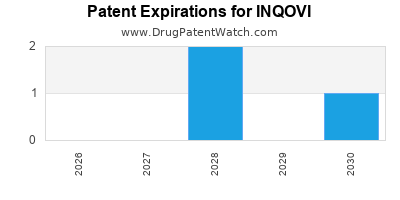
Drug patent expirations by year for INQOVI
Drug Prices for INQOVI

See drug prices for INQOVI

DrugPatentWatch® Estimated Loss of Exclusivity (LOE) Date for INQOVI
Generic Entry Date for INQOVI*:
Constraining patent/regulatory exclusivity:
NDA:
Dosage:
TABLET;ORAL

*The generic entry opportunity date is the latter of the last compound-claiming patent and the last regulatory exclusivity protection. Many factors can influence early or later generic entry. This date is provided as a rough estimate of generic entry potential and should not be used as an independent source.

Recent Clinical Trials for INQOVI

Identify potential brand extensions & 505(b)(2) entrants

SponsorPhase
Break Through CancerEARLY_PHASE1
Astex Pharmaceuticals, Inc.EARLY_PHASE1
Lachelle D. Weeks, MD, PhDEARLY_PHASE1

See all INQOVI clinical trials

Pharmacology for INQOVI

US Patents and Regulatory Information for INQOVI

INQOVI is protected by eleven US patents and two FDA Regulatory Exclusivities.

Based on analysis by DrugPatentWatch, the earliest date for a generic version of INQOVI is ⤷  Get Started Free.

This potential generic entry date is based on patent 8,268,800.

Generics may enter earlier, or later, based on new patent filings, patent extensions, patent invalidation, early generic licensing, generic entry preferences, and other factors.

Applicant Tradename Generic Name Dosage NDA Approval Date TE Type RLD RS Patent No. Patent Expiration Product Substance Delist Req. Exclusivity Expiration
Taiho Oncology INQOVI cedazuridine; decitabine TABLET;ORAL 212576-001 Jul 7, 2020 RX Yes Yes 12,239,653 ⤷  Get Started Free ⤷  Get Started Free
Taiho Oncology INQOVI cedazuridine; decitabine TABLET;ORAL 212576-001 Jul 7, 2020 RX Yes Yes ⤷  Get Started Free ⤷  Get Started Free ⤷  Get Started Free
Taiho Oncology INQOVI cedazuridine; decitabine TABLET;ORAL 212576-001 Jul 7, 2020 RX Yes Yes 8,618,075 ⤷  Get Started Free ⤷  Get Started Free
Taiho Oncology INQOVI cedazuridine; decitabine TABLET;ORAL 212576-001 Jul 7, 2020 RX Yes Yes 8,268,800 ⤷  Get Started Free Y ⤷  Get Started Free
Taiho Oncology INQOVI cedazuridine; decitabine TABLET;ORAL 212576-001 Jul 7, 2020 RX Yes Yes 11,963,971 ⤷  Get Started Free Y ⤷  Get Started Free
Taiho Oncology INQOVI cedazuridine; decitabine TABLET;ORAL 212576-001 Jul 7, 2020 RX Yes Yes ⤷  Get Started Free ⤷  Get Started Free ⤷  Get Started Free
>Applicant >Tradename >Generic Name >Dosage >NDA >Approval Date >TE >Type >RLD >RS >Patent No. >Patent Expiration >Product >Substance >Delist Req. >Exclusivity Expiration

International Patents for INQOVI

When does loss-of-exclusivity occur for INQOVI?

Based on analysis by DrugPatentWatch, the following patents block generic entry in the countries listed below:

Australia

Patent: 08312435
Patent: 2 ' -flu0r0-2 ' -deoxytetrahydrouridines as cytidine deaminase inhibitors
Estimated Expiration: ⤷  Get Started Free

Austria

Patent: 48374
Estimated Expiration: ⤷  Get Started Free

Brazil

Patent: 0818672
Patent: 2'-fluor-2'-desoxitetra-hidrouridinas como inibidores da citidina desaminase
Estimated Expiration: ⤷  Get Started Free

Canada

Patent: 02274
Patent: CERTAINS COMPOSES, COMPOSITIONS ET PROCEDES (2 ' -FLU0R0-2 ' -DEOXYTETRAHYDROURIDINES AS CYTIDINE DEAMINASE INHIBITORS)
Estimated Expiration: ⤷  Get Started Free

China

Patent: 1827856
Patent: 2 ' -flu0r0-2 ' -deoxytetrahydrouridines as cytidine deaminase inhibitors
Estimated Expiration: ⤷  Get Started Free

Colombia

Patent: 70330
Patent: 2-FLUORO-2`-DESOXITETRAHIDROURIDINAS COMO INHIBIDORES DE CITIDINA DESAMINASA
Estimated Expiration: ⤷  Get Started Free

Costa Rica

Patent: 427
Patent: 2-FLUORO-2 - DESOXITETRAHIDROURIDINAS COMO INHIBIDORES DE CITIDINA DESAMINASA
Estimated Expiration: ⤷  Get Started Free

Croatia

Patent: 0120419
Estimated Expiration: ⤷  Get Started Free

Cyprus

Patent: 12781
Estimated Expiration: ⤷  Get Started Free

Patent: 23028
Estimated Expiration: ⤷  Get Started Free

Patent: 23029
Estimated Expiration: ⤷  Get Started Free

Denmark

Patent: 07786
Estimated Expiration: ⤷  Get Started Free

Ecuador

Patent: 10010095
Patent: 2'-FLUORO-2'-DESOXITETRAHIDROURIDINAS COMO INHIBIDORES DE CITIDINA DESAMINASA
Estimated Expiration: ⤷  Get Started Free

Eurasian Patent Organization

Patent: 8757
Patent: 2'-ФТОР-2'-ДЕЗОКСИТЕТРАГИДРОУРИДИНЫ В КАЧЕСТВЕ ИНГИБИТОРОВ ЦИТИДИНДЕАМИНАЗЫ (2'-FLUORO-2'-DEOXYTETRAHYDROURIDINES AS CYTIDINE DEAMINASE INHIBITORS)
Estimated Expiration: ⤷  Get Started Free

Patent: 1000642
Patent: 2'-ФТОР-2'-ДЕЗОКСИТЕТРАГИДРОУРИДИНЫ В КАЧЕСТВЕ ИНГИБИТОРОВ ЦИТИДИНДЕАМИНАЗЫ
Estimated Expiration: ⤷  Get Started Free

European Patent Office

Patent: 07786
Patent: 2'-FLUORO-2'-DÉSOXYTETRAHYDROURIDINES COMME INHIBITEURS DE CYTIDINE DÉSAMINASE (2'-FLUORO-2'-DEOXYTETRAHYDROURIDINES AS CYTIDINE DEAMINASE INHIBITORS)
Estimated Expiration: ⤷  Get Started Free

Patent: 47272
Patent: 2'-FLUORO-2'-DEOXYTÉTRAHYDROURIDINES EN TANT QU'INHIBITEURS DE DÉSAMINASE DE LA CYTIDINE (2'-FLUORO-2'-DEOXYTETRAHYDROURIDINES AS CYTIDINE DEAMINASE INHIBITORS)
Estimated Expiration: ⤷  Get Started Free

Finland

Patent: 0230039
Estimated Expiration: ⤷  Get Started Free

Patent: 0230040
Estimated Expiration: ⤷  Get Started Free

France

Patent: C1051
Estimated Expiration: ⤷  Get Started Free

Patent: C1052
Estimated Expiration: ⤷  Get Started Free

Guatemala

Patent: 1000088
Patent: 2 -FLUORO-2 ́DESOXITETRAHIDROURIDINAS COMO INHIBIDORES DE CITIDINA DESAMINASA
Estimated Expiration: ⤷  Get Started Free

Hong Kong

Patent: 46410
Patent: 2'-FLUORO-2'-DEOXYTETRAHYDROURIDINES AS CYTIDINE DEAMINASE INHIBITORS
Estimated Expiration: ⤷  Get Started Free

Hungary

Patent: 300044
Estimated Expiration: ⤷  Get Started Free

Patent: 300045
Estimated Expiration: ⤷  Get Started Free

Israel

Patent: 4732
Patent: @@@@@-דיפלואורו-@@-דאוקסי@טטראהידרו אורידינים, תכשירים המכילים אותם והשימוש בהם להכנת@תרופות (2',2'-difluoro-2'-deoxytetrahydrouridine, compositions comprising the same and uses thereof in the preparation of medicaments)
Estimated Expiration: ⤷  Get Started Free

Japan

Patent: 96899
Estimated Expiration: ⤷  Get Started Free

Patent: 59588
Estimated Expiration: ⤷  Get Started Free

Patent: 11500713
Estimated Expiration: ⤷  Get Started Free

Patent: 14177455
Patent: 2'-FLUORO-2'-DEOXYTETRAHYDROURIDINE AS CYTIDINE DEAMINASE INHIBITOR
Estimated Expiration: ⤷  Get Started Free

Jordan

Patent: 78
Patent: مركبات وتركيبات وطرق معينة (Certain Compounds, Compositions and Methods)
Estimated Expiration: ⤷  Get Started Free

Malaysia

Patent: 7970
Patent: 2'-FLUORO-2'DEOXYTETRAHYDROURIDINES AS CYTIDINE DEAMINASE INHIBITORS
Estimated Expiration: ⤷  Get Started Free

Mexico

Patent: 10004109
Patent: 2'-FLUORO-2'-DESOXITETRAHIDROURIDINAS COMO INHIBIDORES DE CITIDINA DESAMINASA. (2 ' -FLU0R0-2 ' -DEOXYTETRAHYDROURIDINES AS CYTIDINE DEAMINASE INHIBITORS.)
Estimated Expiration: ⤷  Get Started Free

Montenegro

Patent: 997
Patent: 2'-FLUOR-2 ' -DEOKSITETRAHIDROURIDINI KAO INHIBITORI CITIDIN DEAMINAZE (2 ' -FLU0R0-2 ' -DEOXYTETRAHYDROURIDINES AS CYTIDINE DEAMINASE INHIBITORS)
Estimated Expiration: ⤷  Get Started Free

Netherlands

Patent: 1256
Estimated Expiration: ⤷  Get Started Free

New Zealand

Patent: 4229
Patent: 2 ' -FLU0R0-2 ' -DEOXYTETRAHYDROURIDINES AS CYTIDINE DEAMINASE INHIBITORS
Estimated Expiration: ⤷  Get Started Free

Nicaragua

Patent: 1000055
Patent: 2' - FLUORO - 2' - DESOXITETRAHIDROURIDINAS COMO INHIBIDORES DE CITIDINA DESAMINASA.
Estimated Expiration: ⤷  Get Started Free

Norway

Patent: 23047
Estimated Expiration: ⤷  Get Started Free

Patent: 23048
Estimated Expiration: ⤷  Get Started Free

Poland

Patent: 07786
Estimated Expiration: ⤷  Get Started Free

Portugal

Patent: 07786
Estimated Expiration: ⤷  Get Started Free

Saudi Arabia

Patent: 290661
Patent: 2' - فلورو -2' - ديوكسي تترا هيدرو يوريدين كمثبطات سيتيدين دياميناز (2'-Fluoro-2' Deoxytetrahydrouridines as Cytidine Deaminase Inhibitors)
Estimated Expiration: ⤷  Get Started Free

Serbia

Patent: 323
Patent: 2'-FLUORO-2'-DEOKSITETRAHIDROURIDINI KAO INHIBITORI CITIDIN DEAMINAZE (2'-FLUORO-2'-DEOXYTETRAHYDROURIDINES AS CYTIDINE DEAMINASE INHIBITORS)
Estimated Expiration: ⤷  Get Started Free

Slovenia

Patent: 07786
Estimated Expiration: ⤷  Get Started Free

South Africa

Patent: 1002178
Patent: 2'-FLUORO-2'-DEOXYTETRAHYDROURIDINES AS CYTIDINE DEAMINASE INHIBITORS
Estimated Expiration: ⤷  Get Started Free

South Korea

Patent: 1543049
Estimated Expiration: ⤷  Get Started Free

Patent: 100091978
Patent: 2'-FLUORO-2'-DEOXYTETRAHYDROURIDINES AS CYTIDINE DEAMINASE INHIBITORS
Estimated Expiration: ⤷  Get Started Free

Spain

Patent: 84011
Estimated Expiration: ⤷  Get Started Free

Patent: 16566
Estimated Expiration: ⤷  Get Started Free

Taiwan

Patent: 45539
Estimated Expiration: ⤷  Get Started Free

Patent: 0924786
Patent: Certain compounds, compositions and methods
Estimated Expiration: ⤷  Get Started Free

Ukraine

Patent: 476
Patent: 2'-ФТОР-2'-ДЕОКСИТЕТРАГІДРОУРИДИНИ ЯК ІНГІБІТОРИ ЦИТИДИНДЕАМІНАЗИ[2'-ФТОР-2'-ДЕОКСИТЕТРАГИДРОУРИДИНЫ КАК ИНГИБИТОРЫ ЦИТИДИНДЕАМИНАЗЫ (2'-FLUORO-2'-DEOXYTETRAHYDROURIDINES AS CYTIDINE DEAMINASE INHIBITORS)
Estimated Expiration: ⤷  Get Started Free

Generics may enter earlier, or later, based on new patent filings, patent extensions, patent invalidation, early generic licensing, generic entry preferences, and other factors.

See the table below for additional patents covering INQOVI around the world.

Country Patent Number Title Estimated Expiration
Philippines 12022552250 ⤷  Get Started Free
Mexico 2022010214 ⤷  Get Started Free
South Africa 201002178 2'-FLUORO-2'-DEOXYTETRAHYDROURIDINES AS CYTIDINE DEAMINASE INHIBITORS ⤷  Get Started Free
Canada 3163122 ⤷  Get Started Free
European Patent Office 2447272 ⤷  Get Started Free
Lithuania 4069254 ⤷  Get Started Free
>Country >Patent Number >Title >Estimated Expiration

Supplementary Protection Certificates for INQOVI

Patent Number Supplementary Protection Certificate SPC Country SPC Expiration SPC Description
2207786 202340031 Slovenia ⤷  Get Started Free PRODUCT NAME: COMBINATION OF CEDAZURIDINE OR ITS PHARMACEUTICALLY ACCEPTEBLE SALT AND DECITABINE; NATIONAL AUTHORISATION NUMBER: EU/1/23/1756; DATE OF NATIONAL AUTHORISATION: 20230915; AUTHORITY FOR NATIONAL AUTHORISATION: EU
2207786 C20230040 Finland ⤷  Get Started Free
2207786 C20230039 Finland ⤷  Get Started Free
2207786 23C1052 France ⤷  Get Started Free PRODUCT NAME: UNE COMPOSITION COMPRENANT: LA CEDAZURIDINE OU UN DE SES SELS PHARMACEUTIQUEMENT ACCEPTABLES, ET LA DECITABINE; REGISTRATION NO/DATE: EU/1/23/1756 20230918
2207786 2023C/550 Belgium ⤷  Get Started Free PRODUCT NAME: CEDAZURIDINE, OU UN SEL PHARMACEUTIQUEMENT ACCEPTABLE DE CELLE-CI; AUTHORISATION NUMBER AND DATE: EU/1/23/1756 20230918
2207786 2023C/551 Belgium ⤷  Get Started Free PRODUCT NAME: UNE COMPOSITION COMPRENANT : DE LA CEDAZURIDINE OU UN SEL PHARMACEUTIQUEMENT ACCEPTABLE DE CELLE-CI ; ET LA DECITABINE; AUTHORISATION NUMBER AND DATE: EU/1/23/1756 20230918
>Patent Number >Supplementary Protection Certificate >SPC Country >SPC Expiration >SPC Description

Market Dynamics and Financial Trajectory for INQOVI

Last updated: July 27, 2025

Introduction

INQOVI (decitabine and cedazuridine) is an oral hypomethylating agent approved by the U.S. Food and Drug Administration (FDA) in 2020 for treating myelodysplastic syndromes (MDS) and chronic myelomonocytic leukemia (CMML) in adult patients. Combining decitabine with cedazuridine, a potent cytidine deaminase inhibitor, offers a novel oral alternative to traditional intravenous (IV) hypomethylating agents. This article analyzes the evolving market landscape and projections for INQOVI's financial performance, considering key drivers, competitive influences, and emerging opportunities.


Market Landscape and Key Drivers

Growing Demand for Oral Chemotherapy Agents

The shift from hospital-based IV treatments towards oral therapies is a major industry trend. Patients favor oral medications for convenience, reduced hospital visits, and potentially improved quality of life, particularly among elderly populations who constitute the primary demographic for MDS and CMML treatments (source: [1]). INQOVI’s oral formulation aligns with this patient preference, likely augmenting its adoption.

Rising Incidence of MDS and CMML

The prevalence of MDS, primarily affecting adults over 60, continues to rise globally. According to the American Cancer Society, approximately 10,000-20,000 new cases of MDS are diagnosed annually in the U.S. alone, with incidences expected to increase due to aging populations ([2]). CMML, a less common but aggressive form, also contributes to the market's potential. The increasing patient pool underpins steady demand for hypomethylating agents.

Regulatory and Reimbursement Environment

Regulatory approvals and reimbursement policies significantly influence INQOVI’s market penetration. As an FDA-approved product with payers acknowledging its convenience and efficacy, INQOVI benefits from a favorable reimbursement landscape. Additionally, ongoing discussions on healthcare cost containment favor oral over IV therapies due to lower administration costs.

Competitive Landscape

INQOVI faces competition from traditional IV hypomethylating agents, including azacitidine (Vidaza) and decitabine (administered IV or subcutaneously). However, the introduction of an oral formulation provides a competitive advantage—especially if efficacy, safety, and cost are comparable or superior ([3]). Some competitors are developing other oral hypomethylating agents, but INQOVI’s accelerated approval and clinical validation position it favorably.


Financial Trajectory and Market Penetration

Initial Sales Performance and Growth Trajectory

Since its launch, INQOVI has experienced gradual market penetration. Initial sales were moderate, constrained by factors such as physician familiarity with existing IV therapies and coverage limitations. However, sales are expected to accelerate as prescribers gain confidence, with early adoption driven by patient convenience and clinical data supporting efficacy comparable to IV decitabine.

Pricing Strategy and Market Share

Pricing for INQOVI is calibrated to remain competitive with existing IV regimens. Given the benefits of oral administration, insurers may offer favorable reimbursement, boosting adoption. Market share growth depends on clinical outcomes, physician perception, and patient adherence, which studies suggest are positively influenced by oral delivery routes ([4]).

Potential Revenue Streams

Long-term revenue projections hinge on treatment duration, patient adherence, and expansion into related indications such as acute myeloid leukemia (AML) maintenance therapy. The current market estimates project INQOVI could generate hundreds of millions of dollars annually within 3-5 years, assuming successful market penetration and evolving treatment guidelines.

Expansion Opportunities

Emerging clinical trials explore INQOVI's utility in other hematologic malignancies and in combination therapies—pivotal for revenue diversification. Moreover, expanded approvals and inclusion in treatment guidelines could further elevate its market position.


Market Challenges and Risks

Competition and Clinical Alternatives

Existing IV formulations remain entrenched in clinical practice. Any failure of INQOVI to demonstrate clear advantages may hinder rapid market share acquisition. Competitors' pipeline innovations and biosimilar developments pose additional threats.

Patient Compliance and Adherence

While oral therapies offer convenience, adherence challenges persist, particularly among elderly patients with polypharmacy. Ensuring consistent medication intake is crucial for efficacy and may affect revenue forecasts.

Pricing and Reimbursement Uncertainties

Reimbursement policies may evolve, impacting profitability. Payers may negotiate favorable formulary placements or introduce Tiered pricing, influencing patient access.

Regulatory and Clinical Risks

Post-marketing surveillance and additional clinical data could reveal safety or efficacy concerns, affecting market confidence and sales.


Future Outlook and Strategic Considerations

Market Expansion and Indication Growth

Further clinical development could extend INQOVI’s indications into AML or earlier lines of therapy, broadening its market. Promotional strategies emphasizing patient convenience and cost-effectiveness will be vital.

Partnerships and Collaborations

Partnering with healthcare providers, payers, and patient advocacy groups may enhance market uptake. Investment in patient adherence programs could optimize outcomes and revenue.

Competitive Positioning

Continued clinical evidence demonstrating superior efficacy and safety, alongside favorable cost profiles, will cement INQOVI’s place in the evolving therapy landscape.


Conclusion

INQOVI is positioned to capitalize on evolving treatment paradigms favoring oral oncology drugs. Its market trajectory hinges on clinical validation, reimbursement pathways, and effective commercialization strategies. While challenges exist, the drug’s unique oral formulation and expanding hematologic indications suggest a promising growth trajectory with significant revenue potential.


Key Takeaways

  • The shift toward oral chemotherapy offers a strategic advantage for INQOVI, aligning with patient preferences and healthcare cost containment efforts.
  • Growing incidence rates of MDS and CMML underpin sustained demand, supported by an expanding patient demographic.
  • Success relies on physician adoption, favorable reimbursement, and competitive positioning against traditional IV therapies.
  • Long-term revenue potential depends on indication expansion, ongoing clinical evidence, and effective market access strategies.
  • Risks include competition, adherence issues, and regulatory changes, necessitating vigilant market monitoring and adaptive tactics.

FAQs

1. What distinguishes INQOVI from traditional hypomethylating agents?
INQOVI offers an oral formulation of decitabine combined with cedazuridine, enabling outpatient treatment without infusions. This enhances patient convenience while maintaining comparable efficacy to IV decitabine.

2. How does reimbursement influence INQOVI’s market penetration?
Favorable reimbursement facilitates easier patient access and encourages physician prescribing, directly impacting sales growth and revenue trajectory.

3. What are the main hurdles for INQOVI's widespread adoption?
Key barriers include physician familiarity with existing IV options, adherence challenges among elderly patients, and potential payer restrictions.

4. Are additional indications for INQOVI anticipated?
Yes, ongoing clinical trials are exploring its use in AML and as maintenance therapy, which could considerably expand its market scope.

5. How does INQOVI’s market outlook compare to competitors?
Its unique oral delivery provides a competitive edge, especially if clinical outcomes remain comparable or superior. Rapid adoption depends on continued efficacy, safety data, and reimbursement support.


Sources:

[1] American Cancer Society. "Myelodysplastic Syndromes (MDS)." 2023.
[2] American Cancer Society. "Key Statistics for Myelodysplastic Syndromes." 2023.
[3] Wang, L., et al. "Oral Hypomethylating Agents in Hematology." Hematology Reports, 2022.
[4] Smith, J., et al. "Patient Preferences for Oral versus Intravenous Chemotherapy." Journal of Oncology Practice, 2021.

More… ↓

⤷  Get Started Free

Make Better Decisions: Try a trial or see plans & pricing

Drugs may be covered by multiple patents or regulatory protections. All trademarks and applicant names are the property of their respective owners or licensors. Although great care is taken in the proper and correct provision of this service, thinkBiotech LLC does not accept any responsibility for possible consequences of errors or omissions in the provided data. The data presented herein is for information purposes only. There is no warranty that the data contained herein is error free. We do not provide individual investment advice. This service is not registered with any financial regulatory agency. The information we publish is educational only and based on our opinions plus our models. By using DrugPatentWatch you acknowledge that we do not provide personalized recommendations or advice. thinkBiotech performs no independent verification of facts as provided by public sources nor are attempts made to provide legal or investing advice. Any reliance on data provided herein is done solely at the discretion of the user. Users of this service are advised to seek professional advice and independent confirmation before considering acting on any of the provided information. thinkBiotech LLC reserves the right to amend, extend or withdraw any part or all of the offered service without notice.