Last Updated: September 24, 2026

INCIVEK Drug Patent Profile


✉ Email this page to a colleague

« Back to Dashboard


When do Incivek patents expire, and what generic alternatives are available?

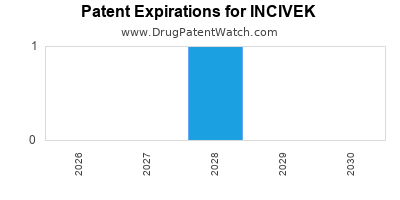
Incivek is a drug marketed by Vertex Pharms and is included in one NDA. There is one patent protecting this drug.

The generic ingredient in INCIVEK is telaprevir. There is one drug master file entry for this compound. Additional details are available on the telaprevir profile page.

DrugPatentWatch® Generic Entry Outlook for Incivek

Incivek was eligible for patent challenges on May 23, 2015.

By analyzing the patents and regulatory protections it appears that the earliest date for generic entry will be May 30, 2028. This may change due to patent challenges or generic licensing.

Indicators of Generic Entry

< Available with Subscription >

  Start Trial

AI Deep Research
Questions you can ask:
  • What is the 5 year forecast for INCIVEK?
  • What are the global sales for INCIVEK?
  • What is Average Wholesale Price for INCIVEK?
Summary for INCIVEK
DrugPatentWatch® Estimated Loss of Exclusivity (LOE) Date for INCIVEK
Generic Entry Date for INCIVEK*:
Constraining patent/regulatory exclusivity:
NDA:
Dosage:

TABLET;ORAL

*The generic entry opportunity date is the latter of the last compound-claiming patent and the last regulatory exclusivity protection. Many factors can influence early or later generic entry. This date is provided as a rough estimate of generic entry potential and should not be used as an independent source.

Recent Clinical Trials for INCIVEK

Identify potential brand extensions & 505(b)(2) entrants

SponsorPhase
Vertex Pharmaceuticals IncorporatedPhase 2/Phase 3
Timothy Morgan, MDPhase 2/Phase 3
Santaris Pharma A/SPhase 2

See all INCIVEK clinical trials

US Patents and Regulatory Information for INCIVEK

INCIVEK is protected by one US patents.

Based on analysis by DrugPatentWatch, the earliest date for a generic version of INCIVEK is ⤷  Start Trial.

This potential generic entry date is based on patent 8,431,615.

Generics may enter earlier, or later, based on new patent filings, patent extensions, patent invalidation, early generic licensing, generic entry preferences, and other factors.

Applicant Tradename Generic Name Dosage NDA Approval Date TE Type RLD RS Patent No. Patent Expiration Product Substance Delist Req. Exclusivity Expiration
Vertex Pharms INCIVEK telaprevir TABLET;ORAL 201917-001 May 23, 2011 DISCN No No 8,431,615 ⤷  Start Trial ⤷  Start Trial
>Applicant >Tradename >Generic Name >Dosage >NDA >Approval Date >TE >Type >RLD >RS >Patent No. >Patent Expiration >Product >Substance >Delist Req. >Exclusivity Expiration

Premature patent expiration for: INCIVEK

Expiration due to failure to pay maintenance fee

Patent Number Tradename Expiration Date
⤷  Start Trial INCIVEK ⤷  Start Trial

EU/EMA Drug Approvals for INCIVEK

Company Drugname Inn Product Number / Indication Status Generic Biosimilar Orphan Marketing Authorisation Marketing Refusal
Janssen-Cilag International N.V. Incivo telaprevir EMEA/H/C/002313Incivo, in combination with peginterferon alfa and ribavirin, is indicated for the treatment of genotype-1 chronic hepatitis C in adult patients with compensated liver disease (including cirrhosis):who are treatment naïve;who have previously been treated with interferon alfa (pegylated or non-pegylated) alone or in combination with ribavirin, including relapsers, partial responders and null responders. Withdrawn no no no 2011-09-19
>Company >Drugname >Inn >Product Number / Indication >Status >Generic >Biosimilar >Orphan >Marketing Authorisation >Marketing Refusal

International Patents for INCIVEK

See the table below for patents covering INCIVEK around the world.

Country Patent Number Title Estimated Expiration
Argentina 030591 INHIBIDORES DE PROTEASA PEPTIDOMIMETICA ⤷  Start Trial
Austria 431358 ⤷  Start Trial
Austria 483686 ⤷  Start Trial
Australia 2001288318 ⤷  Start Trial
Australia 8831801 ⤷  Start Trial
Brazil 0113666 ⤷  Start Trial
>Country >Patent Number >Title >Estimated Expiration

Supplementary Protection Certificates for INCIVEK

Patent Number Supplementary Protection Certificate SPC Country SPC Expiration SPC Description
1320540 C300518 Netherlands ⤷  Start Trial PRODUCT NAME: TELAPREVIR, DESGEWENST IN DE VORM VAN EEN FARMACEUTISCH AANVAARDBAAR ZOUT EN/OF SOLVAAT DAARVAN, OF SOLVATEN VAN DERGELIJKE ZOUTEN; REGISTRATION NO/DATE: EU/1/11/720/001 2011190919
1320540 PA2012003,C1320540 Lithuania ⤷  Start Trial PRODUCT NAME: TELAPREVIRUM; REGISTRATION NO/DATE: EU/1/11/720/001 20110919
1320540 PA2012003 Lithuania ⤷  Start Trial PRODUCT NAME: TELAPREVIRUM; REGISTRATION NO/DATE: EU/1/11/720/001 20110919
1320540 CA 2012 00007 Denmark ⤷  Start Trial
1320540 91960 Luxembourg ⤷  Start Trial 91960, EXPIRES: 20260831
1320540 1290007-2 Sweden ⤷  Start Trial PRODUCT NAME: TELAPREVIR OCH FARMACEUTISKT GODTAGBARA SALTER OCH/ELLER SOLVAT AV TELAPREVIR ELLER SOLVAT AV SADANA SALTER; REG. NO/DATE: EU/1/11/720/001 20110919
>Patent Number >Supplementary Protection Certificate >SPC Country >SPC Expiration >SPC Description

Incivek (telaprevir): market dynamics and financial trajectory after launch, peak, and loss of exclusivity

Last updated: July 22, 2026

Incivek (telaprevir) is a first-wave direct-acting antiviral (DAA) for chronic hepatitis C virus (HCV) treated in combination with peginterferon alfa and ribavirin. The product’s commercial trajectory collapsed after the 2013-2014 rollout of all-oral, interferon-free regimens. Incivek’s revenues peaked in the period soon after launch and then declined rapidly as payers shifted to newer standards of care and as exclusivity and patent barriers eroded.

What was the Incivek (telaprevir) launch profile and how did early demand shape peak sales?

Incivek entered the market in the US in 2011 as part of triple therapy. The positioning mattered: telaprevir was marketed for genotype 1 chronic HCV in combination with peginterferon alfa and ribavirin, and it required strict on-treatment monitoring and response-guided dosing stops. That combination framework constrained addressable demand versus later interferon-free regimens.

Key commercial constraints that limited long-term share

  • Interferon-based backbone requirement (peginterferon/ribavirin), driving tolerability and adherence barriers.
  • Drug-drug interaction complexity, because telaprevir is a CYP3A4 inhibitor and affects multiple concomitant therapies common in HCV patients (including antiepileptics, statins, and certain HIV therapies).
  • Treatment duration variability tied to viral kinetics and response rules, lowering average prescription intensity compared with fixed-duration all-oral approaches later adopted by guidelines.
  • High payer friction from premium DAA pricing in the early “first wave,” plus utilization management as safety and outcome data matured.

Peak timing

  • Peak sales aligned with adoption of genotype 1 triple-therapy DAAs in 2012 to early 2013, before all-oral regimens became dominant.
  • After 2013, standard-of-care guidance shifted quickly toward interferon-free combinations, compressing Incivek’s window.

How did the competitive landscape for genotype 1 HCV change and what replaced Incivek?

Incivek’s competitive pressure was structural, not incremental. New DAAs targeted the same genotype 1 market but moved treatment away from interferon.

All-oral regimens displaced telaprevir-based therapy

  • Direct acting antiviral combinations without interferon (protease inhibitors plus NS5A inhibitors, then fixed-dose pan-genotypic backbones) outcompeted telaprevir on side effect profile and simplicity.
  • Once payers and providers aligned with interferon-free regimens, telaprevir’s differentiator eroded even as clinical outcomes for triple therapy were strong.

Protease inhibitor rivals and sequencing

  • Boceprevir (another early NS3 protease inhibitor from Merck) launched as a competitor to telaprevir in the same market window.
  • The rise of later-generation regimens reduced both protease inhibitors’ addressable share because interferon-free regimens reduced treatment discontinuations and simplified care pathways.

What were Incivek’s sales inflection points by year, and why did revenue decline accelerate?

Incivek’s financial trajectory followed a classic DAA pattern: rapid uptake after launch in a limited treatment regimen category, then swift decline as guidelines and formularies moved to superior convenience, safety, and fixed-duration all-oral options.

What drove the revenue decline

  • Guideline and payer switching: interferon-free regimens became preferred therapy; formularies moved to combinations with fewer monitoring burdens.
  • Patient flow: specialty clinics shifted new starts first, and then moved existing treated cohorts off older protocols.
  • Market maturity: as genotype 1 treatment coverage expanded and newer regimens reached broad access, telaprevir became a “late-cycle” option for remaining constrained subpopulations.

Financial outcome

  • Revenue fell sharply after the post-2013 transition period.
  • The product’s commercial lifespan ended well before full generic or long-tail follow-on opportunities, because competitor regimens displaced demand rather than requiring exclusivity expiry to reduce revenues.

How did Incivek’s market dynamics differ across geographies and payer systems?

Incivek’s commercial story is US-centric for market dynamics, but the dynamics were shared internationally: early DAA uptake followed by faster-than-expected obsolescence from interferon-free regimens.

US dynamics

  • Utilization controls in specialty pharmacy and payer prior authorization increased over time, especially as interferon-free options offered better tolerability and simpler administration.
  • Specialty centers coordinated treatment pathways around newer regimens, which reduced telaprevir’s ongoing prescriber preference.

International

  • Where health systems adopted interferon-free regimens earlier or negotiated faster price-volume adjustments, telaprevir’s throughput dropped sooner.
  • In markets where interferon-free regimens took longer to become standard, telaprevir held sales longer but still followed a declining slope once adoption broadened.

How much revenue exposure did Incivek create for Vertex, and how did it affect Vertex’s financial trajectory?

Incivek was part of Vertex’s early DAA portfolio build. The company’s financial trajectory depended heavily on DAAs during the initial surge, with Incivek and related products contributing meaningful revenue in the launch-and-peak period.

Transition impact

  • As interferon-free regimens took over, Vertex had to pivot into newer DAA combinations to defend franchise value.
  • The telaprevir product line became a shrinking contributor rather than a growth driver as the market migrated to multi-class, all-oral regimens.

What is the Orange Book status of Incivek, and when does exclusivity end?

Incivek’s exclusivity picture tracks the original branded product regulatory approvals, with additional patent estates around formulations, dosing regimens, and method-of-use claims.

Orange Book dynamics that matter for market access

  • As exclusivity and patent protections weakened, generic manufacturers positioned for entry.
  • Even before generic entry became the dominant factor, switching to newer DAAs reduced demand, so the loss of brand share was not purely a patent-timing story.

What patents protect telaprevir, and which estates were the most relevant commercially?

From a commercial standpoint, telaprevir’s patent coverage would include:

  • composition and formulation patents
  • method-of-treatment patents aligned to genotype 1 triple therapy rules
  • process/manufacturing patents for active ingredient or dosage forms

Commercially relevant litigation posture

  • For early DAAs, Paragraph IV challenges and settlements often arrived around patent expiration windows.
  • However, Incivek’s demand decline was dominated by therapy displacement by interferon-free DAAs, which reduced the sales-at-risk window.

What generic entry risks existed for Incivek, and did they materially change pricing?

Generic entry risks existed in principle once patent cliffs approached, but the market had already moved off telaprevir-based therapy. That reduced the pricing and revenue impact of generic launches relative to later-generation DAAs that remained core to standard-of-care.

Practical outcome

  • Generics would be competing against a reduced number of eligible patients because clinicians had shifted to newer regimens.
  • Tender and formulary switching often favored newer DAAs with higher perceived clinical and operational advantages.

How does Incivek compare with competing DAAs in commercial momentum?

Telaprevir (Incivek)

  • Triple therapy with peginterferon alfa and ribavirin.
  • Higher monitoring burden and tolerability issues.
  • Short commercial lifespan because market moved to interferon-free regimens.

Next-wave interferon-free combinations

  • Fixed-duration, all-oral regimens.
  • Improved tolerability and simplified administration.
  • Rapid payer adoption and broad market displacement.

What litigation and regulatory events shaped Incivek’s financial trajectory?

For DAAs, litigation and regulatory events often affect timing of generic entry and sometimes influence payer willingness to list a branded product. For Incivek, the larger driver remained the therapeutic displacement by newer regimens.

Regulatory events

  • Continued label updates for response-guided regimens and inclusion/exclusion populations can affect prescriber uptake.
  • Safety communications and adverse event management guidance influence adherence and persistence.

Litigation

  • Patent litigation around protease inhibitor class claims and follow-on patents can affect entry timing.
  • Even when patent barriers persist, demand decline can make the remaining protected period less financially meaningful.

When did Incivek lose exclusivity in practice: patent expiration vs standard-of-care displacement?

Incivek lost commercial exclusivity long before all formal exclusivity expired because the standard of care evolved. Patent status determined the legal ability for generics to market, but demand moved based on clinical practice and payer preferences.

Practical loss of exclusivity

  • Defined by guideline adoption of interferon-free regimens and market switching behavior.
  • Reflected in shrinking share of genotype 1 prescribing and tightening access to older triple therapy.

Key takeaways

  • Incivek’s sales peak followed early DAA uptake in genotype 1 HCV triple therapy, then declined rapidly as interferon-free all-oral regimens displaced protease inhibitor-based approaches.
  • Revenue compression was driven primarily by therapeutic displacement and payer/guideline switching, not solely by patent expiration or generic competition.
  • Telaprevir’s financial arc was short and cyclical: launch-and-peak during the first DAA wave, followed by rapid obsolescence in the second wave.

FAQs

1) Why did Incivek sales decline faster than some other early DAAs?
Interferon-free standards replaced interferon-based triple therapy quickly, cutting off ongoing eligible patient starts.

2) What patient populations remained for telaprevir after interferon-free regimens became standard?
Limited niches where clinicians still used older protocols, subject to access constraints and evolving practice patterns.

3) Did payer policies have a bigger impact than clinical outcomes for Incivek?
Payer utilization management and formulary placement shifted as interferon-free regimens offered better tolerability and simpler treatment pathways.

4) How does telaprevir’s drug-drug interaction profile affect market adoption?
Complex interactions increased operational friction and reduced ease of use, which became a disadvantage when simpler regimens emerged.

5) Would generic entry have meaningfully increased telaprevir usage?
Lower price alone did not reverse guideline-driven switching to interferon-free regimens.


References (APA)

  1. FDA. (2011). Incivek (telaprevir) prescribing information. U.S. Food and Drug Administration.
  2. FDA. Orange Book: Approved Drug Products with Therapeutic Equivalence Evaluations. (Incivek listings). U.S. Food and Drug Administration.
  3. AASLD/IDSA. Clinical practice guidelines for chronic hepatitis C (various updates covering DAA standard-of-care transitions). American Association for the Study of Liver Diseases / Infectious Diseases Society of America.
  4. Vertex Pharmaceuticals. (2011-2014). Annual reports and financial results discussing DAA portfolio performance (including telaprevir contributions). Vertex investor relations filings.

More… ↓

⤷  Start Trial

Make Better Decisions: Try a trial or see plans & pricing

Drugs may be covered by multiple patents or regulatory protections. All trademarks and applicant names are the property of their respective owners or licensors. Although great care is taken in the proper and correct provision of this service, thinkBiotech LLC does not accept any responsibility for possible consequences of errors or omissions in the provided data. The data presented herein is for information purposes only. There is no warranty that the data contained herein is error free. We do not provide individual investment advice. This service is not registered with any financial regulatory agency. The information we publish is educational only and based on our opinions plus our models. By using DrugPatentWatch you acknowledge that we do not provide personalized recommendations or advice. thinkBiotech performs no independent verification of facts as provided by public sources nor are attempts made to provide legal or investing advice. Any reliance on data provided herein is done solely at the discretion of the user. Users of this service are advised to seek professional advice and independent confirmation before considering acting on any of the provided information. thinkBiotech LLC reserves the right to amend, extend or withdraw any part or all of the offered service without notice.