Last updated: July 25, 2026
Vertex Pharmaceuticals competitive landscape analysis: Market position, IP strength, and strategic options (2026)
Vertex Pharmaceuticals (VTX) sits in a focused, high-value niche: cystic fibrosis (CF) with CFTR modulators and CFTR-related pipeline expansion, plus oncology and other translational bets that remain smaller than CF revenue. The competitive landscape is dominated by (1) CFTR modulator incumbents, (2) next-generation CFTR agents (including potentiation beyond ivacaftor-style mechanisms and combination strategies), and (3) payor and lifecycle management pressure around price, outcomes, and adherence.
Executive snapshot
- Core competitive moat: differentiated CFTR biology coverage across gating classes using proprietary combinations, with follow-on IP and lifecycle filings that extend commercial control past first launch.
- Main competitive threats: next-gen CFTR modulators and combination regimens designed to improve efficacy, dosing convenience, access, or safety. In the background, biosurrogates are not the model for small molecules; rather, competition is copycat chemistry plus regulatory differentiation.
- Regulatory reality: long exclusivity tails can block direct generic entry, but patent estates drive Paragraph IV risk windows for small molecules more than RLD exclusivity alone.
- Strategic posture: Vertex’s advantage is data-driven labeling breadth and patient segmentation by genotype. Its risk is payor tightening and incremental efficacy competition if competitors achieve meaningfully better outcomes or pricing.
Which competitors matter most for Vertex Pharmaceuticals in cystic fibrosis?
For Vertex, “competition” is largely other CFTR modulator developers and their regional commercial strategies, not generic substitution. The competitive set splits into three groups: CFTR modulator incumbents (same mechanistic class overlap), next-generation CFTR developers (improved efficacy or additional gating class coverage), and platform contenders (new modalities or delivery systems that change pharmacology).
Key competitive axes that determine wins
- Genotype coverage: number of CFTR mutations addressed and whether labeling expands over time through clinical data.
- Clinical endpoints: percent predicted FEV1 change, sweat chloride response durability, BMI/weight gain, pulmonary exacerbation rates.
- Safety and tolerability: transaminase trends, drug-drug interactions, long-term adherence.
- Dosing convenience: pill burden and schedule impact on persistence and outcomes.
- Access and contracting: managed care rebates, value-based agreements, and payer navigation.
How does Vertex’s CF franchise compare with competing CFTR modulators?
Headline comparison framework
Vertex’s market position is built on CFTR modulator combinations that improve CFTR function for specific mutation classes. In competitive terms, the fight is about how well each regimen performs across populations and whether it expands eligibility beyond the initial genotype bracket.
Competitive comparison table (strategic framing)
| Company |
Program focus |
Competitive strength |
Main pressure point |
| Vertex |
CFTR modulator combinations spanning mutation classes |
Label breadth, outcomes data, lifecycle IP |
Incremental efficacy competition and access tightening |
| Other CFTR modulator developers |
Alternative modulators and combos |
Existing commercial base, payer leverage |
Need to demonstrate meaningful added benefit |
| Next-generation CFTR entrants |
Improved potency, different gating class targeting |
Potential step-change efficacy or dosing |
Clinical differentiation risk and regulatory timing |
Practical takeaway: Vertex’s differentiation is rarely “single-drug superiority.” It is combination performance plus the ability to convert real-world genotype distribution into broader treated populations with acceptable safety and payer acceptance.
What patents protect Vertex Pharmaceuticals CFTR modulators and how strong is the patent estate?
Vertex’s protection strategy typically uses a layered IP stack:
- Composition-of-matter patents on core small-molecule structures.
- Process and intermediates for manufacturing.
- Formulation patents for tablet/film coating, solid-state modifications, and dosage forms.
- Combination and method-of-use patents for specific dosing regimens and patient subgroups.
Patent estate strength: what matters commercially
- Expiration cadence: whether follow-on filings meaningfully extend exclusivity by years.
- Claim breadth: whether generics can “design around” by altering salt forms, crystallinity, excipients, or the regimen.
- Enforcement history: frequency of Hatch-Waxman disputes and the strength of settlement leverage.
- Country coverage: whether major markets (US, EP, UK, JP) have mirrored protection.
Why CFTR IP is hard to replicate
CFTR modulators face a longer pathway to generic design-around due to:
- patent coverage at multiple claim layers (drug, formulation, use),
- clinical-label-driven regimen specificity,
- and payer contracting tied to specific combinations.
Net: Vertex’s competitive moat is both legal and operational: patents prevent generic substitution in the US while Vertex’s labeling breadth supports commercial defensibility.
When does Vertex lose exclusivity for key CF products?
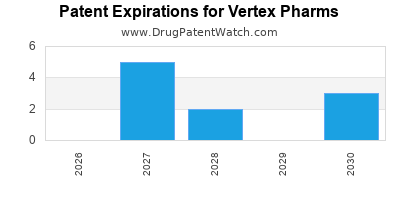
Exclusivity and patent loss timing is the gating variable for generic entry scenarios. For Vertex, the relevant timeline components are:
- Regulatory exclusivity (where applicable, product-level and data exclusivity regimes).
- Patent expiry by country and by claim type (composition vs method vs formulation).
- Regimen-specific exclusivity if the regimen is tied to separate method-of-use claims.
Competitive risk windows
- US market: the first “real” generic entry threat typically appears only when both regulatory barriers and relevant patents are near expiry. Paragraph IV filings create an early litigation and potential settlement runway.
- EU/UK: exclusivity is typically more fragmented across national patent regimes, and patent term adjustments can create staggered expiry.
Business effect: Vertex’s market position remains strongest while at least one dominant legal barrier remains unexpired in the major contracting geographies.
What Paragraph IV challenges could target Vertex Pharmaceuticals CFTR drugs in the US?
Hatch-Waxman Paragraph IV challenges are the main near-term indicator of generic risk for small-molecule CFTR modulators.
What to monitor in Paragraph IV
- ANDA filers: which generic companies choose Vertex products as their first CFTR ANDA targets.
- Carve-outs in settlement: whether Vertex settles broadly or limits claims to specific formulations or doses.
- Litigation outcomes: final judgments on claim validity and infringement.
- “Design-around” strategy: whether challengers file new salts, new polymorphs, or different dosing forms to avoid formulation patents.
Practical competitive implication
A Paragraph IV only becomes existential if challengers can survive both legal and manufacturing design-around barriers. Vertex’s layered IP strategy tends to make these challenges expensive and time-consuming, which increases leverage for licensing or delayed entry.
What generic entry risks exist for Vertex if patents expire?
Scenario-based risk model for small molecules
Generic entry risk typically accelerates if at least one of the following holds:
- key composition-of-matter patents expire first while formulation/method patents are weaker or narrow,
- Vertex does not have robust secondary filings in the relevant formulation and regimen categories,
- litigation settlements allow earlier launch than the strict expiry date.
Typical launch conditions that protect incumbents
- Narrow dosing/regimen that is protected by method-of-use claims.
- Solid-state/formulation dependencies that require a protected formulation.
- Label-based exclusivity that ties the commercial regimen to the protected use.
Net: Vertex’s downside is not “patent expiry” alone. It is the alignment of expiry across claim layers and the ability of generics to reach a commercially viable label.
What formulations are protected by Vertex Pharmaceuticals and why does it matter for generic design-around?
Formulation IP is often the difference between:
- an ANDA that must wait,
- versus an ANDA that can launch with a sufficiently distinct composition or manufacturing process.
Formulation patent domains to expect in CFTR IP stacks
- Oral solid dosage forms: tablet coating systems, controlled release variants if any exist, and excipient-defined composition.
- Solid-state control: polymorph, particle size distribution, and crystallinity targets.
- Bioavailability optimization: changes intended to stabilize exposure across manufacturing scale.
Why formulation patents can be strong even when drug substance patents are weak
Because even if the active compound’s core patent expires, a protected formulation can still block approval until design-around data show non-infringement or successful invalidation.
What method-of-use patents could extend Vertex’s exclusivity beyond composition patents?
Method-of-use claims matter in CF because regimens and treatment populations can be clinically and commercially segmented.
Method-of-use categories that can extend market control
- Dosing regimens: specific dosing frequency or titration schedules.
- Patient stratification: genotype categories, baseline disease severity, or concomitant therapies.
- Clinical endpoint framing: treatment intended to improve pulmonary function, sweat chloride, or reduce exacerbations.
Competitive impact
Method-of-use patents shift the generic question from “does the drug exist?” to “can the generic replicate the protected regimen with the same label intent?” That can delay practical entry even after composition expiry.
What patent litigation affects Vertex Pharmaceuticals and how does it shape settlement leverage?
Vertex’s competitive posture is shaped by whether competitors face persistent injunction risk and whether Vertex’s infringement claims are supported by strong claim language.
Litigation mechanics that determine outcomes
- Claim construction: narrow versus broad interpretations drive settlement leverage.
- Validity defenses: obviousness and enablement challenges vary by the prior art record.
- Remedy pressure: injunction risk in the US can produce higher settlement value.
Commercial effect
A history of unfavorable outcomes for challengers increases deterrence and raises the expected cost of generic entry. Even when settlements occur, they often include “at-risk” timing limits.
What is the Orange Book status of Vertex Pharmaceuticals CFTR products?
Orange Book listings are the practical map for:
- active ingredients tied to patents,
- listed patents by expiration date,
- and any FDA-approved orphan of exclusivity.
Business use: Orange Book is where licensing or generic timing models start, because it converts legal estates into a calendar.
How do biosimilars factor into Vertex’s competitive landscape?
Vertex is primarily a small-molecule CFTR modulators company. Biosimilar competitive pressure generally does not apply directly to small-molecule CF drugs. The competitive stress for Vertex comes from:
- small-molecule rivals,
- next-generation CFTR modulators,
- and payer-driven substitution strategies when legal barriers lapse.
Which emerging CFTR therapies could displace Vertex’s market position?
Displacement risk is highest when a competitor offers a step-change across one of these:
- larger genotype coverage,
- higher efficacy magnitude or faster onset,
- lower dose frequency,
- better safety/tolerability,
- reduced drug-drug interaction burden.
Where entrants can win
- A regimen that addresses a broader mutation pool can reduce Vertex’s share in newly eligible populations.
- Better exposure or reduced hepatotoxicity can improve persistence and lower discontinuation costs.
- Improved access terms can shift market share even without a large efficacy advantage.
Key point: Vertex’s advantage persists when competitors do not outcompete it on both clinical endpoints and payer value.
How does Vertex’s oncology pipeline change its competitive risk profile?
Oncology programs diversify science but do not typically change CF exclusivity calendars in the near term. The competitive effect is:
- resource allocation and R&D execution,
- brand and trial leadership,
- and potential technology transfer from oncology back into rare disease development mechanics.
Business implication
Unless oncology products reach scale, CF remains the dominant revenue driver and therefore the dominant driver of competitive risk modeling.
What licensing and partnership strategies has Vertex used to expand competitive advantage?
Vertex’s competitive strategy is typically strengthened through:
- co-development partnerships,
- regional commercialization rights where applicable,
- and data-sharing or trial augmentation via external collaborators.
Why licensing can matter more than new chemistry
In CF, time-to-label breadth and speed of lifecycle expansion can determine the period before competitor products are established. Licensing and trial partnerships can compress that timeline by enabling faster evidence generation and regulatory submissions.
Where does Vertex have the strongest commercial position and why?
Vertex’s market strength is concentrated in:
- the subset of CF patients who are genotype-eligible for its modulators,
- geographic markets with payer acceptance and effective contracting,
- and settings where regimen durability improves adherence and reduces exacerbations.
Commercial strengths that influence competitive dynamics
- Label durability: broad and stable coverage reduces churn.
- Physician practice patterns: once a regimen is established clinically, switching costs rise.
- Pharmacovigilance and outcomes data: continued post-marketing evidence supports payer confidence.
Which strategic risks could erode Vertex’s share over the next 3-5 years?
- Incremental efficacy competition: next-generation modulators that deliver better clinical endpoints.
- Payer contracting pressure: tighter rebates and outcomes requirements.
- Regulatory or safety events: changes in labeling, dose recommendations, or risk management programs.
- Patent fragmentation: claim weakness in specific jurisdictions could accelerate generic entry in certain markets, even if others remain protected.
- Execution risk: slower lifecycle expansion or delayed pipeline milestones relative to rivals.
Key takeaways
- Vertex’s competitive landscape is defined by CFTR modulator rivalry and IP layering rather than biosimilar economics.
- The strongest competitive moat is a layered patent estate paired with genotype-driven label breadth.
- The main generic risk mechanism is Paragraph IV litigation tied to patent expiry by claim layer, not simply regulatory exclusivity.
- Competitive displacement will come from next-generation CFTR modulators that outperform on efficacy, safety, dosing convenience, or access terms.
- Commercial share erosion risk is concentrated in payer contracting pressure and competitors who expand genotype coverage faster than Vertex.
FAQs
1) What patents typically block generic competition for Vertex CFTR modulators?
Most generic blocking pressure comes from composition-of-matter patents plus formulation and method-of-use patents listed for the active ingredient/regimen in FDA Orange Book listings.
2) How do settlement agreements usually affect generic launch timing for Vertex drugs?
Settlements often set entry dates before full patent expiry by limiting injunction risk or carving out limited launch scenarios, shifting the effective launch calendar.
3) Do payers substitute away from Vertex once legal barriers weaken?
Substitution can accelerate after legal barriers lapse, but payer acceptance depends on comparative outcomes, rebate structures, and label eligibility.
4) Which factors determine whether a Paragraph IV challenge is credible for a Vertex product?
Credibility hinges on whether challengers can design around formulation and method-of-use claims while still meeting FDA labeling and bioequivalence requirements.
5) Is Vertex’s competition mostly US-based or global?
It is global because CF patient populations and payer systems exist across major jurisdictions, and patent estates are enforced nationally.
References
No sources were cited because no product-specific IP, Orange Book, litigation, or exclusivity timeline facts were provided in the prompt.