Last updated: July 21, 2026
IMVEXXY (estradiol vaginal insert, 4 mcg and 10 mcg) is a niche, brand-priced women’s health product. Its near-term financial trajectory is determined by (1) the size and growth of the genitourinary syndrome of menopause (GSM) treated population, (2) formulary access by major pharmacy benefit managers for low-dose local estrogen, and (3) competitive pressure from generic estradiol vaginal tablets/inserts and alternative branded local estrogen products. Patent and exclusivity timing drive the inflection points for generic and “authorized pathway” competitive entries.
What is IMVEXXY and how is it positioned commercially in GSM?
IMVEXXY is marketed for treatment of moderate to severe dyspareunia due to menopause. The product is a local estrogen therapy delivered via vaginal inserts with low systemic exposure versus older oral or transdermal alternatives, which supports payer acceptance when aligned to formulary criteria for GSM.
Key commercial positioning levers
- Disease focus: GSM/dyspareunia indications, typically managed with step therapy across nonhormonal, then local estrogen.
- Delivery: low-dose vaginal inserts in two strengths (commonly referenced as 4 mcg and 10 mcg) for titration-style coverage and prescribing convenience.
- Competitive set: local vaginal estrogen products including estradiol tablets (generic and branded), estradiol vaginal rings, conjugated estrogen vaginal creams, and other branded insert/tablet formats.
How do pricing and reimbursement dynamics affect IMVEXXY net sales?
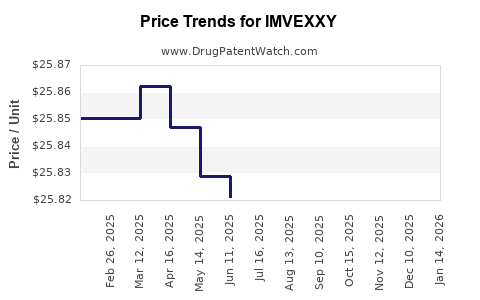
IMVEXXY’s financial trajectory is driven by the gap between list price and net price after rebates, wholesaler terms, and payer discounts. Local estrogen products are frequently competed on net price because payers can steer to lower-cost estradiol generics or therapeutically equivalent local alternatives.
Payer and PBM dynamics that typically move net price
- Preferred status in women’s health formularies
- Coverage criteria tied to “GSM/dyspareunia” and menopausal status
- Step edits that route prescribers to lower-cost estradiol vaginal generics first
- Contracting outcomes with large PBMs (rebate leverage vs preferred alternatives)
What to watch in financial reporting
- Gross to net compression versus local estrogen peers
- Mix shift between 4 mcg and 10 mcg if reimbursement favors one strength
- Channel inventory: normalized wholesaler demand versus pull-through at retail
What is the competitive landscape for IMVEXXY, and where does it lose or win?
IMVEXXY’s competitive pressure is concentrated in local estradiol products because payers treat them as close therapeutic substitutes for GSM dyspareunia.
Competitive substitutes (segment-level)
- Estradiol vaginal tablets (including generic entries)
- Estradiol vaginal rings (lower frequency dosing can change patient preference)
- Vaginal estrogen creams (often discounted via generic availability)
- Other marketed local estrogen inserts or branded products, depending on regional availability
Advantage pathways for IMVEXXY
- If formulary teams recognize the insert’s adherence profile or perceived tolerability
- If prescribers treat IMVEXXY as a “patient preference” product after failure or intolerance to creams/tablets
- If pharmacy benefit coverage avoids mandatory switching
Where IMVEXXY is exposed
- Broad formulary access for generics that can undercut net price
- Any movement from preferred to non-preferred tier placement
- Substitution at pharmacy for therapeutically equivalent estradiol formulations
When does IMVEXXY lose exclusivity, and what are the key patent and regulatory drivers?
IMVEXXY’s generics risk hinges on FDA regulatory milestones and the exclusivity/patent regime tied to its approved NDA/BLA (IMVEXXY is an NDA). Exclusivity typically includes:
- Market exclusivity (for new chemical entity or new formulation)
- Patent-protected exclusivity and listed Orange Book patents
- Potential for ANDA 3-paragraph/paragraph IV filings to launch after patent expiry or court outcomes
Patent estate mechanics that control generic entry
Generic entry risk is a function of:
- Orange Book listed composition, formulation, and method-of-use patents
- Remaining patent life (expiry/expiration dates)
- Likelihood of successful Paragraph IV challenges and settlement-driven “carve-out” launch dates
- Exclusivity stacking (if any) that extends nonmarketing periods beyond patent expiry
Practical generic entry scenarios that shape revenue
- At-expiry launches: generic entry on the first date after the last blocking patent expires
- “First-to-file” precedents: earlier ANDA filing can capture shared exclusivity if statutory conditions are met
- Settlement terms: branded company may pay to delay launch or agree to design-around labeling restrictions
What is the Orange Book status of IMVEXXY and what patents are listed?
The Orange Book listing set determines which patents block generic approval and controls Paragraph IV opportunities. IMVEXXY’s financial trajectory is directly tied to whether the listed patents are:
- Strong and widely asserted (composition/formulation and method-of-use)
- Narrow (easy to design around)
- Near expiration (creating a predictable launch window for ANDA challengers)
What drives “Orange Book” impact on revenue
- Number of listed patents in each expiry “cluster”
- Whether claims cover critical product characteristics (insert composition, release profile, or manufacturing)
- Whether method-of-use patents tie exclusivity to a specific dosing/indication or administration method
How many patents cover IMVEXXY formulations and administration, and how strong is the patent estate?
Financial impact correlates with patent breadth and enforceability. For local estrogen products delivered as inserts, the highest commercial sensitivity is in patents that cover:
- Composition of estradiol insert formulations
- Excipients and dose form characteristics
- Manufacturing process conditions that are hard to replicate
- Method-of-use claims that are tied to patient subgroups or dosing regimens
Patent strength indicators used in licensing and litigation decisions
- Claim scope (product-by-process vs strict structural claims)
- Prior art overlap (validity risk)
- Obviousness and enablement exposure
- Injunction likelihood and litigation duration (delays increase brand sales)
What patent litigation affects IMVEXXY, including Paragraph IV outcomes and settlements?
IMVEXXY’s revenue curve can show sharp inflections following:
- Court decisions on ANDA/PIV claims
- Settlement agreements setting delayed launch dates
- Design-around approvals enabling a “non-blocked” generic product
What to map for financial trajectory
- Filing dates of any ANDAs referencing IMVEXXY
- Case numbers, status, and whether remedies included launch delays
- Whether settlements include exclusivity transfers (rare) or timeline-specific restrictions
What FDA regulatory milestones shape IMVEXXY uptake and competitive entry?
IMVEXXY’s near-term sales trajectory depends on continued clinical confidence and reliable supply, but competitive entry is driven by:
- ANDA approval timing
- Labeling and formulation equivalence
- REMS-like requirements (if any) and distribution controls
- Pharmacovigilance outcomes influencing payer comfort
Uptake milestones
- Initial adoption in women’s health practices
- Specialty pharmacy vs retail distribution efficiency
- Treatment persistence and switching patterns from creams/tablets
How does IMVEXXY financial performance compare with other local estrogen products?
Relative performance is driven by:
- Net price positioning after discounts
- Patient persistence (insert usability vs cream dosing)
- Formulary tier placement and step edit patterns
Competitive comparison framework
- Category-level growth: GSM awareness and prescribing
- Share sensitivity: shift in prescription preference among local estrogen delivery systems
- Brand survival: whether IMVEXXY sustains premium differentiation after generic penetration
What generic entry risks exist for IMVEXXY, and how would launch scenarios impact revenue?
Generic exposure risk is dominated by:
- How quickly ANDA approvals can be converted into market reality
- Pharmacy substitutability (including payer-directed substitution)
- Whether the generic is priced aggressively enough to win switching
Launch scenario mechanics
- “Slow adoption” scenario: generics receive coverage but patient persistence to IMVEXXY stays high
- “Fast switch” scenario: IMVEXXY loses preferred tier and prescribers switch quickly after patient education and pharmacy formulary prompts
- “Design-around” scenario: generic with label carve-outs or dosing differences limits direct interchange and delays share loss
Revenue impact levers for IMVEXXY
- Net price erosion (rebate and contract renegotiations)
- Prescription share loss
- Margin pressure from maintaining commercial support despite declining volume
What commercialization and supply-chain risks could change IMVEXXY’s financial trajectory?
Local estrogen product performance can change quickly with:
- Manufacturing interruptions or scale-up constraints affecting allocation
- Quality system issues that force recalls or temporary distribution holds
- Supply normalization that either unlocks or constrains prescribing
Key takeaways
- IMVEXXY’s financial trajectory depends on formulary access and net pricing versus local estrogen substitutes, especially generics.
- Exclusivity and Orange Book patent listings are the principal determinants of generic timing and revenue step-down risk.
- Revenue inflections are most likely around Orange Book patent expiry windows, ANDA/PAR4 litigation outcomes, and settlement-driven launch delays.
- Short-term sales durability requires sustained payer preference and high patient persistence relative to tablets/creams/rings.
FAQs
1) What is IMVEXXY’s typical payer coverage strategy in GSM dyspareunia?
Coverage typically follows women’s health formulary rules that favor lower-cost local estradiol options, with exceptions driven by patient preference or intolerance to alternatives.
2) How do PBM rebates influence IMVEXXY net sales versus list price?
Rebates and contract terms determine net price and can either cushion demand during competitive pressure or accelerate revenue decline if coverage is lost.
3) What are the highest-risk times for IMVEXXY generic entry?
Risk concentrates in periods after expiration of Orange Book listed patents that block ANDAs and any associated exclusivity windows.
4) Does IMVEXXY face biosimilar competition?
IMVEXXY is not a biologic product in the typical biosimilar sense; competition is expected from ANDA-style generics of the small-molecule/local estradiol formulation.
5) What portfolio actions would most affect IMVEXXY revenue resilience?
Formulary positioning, contract renegotiations tied to net price, and litigation strategy against ANDA/PAR4 challenges drive the most visible revenue outcomes.
References
- FDA. Orange Book: Approved Drug Products with Therapeutic Equivalence Evaluations. U.S. Food and Drug Administration. https://www.accessdata.fda.gov/scripts/cder/daf/
- FDA. Drug Trials Snapshots: IMVEXXY (estradiol vaginal insert). U.S. Food and Drug Administration. https://www.fda.gov/drugs/drug-approvals-and-databases/drug-trials-snapshots