Last updated: August 15, 2026
iDose TR is Glaukos Corp.’s intracameral travoprost implant for reducing elevated intraocular pressure in patients with ocular hypertension or open-angle glaucoma. The FDA approved iDose TR on Dec. 13, 2023, making it the first FDA-approved long-duration travoprost implant. Its commercial opportunity depends on replacing or delaying topical glaucoma therapy, securing reimbursement for an office-administered procedure, and overcoming physician adoption barriers tied to implantation, retreatment, and corneal safety.
Glaukos’ financial exposure is meaningful but initially limited relative to its established iStent franchise. The company generated approximately $348.6 million in 2023 revenue, primarily from glaucoma and corneal products. iDose TR was not a material contributor to 2023 revenue because commercial launch followed FDA approval. The product’s financial impact should emerge through procedure volume, reimbursement, repeat implantation, and expansion from surgical glaucoma specialists into broader ophthalmology practices.
What is iDose TR and how does it work?
iDose TR is a drug-device combination product containing travoprost, a prostaglandin analog. An ophthalmologist places the implant in the anterior chamber of the eye, where it releases travoprost over an extended period.
The product is indicated for the reduction of elevated intraocular pressure in patients with ocular hypertension or open-angle glaucoma. The FDA label identifies the implant as a single-use product administered through an intraocular procedure. It is not a topical drop and does not rely on daily patient adherence. (U.S. Food and Drug Administration, 2023a)
What clinical problem does iDose TR address?
Topical prostaglandin analogs are widely used first-line treatments for glaucoma, but adherence is poor. Patients may miss doses, use incorrect administration technique, or discontinue treatment because of ocular irritation, cost, or treatment fatigue.
iDose TR changes the treatment model from daily self-administration to physician-administered sustained delivery. That creates a commercial opportunity in patients who have difficulty maintaining pressure control with topical therapy. It also creates new clinical and economic barriers because every implant requires an ophthalmic procedure and post-procedure monitoring.
When did the FDA approve iDose TR?
The FDA approved iDose TR under NDA 214026 on Dec. 13, 2023. The approval was based on clinical studies evaluating intraocular pressure reduction and safety in patients with open-angle glaucoma or ocular hypertension. (U.S. Food and Drug Administration, 2023a)
The approval did not establish iDose TR as a replacement for all topical glaucoma medications. Its addressable population is patients who require pressure-lowering therapy and are appropriate candidates for an intracameral implant.
| Regulatory milestone |
Date |
Commercial implication |
| FDA approval |
Dec. 13, 2023 |
Enables U.S. commercialization |
| Approved indication |
Dec. 13, 2023 |
Ocular hypertension and open-angle glaucoma |
| Product type |
2023 |
Intracameral travoprost drug-device combination |
| Initial commercial phase |
2024 |
Reimbursement and physician adoption become primary variables |
What exclusivity protects iDose TR?
iDose TR benefits from regulatory exclusivity associated with its approved dosage form and clinical development, although travoprost itself is an established active ingredient. The likely commercial protection is narrower than the exclusivity available to a new chemical entity.
The key distinction is that iDose TR contains travoprost, which has been marketed for years in topical products such as Travatan Z. The product’s regulatory protection therefore relates to the implant formulation, delivery system, clinical evidence, and approved use rather than ownership of the travoprost molecule.
When does iDose TR lose regulatory exclusivity?
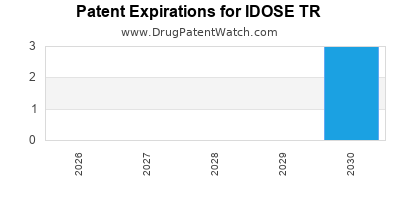
FDA approval of a new dosage form can support three years of marketing exclusivity when the approval relies on new clinical investigations conducted or sponsored by the applicant. For iDose TR, the relevant three-year period would generally run from the Dec. 13, 2023 approval date, implying a potential regulatory exclusivity endpoint in December 2026. The exact scope depends on FDA’s Orange Book designation and the type of exclusivity assigned to the NDA. (U.S. Food and Drug Administration, 2023b)
Three-year exclusivity would not block all competing products. It generally prevents FDA approval of a duplicate product for the protected conditions of approval during the exclusivity period. It does not prevent development of a different implant, a different active ingredient, or a product supported through an independent regulatory pathway.
What patents protect iDose TR?
The iDose TR patent estate is expected to rely on several overlapping categories:
- The intracameral implant structure.
- Travoprost release from the implant.
- Placement and delivery methods.
- Implant materials and drug reservoirs.
- Methods of treating ocular hypertension and glaucoma.
- Manufacturing processes and device assembly.
The strongest commercial protection is likely to come from patents covering the implant architecture and drug-release profile. Method-of-use patents can extend protection against specific treatment practices but are more difficult to enforce against products prescribed for broader glaucoma management.
What is the Orange Book status of iDose TR?
The FDA Orange Book is the controlling source for NDA patent listings and regulatory exclusivity. iDose TR is approved under NDA 214026. Orange Book listings, including patent numbers, expiration dates, and pediatric exclusivity adjustments, should be evaluated against the current FDA database before making a launch or litigation decision. (U.S. Food and Drug Administration, 2024)
The commercial importance of Orange Book listings is substantial. If Glaukos lists qualifying patents, an abbreviated new drug application applicant could face Paragraph IV certification requirements. A timely Paragraph IV notice could trigger patent litigation and a statutory 30-month stay of approval, subject to the applicable statutory conditions.
Are Paragraph IV challenges or generic launches likely?
A conventional generic challenge is less straightforward than for a topical travoprost product. iDose TR combines an active ingredient with an implant, a delivery procedure, and a controlled-release profile. An applicant would need to demonstrate pharmaceutical equivalence and bioequivalence or satisfy FDA requirements through another pathway.
The principal competitive risks are:
- A generic or follow-on intracameral travoprost implant.
- A competing long-acting prostaglandin implant.
- A different sustained-release glaucoma therapy.
- Expanded use of topical generics after adherence interventions.
- Surgical or laser treatment that reduces the need for chronic medication.
A Paragraph IV case would likely focus on implant design, release kinetics, manufacturing processes, and treatment methods. The litigation value of the estate will depend on whether one or more patents cover commercially necessary product attributes rather than optional design choices.
How does iDose TR compare with Durysta and topical glaucoma drugs?
iDose TR competes with three major treatment categories: topical medications, sustained-release implants, and procedural glaucoma interventions.
| Product or category |
Active treatment |
Administration |
Competitive strength |
Limitation |
| iDose TR |
Travoprost |
Intracameral implant |
Reduces daily adherence burden |
Requires implantation and monitoring |
| Topical prostaglandins |
Latanoprost, travoprost, bimatoprost |
Daily eye drops |
Low cost and broad availability |
Adherence and administration problems |
| Durysta |
Bimatoprost |
Intracameral implant |
Established sustained-release precedent |
Retreatment and corneal endothelial concerns |
| SLT |
Laser treatment |
Office procedure |
Can reduce medication burden |
Variable durability and procedural access |
| MIGS devices |
Various |
Surgical implantation |
Treats disease through procedure |
Usually linked to cataract or glaucoma surgery |
Durysta, marketed by AbbVie after its acquisition of Allergan, was the first FDA-approved intracameral prostaglandin implant. Its use has been constrained by safety considerations, including corneal endothelial cell loss and limitations on repeat administration. iDose TR’s commercial success will depend partly on whether ophthalmologists view its safety and retreatment profile as more usable in routine care. (U.S. Food and Drug Administration, 2020)
Topical generic latanoprost remains the largest economic barrier. Its low acquisition cost makes iDose TR difficult to justify solely through drug-cost savings. The product’s value proposition instead depends on avoided nonadherence, fewer pressure excursions, reduced disease progression, and lower treatment-management burden.
What is the market opportunity for iDose TR?
The U.S. glaucoma market is large, but the addressable market for an implant is narrower. The Centers for Disease Control and Prevention estimates that approximately 3 million Americans have glaucoma, with many patients requiring chronic pressure-lowering treatment. Globally, glaucoma affects tens of millions of people and remains a leading cause of irreversible blindness. (Centers for Disease Control and Prevention, 2024; World Health Organization, 2023)
The initial commercial segment is likely to include:
- Patients with documented adherence problems.
- Patients requiring multiple topical medications.
- Patients with inadequate pressure control despite topical therapy.
- Patients undergoing other ophthalmic procedures.
- Patients managed by glaucoma specialists.
- Patients with difficulty administering eye drops because of age, dexterity, or cognitive limitations.
The market will develop through a staged adoption curve. Early use is likely to concentrate in specialist practices and controlled reimbursement settings. Broader use requires physician confidence in implantation, repeat treatment, adverse-event management, and payment.
What reimbursement and pricing factors affect iDose TR?
iDose TR is purchased and administered through an ophthalmic practice, which creates a buy-and-bill commercial model rather than a conventional retail prescription model. Revenue depends on the combination of product reimbursement, procedure payment, facility economics, and patient cost sharing.
A favorable reimbursement code can accelerate adoption by allowing physicians to recover product acquisition cost and procedural expenses. Coding friction can delay use even when clinical interest is high. Payer policies may also require documentation of prior topical therapy, inadequate control, or adherence failure.
The economic comparison is difficult because topical generics have very low annual drug costs. Glaukos must demonstrate that iDose TR reduces downstream costs or improves outcomes enough to justify a higher episode-of-care cost.
How has iDose TR affected Glaukos’ financial trajectory?
Glaukos reported approximately $348.6 million in 2023 net sales, compared with roughly $309 million in 2022. The company’s revenue base was driven primarily by its existing glaucoma products, including iStent systems, and by corneal products. (Glaukos Corporation, 2024)
iDose TR did not materially affect 2023 revenue because FDA approval occurred at year-end. Its financial trajectory is therefore best analyzed through four stages:
| Stage |
Period |
Financial effect |
| Development |
Before December 2023 |
R&D expense and regulatory investment |
| Launch preparation |
Late 2023 to 2024 |
Sales-force, training, reimbursement, and inventory costs |
| Commercial ramp |
2024 to 2026 |
Procedure volume and recurring implant revenue |
| Competitive maturity |
After 2026 |
Patent, exclusivity, reimbursement, and competing implant pressure |
Glaukos’ 2024 guidance called for revenue growth from the 2023 base, but the company’s reported results remain diversified across its broader product portfolio. iDose TR’s contribution is not separately disclosed in the company’s standard financial reporting, limiting direct assessment of product-level revenue and margin.
The product has potential to improve revenue quality because it is a proprietary procedure-linked product rather than a low-priced generic drug. Gross-margin performance will depend on manufacturing scale, sales-force efficiency, physician training costs, reimbursement levels, and any post-market safety obligations.
How strong is the iDose TR patent estate?
The estate has meaningful technical differentiation but faces several limits.
Its strengths include the combination of a known drug with a specialized intraocular delivery platform, physician-administered treatment, and potential protection across product and method claims. The drug-device combination also raises the complexity of designing a clinically equivalent substitute.
Its weaknesses include the age and generic availability of travoprost, the possibility that competitors can use different prostaglandins or release technologies, and the difficulty of enforcing method-of-use claims when physicians prescribe products for overlapping glaucoma indications.
Patent strength should therefore be assessed by claim breadth, expiration timing, implant design-around options, Orange Book listing status, and the ability to obtain injunctive or settlement relief in a Paragraph IV case.
What litigation and settlement risks affect iDose TR?
No major public Paragraph IV litigation involving a generic iDose TR product had defined the commercial outlook through the initial launch period. The more immediate legal risks concern product liability, patent disputes with competing sustained-release platforms, reimbursement disputes, and potential challenges to patent validity or claim scope.
A future generic settlement could include a licensed entry date, restrictions on product design, or a royalty-bearing launch. The value of such a settlement would depend on the remaining patent term and the ability of an entrant to obtain FDA approval.
What generic entry scenarios exist for iDose TR?
Three launch scenarios are most relevant:
Early follow-on challenge
A competitor files an ANDA or another abbreviated application soon after Orange Book patent listings become available. Litigation could delay approval through a 30-month stay or settlement.
Non-infringing alternative implant
A competitor develops a different sustained-release prostaglandin implant or uses another intraocular delivery mechanism. This route could avoid iDose TR patents while competing for the same physicians and patients.
Post-exclusivity competition
After regulatory exclusivity expires, multiple developers may pursue follow-on products. Market entry would still require clinical, manufacturing, and procedural evidence, so loss of exclusivity would not automatically produce immediate price erosion.
What geographic markets can iDose TR address?
The United States is the initial commercial anchor because Glaukos obtained FDA approval there. International expansion depends on country-specific medical-device and drug regulations, reimbursement, ophthalmic practice patterns, and local competition.
Europe, Japan, Canada, and selected Asia-Pacific markets have large glaucoma populations, but pricing and adoption may differ sharply from the United States. In markets where topical generics dominate and physician payment for implants is limited, uptake may be slower. In markets with aging populations, specialist access, and strong pressure to reduce medication adherence failures, the product may have greater clinical appeal.
Key Takeaways
- iDose TR is an FDA-approved intracameral travoprost implant for ocular hypertension and open-angle glaucoma.
- FDA approval occurred Dec. 13, 2023, under NDA 214026.
- The commercial opportunity is based on sustained drug delivery and reduced dependence on daily eye drops.
- Topical generic prostaglandins are the main price and access constraint.
- Durysta provides the closest approved implant comparison but also establishes safety and retreatment concerns for the class.
- Regulatory exclusivity may extend through approximately December 2026, subject to FDA’s formal Orange Book designation.
- A conventional generic challenge is more complex than a topical travoprost challenge because iDose TR combines a drug, implant, release profile, and procedure.
- Glaukos’ 2023 revenue was approximately $348.6 million, but iDose TR was not a material contributor because approval occurred at year-end.
- Future financial performance depends on reimbursement, specialist adoption, repeat implantation, manufacturing scale, and competing long-acting glaucoma therapies.
- The patent estate is strategically important but must be analyzed claim by claim across implant, formulation, manufacturing, and method-of-use patents.
FAQs
Is iDose TR a generic glaucoma medication?
No. iDose TR is a proprietary intracameral drug-device combination containing travoprost. It is administered by an ophthalmologist rather than dispensed as a daily topical generic.
How long does iDose TR remain in the eye?
The implant is designed for extended travoprost delivery. Duration of drug release and retreatment timing depend on the approved labeling, clinical response, and physician judgment.
Does iDose TR replace glaucoma surgery?
No. iDose TR is a medication-delivery treatment. It competes with topical therapy and may delay escalation to laser or surgical treatment in appropriate patients, but it does not replace all glaucoma procedures.
Who manufactures iDose TR?
Glaukos Corp. developed and commercializes iDose TR. The company also sells iStent glaucoma surgical systems and corneal products.
What is the largest commercial risk for iDose TR?
The largest risk is reimbursement and adoption friction. Physicians must be willing to perform the implant procedure, payers must cover the product and associated services, and clinical outcomes must justify the cost relative to inexpensive topical generics.
References
Centers for Disease Control and Prevention. (2024). About glaucoma. https://www.cdc.gov/vision-health/about-eye-disorders/glaucoma.html
Glaukos Corporation. (2024). 2023 annual report. U.S. Securities and Exchange Commission. https://www.sec.gov/
U.S. Food and Drug Administration. (2020). Durysta approval package. https://www.accessdata.fda.gov/
U.S. Food and Drug Administration. (2023a). iDose TR approval letter and prescribing information. https://www.accessdata.fda.gov/
U.S. Food and Drug Administration. (2023b). Small business assistance: Frequently asked questions on the FDA drug approval process. https://www.fda.gov/
U.S. Food and Drug Administration. (2024). Approved drug products with therapeutic equivalence evaluations: Orange Book. https://www.accessdata.fda.gov/scripts/cder/ob/
World Health Organization. (2023). Blindness and vision impairment. https://www.who.int/health-topics/blindness-and-vision-impairment