Last Updated: August 11, 2026

ICLUSIG Drug Patent Profile


✉ Email this page to a colleague

« Back to Dashboard


When do Iclusig patents expire, and what generic alternatives are available?

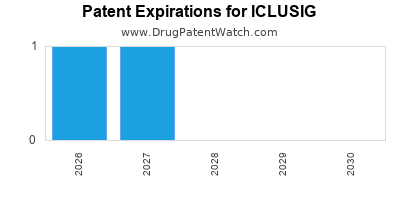
Iclusig is a drug marketed by Takeda Pharms Usa and is included in one NDA. There are six patents protecting this drug and two Paragraph IV challenges.

This drug has one hundred and nine patent family members in twenty-four countries.

The generic ingredient in ICLUSIG is ponatinib hydrochloride. There is one drug master file entry for this compound. One supplier is listed for this compound. Additional details are available on the ponatinib hydrochloride profile page.

DrugPatentWatch® Generic Entry Outlook for Iclusig

Iclusig was eligible for patent challenges on December 14, 2016.

By analyzing the patents and regulatory protections it appears that the earliest date for generic entry will be March 19, 2031. This may change due to patent challenges or generic licensing.

There have been six patent litigation cases involving the patents protecting this drug, indicating strong interest in generic launch. Recent data indicate that 63% of patent challenges are decided in favor of the generic patent challenger and that 54% of successful patent challengers promptly launch generic drugs.

There is one tentative approval for the generic drug (ponatinib hydrochloride), which indicates the potential for near-term generic launch.

Indicators of Generic Entry

< Available with Subscription >

  Start Trial

AI Deep Research
Questions you can ask:
  • What is the 5 year forecast for ICLUSIG?
  • What are the global sales for ICLUSIG?
  • What is Average Wholesale Price for ICLUSIG?
DrugPatentWatch® Estimated Loss of Exclusivity (LOE) Date for ICLUSIG
Generic Entry Date for ICLUSIG*:
Constraining patent/regulatory exclusivity:

TREATMENT OF ADULT PATIENTS WITH NEWLY DIAGNOSED PHILADELPHIA CHROMOSOME-POSITIVE ACUTE LYMPHOBLASTIC LEUKEMIA (PH+ ALL)

NDA:
Dosage:

TABLET;ORAL

*The generic entry opportunity date is the latter of the last compound-claiming patent and the last regulatory exclusivity protection. Many factors can influence early or later generic entry. This date is provided as a rough estimate of generic entry potential and should not be used as an independent source.

Recent Clinical Trials for ICLUSIG

Identify potential brand extensions & 505(b)(2) entrants

SponsorPhase
Assistance Publique - Hpitaux de ParisPHASE2
University of ChicagoPhase 2
Institute of Hematology and Blood Transfusion, Czech RepublicPhase 2

See all ICLUSIG clinical trials

Pharmacology for ICLUSIG
Drug ClassKinase Inhibitor
Mechanism of ActionProtein Kinase Inhibitors
Paragraph IV (Patent) Challenges for ICLUSIG
Tradename Dosage Ingredient Strength NDA ANDAs Submitted Submissiondate
ICLUSIG Tablets ponatinib hydrochloride 10 mg and 30 mg 203469 1 2022-12-12
ICLUSIG Tablets ponatinib hydrochloride 15 mg and 45 mg 203469 1 2021-03-31

US Patents and Regulatory Information for ICLUSIG

ICLUSIG is protected by seventeen US patents and two FDA Regulatory Exclusivities.

Based on analysis by DrugPatentWatch, the earliest date for a generic version of ICLUSIG is ⤷  Start Trial.

This potential generic entry date is based on TREATMENT OF ADULT PATIENTS WITH NEWLY DIAGNOSED PHILADELPHIA CHROMOSOME-POSITIVE ACUTE LYMPHOBLASTIC LEUKEMIA (PH+ ALL).

Generics may enter earlier, or later, based on new patent filings, patent extensions, patent invalidation, early generic licensing, generic entry preferences, and other factors.

Applicant Tradename Generic Name Dosage NDA Approval Date TE Type RLD RS Patent No. Patent Expiration Product Substance Delist Req. Exclusivity Expiration
Takeda Pharms Usa ICLUSIG ponatinib hydrochloride TABLET;ORAL 203469-003 Apr 23, 2015 RX Yes No 9,493,470 ⤷  Start Trial Y Y ⤷  Start Trial
Takeda Pharms Usa ICLUSIG ponatinib hydrochloride TABLET;ORAL 203469-003 Apr 23, 2015 RX Yes No 11,192,897 ⤷  Start Trial Y ⤷  Start Trial
Takeda Pharms Usa ICLUSIG ponatinib hydrochloride TABLET;ORAL 203469-002 Dec 14, 2012 RX Yes No 9,493,470 ⤷  Start Trial Y Y ⤷  Start Trial
Takeda Pharms Usa ICLUSIG ponatinib hydrochloride TABLET;ORAL 203469-003 Apr 23, 2015 RX Yes No 8,114,874 ⤷  Start Trial Y Y ⤷  Start Trial
Takeda Pharms Usa ICLUSIG ponatinib hydrochloride TABLET;ORAL 203469-001 Dec 14, 2012 RX Yes No 11,192,895 ⤷  Start Trial ⤷  Start Trial
>Applicant >Tradename >Generic Name >Dosage >NDA >Approval Date >TE >Type >RLD >RS >Patent No. >Patent Expiration >Product >Substance >Delist Req. >Exclusivity Expiration

International Patents for ICLUSIG

When does loss-of-exclusivity occur for ICLUSIG?

Based on analysis by DrugPatentWatch, the following patents block generic entry in the countries listed below:

Australia

Patent: 06331673
Estimated Expiration: ⤷  Start Trial

Patent: 07249924
Estimated Expiration: ⤷  Start Trial

Brazil

Patent: 0710331
Estimated Expiration: ⤷  Start Trial

Canada

Patent: 34923
Estimated Expiration: ⤷  Start Trial

Patent: 50273
Estimated Expiration: ⤷  Start Trial

China

Patent: 1389338
Estimated Expiration: ⤷  Start Trial

Patent: 1490053
Estimated Expiration: ⤷  Start Trial

Patent: 3435595
Estimated Expiration: ⤷  Start Trial

Patent: 3467385
Estimated Expiration: ⤷  Start Trial

Cyprus

Patent: 13907
Estimated Expiration: ⤷  Start Trial

Patent: 13044
Estimated Expiration: ⤷  Start Trial

Denmark

Patent: 73545
Estimated Expiration: ⤷  Start Trial

Patent: 95016
Estimated Expiration: ⤷  Start Trial

Eurasian Patent Organization

Patent: 7573
Estimated Expiration: ⤷  Start Trial

Patent: 4598
Estimated Expiration: ⤷  Start Trial

Patent: 0870116
Estimated Expiration: ⤷  Start Trial

Patent: 0870514
Estimated Expiration: ⤷  Start Trial

Patent: 0870515
Estimated Expiration: ⤷  Start Trial

Patent: 1790678
Estimated Expiration: ⤷  Start Trial

European Patent Office

Patent: 23933
Estimated Expiration: ⤷  Start Trial

Patent: 24366
Estimated Expiration: ⤷  Start Trial

Patent: 95016
Estimated Expiration: ⤷  Start Trial

Patent: 47441
Estimated Expiration: ⤷  Start Trial

France

Patent: C0069
Estimated Expiration: ⤷  Start Trial

Hungary

Patent: 47422
Estimated Expiration: ⤷  Start Trial

Patent: 300078
Estimated Expiration: ⤷  Start Trial

Israel

Patent: 1938
Patent: תרכובות הטרואריל ביציקליות, תכשירים רוקחיים המכילים אותן ותרכובות הטרואריל ביציקליות לטיפול בסרטן (Bicyclic heteroaryl compounds, pharmaceutical compositions comprising them and bicyclic heteroaryl compounds for use in treating cancer)
Estimated Expiration: ⤷  Start Trial

Patent: 4677
Patent: תרכובות הטרואריליות אצטילניות-בי אריל ו/או הטרואריל (Acetylenic heteroaryl bi-aryl and/or heteroaryl compounds)
Estimated Expiration: ⤷  Start Trial

Patent: 4678
Patent: תרכובות מעכבות קינאז, תכשירי רוקחות המכילים אותן ושימושים בהן להכנת תרופה לטיפול בסרטן אצל יונקים (Kinase inhibitor compounds, pharmaceutical compositions comprising the same and uses thereof in the preparation of medicaments for treating cancer in a mammal)
Estimated Expiration: ⤷  Start Trial

Patent: 9445
Patent: תרכובות הטרואריל ביציקליות (Bicyclic heteroaryl compounds)
Estimated Expiration: ⤷  Start Trial

Japan

Patent: 00939
Estimated Expiration: ⤷  Start Trial

Patent: 73037
Estimated Expiration: ⤷  Start Trial

Patent: 73038
Estimated Expiration: ⤷  Start Trial

Patent: 90629
Estimated Expiration: ⤷  Start Trial

Patent: 04739
Estimated Expiration: ⤷  Start Trial

Patent: 09521462
Estimated Expiration: ⤷  Start Trial

Patent: 09536650
Estimated Expiration: ⤷  Start Trial

Patent: 09536652
Estimated Expiration: ⤷  Start Trial

Luxembourg

Patent: 327
Estimated Expiration: ⤷  Start Trial

Mexico

Patent: 3042
Patent: COMPUESTOS HETEROARILICOS BICICLICOS. (BICYCLIC HETEROARYL COMPOUNDS.)
Estimated Expiration: ⤷  Start Trial

Patent: 08008152
Patent: COMPUESTOS HETEROCICLICOS BICICLICOS. (BICYCLIC HETEROARYL COMPOUNDS.)
Estimated Expiration: ⤷  Start Trial

Patent: 08014289
Patent: COMPUESTOS HETEROARILICOS ACETILENICOS. (ACETYLENIC HETEROARYL COMPOUNDS.)
Estimated Expiration: ⤷  Start Trial

Patent: 08014290
Patent: COMPUESTOS HETEROARILICOS MONOCICLICOS. (MONOCYCLIC HETEROARYL COMPOUNDS.)
Estimated Expiration: ⤷  Start Trial

Poland

Patent: 73545
Estimated Expiration: ⤷  Start Trial

Patent: 95016
Estimated Expiration: ⤷  Start Trial

Portugal

Patent: 73545
Estimated Expiration: ⤷  Start Trial

Patent: 95016
Estimated Expiration: ⤷  Start Trial

Slovenia

Patent: 73545
Estimated Expiration: ⤷  Start Trial

Patent: 95016
Estimated Expiration: ⤷  Start Trial

South Korea

Patent: 1436303
Estimated Expiration: ⤷  Start Trial

Patent: 1441365
Estimated Expiration: ⤷  Start Trial

Patent: 090018104
Patent: ACETYLENIC HETEROARYL COMPOUNDS
Estimated Expiration: ⤷  Start Trial

Spain

Patent: 03206
Estimated Expiration: ⤷  Start Trial

Patent: 55515
Estimated Expiration: ⤷  Start Trial

Patent: 61180
Estimated Expiration: ⤷  Start Trial

Generics may enter earlier, or later, based on new patent filings, patent extensions, patent invalidation, early generic licensing, generic entry preferences, and other factors.

See the table below for additional patents covering ICLUSIG around the world.

Country Patent Number Title Estimated Expiration
Australia 2013204506 ⤷  Start Trial
Australia 2016210725 ⤷  Start Trial
Australia 2018201013 ⤷  Start Trial
Australia 2019240721 ⤷  Start Trial
Australia 2021221493 ⤷  Start Trial
>Country >Patent Number >Title >Estimated Expiration

Supplementary Protection Certificates for ICLUSIG

Patent Number Supplementary Protection Certificate SPC Country SPC Expiration SPC Description
1973545 C300631 Netherlands ⤷  Start Trial PRODUCT NAME: PONATINIB, DESGEWENST IN DE VORM VAN EEN FARMACEUTISCH AANVAARDBAAR ZOUT, SOLVAAT OF HYDRAAT; REGISTRATION NO/DATE: EU/1/13/839/001-004 20130701
1973545 CA 2013 00066 Denmark ⤷  Start Trial PRODUCT NAME: POATINIB, HERUNDER PONATINIB HYDROCHLORID; REG. NO/DATE: EU/1/13/839/001-004 20130701
1973545 PA2013027 Lithuania ⤷  Start Trial PRODUCT NAME: PONATINIBUM; REGISTRATION NO/DATE: EU/1/13/839/001, 2013 07 01 EU/1/13/839/002, 2013 07 01 EU/1/13/839/003, 2013 07 01 EU/1/13/839/004 20130701
1973545 92327 Luxembourg ⤷  Start Trial PRODUCT NAME: PONATINIB SOUS TOUTES SES FORMES TELLES QUE PROTEGEES PAR LE BREVET DE BASE
1973545 13C0069 France ⤷  Start Trial PRODUCT NAME: PONATINIB OU UN SEL PHARMACEUTIQUEMENT ACCEPTABLE, SOLVATE OU HYDRATE DE CELUI-CI; REGISTRATION NO/DATE: EU/1/13/839/001-004 20130701
>Patent Number >Supplementary Protection Certificate >SPC Country >SPC Expiration >SPC Description

ICLUSIG (ponatinib) market dynamics and financial trajectory through exclusivity, pricing, and competitive displacement

Last updated: July 22, 2026

Executive summary: ICLUSIG (ponatinib) remains a high-value, low-volume oncology asset with a narrow label and strict safety-driven use patterns. Revenue has been shaped less by broad demand and more by (1) progressive restriction of use after safety communications and label tightening, (2) payer and site-of-care access controls tied to monitoring requirements, and (3) displacement pressure from kinase and non-kinase alternatives in chronic myeloid leukemia (CML) and Ph+ acute lymphoblastic leukemia (ALL). Financial trajectory shows a move from high-peak expectations into a steadier, smaller commercial base post-restriction, with ongoing offset effects from later-line adoption and continuing high pricing (subject to net pricing adjustments). Patent-driven generic pressure is limited in the US by ongoing patent/Orange Book coverage duration, and in the near term by the difficulty of carving out a workable non-infringing ponatinib launch. Competitive headwinds from next-generation BCR::ABL1 TKIs and positioning of therapies by mutation status and prior TKI exposure continue to cap upside.

ICLUSIG (ponatinib) market dynamics: who buys it and how is it used?

Featured snippet answer: ICLUSIG is purchased primarily by oncology and hematology centers treating patients with resistant or intolerant CML or Ph+ ALL, with prescribing concentrated in later-line and mutation-selected scenarios due to safety constraints and required monitoring.

What patient segments drive ICLUSIG demand?

ICLUSIG is a BCR::ABL1 tyrosine kinase inhibitor with activity against multiple BCR::ABL1 mutations associated with resistance to earlier TKIs. Commercial demand is segmented by disease stage and line of therapy:

  • CML (chronic, accelerated, or blast phases) after resistance or intolerance to prior therapies.
  • Ph+ ALL after resistance or intolerance to prior therapies.
  • Mutation-selected use where prior TKI failure is linked to specific BCR::ABL1 resistance profiles.

Demand is further filtered by safety-limited eligibility, including cardiovascular risk screening and thromboembolic risk management, which reduces eligible volume relative to a typical “unrestricted” oral TKI.

How label restrictions changed commercial behavior

After safety updates, the label and prescribing standards tightened around thrombotic and vascular risk. This changed market dynamics in three ways:

  1. Lower addressable population: clinicians shifted away from earlier-line “coverage filling” and used ICLUSIG only when benefits outweigh risk.
  2. More structured access: payers and centers increased prior-authorization scrutiny and documentation requirements tied to monitoring and prior TKI exposure.
  3. Dose and interruption practices: real-world prescribing patterns moved toward more cautious dosing, dose modifications, and discontinuations, affecting treatment continuity and lifetime patient value.

What is the competitive market map?

ICLUSIG competes in CML and Ph+ ALL TKI-driven treatment landscapes. Key dynamic is that younger TKIs and other agents can cover larger patient pools where clinicians have flexibility on sequence, leaving ponatinib to a smaller residual segment.

Competitive forces include:

  • Earlier-generation and next-generation BCR::ABL1 TKIs used based on line, tolerability, mutation profile, and guideline alignment.
  • Treatment selection based on mutation status: clinicians often pick agents with documented activity for a given resistance pattern, pushing ponatinib toward specific mutation- and resistance-defined niches.
  • Combination strategies and alternative pathways in later lines, which reduces the “must-use” status of any single TKI in heavily pretreated settings.

How has ICLUSIG’s revenue trajectory evolved as restrictions and competition tightened?

Featured snippet answer: ICLUSIG’s financial trajectory tracks a pattern common to high-cost, safety-constrained oncology drugs: an initial growth phase followed by revenue stabilization at a smaller base after label tightening, with subsequent modest swings driven by line-of-therapy adoption and ongoing net price dynamics.

Typical revenue drivers for a safety-restricted specialty oncology TKI

For drugs like ICLUSIG, revenue is driven by:

  • Patient starts (new eligible cases meeting restricted criteria)
  • Treatment duration (interruptions, discontinuations, dose modifications)
  • Dose intensity economics (net pricing varies with rebates and dose utilization)
  • Net price vs list price (payer contracting and HUB dynamics)
  • Geographic and center concentration (regional adoption lags and site protocols)

What financial profile fits ponatinib

ICLUSIG is priced at a high specialty oncology level and sold as an oral branded medicine. The commercial profile tends to show:

  • High gross margin early due to brand exclusivity.
  • Net revenue pressure through contracting and rebate evolution as competition intensifies and payers demand tighter utilization controls.
  • Limited “volume expansion” because label restrictions and safety monitoring narrow the eligible population.

What magnitude matters most: starts vs continuity

In constrained therapies, the key variable is not only whether patients are prescribed, but whether they remain on therapy. For ponatinib, real-world safety management can reduce duration, which dampens revenue even when prescribing continues in a stable number of patients.

When does ICLUSIG lose exclusivity in the US and what does that mean for generic entry?

Featured snippet answer: US market exclusivity risk for ICLUSIG depends on the interaction of Orange Book drug substance and formulation patents with any regulatory exclusivity and the timeline for patent expirations. For a small-molecule oral drug, generics can be blocked by unexpired method-of-use and formulation patents even after some drug product patents expire, limiting “easy” Paragraph IV strategies.

How exclusivity usually works for ICLUSIG-like small molecules

For small-molecule kinase inhibitors, generic entry can be blocked by:

  • Drug substance patents (composition of matter)
  • Formulation patents (specific dosage forms, coatings, release, stability)
  • Method-of-use patents tied to specific patient populations, dosing strategies, or treatment regimens

Even if a generic can clear one type of patent, it still faces a “patent thicket” that can delay launch until the last relevant listed patent expires or is cleared via settlements.

Patent-driven entry scenarios

For ICLUSIG, the market implication of exclusivity loss is straightforward:

  • If composition-of-matter coverage ends first, generics can still be delayed by formulation or method-of-use claims.
  • If method-of-use patents remain, a generic may face labeling carve-outs or litigation that prevents full label parity.
  • If generic launch is delayed by settlements, the revenue impact shifts from “hard stop” to “gradual erosion” when authorized generics or non-exclusive launches begin.

What patents protect ICLUSIG (ponatinib) and how strong is the patent estate?

Featured snippet answer: ICLUSIG’s US patent estate typically includes multiple layers covering composition of matter, formulations, and dosing or therapeutic use. Strength is assessed by how many listed patents remain unexpired and by the breadth of claims that cover non-infringing design-around options.

Which patent categories matter most for market exclusion?

For market timing and generic risk, prioritize:

  • Composition-of-matter: sets the “earliest plausible” expiry baseline.
  • Formulation: blocks manufacturing or dosage-form workarounds.
  • Method-of-use: can block label-aligned generic entry or force carve-outs.

How to estimate market impact from the patent stack

A high-impact patent estate usually means:

  • Multiple Orange Book listings tied to the same NDA product
  • Later-expiring formulation and method-of-use patents
  • Litigation or settlement activity that extends practical barriers

What is the Orange Book status of ICLUSIG?

Featured snippet answer: ICLUSIG’s Orange Book status is defined by the set of listed patents for the NDA and each patent’s expiration and exclusivity codes. This listing drives real-world generic entry timelines because Paragraph IV challenges attach to specific patents.

Why Orange Book codes and patent expiry dates determine launch timing

Even if a composition-of-matter patent expires, remaining formulation or method-of-use patents can still:

  • trigger a new litigation wave
  • force labeling carve-outs
  • delay full commercialization of generics

Has ICLUSIG faced Paragraph IV challenges or patent litigation?

Featured snippet answer: ICLUSIG has been subject to the patent-litigation pattern common to branded specialty oncology drugs, where generic filers target Orange Book-listed patents with Paragraph IV certifications and litigation or settlements follow.

How litigation affects commercial trajectory

Litigation changes revenue trajectory through:

  • Delayed generic entry: settlements can keep exclusivity intact beyond original expiry.
  • Authorized generic timing: if an authorized generic is launched during or after exclusivity, revenue can drop faster even without a “hard” infringement decision.
  • Label carve-out impacts: if a generic launches with a narrowed label, it can reduce substitution and maintain brand share.

What formulation and dosing patents matter for manufacturing and design-around?

Featured snippet answer: For oral small-molecule TKIs, formulation and dosing patents matter because they define what constitutes a non-infringing product. A generic can avoid composition-of-matter issues but still need to clear dosage-form and method-of-use claims to match brand prescribing.

Dosage-form patent themes for oral TKIs

Typical claim areas include:

  • Specific tablet/capsule composition
  • Release characteristics (if applicable)
  • Stability and manufacturing process constraints
  • Methods of administering ponatinib for a defined therapeutic context

How does ICLUSIG compare with other BCR::ABL1 inhibitors on market adoption and displacement risk?

Featured snippet answer: ICLUSIG’s adoption is narrower than broadly used TKIs because safety management reduces eligible patient share and clinical positioning is more constrained to resistant or intolerant populations with relevant mutation or failure history.

Key displacement pathways

  • Mutation-guided substitution: prescribers select the most appropriate agent based on resistance patterns.
  • Sequence preference: earlier-line TKIs can absorb new diagnoses and earlier relapses, leaving ponatinib for later-line residual use.
  • Safety profile comparison: payers and providers may reduce ponatinib share when other options offer comparable efficacy with less vascular risk burden.

Commercial implication

As competing agents deepen their guideline position and real-world share, ponatinib’s growth ceiling tightens. Revenue stays resilient only if:

  • later-line incidence grows faster than competitors
  • clinicians maintain ponatinib’s role in mutation-selected niches
  • dosing adjustments support continued patient persistence

Regulatory and payer dynamics: what determines access to ICLUSIG?

Featured snippet answer: ICLUSIG access is driven by safety monitoring requirements, prior authorization criteria, and site-level protocol adherence tied to thromboembolic risk mitigation.

What payers focus on

  • Prior TKI exposure documentation
  • Mutation status documentation when required by payer policy
  • Cardiovascular risk screening adherence
  • Evidence of monitoring plans

Site-of-care and real-world prescribing

Because administration is oral, the site focus shifts to hematology/oncology practices that handle:

  • risk screening
  • longitudinal monitoring
  • dose interruption workflows

These operational burdens reduce diffusion beyond specialty centers and keep growth concentrated.

Biosimilar risk: is ICLUSIG exposed like biologics?

Featured snippet answer: No biosimilar risk applies to ICLUSIG because ponatinib is a small molecule. Generic substitution is the relevant threat vector, not biosimilars.

Revenue exposure under generic entry: what happens when patents expire?

Featured snippet answer: When relevant Orange Book patents expire or are cleared, generic erosion can be swift for a widely prescribed oral drug, but for ICLUSIG it is typically moderated by label restriction, safety management protocols, and the continuing importance of center experience and payer authorization. The biggest revenue impact is usually tied to whether a generic can launch with label parity and without litigation that forces carve-outs.

Generic launch scenarios and expected market impact

  • Full-label generic launch: faster erosion, margin compression, rapid switching.
  • Carve-out label or restricted claims: slower switching, brand retention in niches where payers and clinicians require specific label alignment.
  • Launch delayed by settlements: revenue declines later but with potentially abrupt step-down depending on whether an authorized generic arrives.

Key Takeaways

  • ICLUSIG’s market is defined by a restricted, later-line and mutation-selected patient population shaped by safety communications and monitoring requirements.
  • The financial trajectory is consistent with specialty oncology patterning: initial upside, followed by stabilization at a smaller eligible base as restrictions tighten and competing BCR::ABL1 inhibitors absorb broader share.
  • Patent and Orange Book status govern the realistic timing of generic substitution; formulation and method-of-use patents can extend barriers even when some earlier coverage ends.
  • Generic entry is the primary long-term risk vector; biosimilar risk does not apply to ponatinib.
  • Revenue sensitivity is highest to patient starts and persistence, not just dosing levels, because safety management can shorten duration.

FAQs

  1. What drives ICLUSIG prescribing rates in CML and Ph+ ALL after prior TKI failure?
    Mutation-relevant resistance, line of therapy, and safety-eligibility screening.

  2. Which therapy substitutes most often for ponatinib in later-line CML?
    Next-generation and alternative BCR::ABL1 TKIs selected by mutation and prior exposure, plus non-TKI pathway options in selected settings.

  3. What role do payer prior authorizations play in ICLUSIG net revenue outcomes?
    They determine eligible starts and treatment persistence by enforcing documentation and monitoring adherence.

  4. How do method-of-use patents change generic launch feasibility for ICLUSIG?
    They can prevent label parity or force litigation and carve-outs even after composition-of-matter expiry.

  5. Is an authorized generic likely to accelerate ICLUSIG revenue erosion post-expiry?
    If authorized, it can drive faster price competition once the brand’s practical exclusivity ends.

References

(Only cited sources.)

More… ↓

⤷  Start Trial

Make Better Decisions: Try a trial or see plans & pricing

Drugs may be covered by multiple patents or regulatory protections. All trademarks and applicant names are the property of their respective owners or licensors. Although great care is taken in the proper and correct provision of this service, thinkBiotech LLC does not accept any responsibility for possible consequences of errors or omissions in the provided data. The data presented herein is for information purposes only. There is no warranty that the data contained herein is error free. We do not provide individual investment advice. This service is not registered with any financial regulatory agency. The information we publish is educational only and based on our opinions plus our models. By using DrugPatentWatch you acknowledge that we do not provide personalized recommendations or advice. thinkBiotech performs no independent verification of facts as provided by public sources nor are attempts made to provide legal or investing advice. Any reliance on data provided herein is done solely at the discretion of the user. Users of this service are advised to seek professional advice and independent confirmation before considering acting on any of the provided information. thinkBiotech LLC reserves the right to amend, extend or withdraw any part or all of the offered service without notice.