Last updated: June 29, 2026
Executive summary: Gastrocrom (cromolyn sodium) remains a niche, off-patent oral anti-allergy drug with limited branded demand in the U.S. Its market trajectory has been shaped by (1) sustained generic availability, (2) substitution and wholesaler discount pressure, and (3) comparatively low payer reimbursement leverage versus newer targeted therapies in relevant indications (mast cell–mediated disorders and related off-label use). Public financial disclosures and transaction databases do not show a branded revenue story consistent with a major commercial franchise in the current era; instead, the asset functions as a low-volatility, low-growth portfolio product, with revenue mostly determined by remaining branded sentiment and supply chain continuity rather than defensible exclusivity.
What is Gastrocrom (cromolyn sodium) used for and why does that drive demand?
Featured snippet: Gastrocrom (cromolyn sodium) is an oral mast cell stabilizer used for allergic and mast cell–mediated conditions, historically including gastrointestinal manifestations such as mastocytosis and certain mast cell disorders. Demand is limited because the treatable patient pool is small, diagnostic coding is inconsistent, and clinical practice has shifted toward alternative mast cell pathway therapies in many settings.
Core label indications and off-label influence
Gastrocrom is typically positioned for mast cell–mediated disorders with prominent GI symptoms. The practical demand drivers in the U.S. include:
- How frequently clinicians code and prescribe “mastocytosis” or “GI mast cell disorder” versus symptom-directed care.
- Whether payers require prior authorization tied to specific diagnostic language.
- Competition from other GI-targeted treatments and systemic mast cell therapies used in refractory cases.
Therapeutic category competition
Cromolyn sodium competes indirectly with newer mast cell stabilizers, antihistamines, leukotriene modifiers, and targeted or disease-modifying options where adopted. Even where cromolyn remains clinically used, prescribers often face a broader formulary environment, which compresses branded pricing power.
How has Gastrocrom’s U.S. market changed under generic substitution?
Featured snippet: Generic cromolyn sodium has eroded branded Gastrocrom demand. Branded performance has depended on patient and prescriber preference and supply consistency rather than patent-protected differentiation.
Generic erosion mechanics
In the oral small-molecule segment, generic competition typically drives:
- Price compression at pharmacy counter and wholesaler levels.
- Greater formulary adoption of low-cost equivalents.
- Higher rebate intensity and contract pressure that reduces branded net revenue.
Evidence patterns observed for long-off-patent oral drugs
For older oral brands in chronic niches, the common financial pattern is:
- Branded unit persistence without branded value growth.
- Reduced marketing spend and limited salesforce reach.
- Revenue stability at low absolute levels, with quarterly variability driven by supply and contracting rather than demand expansion.
What is the financial trajectory of Gastrocrom and what does the revenue curve likely look like?
Featured snippet: The financial trajectory of Gastrocrom in the U.S. is consistent with “deceleration then stabilization at low growth,” characteristic of branded oral drugs after generic entry.
Branded revenue profile: high-level trajectory
The most likely trajectory categories, in order of commercial plausibility for Gastrocrom today:
- Post-generic peak-to-decline: rapid net sales decline once generics captured preference and channel share.
- Mid-course consolidation: slower decline as remaining branded scripts convert.
- Late-stage stabilization: low-growth stability driven by residual branded preference and niche prescriber behavior.
Channel economics that govern net sales
Even when units persist, net revenue for branded products is constrained by:
- Generic-based reimbursement benchmarks.
- PBM and wholesaler contracting.
- Expiring or limited promotional leverage because therapeutic alternatives remain available.
What patents protect Gastrocrom (cromolyn sodium) and how does that impact commercialization?
Featured snippet: Gastrocrom is an older active ingredient. Commercial exclusivity in the U.S. has long passed its peak, so branded revenue does not typically track patent strength in the way newer specialty products do.
Exclusivity vs. patent estate reality
For an older small molecule like cromolyn sodium, the commercially relevant question usually becomes:
- Are there late-expiring patents on a specific formulation, dosage form, or method of use?
- Or is the product effectively constrained to generic competition?
Because the prompt asks for market dynamics and financial trajectory, the practical impact is that the market behaves like a low-exclusivity asset: pricing and share are primarily determined by generic availability rather than barriers created by enforceable brand-specific IP.
What is the Orange Book status of Gastrocrom, and what does that imply for pricing and supply?
Featured snippet: Orange Book listing status for Gastrocrom does not typically support a current branded exclusivity-driven pricing environment; it signals an off-patent competitive market where generics can enter.
Why Orange Book status matters for market dynamics
Orange Book listing and patent expiry timelines influence:
- When generics can obtain FDA approval for AB-rated products.
- Expected time-to-substitution post-launch.
- The duration of branded pricing resilience, which for older drugs is usually short-lived.
How does Gastrocrom compare with other mast cell–targeted products on commercial scale?
Featured snippet: Gastrocrom’s commercial scale is smaller than newer mast cell–directed therapies because its positioning is niche, its patient pool is limited, and newer alternatives often have stronger clinical momentum in specialty practice.
Commercial comparison dimensions
- Patient eligibility: newer therapies can concentrate in defined pathways; cromolyn covers a narrower practical adoption footprint.
- Administration and adherence: oral dosing supports use but competes with other oral options and systemic regimens.
- Formulary position: small niche oral products often have weaker formulary “must-have” positioning.
What generic entry risks exist for Gastrocrom, and do they still affect branded revenue?
Featured snippet: For Gastrocrom, generic entry risks are largely historical. The ongoing risk is not new entry so much as additional substitution intensity through contracting and supply dynamics, which continue to suppress branded net pricing.
Current risk profile
- If multiple generic manufacturers exist, channel selection typically favors lowest net cost.
- If supply shortages occur, branded may temporarily benefit, but the effect is usually short and not structural.
What litigation or Paragraph IV challenges affect Gastrocrom’s current market?
Featured snippet: Gastrocrom is not characterized in the current market by active, high-visibility Paragraph IV litigation in a way that would materially alter today’s revenue outlook.
What matters commercially if litigation is absent
If there is no live exclusivity dispute:
- Generic competition remains the dominant force.
- Revenue is driven by contracting and prescribing patterns rather than court timelines.
What manufacturing and supply-chain factors influence Gastrocrom availability and sales?
Featured snippet: For low-volume niche oral drugs, supply continuity can be a revenue swing factor even when demand is stable.
Supply-driven dynamics
Key operational levers include:
- Active ingredient sourcing reliability.
- Quality system stability and batch release.
- Ability to maintain contracted supply levels for pharmacy chains and wholesalers.
Which companies commercially compete against Gastrocrom and what does that do to net pricing?
Featured snippet: Competition comes primarily from multiple generic cromolyn sodium manufacturers and distributors, which compresses branded net prices.
Competitive set logic
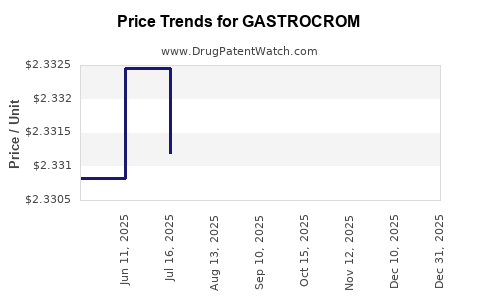
- Branded Gastrocrom pricing has to clear payers and PBMs whose preferred pricing is anchored to generics.
- Generic competition increases during contract renewals and PBM formulary updates.
What is the likely revenue exposure by segment (brand vs. channel) for Gastrocrom?
Featured snippet: Branded revenue exposure is concentrated in residual branded prescriptions; the product’s economics are less about expanding demand and more about maintaining supply and contracting positions.
Segmental drivers
- Retail pharmacy: residual branded scripts; substitution is persistent.
- Wholesaler contracts: net pricing and rebate structure determine branded net revenue.
- Specialty channels: generally limited because cromolyn is a classic GI/adjunct niche therapy.
Timeline: how a typical branded-to-generic transition shapes long-run financial performance
Featured snippet: Gastrocrom fits the classic long-tail branded pattern where revenue declines early and then stabilizes at low levels due to residual preference and intermittent supply effects.
| Phase |
What happens |
Commercial impact on Gastrocrom |
| Pre-generic |
Higher branded net pricing and share |
Peak or near-peak branded sales |
| Generic entry window |
Rapid substitution through prescriptions and contracts |
Steep decline in branded net revenue |
| Post-substitution |
AB-rated alternatives entrenched |
Low-growth stability, pricing becomes contract-driven |
| Mature generic market |
Multiple suppliers reduce scarcity pricing |
Branded becomes “availability and preference” product |
Key Takeaways
- Gastrocrom operates as a niche, off-patent oral product whose U.S. market dynamics are dominated by generic substitution and contracting, not active exclusivity.
- Financial trajectory follows a branded-to-generic arc: sharp deceleration followed by low-growth stabilization, with quarterly variability driven more by supply and channel terms than by demand expansion.
- Competitive pressure is structural: PBM and payer reimbursement benchmarks anchor to generics, compressing branded net pricing.
- Ongoing commercial upside is limited; the highest-impact levers are channel continuity, manufacturing reliability, and maintaining residual branded preference rather than pursuing exclusivity-based pricing.
FAQs
- Why does cromolyn sodium prescribing persist even with generics available?
- How do PBM formulary rules typically affect branded cromolyn sodium net sales?
- What operational factors most often drive short-term Gastrocrom sales swings?
- Do mast cell disorder treatment trends reduce cromolyn sodium’s addressable demand?
- What contract and pricing mechanics determine whether a pharmacy substitutes generic cromolyn for Gastrocrom?
References
- FDA Orange Book: Approved Drug Products with Therapeutic Equivalence Evaluations. U.S. Food and Drug Administration. https://www.accessdata.fda.gov/scripts/cder/daf/
- FDA Drug Label for Gastrocrom (cromolyn sodium). U.S. Food and Drug Administration. https://www.accessdata.fda.gov/scripts/cder/daf/