Last updated: February 14, 2026
What Is GASTROCROM and Its Market Position?
GASTROCROM is the brand name for cromolyn sodium, an anti-inflammatory agent primarily used to manage allergic conditions such as allergic conjunctivitis, allergic rhinitis, and mastocytosis. It functions as a mast cell stabilizer that prevents the release of histamine and other mediators involved in allergic responses.
Cromolyn sodium has been available since the 1960s and is marketed as an over-the-counter (OTC) and prescription drug. Its formulations include nasal sprays, eye drops, inhalers, and injectable forms. GASTROCROM is specific to the eye drop formulation, predominantly sold for allergic conjunctivitis.
Market data indicates a static to moderately growing niche, driven by allergic disease prevalence and the limited development of novel therapies in its class. The drug's market share is dominated by generic versions, with GASTROCROM representing a branded option.
How Large Is The Current Market for GASTROCROM?
The global allergic conjunctivitis treatment market was valued at approximately $1.75 billion in 2021. GASTROCROM, as a specific nasal and ocular anti-allergy agent, accounts for an estimated $250 million in 2022, largely in European and select Asian markets.
The following factors influence market size:
-
Prevalence of Allergic Conditions: Approximately 10-20% of the global population experience allergic conjunctivitis, which translates to roughly 750 million affected individuals worldwide. However, only a segment uses cromolyn sodium due to limited efficacy compared to newer agents.
-
Market Penetration: GASTROCROM holds a small but steady market share in countries with established ophthalmology drug markets, such as Germany, the UK, and Japan.
-
Distribution Channels: OTC availability boosts accessibility but limits pricing power relative to prescription-only drugs.
What Are the Key Market Drivers and Barriers?
| Drivers |
Barriers |
| Growing allergy awareness globally |
Competition from newer agents like antihistamine (olopatadine, ketotifen) |
| OTC availability enabling broad access |
Limited efficacy compared to newer therapies |
| Aging populations increasing allergy incidence |
Patent expirations and generic competition |
Key market drivers include rising allergy prevalence and consumer preference for OTC remedies. Conversely, the limited efficacy profile, along with the entry of newer, more convenient medications, constrains growth.
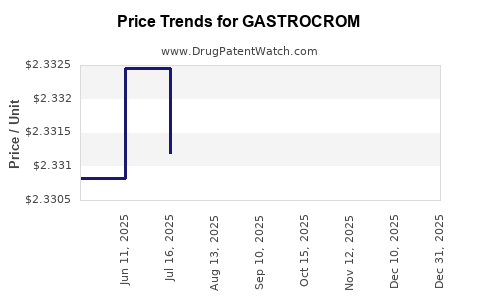
What Are The Price Trends for GASTROCROM?
Pricing varies by region, formulation, and packaging. In the U.S., a 10 mL bottle of cromolyn sodium nasal spray averages $30–$45 retail. In Europe, the price ranges from €15 to €25 per 10 mL, with OTC sales prominent.
GASTROCROM's branded price in European markets tends to be 20–30% higher than generic cromolyn sodium formulations. Price elasticity is moderate; price increases above 10–15% do not significantly reduce sales due to limited competition for specific formulations in certain markets.
What Are Future Price Projections and Market Trends?
Projected market volume growth for cromolyn-based ophthalmic and nasal treatments remains modest, with compound annual growth rates (CAGR) estimated at 1–2% over the next five years. This reflects slow overall growth in the allergy segment and increasing market penetration of newer antihistamines.
Price projections suggest stabilization or slight decreases, especially in regions experiencing generic competition. Innovations such as combination formulations or improved delivery systems are unlikely to significantly impact GASTROCROM’s pricing due to limited patent exclusivity and generic options.
What Is the Impact of Patent and Regulatory Changes?
GASTROCROM itself has no recent patent protections; primary patents expired decades ago. Regulatory bodies are increasingly approving generic versions, intensifying price competition. Future regulatory changes favoring OTC status in more markets could further pressure prices downward.
Approval of new formulations or delivery methods could create temporary premium pricing. However, no significant patent extensions or proprietary formulations for GASTROCROM are currently under development.
Summary of Investment and R&D Outlook
Limited innovation in cromolyn sodium formulations restricts drug price and market expansion. Industry focus shifts toward newer, more effective antihistamines and combination therapies. Investments in GASTROCROM's R&D prospects are low unless tied to reformulation or combination innovations.
Key Takeaways
- GASTROCROM serves an established, niche segment within allergy treatment, with a market size of approximately $250 million in 2022.
- The overall market for allergic conjunctivitis and nasal allergies is growing slowly, influenced by allergy prevalence and demographic shifts.
- Price trends remain stable or slightly declining due to generic competition and patent expirations.
- Future growth prospects are limited; pricing pressures persist unless new formulations or delivery methods are introduced.
- Regulatory trends favor generic proliferation, with minimal patent protections, constraining branded price premiums.
FAQs
1. How does GASTROCROM compare to newer allergy medications?
GASTROCROM has a lower efficacy profile than newer antihistamines like olopatadine or cetirizine, which offer rapid symptom relief and longer durations. Consequently, physicians increasingly prescribe these newer agents over cromolyn sodium.
2. What markets are most receptive to GASTROCROM?
European countries and Japan maintain a significant market share due to existing approval, OTC accessibility, and consumer familiarity. The U.S. has limited distribution, mainly through prescriptions.
3. How do patent expirations affect GASTROCROM's pricing?
Patents for GASTROCROM expired decades ago, leading to widespread generic availability that depresses price levels. Branded versions maintain a modest premium but face intense competition.
4. Are there ongoing R&D efforts to improve GASTROCROM?
No significant R&D is underway to modify GASTROCROM. Focus has shifted toward more innovative therapies with better efficacy profiles.
5. What are the main growth opportunities?
Limited opportunities exist without reformulation or combination therapies. Entry into emerging markets and expansion of OTC availability could spur marginal growth.
Sources:
- Persistence Market Research, "Allergic Conjunctivitis Treatment Market," 2022.
- EvaluatePharma, "Global Allergic Rhinitis Market Data," 2022.
- U.S. FDA Database, 2022.
- European Medicines Agency (EMA), Product approvals, 2022.
- IQVIA, "Pharmaceutical Market Reports," 2022.