Last updated: September 1, 2026
Fluorometholone is a mature ophthalmic corticosteroid with limited standalone commercial visibility. Its market is driven by low-cost generic fluorometholone ophthalmic suspension and smaller branded products such as FML and Flarex. The drug has no meaningful remaining regulatory exclusivity, no biosimilar exposure, and limited patent-based pricing power. Financial performance depends on prescription volume, manufacturing availability, reimbursement, and ophthalmology demand rather than innovation or market exclusivity.
What is fluorometholone used for?
Fluorometholone is a topical corticosteroid used to treat steroid-responsive inflammation of the palpebral and bulbar conjunctiva, cornea, and anterior segment of the eye. It is available primarily as:
| Product type |
Active ingredient |
Typical strength |
Administration |
| Ophthalmic suspension |
Fluorometholone |
0.1% |
Topical eye drops |
| Ophthalmic suspension |
Fluorometholone acetate |
0.1% |
Topical eye drops |
| Ophthalmic ointment |
Fluorometholone |
0.1% |
Topical ocular application |
FML Liquifilm contains fluorometholone 0.1%. Flarex contains fluorometholone acetate 0.1%, a formulation designed for ophthalmic suspension use. The products are used for short-term treatment because prolonged topical steroid exposure can increase intraocular pressure, worsen glaucoma risk, delay wound healing, and increase susceptibility to ocular infection (U.S. Food and Drug Administration [FDA], 2023a, 2023b).
What is the FDA regulatory status of fluorometholone?
Fluorometholone is an FDA-approved small-molecule ophthalmic corticosteroid. Its original approvals date to the era before the modern Hatch-Waxman framework, and the active ingredient has been marketed for decades.
The current regulatory structure is characterized by:
- Approved branded and generic ophthalmic products.
- Abbreviated new drug applications for generic versions.
- No remaining new chemical entity exclusivity.
- No meaningful pediatric exclusivity affecting current competition.
- No biosimilar pathway because fluorometholone is a chemically synthesized small molecule rather than a biologic.
FDA-approved product labeling identifies the main risks as increased intraocular pressure, glaucoma, cataract formation, delayed healing, and secondary infection. Ophthalmic corticosteroid products also require sterile manufacturing and container-closure systems capable of maintaining product quality during repeated use (FDA, 2023a).
What patents protect fluorometholone products?
The original composition and product patents covering fluorometholone are historical and have expired. Publicly available FDA and patent records do not indicate a current, commercially important patent estate protecting the fluorometholone molecule itself.
The practical patent position is:
| Patent category |
Current commercial relevance |
| Original fluorometholone composition patents |
Expired |
| Original ophthalmic formulation patents |
Expired or no longer commercially blocking |
| New chemical entity protection |
Expired |
| Orange Book-listed formulation patents |
No material active barrier identified for routine generic entry |
| Method-of-use patents |
Limited practical relevance for standard anti-inflammatory use |
| Device or container patents |
Potentially relevant to individual products, but not to the active ingredient market |
A company could seek patent protection for a novel suspension system, preservative system, delivery device, or combination product. Such a patent would protect the specific formulation or device, not the broader fluorometholone market.
What is the Orange Book status of fluorometholone?
The FDA Orange Book lists approved fluorometholone and fluorometholone acetate drug products by application and dosage form. The commercial significance of an Orange Book listing depends on whether an unexpired patent is listed against the reference product.
For mature fluorometholone products, the primary competitive issue is generic approval rather than patent certification. Generic applicants generally rely on abbreviated new drug applications and demonstrate pharmaceutical equivalence, bioequivalence where applicable, and compliance with ophthalmic quality requirements.
There is no evidence that a current Orange Book patent substantially delays generic competition for the standard 0.1% fluorometholone products. The reference products therefore operate in a market with limited legal protection from substitution.
When does fluorometholone lose exclusivity?
Fluorometholone lost meaningful exclusivity decades ago. The drug’s market is already post-exclusivity and should be analyzed as a mature generic ophthalmic segment.
| Exclusivity type |
Status |
| New chemical entity exclusivity |
Expired |
| Original product exclusivity |
Expired |
| Patent exclusivity |
Historical patents expired |
| Pediatric exclusivity |
No current commercial effect |
| Orphan exclusivity |
Not applicable |
| Biosimilar reference-product exclusivity |
Not applicable |
Because fluorometholone is already genericized, the key timing question is not when exclusivity ends. It is whether manufacturers can maintain reliable supply and whether branded or authorized-generic products retain reimbursement advantages.
Which companies compete in the fluorometholone market?
Competition includes branded ophthalmology companies, generic manufacturers, specialty pharmaceutical companies, and contract manufacturers. The competitive field varies by country and by dosage form.
Relevant market participants have included:
- AbbVie, through the former Allergan ophthalmology portfolio.
- Bausch + Lomb, a major ophthalmic products company and supplier of prescription eye-care products.
- Sandoz and other generic pharmaceutical manufacturers.
- Regional generic companies holding abbreviated approvals or contract-manufacturing arrangements.
- Specialty ophthalmology companies marketing steroid, antibiotic-steroid, and post-operative eye-drop products.
The most important competitive products are not limited to fluorometholone. Ophthalmologists can substitute among several topical corticosteroids, depending on potency, tolerability, formulation, disease severity, and intraocular-pressure risk.
| Product |
Active ingredient |
Competitive position |
| Fluorometholone |
Fluorometholone |
Lower-potency topical steroid; mature generic |
| Pred Forte |
Prednisolone acetate |
Widely used ophthalmic corticosteroid |
| Dexamethasone ophthalmic |
Dexamethasone |
Potent generic steroid option |
| Lotemax |
Loteprednol etabonate |
Branded or generic steroid with differentiated safety positioning |
| Durezol |
Difluprednate |
Higher-potency branded or generic option |
| Pred-G and similar products |
Steroid plus antibiotic |
Combination therapy for selected indications |
Fluorometholone’s commercial defense is therefore based on prescribing familiarity, lower cost, availability, and perceived tolerability rather than patent differentiation.
How strong is the fluorometholone patent estate?
The patent estate is weak from an exclusivity perspective but sufficient for a mature generic market. There is no broad, active molecule patent that can support premium pricing or prevent routine substitution.
Strength by category:
| Factor |
Assessment |
| Molecule protection |
Weak; expired |
| Formulation protection |
Weak for conventional products |
| Method-of-use protection |
Weak |
| Manufacturing know-how |
Moderate operational importance |
| Sterile production capability |
Important entry barrier |
| Brand recognition |
Moderate for established ophthalmic brands |
| Regulatory complexity |
Moderate |
| Pricing power |
Low |
Sterile ophthalmic manufacturing is the principal practical barrier. Suspensions require control of particle size, uniformity, redispersibility, preservative performance, sterility, container compatibility, and dose consistency. These requirements can produce supply interruptions or quality-related withdrawals even when patent protection is absent.
What generic entry risks exist for fluorometholone?
Generic entry risk is already realized rather than prospective. Multiple manufacturers can compete where approvals and commercial supply are available. The principal risks to branded fluorometholone products are:
- Pharmacy substitution.
- Formulary exclusion.
- Generic price compression.
- Loss of prescriber loyalty.
- Procurement concentration among wholesalers and health systems.
- Manufacturing interruptions by one or more suppliers.
Paragraph IV litigation risk is low for the legacy fluorometholone products because the principal patents have expired. A new Paragraph IV dispute could arise only if a sponsor listed a later patent covering a specific formulation, delivery system, or combination product. Such a dispute would not restore exclusivity for conventional fluorometholone ophthalmic suspension.
What patent litigation and settlement agreements affect fluorometholone?
No major current patent litigation or widely reported settlement agreement appears to shape the conventional fluorometholone market. The product’s commercial history predates the current wave of high-value ophthalmic patent disputes involving newer branded drugs and delivery technologies.
Litigation exposure is more likely to arise from:
- Product liability claims involving elevated intraocular pressure or delayed healing.
- Manufacturing and sterility disputes.
- Trademark disputes involving legacy brand names.
- ANDA litigation tied to a new formulation rather than the fluorometholone molecule.
- Regulatory enforcement involving manufacturing quality.
The absence of a major current patent dispute reduces launch uncertainty for generic suppliers but also limits the ability of originators to defend market share through litigation.
How does fluorometholone compare with competing ophthalmic steroids?
Fluorometholone is generally positioned below prednisolone acetate and dexamethasone in perceived anti-inflammatory potency. Its commercial appeal comes from established use and a potentially lower tendency toward intraocular-pressure elevation in some patients, although the label still carries steroid-related glaucoma warnings.
Loteprednol competes on a differentiated safety and ester-based pharmacology narrative. Difluprednate competes on potency and post-operative use. Prednisolone acetate remains a common generic benchmark. These products constrain price increases and reduce the likelihood that fluorometholone can expand through broad category growth.
The competitive decision is usually clinical rather than patent-based. Physicians select among agents based on inflammation severity, prior response, ocular pressure, surgical context, formulation preference, and payer coverage.
What is the financial trajectory for fluorometholone?
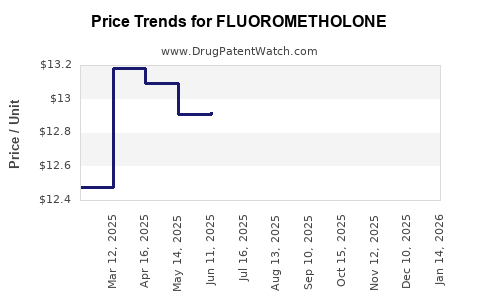
No major manufacturer publicly reports fluorometholone revenue as a standalone product. The drug is generally included within broader ophthalmology, prescription pharmaceutical, or established-brands reporting. Public financial filings therefore do not support a precise product-level revenue series.
The likely financial trajectory is:
| Period |
Financial profile |
| Initial commercialization |
Branded product with protected or semi-protected pricing |
| Generic-entry period |
Rapid price and share erosion |
| Mature market |
Low unit economics, stable clinical demand |
| Current market |
Volume-driven, supply-sensitive, limited innovation premium |
Revenue exposure for the original brand owner is likely modest relative to newer ophthalmology products, biologics, surgical products, and specialty medicines. The more valuable commercial assets are products with active patents, differentiated delivery systems, or chronic-use indications.
Generic fluorometholone manufacturers can generate recurring revenue if they maintain reliable supply and secure payer or wholesaler access. Margins remain vulnerable to price competition, manufacturing costs, product recalls, and concentration among a small number of approved suppliers.
What market dynamics will affect fluorometholone through 2030?
The market should remain mature and price-sensitive. The principal demand drivers are:
- Ophthalmic surgery and post-operative inflammation.
- Routine treatment of steroid-responsive ocular inflammation.
- Aging populations with increased eye-care utilization.
- Generic substitution and formulary coverage.
- Availability of lower-cost alternatives.
The principal constraints are:
- Short treatment duration.
- Clinical caution around steroid adverse effects.
- Competition from prednisolone, dexamethasone, and loteprednol.
- Limited opportunity for chronic maintenance use.
- Lack of active patent protection.
- Low willingness among payers to reimburse premium pricing for an old molecule.
Growth in prescriptions would not necessarily produce proportional revenue growth because additional volume is likely to be accompanied by lower prices.
What manufacturing and geographic barriers affect fluorometholone?
The active pharmaceutical ingredient is not the only supply consideration. Finished ophthalmic products require sterile filling, validated suspension processing, preservative control, stability testing, and compliant packaging.
Geographic market conditions differ:
- The United States has substantial generic substitution and FDA manufacturing requirements.
- Europe relies on national marketing authorizations and country-level reimbursement decisions.
- Emerging markets may have stronger brand loyalty but more variable quality controls and pricing.
- Hospital and surgical channels can favor dependable suppliers over premium branding.
A manufacturer with diversified sterile facilities and strong regulatory compliance has a commercial advantage even without patent protection. Supply reliability can temporarily improve pricing, but it is unlikely to create durable market exclusivity.
Key Takeaways
- Fluorometholone is a mature, genericized ophthalmic corticosteroid.
- Original molecule and product patents have expired.
- No current patent estate appears capable of blocking routine generic competition.
- Paragraph IV litigation risk is low for conventional 0.1% products.
- No biosimilar risk applies because fluorometholone is a small molecule.
- Financial performance is volume-driven and not separately disclosed by major public companies.
- FML and Flarex retain brand recognition, but generic substitution limits pricing power.
- Sterile ophthalmic manufacturing is the main operational barrier.
- Prednisolone acetate, dexamethasone, loteprednol, and difluprednate constrain market expansion.
- Long-term revenue growth is likely to be modest, with supply reliability more important than patent strategy.
FAQs
Is fluorometholone still commercially attractive for generic manufacturers?
Yes, but primarily as a portfolio product. The opportunity depends on reliable sterile manufacturing, low production costs, and access to pharmacy and payer channels rather than premium pricing.
Is FML still patent protected?
The original FML-related patent protection is historical. Current commercial protection is more likely to arise from branding, manufacturing capability, and distribution than from active composition patents.
Can fluorometholone be substituted with prednisolone acetate?
Clinical substitution depends on the indication and prescriber judgment. The products are competing topical steroids but are not automatically interchangeable in every clinical setting.
Does fluorometholone have an authorized generic?
Authorized-generic availability can vary by product, manufacturer, and market. Product-level status must be assessed through current FDA approval and commercial-distribution records.
Could a new fluorometholone formulation regain exclusivity?
A sponsor could pursue patents and regulatory exclusivity for a novel delivery system, combination, or differentiated formulation. That protection would apply to the new product, not to conventional fluorometholone ophthalmic products.
References
-
AbbVie Inc. (2024). Annual report pursuant to Section 13 or 15(d) of the Securities Exchange Act of 1934 for the fiscal year ended December 31, 2023. U.S. Securities and Exchange Commission.
-
U.S. Food and Drug Administration. (2023a). FML Liquifilm: Fluorometholone ophthalmic suspension 0.1% prescribing information. FDA.
-
U.S. Food and Drug Administration. (2023b). Flarex: Fluorometholone acetate ophthalmic suspension 0.1% prescribing information. FDA.
-
U.S. Food and Drug Administration. (2024). Approved drug products with therapeutic equivalence evaluations, 44th edition. FDA.
-
U.S. Food and Drug Administration. (2024). Drugs@FDA: FDA-approved drugs database. FDA.