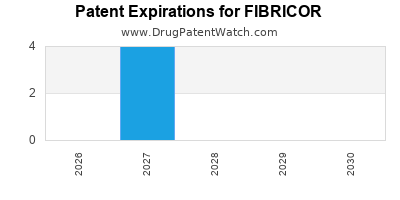
Last updated: September 3, 2026
Fibricor is a mature fenofibric acid product with limited commercial differentiation, no publicly reported standalone revenue, and substantial exposure to generic substitution. Its market is constrained by the dominance of statins, selective use of fibrates for severe hypertriglyceridemia, and competition from generic fenofibrate and other fenofibric acid formulations. The product’s financial trajectory is best characterized as a declining, low-visibility maintenance franchise rather than a growth asset.
What is Fibricor and how is it used?
Fibricor contains fenofibric acid, the active metabolite of fenofibrate. It is an oral tablet available in 35 mg and 105 mg strengths. The FDA label identifies Fibricor as an adjunct to diet for severe hypertriglyceridemia and for primary hypercholesterolemia or mixed dyslipidemia. The label also includes warnings related to myopathy, renal impairment, liver toxicity, gallbladder disease, and interactions with statins and anticoagulants (U.S. Food and Drug Administration [FDA], 2008).
Fenofibric acid belongs to the fibrate class, which activates peroxisome proliferator-activated receptor alpha. The resulting pharmacologic effects include lower triglycerides, reduced very-low-density lipoprotein, modest low-density lipoprotein changes, and increased high-density lipoprotein.
Fibricor differs from Trilipix in dosage form:
| Product |
Active ingredient |
Dosage form |
Key commercial distinction |
| Fibricor |
Fenofibric acid |
Immediate-release tablet |
35 mg and 105 mg strengths |
| Trilipix |
Fenofibric acid |
Delayed-release capsule |
Developed for use as monotherapy or with statins |
| Generic fenofibrate |
Fenofibrate |
Multiple oral formulations |
Broad generic competition and lower pricing |
| Generic fenofibric acid |
Fenofibric acid |
Tablets or capsules, depending on manufacturer |
Direct substitution pressure |
What is the FDA regulatory status of Fibricor?
Fibricor was approved under NDA 022118 in 2008. The product entered the market as a prescription fibrate for lipid disorders. Abbott Laboratories originally developed the product, and the relevant pharmaceutical operations later became part of AbbVie after Abbott separated its research-based pharmaceutical business in 2013.
The product is regulated as a small-molecule prescription drug, not a biologic. Biosimilar competition is therefore irrelevant. The principal competitive risk is conventional generic substitution under the abbreviated new drug application pathway.
What are the main clinical limitations?
Fibricor’s commercial use is limited by treatment guidelines and clinical positioning:
- Statins remain the primary pharmacologic treatment for atherosclerotic cardiovascular disease risk.
- Fibrates are used more selectively, especially when triglycerides are severely elevated and pancreatitis risk is a concern.
- Add-on fibrate therapy has a narrower role in patients already receiving statins.
- Renal dosing and safety monitoring reduce use in older patients and patients with chronic kidney disease.
- Prescription omega-3 products and newer triglyceride-lowering therapies compete for selected patients with severe hypertriglyceridemia.
The 2018 American College of Cardiology and American Heart Association cholesterol guideline places fibrates outside the central treatment pathway for most patients whose principal issue is atherosclerotic cardiovascular risk (Grundy et al., 2019).
When did Fibricor lose exclusivity?
Fibricor is a mature product whose commercial exclusivity has expired or is no longer the principal barrier to substitution. The market is exposed to generic fenofibric acid and to multiple generic fenofibrate products.
FDA approval records and Orange Book materials should be used to determine the current status of any listed patents, pediatric exclusivity, or market exclusivity. The key commercial fact is that Fibricor does not retain the characteristics of a protected branded product: it has no reported blockbuster revenue, no high-growth indication, and no meaningful evidence of pricing power.
What is the Orange Book status of Fibricor?
Fibricor is associated with NDA 022118. Orange Book listings can change through patent delistings, drug-status updates, and sponsor amendments. Publicly available FDA materials do not establish a current commercial moat comparable with an active, late-life-cycle patent estate for a high-value specialty product.
The practical implication is that an ANDA applicant’s main barrier is regulatory and commercial execution rather than a clearly visible, durable composition-of-matter patent position.
How many patents cover Fibricor?
The principal historical intellectual-property value was likely concentrated in product formulation and fenofibric-acid delivery technology rather than in a new molecular entity patent. Fenofibric acid is the active metabolite associated with fenofibrate, and the market contains several related formulations.
Patent categories relevant to Fibricor include:
| Patent category |
Commercial relevance |
| Active ingredient or metabolite claims |
Limited for a mature product and vulnerable to expiration |
| Tablet formulation claims |
May delay exact-copy competition but generally have finite duration |
| Dosage-strength claims |
Can protect product presentation without preserving broad market exclusivity |
| Method-of-use claims |
May affect labeling and induced-infringement risk |
| Manufacturing claims |
Can raise process costs but rarely block all generic entry |
| Salt, polymorph, or particle-size claims |
Potentially relevant if specifically listed and enforceable |
A complete current patent-risk assessment requires matching the live Orange Book record against issued patents, FDA-approved labels, court dockets, and ANDA certifications. No publicly reported Fibricor litigation has established a major continuing barrier to generic entry comparable with litigation surrounding high-revenue branded medicines.
Which companies are challenging Fibricor?
Fibricor’s competitive field is primarily generic rather than litigation-led. Generic manufacturers of fenofibrate and fenofibric acid compete through:
- Lower reimbursement prices.
- Pharmacy substitution.
- Formulary placement.
- Contracting with wholesalers and pharmacy benefit managers.
- Broad availability across dosage strengths.
The most important competitive threat is not a single challenger. It is cumulative substitution from multiple manufacturers. This structure creates price compression and reduces the commercial value of brand promotion.
Direct company-level market-share analysis is difficult because Fibricor-specific sales are not publicly disclosed and generic manufacturers generally report revenue by broader portfolios rather than by individual fenofibrate product.
What is the financial trajectory of Fibricor?
AbbVie does not separately report Fibricor revenue in its annual reports. The product is included, if reported at all, within broader pharmaceutical or established-product categories. No audited public revenue series identifies Fibricor net sales, prescription volume, gross margin, or operating profit.
The likely financial trajectory is:
| Period |
Commercial condition |
Financial effect |
| 2008-2012 |
Branded launch and early adoption |
Initial sales build, limited by established fenofibrate competition |
| 2013-2017 |
Mature branded lipid product |
Stable or declining demand; portfolio integration after Abbott separation |
| 2018-2021 |
Increasing generic pressure |
Lower price realization and reduced branded prescriptions |
| 2022 onward |
Low-growth or declining mature product |
Limited strategic contribution and weak pricing power |
Fibricor’s economics are likely driven by residual branded demand, legacy prescribing, limited brand loyalty, and payer coverage. Its cost structure may remain favorable if manufacturing and distribution are established, but lower net pricing and substitution reduce the absolute profit pool.
Does Fibricor have material revenue exposure?
No material Fibricor-specific revenue exposure has been disclosed by AbbVie. The absence of separate reporting indicates that the product is not financially significant relative to AbbVie’s major franchises, including immunology, oncology, neuroscience, and aesthetics.
For investors, Fibricor should not be modeled as a meaningful driver of AbbVie’s consolidated revenue, earnings, or valuation. It is more relevant as part of the company’s mature-product portfolio and potential divestiture or licensing inventory.
What generic entry risks exist for Fibricor?
Generic entry risk is high. The principal risks are:
- Direct substitution into the same fenofibric acid dosage strengths.
- Therapeutic substitution from generic fenofibrate.
- Formulary exclusion of the branded product.
- Pharmacy-level switching driven by reimbursement.
- Price erosion caused by several generic suppliers.
- Reduced physician attention because fibrates are used in a narrower treatment segment.
The generic launch scenario is likely to produce rapid prescription displacement if a generic product has FDA approval, appropriate therapeutic equivalence, and broad wholesaler distribution. A first generic may obtain temporary commercial advantages, but later entrants generally intensify price competition.
How does Fibricor compare with generic fenofibrate?
| Factor |
Fibricor |
Generic fenofibrate |
| Brand status |
Branded mature product |
Generic |
| Active moiety |
Fenofibric acid |
Fenofibrate, converted to fenofibric acid |
| Pricing power |
Low |
Very low |
| Payer preference |
Generally unfavorable versus generic |
Usually preferred |
| Differentiation |
Limited to formulation and dosage presentation |
Multiple strengths and formulations |
| Prescriber rationale |
Legacy use or specific formulation preference |
Cost and formulary access |
| Growth potential |
Low |
Limited, but protected by broad generic demand |
Fibricor’s potential advantage is formulation familiarity and availability in specific strengths. That advantage is generally insufficient to offset the price differential created by generic substitution.
What formulation patents and manufacturing barriers matter?
Formulation and manufacturing barriers have more relevance than the underlying pharmacology. A generic applicant must demonstrate pharmaceutical equivalence, bioequivalence, stability, dissolution performance, and acceptable manufacturing controls.
Potential technical barriers include:
- Reproducible tablet dissolution.
- Control of fenofibric acid particle characteristics.
- Uniformity across 35 mg and 105 mg strengths.
- Stability under long-term storage.
- Scale-up of formulation processes.
- Consistency of absorption across batches.
These issues can delay approval or increase development costs. They are unlikely to preserve long-term brand pricing once multiple therapeutically equivalent products reach the market.
What patent litigation and settlement agreements affect Fibricor?
No major, publicly prominent Fibricor patent litigation or settlement agreement is associated with the product’s current commercial profile. The absence of high-value litigation is consistent with a mature product facing generic and therapeutic substitution rather than a concentrated patent challenge to a high-revenue franchise.
Any future Paragraph IV litigation would depend on the patents listed for the relevant NDA and the timing of ANDA filings. The likely commercial stakes are modest compared with litigation involving oncology, immunology, diabetes, or specialty biologic products.
What is the competitive landscape for triglyceride-lowering drugs?
Fibricor competes in a segmented market:
- Statins dominate treatment for LDL cholesterol and cardiovascular-risk reduction.
- Generic fenofibrate products compete directly on price.
- Prescription omega-3 products target severe hypertriglyceridemia.
- Icosapent ethyl competes in cardiovascular-risk reduction for selected patients with elevated triglycerides.
- Newer metabolic and obesity therapies may indirectly reduce demand for older lipid agents as weight and metabolic control improve.
The most durable demand for fenofibric acid products is concentrated in patients with substantially elevated triglycerides, mixed dyslipidemia, or intolerance to other therapies.
How strong is the Fibricor patent estate?
Fibricor’s patent estate appears commercially weak relative to protected branded drugs. Its strengths are historical formulation know-how, an established FDA-approved label, and manufacturing familiarity. Its weaknesses are generic exposure, limited clinical differentiation, absence of separately disclosed revenue growth, and the lack of a clearly identified active exclusivity period that would support premium pricing.
The product’s remaining value is therefore operational rather than exclusionary. A buyer could extract cash flow from residual prescriptions, but the asset would have limited strategic value without a differentiated formulation, new indication, or combination product.
Key Takeaways
- Fibricor is a mature fenofibric acid tablet approved in 2008 under NDA 022118.
- Its principal commercial exposure is generic substitution, not biosimilar competition.
- Statins and generic fenofibrate products limit market growth.
- AbbVie does not separately disclose Fibricor revenue or profitability.
- The likely financial trajectory is declining or low-growth mature-product revenue.
- Formulation and manufacturing issues may affect generic timing but are unlikely to sustain long-term pricing power.
- No major current Fibricor litigation or settlement is publicly associated with the product’s commercial profile.
- Fibricor is unlikely to have a material effect on AbbVie’s consolidated financial outlook.
FAQs about Fibricor market outlook
Is Fibricor still commercially important to AbbVie?
No. AbbVie does not report Fibricor as a separately material revenue contributor. Its value is likely limited to residual mature-product cash flow.
Is Fibricor interchangeable with fenofibrate?
The products are pharmacologically related but are not automatically interchangeable solely because both are fibrates. Substitution depends on the specific formulation, strength, FDA therapeutic-equivalence rating, and applicable pharmacy rules.
Can a generic manufacturer launch Fibricor without a Paragraph IV challenge?
Yes. An ANDA applicant can rely on patent expiration, patent certification, or absence of relevant listed patents. A Paragraph IV certification is only one route and does not apply to every generic filing.
Does Fibricor have biosimilar risk?
No. Fibricor is a small-molecule drug. Its relevant competitors are generic products approved through the ANDA pathway.
Could Fibricor regain growth through a new indication?
Growth would require clinical development, regulatory approval, and a differentiated reimbursement position. The established role of statins and the availability of low-cost fibrates make a commercially meaningful relaunch difficult.
References
-
American College of Cardiology/American Heart Association. (2019). 2018 AHA/ACC/AACVPR/AAPA/ABC/ACPM/ADA/AGS/APhA/ASPC/NLA/PCNA guideline on the management of blood cholesterol. Circulation, 139(25), e1082-e1143.
-
AbbVie Inc. (2024). Annual report pursuant to Section 13 or 15(d) of the Securities Exchange Act of 1934. AbbVie.
-
U.S. Food and Drug Administration. (2008). Fibricor: Fenofibric acid tablets, prescribing information. NDA 022118.
-
U.S. Food and Drug Administration. (2024). Approved drug products with therapeutic equivalence evaluations, Orange Book. FDA.
-
U.S. Food and Drug Administration. (2024). Drugs@FDA: FDA-approved drugs database. FDA.
-
DailyMed. (2024). Fibricor-fenofibric acid tablet, film coated. National Library of Medicine.