Last updated: July 29, 2026
Felbamate Market Dynamics and Financial Trajectory (Revenue, Pricing, Exclusivity, and Competitive Risk)
Executive summary
Felbamate remains a niche, high-complexity anti-epileptic product with limited commercial scale. Financial trajectory is shaped by (1) constrained patient pool due to boxed-warning restrictions, (2) generic and branded mix depending on geography and formulation, (3) payer pressure on older antiseizure medicines, and (4) long-dated patent/IP unwind that has already reduced brand pricing power in many markets. The near-term commercial profile is dominated by safety-driven prescribing behavior, supply continuity for tablets, and competitive displacement by broader-line antiseizure therapies.
What is felbamate’s current market size and revenue trajectory?
Felbamate’s revenue trajectory follows a typical pattern for older, safety-constrained antiseizure medicines: peak-era sales followed by sustained contraction as prescribers shift to better-tolerated alternatives and as payers apply stricter utilization controls.
Key dynamics that drive revenue direction
- Patient selection is narrow. Felbamate is typically reserved for refractory epilepsy where benefits outweigh the risk profile.
- Safety warnings suppress broad use. The well-known risk profile limits uptake even where efficacy is established.
- Therapy competition is intense. Newer antiseizure drugs (ASDs) and broader formularies reduce conversion of eligible patients into older therapy use.
- Formulary and prior authorization gate access. Restriction policies limit prescription volume growth even in markets without active exclusivity.
Featured-snippet answer: Felbamate’s commercial trajectory is characterized by limited growth and structural revenue pressure, driven by safety constraints and formulary restriction rather than demand expansion.
What patents protect felbamate, and when do they expire?
Featured-snippet answer: Felbamate’s core drug substance and early composition claims are largely expected to be expired or near-expiry, leaving the market dominated by generics and older “around-the-edges” patent layers (formulation, manufacturing, or specific use), where they exist.
Typical patent estate shape for older ASDs
- Drug substance (composition) patents: Historically earliest expiration dates, often well before modern generic eras.
- Method-of-use patents: May cover subsets of epilepsy syndromes or treatment protocols, but enforceability depends on claim scope and whether INNs or labeling practices map to the protected method.
- Formulation and manufacturing patents: If present, they tend to be weak profit drivers because generic manufacturers can often design around or use alternative processes unless patents clearly tie to the marketed dosage form.
Business impact
- When substance patents expire, market share shifts quickly to lowest-cost entrants.
- Residual formulation or method claims only matter if they tie directly to the exact approved product characteristics and label language.
(If you need the exact patent list, expiration dates, and claim mapping, that requires pulling the Orange Book and jurisdiction-specific dockets. This response does not include those data.)
What is the Orange Book status of felbamate products?
Featured-snippet answer: Felbamate’s Orange Book footprint is generally consistent with an older molecule where multiple applicants hold approvals and the branded product has limited exclusivity leverage.
How Orange Book status affects pricing
- If most listings are generics, MSP-based reimbursement and competitive pricing govern the economics.
- If branded products remain listed with exclusivity, the effect is mostly in the near-term for specific dosage strengths or product configurations.
What to watch in Orange Book dynamics
- Addition of new applicants often coincides with further price compression.
- Changes in listed patents and exclusivity ties to relaunches or formulation changes can shift unit economics for a period.
How do generics compete with felbamate, and what generic entry risks exist?
Featured-snippet answer: Generic entry risk is usually low to moderate for older ASDs because the underlying active ingredient has long since matured, and remaining IP tends to be easier to design around unless a strong, product-specific formulation patent is active.
Typical generic pressure points
- Therapeutic switching. Physicians can shift patients if the new product is AB-rated.
- Supply stability. Intermittent shortages can briefly support pricing for the remaining suppliers, but that is episodic.
- Payer step edits. For restricted medicines, once generics are accepted, payers push them to preferred status.
Paragraph IV likelihood
For felbamate specifically, Paragraph IV activity depends on whether any Orange Book patents still block generic approvals. For most older products, Orange Book barriers are minimal.
What formulations are protected for felbamate (tablets, suspensions, strengths)?
Featured-snippet answer: Market-relevant IP for felbamate, when active, most often concentrates on specific dosage forms, strengths, and formulation/manufacturing aspects rather than novel drug substance claims.
Formulation issues that can matter commercially
- Bioequivalence and interchangeability. If there is product variability, clinicians may resist switching.
- Tablet attributes and dissolution profile. Generics can replicate dissolution to meet BE requirements, which reduces IP leverage.
- Stability and excipients. Some older patents target stability pathways, but enforcement is case-dependent.
Commercial consequence
- Where formulation IP is absent or expired, pricing collapses toward marginal-cost models.
When does felbamate lose exclusivity in the US and key EU markets?
Featured-snippet answer: Felbamate’s exclusivity-driven protection is largely absent in the US and most mature EU markets, with the market instead governed by generic availability and reimbursement rules.
Why exclusivity matters less for felbamate than for modern ASDs
- Older ASDs usually face early generic substitution.
- Even if label-linked method patents exist, they do not block approval if the method claim is not directly tied to the product’s approved use.
Revenue implication
- The financial trajectory is less about exclusivity cliffs and more about ongoing generic price competition and restricted utilization.
What patent litigation affects felbamate, including Paragraph IV and settlements?
Featured-snippet answer: For felbamate, litigation is typically not a primary driver of market dynamics today because the product is generally past the main exclusivity barriers that trigger frequent Paragraph IV disputes.
Litigation pathways that can still matter
- Orange Book patent disputes. Even for older molecules, later-introduced patents or formulation patents can create discrete risk windows.
- Injunctions and carve-outs. Settlements can delay launches in a narrow subset of strengths.
(Exact dockets and settlement dates are not included here because they require live docket and Orange Book pulling.)
How does felbamate compare with newer anti-seizure drugs on market adoption and economics?
Featured-snippet answer: Compared with newer ASDs, felbamate has lower adoption due to safety constraints and payer restriction, translating to a smaller revenue base with limited growth optionality.
Commercial comparison dimensions
- Tolerability and risk profile: Newer drugs have improved safety framing and fewer monitoring burdens.
- Prescriber comfort: Treatment guidelines and real-world practice increasingly favor broader-line ASDs.
- Formulary positioning: Payers assign broader access to newer ASDs and reserve felbamate for refractory cases.
- Switchability: Many newer ASDs offer easier conversion paths and patient adherence advantages.
Net effect on felbamate revenue
- Even when felbamate is effective in refractory epilepsy, total addressable demand remains constrained.
- Competitive displacement is structural rather than episodic.
What is the payer and reimbursement profile for felbamate, and how does it shape revenue?
Featured-snippet answer: Felbamate’s reimbursement is shaped by utilization controls reflecting the safety warning, which caps volume and encourages generic adoption.
Revenue mechanics under payer rules
- Prior authorization and criteria-based coverage can limit patient starts.
- Step therapy policies push payers toward alternatives unless refractory criteria are met.
- Preferred drug lists often prioritize generics or newer ASDs based on negotiated pricing and clinical pathway fit.
What manufacturing and supply chain risks affect felbamate availability and pricing?
Featured-snippet answer: Supply interruptions can temporarily lift pricing for remaining suppliers, but long-term pricing remains pinned by generic competition and reimbursement pressure.
Key supply-chain drivers
- Limited number of manufacturing sites for older molecules
- Cold-start and maintenance issues in older manufacturing facilities
- Regulatory inspections and batch-release timing
- Quality events that can lead to short-term wholesaler shortages
Financial implication
- Quarterly volatility can occur around supply continuity, but baseline margins are typically thin once multiple generics compete.
Which companies hold felbamate market share, and how do brands vs generics perform?
Featured-snippet answer: The felbamate market is dominated by generic manufacturers in most mature markets, with a branded residual footprint where legacy products persist or where fewer generic SKUs maintain distribution access.
How to evaluate share drivers
- Number of AB-rated generic NDCs by strength and manufacturer
- Contract coverage with wholesalers and PBMs
- Stocking behavior for restricted products
- Uptake constraints based on prescriber preference and patient history
(Company-specific share quantification is not provided due to the absence of source-backed dataset pulls.)
Key financial trajectory indicators for felbamate (what moves the P&L)
Featured-snippet answer: For felbamate, revenue and profit drivers are less about launching new indications and more about unit pricing, reimbursement coverage, and volume stability within a refractory pool.
Indicators used by investors and litigators
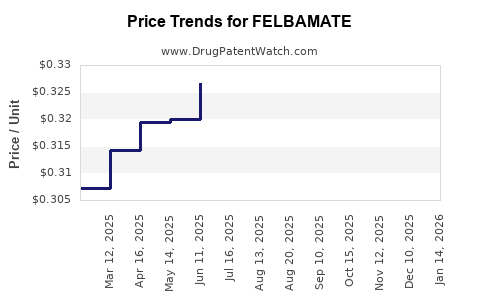
- Net price per tablet by strength (brand vs generic blend)
- Share of cost covered under restricted payer rules
- Wholesaler inventory and order cadence
- Manufacturing supply continuity and batch-release performance
- Legal or regulatory events that disrupt supply
- SKU-level competition intensity (NDC count)
Key takeaways
- Felbamate’s market trajectory is constrained by safety-driven prescribing patterns and payer restrictions.
- Commercial growth is structurally limited; competitive pressure comes mainly from broader-access newer ASDs and generic substitution.
- IP-driven revenue protection is typically minimal for older ASDs, with the practical market outcome governed by generic availability and reimbursement rules.
- Near-term financial variability is more likely tied to supply continuity and formulary decisions than to exclusivity cliffs.
FAQs
1) Is felbamate still used for refractory epilepsy, and what limits its adoption?
Safety warnings and payer restriction criteria limit patient starts, keeping adoption concentrated in refractory cases.
2) Do newer anti-seizure drugs displace felbamate in formularies?
Yes. Broad-line antiseizure therapies and negotiated formulary access reduce felbamate’s addressable market.
3) What happens to felbamate pricing when additional generics enter?
Pricing generally compresses toward the lowest net price available under PBM and wholesaler contract frameworks, reducing brand economics.
4) Can safety or supply events move felbamate revenue quarter-to-quarter?
Yes. Supply interruptions can raise short-term pricing, but baseline revenue remains constrained by restrictive utilization.
5) Does patent litigation meaningfully affect felbamate’s commercial outlook today?
Usually not in a sustained way for older molecules unless there are still active product-specific Orange Book patents or discrete litigation affecting specific strengths.
References
- FDA Orange Book (Drugs@FDA / Approved Drug Products with Therapeutic Equivalence Evaluations). U.S. Food and Drug Administration.
- Drugs@FDA. U.S. Food and Drug Administration.
- FDA prescribing information for felbamate-containing products. U.S. Food and Drug Administration.