EVOTAZ Drug Patent Profile
✉ Email this page to a colleague
Which patents cover Evotaz, and when can generic versions of Evotaz launch?
Evotaz is a drug marketed by Bristol and is included in one NDA. There are two patents protecting this drug and one Paragraph IV challenge.
This drug has three hundred and six patent family members in forty-one countries.
The generic ingredient in EVOTAZ is atazanavir sulfate; cobicistat. There are twenty-five drug master file entries for this compound. One supplier is listed for this compound. Additional details are available on the atazanavir sulfate; cobicistat profile page.
DrugPatentWatch® Generic Entry Outlook for Evotaz
Evotaz was eligible for patent challenges on August 27, 2016.
By analyzing the patents and regulatory protections it appears that the earliest date
for generic entry will be September 3, 2029. This may change due to patent challenges or generic licensing.
There have been nine patent litigation cases involving the patents protecting this drug, indicating strong interest in generic launch. Recent data indicate that 63% of patent challenges are decided in favor of the generic patent challenger and that 54% of successful patent challengers promptly launch generic drugs.
Indicators of Generic Entry
AI Deep Research
Questions you can ask:
- What is the 5 year forecast for EVOTAZ?
- What are the global sales for EVOTAZ?
- What is Average Wholesale Price for EVOTAZ?
Summary for EVOTAZ
| International Patents: | 306 |
| US Patents: | 2 |
| Applicants: | 1 |
| NDAs: | 1 |
| Finished Product Suppliers / Packagers: | 1 |
| Raw Ingredient (Bulk) Api Vendors: | 1 |
| Clinical Trials: | 5 |
| Patent Applications: | 68 |
| Drug Prices: | Drug price information for EVOTAZ |
| Patent Litigation and PTAB cases: | See patent lawsuits and PTAB cases for EVOTAZ |
| What excipients (inactive ingredients) are in EVOTAZ? | EVOTAZ excipients list |
| DailyMed Link: | EVOTAZ at DailyMed |
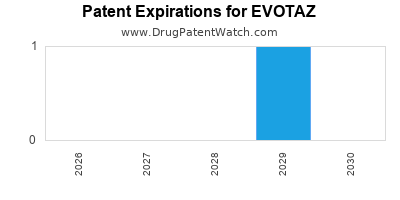
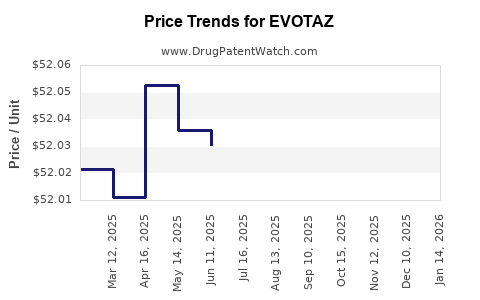
DrugPatentWatch® Estimated Loss of Exclusivity (LOE) Date for EVOTAZ
Generic Entry Date for EVOTAZ*:
Constraining patent/regulatory exclusivity:
NDA:
Dosage:
TABLET;ORAL |
*The generic entry opportunity date is the latter of the last compound-claiming patent and the last regulatory exclusivity protection. Many factors can influence early or later generic entry. This date is provided as a rough estimate of generic entry potential and should not be used as an independent source.
Recent Clinical Trials for EVOTAZ
Identify potential brand extensions & 505(b)(2) entrants
| Sponsor | Phase |
|---|---|
| Gilead Sciences | Phase 3 |
| St Stephens Aids Trust | Phase 1 |
| Bristol-Myers Squibb | Phase 1 |
Pharmacology for EVOTAZ
Paragraph IV (Patent) Challenges for EVOTAZ
| Tradename | Dosage | Ingredient | Strength | NDA | ANDAs Submitted | Submissiondate |
|---|---|---|---|---|---|---|
| EVOTAZ | Tablets | atazanavir sulfate; cobicistat | 300 mg/150 mg | 206353 | 1 | 2017-09-13 |
US Patents and Regulatory Information for EVOTAZ
EVOTAZ is protected by two US patents.
Based on analysis by DrugPatentWatch, the earliest date for a generic version of EVOTAZ is ⤷ Start Trial.
This potential generic entry date is based on patent 8,148,374.
Generics may enter earlier, or later, based on new patent filings, patent extensions, patent invalidation, early generic licensing, generic entry preferences, and other factors.
| Applicant | Tradename | Generic Name | Dosage | NDA | Approval Date | TE | Type | RLD | RS | Patent No. | Patent Expiration | Product | Substance | Delist Req. | Exclusivity Expiration |
|---|---|---|---|---|---|---|---|---|---|---|---|---|---|---|---|
| Bristol | EVOTAZ | atazanavir sulfate; cobicistat | TABLET;ORAL | 206353-001 | Jan 29, 2015 | RX | Yes | Yes | 8,148,374 | ⤷ Start Trial | Y | Y | ⤷ Start Trial | ||
| Bristol | EVOTAZ | atazanavir sulfate; cobicistat | TABLET;ORAL | 206353-001 | Jan 29, 2015 | RX | Yes | Yes | 10,039,718 | ⤷ Start Trial | Y | ⤷ Start Trial | |||
| >Applicant | >Tradename | >Generic Name | >Dosage | >NDA | >Approval Date | >TE | >Type | >RLD | >RS | >Patent No. | >Patent Expiration | >Product | >Substance | >Delist Req. | >Exclusivity Expiration |
International Patents for EVOTAZ
When does loss-of-exclusivity occur for EVOTAZ?
Based on analysis by DrugPatentWatch, the following patents block generic entry in the countries listed below:
Croatia
Patent: 0090077
Patent: MODULATORI FARMAKOKINETIČKIH SVOJSTAVA TERAPEUTIKA (MODULATORS OF PHARMACOKINETIC PROPERTIES OF THERAPEUTICS)
Estimated Expiration: ⤷ Start Trial
Patent: 0161428
Estimated Expiration: ⤷ Start Trial
Patent: 0200349
Estimated Expiration: ⤷ Start Trial
Cyprus
Patent: 16688
Estimated Expiration: ⤷ Start Trial
Patent: 17002
Estimated Expiration: ⤷ Start Trial
Denmark
Patent: 87162
Estimated Expiration: ⤷ Start Trial
European Patent Office
Patent: 49506
Patent: MODULATEURS DE PROPRIÉTÉS PHARMACOCINÉTIQUES D'AGENTS THÉRAPEUTIQUES (MODULATORS OF PHARMACOKINETIC PROPERTIES OF THERAPEUTICS)
Estimated Expiration: ⤷ Start Trial
Patent: 18082
Patent: MODULATEURS DE PROPRIÉTÉS PHARMACOCINÉTIQUES DE PRODUITS THÉRAPEUTIQUES (MODULATORS OF PHARMACOKINETIC PROPERTIES OF THERAPEUTICS)
Estimated Expiration: ⤷ Start Trial
Patent: 87161
Patent: Modulateurs de propriétés pharmacocinétiques d'agents thérapeutiques (Modulators of pharmacokinetic properties of therapeutics)
Estimated Expiration: ⤷ Start Trial
Patent: 87163
Patent: Modulateurs de propriétés pharmacocinétiques d'agents thérapeutiques (Modulators of pharmacokinetic properties of therapeutics)
Estimated Expiration: ⤷ Start Trial
Patent: 87166
Patent: Modulateurs de propriétés pharmacocinétiques d'agents thérapeutiques (Modulators of pharmacokinetic properties of therapeutics)
Estimated Expiration: ⤷ Start Trial
Patent: 87168
Patent: Modulateurs de propriétés pharmacocinétiques d'agents thérapeutiques (Modulators of pharmacokinetic properties of therapeutics)
Estimated Expiration: ⤷ Start Trial
Patent: 96171
Patent: MODULATEURS DE PROPRIÉTÉS PHARMACOCINÉTIQUES D'AGENTS THÉRAPEUTIQUES (MODULATORS OF PHARMACOKINETIC PROPERTIES OF THERAPEUTICS)
Estimated Expiration: ⤷ Start Trial
Patent: 03221
Estimated Expiration: ⤷ Start Trial
Finland
Patent: 49506
Estimated Expiration: ⤷ Start Trial
France
Patent: C0078
Estimated Expiration: ⤷ Start Trial
Hong Kong
Patent: 26485
Patent: 藥動性質治療調節器 (MODULATORS OF PHARMACOKINETIC PROPERTIES OF THERAPEUTICS)
Estimated Expiration: ⤷ Start Trial
Israel
Patent: 5488
Patent: תרכובות, תכשירים רוקחיים המכילים אותן ושימושים שלהם (Compounds, pharmaceutical compositions comprising the same and uses thereof)
Estimated Expiration: ⤷ Start Trial
Japan
Patent: 54300
Estimated Expiration: ⤷ Start Trial
Patent: 47388
Estimated Expiration: ⤷ Start Trial
Patent: 15078241
Patent: 治療薬の薬物動態特性の調節 (ADJUSTMENT OF PHARMACOKINETICS OF CURATIVE MEDICINE)
Estimated Expiration: ⤷ Start Trial
Lithuania
Patent: 87166
Estimated Expiration: ⤷ Start Trial
Patent: 50586
Estimated Expiration: ⤷ Start Trial
Patent: 487166
Estimated Expiration: ⤷ Start Trial
Patent: 2016038
Estimated Expiration: ⤷ Start Trial
Patent: 2016040
Estimated Expiration: ⤷ Start Trial
Mexico
Patent: 09000234
Patent: MODULADORES DE LAS PROPIEDADES FARMACOCINETICAS DE PRODUCTOS TERAPEUTICOS. (MODULATORS OF PHARMACOKINETIC PROPERTIES OF THERAPEUTICS.)
Estimated Expiration: ⤷ Start Trial
Montenegro
Patent: 680
Patent: Modulatori farmakokinetickih svojstava lijekova (Modulators of pharmacokinetic properties of therapeutics)
Estimated Expiration: ⤷ Start Trial
Netherlands
Patent: 1045
Estimated Expiration: ⤷ Start Trial
New Zealand
Patent: 9802
Patent: Compounds for improving the efficacy of other drugs
Estimated Expiration: ⤷ Start Trial
Norway
Patent: 20011
Estimated Expiration: ⤷ Start Trial
Patent: 210811
Patent: Modulatorer av farmakokinetikkegenskaper til terapeutika
Estimated Expiration: ⤷ Start Trial
Patent: 230434
Patent: Modulatorer av farmakokinetikkegenskaper til terapeutika
Estimated Expiration: ⤷ Start Trial
Poland
Patent: 49506
Estimated Expiration: ⤷ Start Trial
Patent: 87162
Estimated Expiration: ⤷ Start Trial
Portugal
Patent: 87161
Estimated Expiration: ⤷ Start Trial
Slovenia
Patent: 49506
Estimated Expiration: ⤷ Start Trial
South Korea
Patent: 150056665
Patent: 치료제의 약동학적 특성의 조절제 (MODULATORS OF PHARMACOKINETIC PROPERTIES OF THERAPEUTICS)
Estimated Expiration: ⤷ Start Trial
Spain
Patent: 38275
Estimated Expiration: ⤷ Start Trial
Patent: 03645
Estimated Expiration: ⤷ Start Trial
Patent: 96275
Estimated Expiration: ⤷ Start Trial
Taiwan
Patent: 0811167
Patent: Modulators of pharmacokinetic properties of therapeutics
Estimated Expiration: ⤷ Start Trial
Patent: 0904419
Patent: Modulators of pharmacokinetic properties of therapeutics
Estimated Expiration: ⤷ Start Trial
Patent: 1412733
Patent: Modulators for improving pharmacokinetic properties of therapeutics metabolized by cytochrome P450 monooxygenase
Estimated Expiration: ⤷ Start Trial
Ukraine
Patent: 1312
Patent: МОДУЛЯТОРЫ ФАРМАКОКИНЕТИЧЕСКИХ СВОЙСТВ ТЕРАПЕВТИЧЕСКИХ ПРЕПАРАТОВ;МОДУЛЯТОРИ ФАРМАКОКІНЕТИЧНИХ ВЛАСТИВОСТЕЙ ТЕРАПЕВТИЧНИХ ПРЕПАРАТІВ (MODULATORS OF PHARMACOKINETIC PROPERTIES OF THERAPEUTICS)
Estimated Expiration: ⤷ Start Trial
Generics may enter earlier, or later, based on new patent filings, patent extensions, patent invalidation, early generic licensing, generic entry preferences, and other factors.
See the table below for additional patents covering EVOTAZ around the world.
| Country | Patent Number | Title | Estimated Expiration |
|---|---|---|---|
| African Regional IP Organization (ARIPO) | 3089 | ⤷ Start Trial | |
| African Regional IP Organization (ARIPO) | 3250 | ⤷ Start Trial | |
| Argentina | 075369 | ⤷ Start Trial | |
| Australia | 2009242451 | ⤷ Start Trial | |
| Australia | 2010210598 | ⤷ Start Trial | |
| Australia | 2014221210 | ⤷ Start Trial | |
| >Country | >Patent Number | >Title | >Estimated Expiration |
Supplementary Protection Certificates for EVOTAZ
| Patent Number | Supplementary Protection Certificate | SPC Country | SPC Expiration | SPC Description |
|---|---|---|---|---|
| 0900210 | CA 2005 00037 | Denmark | ⤷ Start Trial | |
| 0900210 | 91189 | Luxembourg | ⤷ Start Trial | 91189, EXPIRES: 20190302 |
| 0900210 | 300203 | Netherlands | ⤷ Start Trial | 300203, 20170414, EXPIRES: 20190301 |
| 0900210 | SPC/GB05/036 | United Kingdom | ⤷ Start Trial | SPC/GB05/036: 20060206, EXPIRES: 20190301 |
| 0900210 | C00900210/01 | Switzerland | ⤷ Start Trial | PRODUCT NAME: ATAZANAVIR; REGISTRATION NUMBER/DATE: SWISSMEDIC 56288 06.05.2004 |
| 0900210 | SPC023/2005 | Ireland | ⤷ Start Trial | SPC023/2005, 20060612, EXPIRES: 20190301 |
| >Patent Number | >Supplementary Protection Certificate | >SPC Country | >SPC Expiration | >SPC Description |
More… ↓
Make Better Decisions: Try a trial or see plans & pricing
Drugs may be covered by multiple patents or regulatory protections. All trademarks and applicant names are the property of their respective owners or licensors. Although great care is taken in the proper and correct provision of this service, thinkBiotech LLC does not accept any responsibility for possible consequences of errors or omissions in the provided data. The data presented herein is for information purposes only. There is no warranty that the data contained herein is error free. We do not provide individual investment advice. This service is not registered with any financial regulatory agency. The information we publish is educational only and based on our opinions plus our models. By using DrugPatentWatch you acknowledge that we do not provide personalized recommendations or advice. thinkBiotech performs no independent verification of facts as provided by public sources nor are attempts made to provide legal or investing advice. Any reliance on data provided herein is done solely at the discretion of the user. Users of this service are advised to seek professional advice and independent confirmation before considering acting on any of the provided information. thinkBiotech LLC reserves the right to amend, extend or withdraw any part or all of the offered service without notice.
ISSN: 2162-2639

Privacy and Cookies
Terms & Conditions
Site Map
DrugPatentWatch Alternatives
LOE / Major Patent Expirations 2026 - 2027
NCE-1 Patent Challenge Dates 2026 - 2027
Friedman, Yali. "DrugPatentWatch" DrugPatentWatch, thinkBiotech, 2026, www.DrugPatentWatch.com.
See Primary Research Papers Citing DrugPatentWatch