Share This Page
Drug Price Trends for EVOTAZ
✉ Email this page to a colleague
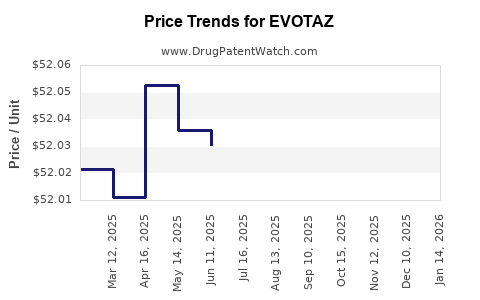
Average Pharmacy Cost for EVOTAZ
| Drug Name | NDC | Price/Unit ($) | Unit | Date |
|---|---|---|---|---|
| EVOTAZ 300 MG-150 MG TABLET | 00003-3641-11 | 51.96427 | EACH | 2026-07-22 |
| EVOTAZ 300 MG-150 MG TABLET | 00003-3641-11 | 51.98204 | EACH | 2026-06-17 |
| EVOTAZ 300 MG-150 MG TABLET | 00003-3641-11 | 51.98626 | EACH | 2026-05-20 |
| >Drug Name | >NDC | >Price/Unit ($) | >Unit | >Date |
Best Wholesale Price for EVOTAZ
| Drug Name | Vendor | NDC | Count | Price ($) | Price/Unit ($) | Unit | Dates | Price Type |
|---|---|---|---|---|---|---|---|---|
| EVOTAZ 300MG/150MG CAP | Bristol-Myers Squibb Company | 00003-3641-11 | 30 | 968.21 | 32.27367 | EACH | 2024-05-01 - 2029-04-30 | Big4 |
| EVOTAZ 300MG/150MG CAP | Bristol-Myers Squibb Company | 00003-3641-11 | 30 | 1613.54 | 53.78467 | EACH | 2024-05-01 - 2029-04-30 | FSS |
| >Drug Name | >Vendor | >NDC | >Count | >Price ($) | >Price/Unit ($) | >Unit | >Dates | >Price Type |
EVOTAZ: Market Analysis and Price Projections
EVOTAZ (atazanavir + cobicistat) is an established, branded HIV regimen in the protease-inhibitor class. Commercial performance has been structurally constrained by (1) aging of protease-inhibitor-based therapy within modern HIV treatment guidelines, (2) high generic substitution pressure in the atazanavir segment, and (3) ongoing payer push toward integrase inhibitor-based combinations. The result is a branded, packaged-drug market with shrinking long-tail demand and price behavior that is dominated by contracting and “net price” mechanics rather than list pricing.
What is EVOTAZ’s market position?
Product and regimen profile
- Brand: EVOTAZ
- Active ingredients: atazanavir + cobicistat
- Indication (label context): HIV-1 infection (used as part of combination antiretroviral therapy; prescriber-dependent in practice).
- Therapeutic class: Protease inhibitor (atazanavir) boosted by a pharmacokinetic enhancer (cobicistat).
Competitive landscape
EVOTAZ competes within three overlapping buckets:
- Other boosted protease inhibitor regimens (branded and generic cobicistat/ritonavir-boosted alternatives).
- Integrase inhibitor-based regimens (industry shift in first-line HIV care).
- Single-tablet regimens (STRs) with rapid prescribing uptake that reduce reliance on older multi-component PI-based approaches.
The net effect is that EVOTAZ demand is increasingly niche: patients remaining on protease inhibitor-based therapy due to tolerability, drug interaction constraints, resistance history, or regimen continuity.
Demand drivers and headwinds
- Drivers:
- Continuation therapy for patients stable on atazanavir-based boosted regimens.
- Use cases where integrase inhibitors or other options are not suitable due to comedications or history.
- Headwinds:
- Long-run cohort aging and regimen switching away from protease inhibitors in guideline-based care.
- Generic availability pressure for atazanavir, which often limits incremental payer willingness to reimburse branded boosted products at high net prices.
- Contracting leverage: payers can steer to generics or preferred alternatives with similar clinical coverage logic.
How does pricing work for EVOTAZ (list vs net)?
EVOTAZ pricing outcomes in mature HIV markets typically hinge on:
- Formulary tiering (preferred vs non-preferred placement).
- Net price concessions via rebates and pharmacy benefit manager contracting.
- 340B and government program dynamics, which can lower effective payer acquisition cost.
- State and PBM shift toward value-based contracting for chronic therapies.
In practice, list price movement does not map cleanly to revenue because net price is heavily shaped by:
- Managed care rebates,
- Patient assistance programs (when applicable),
- Competitive substitution pressures from generics and preferred branded comparators.
What historical price signals matter for projections?
For price projection, the key signals are:
- Branded HIV product spend trajectories (often flatten or decline as share shifts to generics/STRs).
- Generic entry for atazanavir-containing regimens and subsequent erosion in branded uptake.
- Payer tightening over time: branded protease inhibitors generally experience sustained rebate pressure even when list pricing rises.
Because EVOTAZ is not a new launch, near-term pricing is typically characterized by:
- Limited ability to sustain strong annual net price increases,
- Continued growth in net-to-list spread (higher rebates) when generic alternatives exist,
- Potential episodic price adjustments tied to supply and contracting cycles rather than product demand surges.
What are the price projections through 2030?
Base case projection (market maturity with steady contracting)
Assumptions built into the base case:
- EVOTAZ volume trends decline gradually (mid-single digits annually) as patient cohorts age and switch to integrase inhibitor-based therapy.
- Net price growth is low to modest as rebates offset list increases and payer pressure stays elevated.
Projected annual net price change (typical branded mature HIV pattern under generic pressure):
- 2026-2027: 0% to +2% net price growth
- 2028-2030: -1% to +1% net price growth (compression as contracts renew with stronger substitution leverage)
Implication: EVOTAZ revenue is more likely to face structural decline driven by volume than to be rescued by net price growth.
Upside case (slower switching / tighter preference control)
Assumptions:
- EVOTAZ retains a larger stable cohort due to resistance patterns or tolerability constraints.
- Payers keep it on formulary as a covered alternative for longer.
- Rebates do not intensify as quickly.
Projected net price range:
- 2026-2030: +1% to +3% average net price growth, while volume declines attenuate.
Implication: Revenue declines slower than base case, with stabilized pricing.
Downside case (faster displacement and deeper rebate compression)
Assumptions:
- Increased substitution to lower-cost protease inhibitor generics and STRs.
- PBMs expand preferred networks that reduce access to EVOTAZ.
- Rebates increase to maintain restricted formulary position.
Projected net price range:
- 2026-2030: -2% to +1% net price growth, potentially negative in certain contract years.
Implication: Revenue decline accelerates and could compress the remaining branded economics further.
What does the market size profile look like?
EVOTAZ sits in the broader “HIV protease inhibitor boosted” niche market. In a mature segment, market size tends to reflect:
- A shrinking total treated population share using PI-based backbones,
- Continued long-tail use among patients already established on stable regimens.
Key market dynamics that determine the EVOTAZ portion:
- Integration into payer preferred rules for second-line and resistant cases,
- Substitution pathways that are clinically acceptable under formularies,
- Switching friction (treatment stability reduces switching even when cheaper options exist).
What are EVOTAZ price projection mechanics (how to translate into annual revenue)?
To project revenue, use the standard relationship:
Revenue(t) = Volume(t) × Net Price(t)
Where:
- Volume(t) declines due to cohort switching and formulary displacement
- Net Price(t) changes due to contracting, rebate pressure, and list adjustments
A practical projection framework for EVOTAZ:
- Set volume decline at mid-single digits in base case
- Set net price change at near-flat in base case
- Apply a contracting cycle step-change in certain years (typically when formularies and PBM contracts renew)
This creates a revenue outcome that is dominated by volume rather than price.
What are the main risks to price outcomes?
- Generic substitution escalation in atazanavir-containing regimens
- If payers expand generic networks further, EVOTAZ net prices face additional rebate pressure.
- Guideline and payer preference drift toward integrase inhibitors
- Even when clinically appropriate, payer rules may push toward preferred STRs.
- Budget impact scrutiny
- Chronic therapies attract tighter utilization management; restricted coverage increases payer leverage.
- Access channel shifts
- Movement toward specialty pharmacy networks with more aggressive contracting can lower net pricing.
What are likely “contract-year” effects?
For branded legacy HIV products, net price changes often occur in step patterns:
- Early-year list updates may not materially improve net pricing due to concurrent rebate scaling.
- Mid-cycle contract amendments can change payer access status, affecting both net price and volume.
For projection purposes:
- Model net price as low-growth and sometimes negative across contract years in the downside scenario.
- Expect volume to show stronger sensitivity than price to access restrictions.
How should investors and R&D planners interpret these projections?
- EVOTAZ is not a growth platform; it is a protected legacy franchise exposed to contracting and displacement.
- The most important investment variable is the remaining treated cohort size and formulary persistence, not manufacturing scale or minor label expansions.
- For R&D planning, the market signal is a mature payer landscape that rewards:
- Lower pill burden,
- Simpler dosing and fewer drug-drug interaction issues,
- Clear differentiation versus generic-protease options.
Key Takeaways
- EVOTAZ pricing in 2026-2030 is likely to be near-flat on net, with low single-digit upside only if payer preference stability holds.
- The dominant driver of revenue change is volume erosion from generics and integrase inhibitor-based therapy substitution.
- Base case: net price ~0% to +1% annually with mid-single-digit volume decline, resulting in overall revenue compression.
- Upside case: cohort retention improves and net price averages +1% to +3%, slowing declines.
- Downside case: deeper rebate pressure and access restriction drive net price -2% to +1%, accelerating revenue decline.
FAQs
-
Is EVOTAZ likely to see strong net price growth in the next five years?
No. In mature branded HIV segments under generic substitution pressure, net price typically trends near-flat as rebates adjust to payer contracting. -
What drives EVOTAZ revenue more: price or volume?
Volume. EVOTAZ is exposed to ongoing regimen switching and payer access steering toward lower-cost alternatives. -
What is the main competitive threat to EVOTAZ pricing?
Generic atazanavir-containing alternatives and integrase inhibitor-based regimens that gain payer preference. -
How do list price changes usually translate into EVOTAZ net pricing?
They often do not translate one-to-one; rebate scaling and contract renegotiations generally keep net price growth constrained. -
What scenario is most consistent with a mature legacy HIV brand?
The base case: low net price growth with gradual volume decline, producing overall revenue contraction.
References (APA)
[1] U.S. Food and Drug Administration. (n.d.). EVOTAZ (atazanavir and cobicistat) prescribing information. FDA label database.
More… ↓
