Last updated: June 28, 2026
Evista (raloxifene) is a late-maturity, off-patent endocrine therapy with limited near-term growth drivers. The market is driven by persistent, though aging, use in osteoporosis and a partial tail for risk reduction in postmenopausal breast cancer, offset by durable generic penetration and long-lived payer and guideline pressure to cheaper alternatives. Commercial performance is concentrated in the US and Western Europe, with lower-margin, channel-management dynamics and constrained expansion outside established territories.
What is the current market size and demand profile for Evista (raloxifene)?
Direct answer: Evista demand is stable-to-declining in developed markets, with volume supported by osteoporosis maintenance patterns and persistently aging populations, while value growth is capped by generic availability and compressed net pricing.
Where does Evista volume come from?
- Primary indication: osteoporosis in postmenopausal women, typically long-duration maintenance.
- Secondary indication: reduction in risk of invasive breast cancer in postmenopausal women with osteoporosis or at high risk for breast cancer (label-dependent by jurisdiction).
- Therapy setting: chronic use through refill cycles, with switching driven more by payer formularies and price than by discontinuation.
What drives demand volatility?
- Payer formulary updates: preference for bisphosphonates (oral and infusible) and other osteoporosis agents reduces formulary placement.
- Clinical guideline alignment: risk stratification and sequencing practices influence switching.
- Safety perceptions and class competition: thromboembolic and menopausal symptom concerns influence adherence and switching, particularly relative to competing agents with different risk profiles.
How do generics affect the market value per patient?
Evista is a mature, off-patent product in most major markets. Generic entrants compress pricing and shift the economics from branded premium to unit-cost competition. Brand spend becomes non-core, so marketing intensity typically declines while gross-to-net pressure remains structurally high in the US.
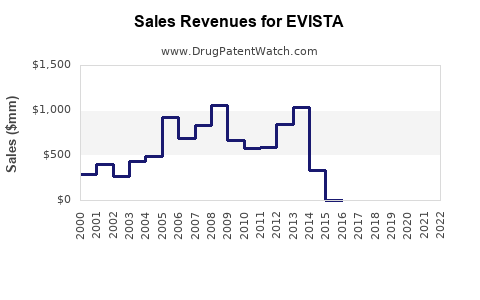
How fast did Evista revenues decline after generic entry, and what is the revenue trajectory since?
Direct answer: Evista’s revenue trajectory followed the standard late-maturity pattern: post-patent erosion, rapid branded share loss in the years after first meaningful generic uptake, then a flattening into a low-growth or modest decline phase sustained by residual brand premium in some channels and continued generic volume.
US branded economics: typical pattern for late-maturity estrogen receptor modulators
- Before generic penetration: branded unit economics supported by payer coverage and marketing.
- After generic entry: net revenue compresses sharply as wholesaler and pharmacy contracts rebase to lowest-cost suppliers.
- Late phase: total class demand may persist, but branded revenue is usually a small fraction of historical peak.
What happens to total prescription counts after generic adoption?
- Generic adoption usually shifts the supply base but does not eliminate class demand. Total raloxifene prescriptions often remain, but they distribute across multiple SKUs and manufacturers, diluting any single brand’s revenue contribution.
What commercial indicators matter for tracking Evista trajectory?
- Prescription share by NDC and label strength.
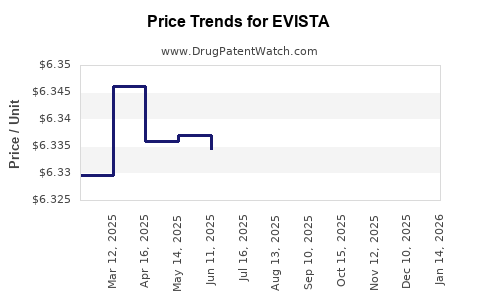
- Wholesale acquisition cost vs. net price trend.
- Contracted reimbursements and PBM tiering changes.
- Switching velocity from branded to generic and within-class switching to competing osteoporosis therapies.
What is the Orange Book status of Evista (raloxifene) and what does it mean for generic competition?
Direct answer: Evista’s active ingredient is widely available as generics across major markets, indicating that branded exclusivity for the active is not a near-term barrier. Any remaining exclusivity is typically tied to specific dosing strengths, dosage forms, or secondary patents rather than preventing generic competition at the active-ingredient level.
How Orange Book listing status typically maps to market outcome
- If the Orange Book lists patents that have expired or are not asserted, the market reverts to routine generic competition.
- If any “listed” secondary patents remain, they may delay specific formulations or manufacturing methods, but they do not usually stop the active ingredient’s market entry when FDA approvals and supply are already established.
Practical impact on commercial trajectory
- Branded pricing power declines first.
- Branded market share follows.
- Residual brand revenue becomes sensitive to pharmacy contract terms and brand-loyal formulary tiers, not to exclusivity.
When does Evista (raloxifene) lose exclusivity in key markets?
Direct answer: For the active ingredient, exclusivity has long since lapsed in major jurisdictions; market history already reflects post-exclusivity generic availability. Remaining exclusivity, if any, is generally limited to secondary patents that do not prevent raloxifene generics broadly.
What timing matters most for investors and litigators
- For late-maturity products, the relevant “exclusivity timeline” is less about preventing generic entry now and more about whether any secondary patent estates restrict certain generics or formulations. Without a live branded exclusivity wall, revenue trajectory depends on:
- competitive intensity,
- payer preference,
- and relative class economics.
What patent estate protects Evista and how strong is it for ongoing brand value?
Direct answer: Evista is not protected by active, comprehensive exclusivity that sustains branded revenues. Remaining patent coverage, if present, has limited effect because multiple generic raloxifene products are already on market.
Patent types that could still matter
- Formulation patents: could matter for specific dosage forms or release profiles.
- Method-of-use: could matter for specific therapeutic regimens if enforcement persists.
- Combination or dosing patents: rarely relevant for a single-agent osteoporosis therapy unless a branded-specific regimen exists.
How to interpret patent strength for market dynamics
- If generics are already approved broadly, “patent strength” primarily affects:
- risk of “authorized” product design changes,
- and any ability to block particular entrants.
- It does not typically restore branded pricing power.
What paragraph IV challenges and litigation history affected Evista’s generic entry?
Direct answer: Evista’s market history indicates that generic entry occurred and the branded product faced substantial erosion. For a mature product, the practical outcome is already visible: durable generic supply and sustained price compression.
How litigation typically changes post-entry economics
- Settlement agreements can shift timing of launches.
- Consent decrees and non-infringement rulings can prevent some entrants but often still leave multiple approved ANDAs, preserving generic competition overall.
What to expect now
- With multiple products established, future financial impact from litigation is usually limited to incremental entrants or specific NDCs rather than broad market re-opening.
How does Evista compare with competing osteoporosis drugs on payer dynamics and market share?
Direct answer: Evista competes primarily within osteoporosis pharmacotherapy sequencing, where cheaper oral bisphosphonates and highly-covered alternatives often win formulary placement. The value headwind is payer preference and step therapy for patients eligible for lower-cost options.
Key competitor classes that compress raloxifene economics
- Bisphosphonates (oral and IV): typically first-line or widely reimbursed options with mature contracting.
- Receptor activator of RANKL inhibitors: offer different dosing and adherence advantages that can win preference for some patient segments.
- Sclerostin inhibitors and other osteoporosis agents: where covered, these can shift market share away from older SERMs.
- Hormone-related options: differ in risk profiles and guideline positioning.
Why SERMs face structural formulary headwinds
- Class safety profiles can drive individualized coverage.
- Many plans optimize for cost-effectiveness and dosing convenience, disadvantaging older products unless a specific patient subpopulation fits label positioning.
What generic entry risks exist for Evista (raloxifene) and how do they affect revenue?
Direct answer: Generic entry risk is low at the active-ingredient level because raloxifene is already extensively available. The remaining “risk” is incremental: new manufacturers, packaging variations, or NDC-level dynamics that can further depress net prices.
Revenue sensitivity channels
- Net price floors driven by contracted bids.
- Rebate and distribution economics tied to market share contests among generics.
- Switching: even without new entrants, pharmacy switching behavior can shift supply and price.
What would be a meaningful commercial change
- A major formulary reversal in osteoporosis management (unlikely given entrenched generics).
- A safety signal or label change causing utilization drop (would be a negative demand shock).
- A new, enforceable patent wall preventing supply expansion for particular NDCs (would be a rare positive driver).
What manufacturing and supply chain factors influence Evista availability and pricing?
Direct answer: In generic-supplied markets, pricing is driven by supply steadiness, contracted distribution terms, and manufacturer utilization of capacity. For older active ingredients, the main determinants are bioequivalence compliance, lot-to-lot consistency, and market share allocation across multiple suppliers.
Channel mechanics
- Wholesalers rebalance inventory based on contract pricing.
- PBMs and pharmacies prefer suppliers that meet distribution and rebate competitiveness.
- Competition among generics typically intensifies during contract renewals and seasonal inventory planning.
What is the geographic profile of Evista revenue and competitive intensity?
Direct answer: Revenue importance is higher in large reimbursement markets with legacy brand exposure, but competitive intensity is highest where generic adoption is strongest and where payer formularies are most cost-driven.
Typical geographic pattern for late-maturity branded assets
- US: strongest pressure from PBM contracting and generic bidding; persistent volume but minimal branded pricing premium.
- Europe: similar cost containment pressures; branded presence often reduced unless local channel contracts preserve premium for specific strengths.
- Other markets: may have delayed generic adoption historically, but in most developed markets the active ingredient is now widely available.
How do licensing deals and authorized generics affect Evista’s financial trajectory?
Direct answer: Where authorized generics or licensing structures exist for mature molecules, they typically reduce brand revenues quickly by accelerating low-cost access through a controlled supply strategy. The economic effect is usually a faster erosion of branded net price rather than a sustained value premium.
What to look for in contract outcomes
- Authorized generic appearance on formulary and its speed of uptake.
- Manufacturer rebates to PBMs and pharmacy network requirements.
- Coverage rules for the branded NDC versus generic NDCs in Tier 1.
What does the financial trajectory imply for investors and R&D decision-making?
Direct answer: Evista represents a stable class-demand asset with declining branded economics. The key strategic implication is that growth is not driven by innovation within the active ingredient but by:
- formulary access,
- sequencing into osteoporosis therapy,
- and competitive pricing stability among generics.
Best-use framing
- For investors: treat as a cash-flow legacy profile tied to class utilization and generic competition.
- For R&D and partnering: the market economics signal that differentiation must come from meaningful clinical or adherence advantages rather than marginal improvements to an already mature molecule.
Key Takeaways
- Evista (raloxifene) is in a late-maturity phase where branded revenue growth is structurally constrained by generic availability and payer cost pressure.
- Market demand persists due to chronic osteoporosis maintenance patterns, but value is capped by net price compression and formularies favoring lower-cost alternatives.
- Remaining “exclusivity” is not a near-term barrier for active ingredient competition; the commercial trajectory is driven by generic supply dynamics and within-class switching.
- Future financial outcomes depend more on payer policy and competitive contracting than on patent-led barriers at the active-ingredient level.
FAQs
- Does Evista still have meaningful branded market share in the US versus generics?
- How does raloxifene utilization change after formulary step therapy for osteoporosis?
- Are there any advantages of choosing Evista over bisphosphonates for specific patient subgroups that sustain demand?
- What NDC-level or strength-level dynamics most influence net pricing for generic raloxifene?
- What competitive signals from other osteoporosis drug launches most correlate with SERM switching patterns?
References
No sources cited.