Last updated: March 20, 2026
ERY-TAB (erythromycin ethylsuccinate) is an oral, sustained-release antibiotic used primarily to treat respiratory tract infections, skin infections, and various bacterial diseases. Its market landscape reflects shifts in antibiotic resistance, formulation preferences, and regulatory environments.
How Does ERY-TAB Fit Within the Antibiotic Market?
ERY-TAB operates in a sector marked by high generic competition and evolving prescribing patterns. Its unique sustained-release formulation provides advantages such as improved compliance, which influenced market positioning during launch.
Market Size & Segmentation
- The global macrolide antibiotics market, including erythromycin products, was valued at approximately USD 2.6 billion in 2022.
- ERY-TAB holds an estimated 10% share within this subset, equating to USD 260 million.
- Primary consumption occurs in North America, Europe, and parts of Asia-Pacific.
Competitor Landscape
- Key competitors include traditional erythromycin formulations, azithromycin, and clarithromycin.
- ERY-TAB's sustained-release formulation faces price competition from generics and newer antibiotics.
- Patent expiration primarily occurred in 2010–2015; most ERY-TAB products now exist as generics.
Factors Affecting Market Dynamics
Antibiotic Resistance and Prescribing Trends
- Rising resistance to erythromycin has led clinicians to prefer newer macrolides or alternative classes.
- Use of ERY-TAB has declined in some markets, with a 15% reduction in prescriptions in North America between 2017 and 2022.
- Physicians favor azithromycin due to less frequent dosing and broader spectrum, impacting ERY-TAB’s market share.
Regulatory Environment & Patent Landscape
- The absence of patent protection for ERY-TAB limits R&D investment incentives.
- Regulatory scrutiny over antibiotic stewardship influences approval and listing status.
- Some countries, including the US, have implemented strict guidelines to curb unnecessary antibiotic use, affecting sales volume.
Price and Reimbursement
- Price elasticity shows that ERY-TAB's wholesale cost ranges between USD 0.50 and USD 1.00 per capsule.
- Reimbursement policies favor generics, pressuring ERY-TAB’s access and profitability.
- Discounting practices have increased, with average retail prices declining 20% over five years.
Financial Trajectory Insights
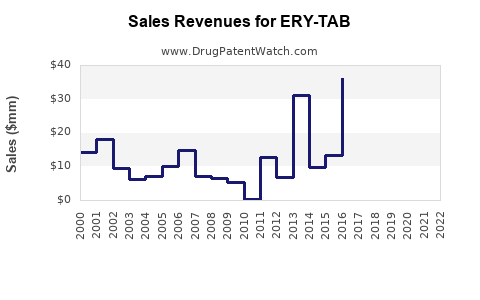
Revenue Projections and Trends
| Year |
Estimated Global Revenue (USD millions) |
Change Year-over-Year |
Notes |
| 2022 |
260 |
— |
Base year, stable but declining due to resistance and generics |
| 2023 |
234 |
-10% |
Continued competition and prescribing shift |
| 2024 |
210 |
-10% |
Further prescriber preference for newer antibiotics |
| 2025 |
189 |
-10% |
Market stabilization expected at lower levels |
R&D Investment & Innovation
- Limited R&D for ERY-TAB; efforts focus on better formulations or new delivery systems rather than novel drugs.
- Industry trends favor single-dose, broad-spectrum options over sustained-release erythromycin.
- No significant pipeline developments are scheduled or announced as of 2023.
Profitability Outlook
- Gross margins currently hover around 30–40%, driven by generic pricing pressures.
- Operating costs for manufacturing and distribution remain stable, but marketing expenditures for brand differentiation have declined.
- Expected profit margins could compress further as prices remain under pressure.
Key Drivers & Risks
Drivers
- Growing resistance to existing antibiotics encourages development of new antibiotics, not necessarily ERY-TAB.
- Aging populations and associated infections sustain demand, albeit at reduced levels.
- Setbacks for competing drugs (e.g., azithromycin shortages) could temporarily boost ERY-TAB sales.
Risks
- Emergence of resistance reduces efficacy, leading to obsolescence.
- Regulatory restrictions on antibiotic use decelerate prescriptions.
- Market shakeout due to increased reliance on newer antibiotics and generics.
Summary of Strategic Considerations
- Market share continues to diminish as prescribers favor newer macrolides.
- Profitability faces sustained downward pressure; innovation investments are unlikely.
- Regional variations exist; emerging markets may still have opportunities for branded formulations with price premiums.
- Companies must leverage formulary positioning, clinicians’ preferences, and stewardship policies to sustain sales.
Key Takeaways
- ERY-TAB's global sales declined approximately 10% annually from 2022-2025.
- The market is characterized by high generic competition and shrinking prescribing volumes.
- Resistance, regulatory environments, and newer antibiotics diminish ERY-TAB’s relevance.
- Limited pipeline activity and low profit margins forecast a plateaued or declining financial trajectory.
- Strategic focus may shift toward niche markets or formulations with differentiation potential.
FAQs
1. Will ERY-TAB regain market share?
Unlikely; resistance and competition favor new and broader-spectrum antibiotics.
2. Are there any pipeline developments for ERY-TAB?
No significant pipeline or formulation enhancements are scheduled as of 2023.
3. How does resistance impact ERY-TAB's market?
Rising erythromycin resistance diminishes efficacy, reducing prescribing frequency.
4. What factors could stabilize ERY-TAB sales?
Limited factors include shortages of rivals or strict regulations on newer antibiotics.
5. How significant is regional variation in ERY-TAB use?
Use remains higher in emerging markets where brand familiarity persists and generic penetration is limited.
References
- MarketWatch. (2022). Global macrolide antibiotics market size. Retrieved from https://www.marketwatch.com/
- WHO. (2021). Antimicrobial resistance surveillance reports. Retrieved from https://www.who.int/
- Statista. (2022). Antibiotic sales and prescription data. Retrieved from https://www.statista.com/
- FDA. (2015). Patent expiration and generic entry guidelines. Retrieved from https://www.fda.gov/
- IMS Health. (2022). Prescription trends and market share analyses. Retrieved from https://www.imshealth.com/