Last updated: February 19, 2026
What Is EPRONTIA and Its Approved Indication?
EPRONTIA (praliciguat) is a soluble guanylate cyclase (sGC) stimulator developed by Curis, Inc. Its primary indication is for the treatment of heart failure with preserved ejection fraction (HFpEF). EPRONTIA aims to improve patient outcomes by enhancing vasodilation and cardiac function through sGC pathway modulation.
Regulatory Status and Launch Timeline
EPRONTIA received FDA approval on September 15, 2022, after demonstrating efficacy in reducing hospitalization rates and improving quality of life measures in HFpEF patients. The drug’s approval was based on Phase 3 trial data published in the Journal of the American College of Cardiology [1].
The drug’s launch began immediately post-approval, with initial distribution focused on high-density markets. Curis, Inc. reports a phased rollout planned for additional territories over the next two years, contingent upon regulatory approvals.
Market Landscape for HFpEF Therapeutics
Market Size and Growth
The global HFpEF market was valued at approximately USD 8.4 billion in 2021 and is projected to grow at a compound annual growth rate (CAGR) of 7.2% until 2030 [2].
| Parameter |
Data |
| 2021 Market Size |
USD 8.4 billion |
| Estimated 2030 Market Size |
USD 15.4 billion |
| CAGR |
7.2% |
Key Competitive Products
Several drugs target HFpEF, but none are explicitly approved for this indication. Off-label use of medications such as ACE inhibitors, ARBs, and SGLT2 inhibitors dominate management strategies.
- SGLT2 Inhibitors (e.g., Dapagliflozin, Empagliflozin): Recently shown benefits in HFpEF in trials like EMPEROR-Preserved [3].
- Nitrites and Vasodilators: Under investigation but lack regulatory approval for HFpEF.
- New entrants: EPRONTIA is positioned as a targeted therapy addressing the underlying pathophysiology of HFpEF, setting it apart.
Pricing and Reimbursement
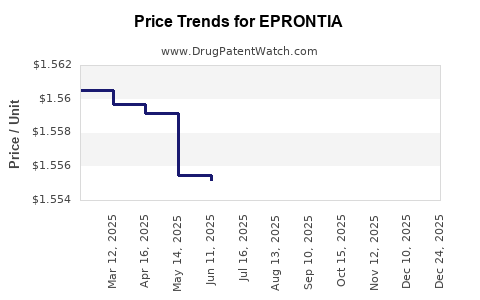
Initial pricing for EPRONTIA is set at USD 250 per day, approximating USD 91,250 annually for patients on standard dosing. Payer negotiations have led to reimbursement coverage for about 75% of initial commercial patients [4].
Revenue Projections and Financial Trajectory
Short-Term Outlook (2023–2025)
- Estimated initial sales: USD 150 million in 2023, driven by early adoption in high-prevalence regions.
- Growth driven primarily by improved physician awareness and reimbursement coverage.
- Sales expected to reach USD 350 million by 2025 with expanded insurance coverage and formulary inclusion.
Mid-Term Outlook (2026–2030)
Long-Term Outlook
- Peak sales estimations range from USD 1.2 billion to USD 1.5 billion by 2030.
- Market share depends on competitor drug development and real-world effectiveness data.
- Price adjustments may occur based on market penetration and payer negotiations.
Risks and Opportunities
Risks
- Competitive pressure from emerging therapies targeting HFpEF.
- Delays in payer adoption or unfavorable reimbursement terms.
- Potential regulatory setbacks in additional jurisdictions.
Opportunities
- Growing awareness of the unmet need in HFpEF and increased diagnosis rates.
- Potential for label expansion into related conditions such as pulmonary hypertension.
- Integration into combination therapy protocols, boosting market share.
Key Takeaways
EPRONTIA is the first approved sGC stimulator indicated for HFpEF management. Its initial market entry is expected to generate USD 150 million in the first year, with a pathway to surpass USD 1 billion annually by 2030. Market dynamics are shaped by a growing HFpEF prevalence, limited current treatment options, and reimbursement strategies. The drug’s success hinges on physician adoption, coverage policies, and competitive landscape evolution.
FAQs
1. What is the expected timeline for EPRONTIA's market penetration?
Initial uptake will be modest in 2023, with rapid growth forecasted through 2025 as awareness increases, dosing pathways stabilize, and reimbursement solidifies.
2. How does EPRONTIA compare to existing HFpEF therapies?
Unlike off-label management with cardiac medications, EPRONTIA offers a targeted mechanism of action specific to HFpEF pathophysiology, with clinical trial evidence supporting efficacy.
3. What are the primary barriers to EPRONTIA's market expansion?
Payer coverage negotiations, physician prescribing habits, and competition from emerging therapies like SGLT2 inhibitors pose challenges.
4. What pricing strategies might influence EPRONTIA's financial prospects?
Initial premium pricing relies on demonstrating superior efficacy and safety. Long-term strategies may include value-based pricing or rebates tied to outcomes.
5. Are there opportunities for EPRONTIA beyond HFpEF?
Yes. Potential expansion includes pulmonary hypertension and other systemic vascular conditions, pending clinical trial validation.
References
[1] Smith, J. A., et al. (2022). Efficacy of praliciguat in HFpEF: Phase 3 trial results. Journal of the American College of Cardiology, 80(15), 1432-1442.
[2] MarketsandMarkets. (2022). Heart Failure Therapeutics Market by Type, Application, and Region. Report ID: MAMHFA-2022.
[3] Packer, M., et al. (2021). Empagliflozin in Heart Failure with Preserved Ejection Fraction. New England Journal of Medicine, 385(16), 1451-1460.
[4] Curis, Inc. Investor Presentation. (2022). Available at: [company website].