Share This Page
ELIPHOS Drug Patent Profile
✉ Email this page to a colleague
Which patents cover Eliphos, and when can generic versions of Eliphos launch?
Eliphos is a drug marketed by Cypress Pharm and is included in one NDA.
The generic ingredient in ELIPHOS is calcium acetate. There is one drug master file entry for this compound. Twenty suppliers are listed for this compound. Additional details are available on the calcium acetate profile page.
DrugPatentWatch® Litigation and Generic Entry Outlook for Eliphos
A generic version of ELIPHOS was approved as calcium acetate by HIKMA on February 26th, 2008.
AI Deep Research
Questions you can ask:
- What is the 5 year forecast for ELIPHOS?
- What are the global sales for ELIPHOS?
- What is Average Wholesale Price for ELIPHOS?
Summary for ELIPHOS
| US Patents: | 0 |
| Applicants: | 1 |
| NDAs: | 1 |
| Raw Ingredient (Bulk) Api Vendors: | 1 |
| Patent Applications: | 3,429 |
| DailyMed Link: | ELIPHOS at DailyMed |
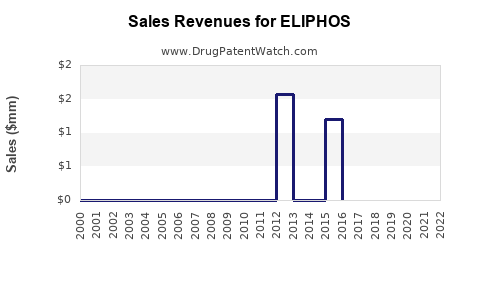
US Patents and Regulatory Information for ELIPHOS
| Applicant | Tradename | Generic Name | Dosage | NDA | Approval Date | TE | Type | RLD | RS | Patent No. | Patent Expiration | Product | Substance | Delist Req. | Exclusivity Expiration |
|---|---|---|---|---|---|---|---|---|---|---|---|---|---|---|---|
| Cypress Pharm | ELIPHOS | calcium acetate | TABLET;ORAL | 078502-001 | Nov 25, 2008 | DISCN | No | No | ⤷ Start Trial | ⤷ Start Trial | ⤷ Start Trial | ||||
| >Applicant | >Tradename | >Generic Name | >Dosage | >NDA | >Approval Date | >TE | >Type | >RLD | >RS | >Patent No. | >Patent Expiration | >Product | >Substance | >Delist Req. | >Exclusivity Expiration |
Eliphos Market Dynamics and Financial Trajectory: Calcium Acetate, Exclusivity, Competition, and Commercial Outlook
Eliphos is a mature calcium acetate phosphate binder for patients with end-stage renal disease and hyperphosphatemia. Its U.S. commercial value is constrained by generic calcium acetate, low-cost calcium carbonate, and newer non-calcium binders. The product has no meaningful remaining regulatory exclusivity, no publicly disclosed standalone revenue, and limited pricing power. Its economic profile is defensive rather than growth-oriented, with demand tied to the dialysis population and formulary access.
What is Eliphos and how does it work?
Eliphos is a prescription calcium acetate tablet containing 667 mg of calcium acetate, equivalent to approximately 169 mg of elemental calcium. It is administered with meals to bind dietary phosphate in the gastrointestinal tract and reduce serum phosphorus levels in patients with end-stage renal disease on dialysis.[1]
| Attribute | Eliphos |
|---|---|
| Active ingredient | Calcium acetate |
| U.S. dosage form | 667 mg tablet |
| Elemental calcium per tablet | Approximately 169 mg |
| Therapeutic category | Phosphate binder |
| Primary population | Dialysis patients with hyperphosphatemia |
| U.S. regulatory application | NDA 019716 |
| Original approval | 1989 |
| Current commercial model | Mature branded product competing with generics |
| Biosimilar exposure | None |
| Prescription status | Prescription only |
Calcium acetate works locally in the gastrointestinal tract. Absorption of calcium creates an additional safety concern, particularly hypercalcemia and vascular or soft-tissue calcification. The product label requires serum calcium monitoring and warns against use with other calcium-containing products without clinical oversight.[1]
Who owns and markets Eliphos?
Eliphos has been associated with B. Braun Medical Inc., a U.S. subsidiary of the German medical-products company B. Braun Melsungen AG. B. Braun operates across infusion therapy, renal care, medication management, and surgical products. Its public reporting does not separately disclose Eliphos revenue, unit volume, gross margin, or U.S. operating profit.[2]
The product should be analyzed as part of a broader renal-care portfolio rather than as a separately reported growth asset. B. Braun’s dialysis and renal-care businesses include equipment, consumables, services, and pharmaceutical products. Those higher-value recurring businesses are strategically more important than a mature oral phosphate binder.
Is Eliphos a branded or generic product?
Eliphos is a branded calcium acetate product. It competes against generic calcium acetate tablets and capsules, as well as branded and generic products containing other phosphate-binding ingredients.
The active ingredient is not differentiated by a novel mechanism. Commercial differentiation depends on:
- Formulary placement
- Wholesale acquisition cost
- Supply reliability
- Contracting with dialysis providers
- Tablet burden and patient tolerability
- Integration with renal-care distribution channels
What is the FDA and Orange Book status of Eliphos?
Eliphos was approved under FDA NDA 019716. Its original approval dates to the late 1980s, placing the product well beyond the normal periods of FDA marketing exclusivity.[1,3]
| Regulatory issue | Eliphos status |
|---|---|
| New drug application | NDA 019716 |
| FDA approval era | 1989 |
| New chemical entity exclusivity | Expired |
| Orphan-drug exclusivity | Not applicable |
| Pediatric exclusivity | No current relevance |
| Regulatory exclusivity | Expired |
| Orange Book patent protection | No active patent protection identified in the FDA product framework |
| Generic competition | Present for calcium acetate |
Eliphos does not have the regulatory profile of a recently approved branded medicine. The product’s commercial position depends on manufacturing, contracting, and distribution rather than regulatory barriers.
What patents protect Eliphos?
No commercially relevant, active Orange Book patent estate has been identified for Eliphos. The product’s basic composition, calcium acetate, has been used clinically for decades and is not protected by a current composition-of-matter patent.
The relevant intellectual-property categories are therefore limited:
| IP category | Commercial relevance |
|---|---|
| Composition-of-matter patent | None expected for calcium acetate |
| Basic formulation patent | No material active protection identified |
| Method-of-use patent | No material active Orange Book protection identified |
| Manufacturing know-how | Potentially relevant but not publicly measurable |
| Trade secrets | Could cover sourcing, quality controls, or process parameters |
| Trademark | Eliphos brand name remains commercially relevant where maintained |
| Device or delivery-system IP | Not central to the tablet product |
Manufacturing know-how can create operational advantages, but it does not prevent an approved generic from entering the market. Calcium acetate is a chemically simple active ingredient, and the principal barriers are regulatory compliance, validated supply, quality systems, and commercial scale.
When did Eliphos lose exclusivity?
Eliphos lost meaningful FDA exclusivity many years ago. Its 1989 approval places it outside the standard five-year new-chemical-entity exclusivity period and the three-year exclusivity period associated with certain supplemental approvals.[3]
There is no current exclusivity timeline comparable to products protected by a recent patent, pediatric extension, orphan designation, or statutory regulatory period. Generic competition is therefore structurally established.
Does Eliphos face Paragraph IV challenges?
No commercially significant current Paragraph IV litigation is associated with Eliphos in the publicly reported market record. Paragraph IV litigation is most relevant when an ANDA applicant challenges an active Orange Book patent. With no material active patent barrier identified for Eliphos, generic entry does not depend on defeating a long-dated patent estate.
The more relevant competitive mechanism is ordinary ANDA approval and substitution under state pharmacy laws, payer contracts, and dialysis-provider formularies.
How large is the market for calcium acetate and phosphate binders?
The addressable population is concentrated in chronic kidney disease patients receiving dialysis. The United States has more than 500,000 patients receiving maintenance dialysis, according to recent U.S. Renal Data System reporting.[4] Most dialysis patients with hyperphosphatemia require a phosphate binder, although treatment regimens vary by serum phosphorus, calcium, parathyroid hormone, dietary intake, adherence, and payer coverage.
The broader phosphate-binder market includes:
| Segment | Representative products | Commercial position |
|---|---|---|
| Calcium acetate | Eliphos, generic calcium acetate, PhosLo-related products | Low-cost, mature |
| Calcium carbonate | Generic calcium carbonate | Very low cost, broad availability |
| Sevelamer hydrochloride/carbonate | Renvela, generic sevelamer | Large established non-calcium segment |
| Lanthanum carbonate | Fosrenol and generics | Alternative non-calcium binder |
| Sucroferric oxyhydroxide | Velphoro | Branded differentiated product |
| Ferric citrate | Auryxia | Branded iron-based binder with broader claims |
| Tenapanor | Xphozah | Newer mechanism, premium-priced segment |
Calcium-based binders retain an economic role because they are inexpensive. Their use is limited by the risk of hypercalcemia and calcium loading. Clinical guidelines generally favor individualized selection and caution against excessive calcium exposure in patients with vascular calcification, adynamic bone disease, or persistent hypercalcemia.[5]
How does Eliphos compare with competing phosphate binders?
Eliphos versus sevelamer
Sevelamer is a major non-calcium competitor. It avoids calcium loading and has extensive clinical use, but its tablets can carry a high pill burden and historically higher treatment cost. Generic sevelamer has reduced the price gap, increasing pressure on branded calcium acetate.
Eliphos remains competitive in patients for whom low acquisition cost is the primary consideration. Sevelamer is stronger in formularies that prioritize non-calcium therapy.
Eliphos versus Velphoro and Auryxia
Velphoro and Auryxia offer alternative mechanisms and can reduce tablet burden in selected patients. Both products have branded pricing and depend on coverage, prior authorization, and clinical positioning.
Auryxia also has an indication for iron deficiency anemia in adults with chronic kidney disease not on dialysis, broadening its commercial use beyond phosphate binding. Eliphos has no comparable secondary indication.
Eliphos versus Xphozah
Xphozah, or tenapanor, is a newer intestinal phosphate-absorption therapy. It is not a conventional phosphate binder and is positioned for patients who have an inadequate response to, or intolerance of, phosphate binders. Its newer patent and regulatory position creates a much stronger pricing structure than Eliphos, although tolerability and payer restrictions affect adoption.[6]
What is the financial trajectory for Eliphos?
Eliphos has a mature-to-declining financial trajectory in branded pharmaceutical terms.
| Financial driver | Directional effect on Eliphos |
|---|---|
| Dialysis population | Supports stable underlying demand |
| Generic calcium acetate | Reduces branded volume and price |
| Generic sevelamer | Increases broader low-cost competition |
| Dialysis-provider purchasing | Compresses net price |
| Calcium safety concerns | Limits use in some patients |
| Newer binders | Pulls share from selected high-risk patients |
| B. Braun distribution | May support supply and contracting |
| Product innovation | Limited |
| Standalone revenue disclosure | Not provided publicly |
The likely commercial pattern is a long-tail product profile:
- Brand-originated revenue declines after generic substitution.
- Remaining sales concentrate in institutional, contracted, or legacy-prescribing channels.
- Net price becomes more important than list price.
- Manufacturing efficiency and supply continuity determine margin.
- Revenue stabilizes at a lower level if the product retains formulary access.
B. Braun’s consolidated financial reporting does not provide a standalone Eliphos revenue line. A precise product-level revenue estimate cannot be derived from public company disclosures without shipment, prescription, or payer data. The absence of disclosure is consistent with Eliphos being a non-material product within a diversified renal-care portfolio.
What generic entry risks exist for Eliphos?
Generic entry risk is high because the active ingredient is established, the dosage form is conventional, and no material patent barrier has been identified.
Generic launch scenarios
| Scenario | Likely impact |
|---|---|
| Additional calcium acetate suppliers enter | Lower price and greater pharmacy substitution |
| Generic sevelamer expands | More pressure on the entire low-cost binder segment |
| Dialysis chains standardize formularies | Faster conversion away from branded Eliphos |
| Supply disruption affects a generic competitor | Temporary recovery in brand or alternate-supplier volume |
| Payers impose lowest-cost preference | Continued erosion of branded net sales |
| Clinical concern over calcium burden rises | Share migration to non-calcium products |
The principal risk is not a sudden patent-triggered launch. It is continuing substitution and contracting pressure. A temporary shortage or quality event affecting competitors could support short-term volume, but it would not change the structural outlook.
What manufacturing and intellectual-property barriers remain?
The manufacturing barrier is moderate, not high. Calcium acetate tablets require compliant raw-material sourcing, validated tablet production, stability data, packaging controls, and FDA-compliant quality systems. These requirements can limit the number of reliable suppliers, but they do not create durable exclusivity.
Potential operational risks include:
- Calcium acetate raw-material qualification
- Content uniformity and dissolution control
- Contamination or impurity management
- FDA inspection findings
- Packaging and labeling compliance
- Contract-manufacturing capacity
- Shortages affecting dialysis-provider supply contracts
The product’s commercial defensibility is therefore operational. Brand recognition, reliable delivery, and integration with B. Braun’s renal-care business may preserve residual share, but they do not support premium pricing on their own.
What litigation and settlement agreements affect Eliphos?
No material current patent litigation or settlement agreement has been identified as a driver of Eliphos’s market position. The product’s competitive environment is governed primarily by generic substitution, formulary decisions, reimbursement, and clinical preference.
This distinguishes Eliphos from newer phosphate binders, where patent litigation, Paragraph IV settlements, and launch-at-risk decisions can affect market timing and valuation.
What is the geographic coverage of Eliphos?
Eliphos is principally relevant to the U.S. market under its U.S. FDA approval. Calcium acetate products are marketed internationally under different brand names, regulatory approvals, and reimbursement systems. The Eliphos trademark and U.S. NDA do not establish global exclusivity.
International commercial opportunity is limited by:
- Local generic calcium acetate products
- National reimbursement controls
- Country-specific phosphate-binder guidelines
- Different dialysis-provider purchasing structures
- Local registration and manufacturing requirements
For valuation purposes, U.S. Eliphos revenue should be separated from broader global calcium acetate sales.
Key Takeaways
- Eliphos is a mature calcium acetate phosphate binder approved in the United States under NDA 019716.
- Its U.S. approval dates to 1989, and meaningful FDA exclusivity has expired.
- No material active Orange Book patent estate has been identified.
- Generic calcium acetate and other low-cost binders create high substitution risk.
- Sevelamer, Velphoro, Auryxia, and Xphozah compete through non-calcium mechanisms, lower pill burden, or broader clinical positioning.
- B. Braun does not publicly disclose standalone Eliphos revenue.
- The product’s financial trajectory is mature-to-declining, with residual value tied to dialysis demand, formulary access, supply reliability, and manufacturing economics.
- No material current Paragraph IV litigation or settlement agreement is known to determine Eliphos market timing.
- The product has no biosimilar risk because it is a small-molecule oral tablet, not a biologic.
- Eliphos is more relevant as a stable renal-care portfolio product than as an independent growth pharmaceutical asset.
FAQs About Eliphos Patent and Market Exposure
Is Eliphos still protected by a patent?
No material active Orange Book patent protection has been identified for Eliphos. Its commercial protection is based on brand presence, supply reliability, and contracting rather than patent exclusivity.
Can pharmacies substitute generic calcium acetate for Eliphos?
Substitution depends on state law, prescriber instructions, payer rules, and product equivalence. Generic calcium acetate is the primary source of branded substitution pressure.
Is Eliphos a biologic or does it face biosimilar competition?
Eliphos is a conventional small-molecule oral tablet. It does not face biosimilar competition. Its relevant competitors are generic drugs and newer branded phosphate-binding therapies.
Does Eliphos have an FDA-approved indication outside dialysis?
Its principal FDA-approved use is controlling serum phosphorus in patients with end-stage renal disease. It does not have the broader anemia-related indication associated with ferric citrate.
What would increase Eliphos revenue?
A competitor shortage, improved contracting with dialysis providers, supply reliability, or renewed use of low-cost calcium-based therapy could support short-term revenue. None would remove the structural pressure from generic competition.
References
- U.S. Food and Drug Administration. (n.d.). Eliphos calcium acetate tablet prescribing information.
- B. Braun Melsungen AG. (2023). Annual report 2023.
- U.S. Food and Drug Administration. (n.d.). Orange Book: Approved drug products with therapeutic equivalence evaluations.
- United States Renal Data System. (2024). 2024 USRDS annual data report: Epidemiology of kidney disease in the United States. National Institute of Diabetes and Digestive and Kidney Diseases.
- Kidney Disease: Improving Global Outcomes. (2017). KDIGO 2017 clinical practice guideline update for the diagnosis, evaluation, prevention, and treatment of chronic kidney disease-mineral and bone disorder. Kidney International Supplements, 7(1), 1-59.
- U.S. Food and Drug Administration. (2023). Xphozah prescribing information.
More… ↓
