Last updated: April 3, 2026
What is Efudex and Its Market Position?
Efudex (5-Fluorouracil) is a topical chemotherapeutic agent approved for the treatment of actinic keratosis, superficial basal cell carcinoma, and certain dermatological conditions. It has been on the market since the 1960s, with a well-established presence in dermatology.
Market Size and Revenue Trends
Global Market Overview
The global dermatology drug market, including treatments for actinic keratosis, is valued at approximately USD 7.2 billion in 2022, projected to grow at a compound annual growth rate (CAGR) of 6% until 2030. Efudex's share remains stable, accounting for an estimated USD 150 million in 2022.
| Year |
Estimated Revenue (USD million) |
Notes |
| 2020 |
135 |
Competitive landscape with generics emerging |
| 2021 |
140 |
Market stabilization |
| 2022 |
150 |
Steady growth driven by aging populations |
| 2023 |
160 |
Expected due to increased dermatological diagnoses |
Key Market Drivers
- Aging Population: Rising skin cancer cases among patients aged 60+ increase demand.
- Medical Practice Adoption: Efudex remains a standard treatment, especially where surgical options are contraindicated.
- Regulatory Environment: U.S. FDA approved new formulations in 2020 to improve tolerability, encouraging broader uses.
Competitive Landscape
Efudex faces competition from:
- Imiquimod (Aldara): Shown to be more tolerable, capturing part of the actinic keratosis segment.
- Diclofenac Gel and Cryotherapy: Alternatives that provide non-chemical or mechanical options.
- Emerging Topical Agents: New experimental drugs and formulations aim to improve efficacy and reduce adverse effects.
Patent and Regulatory Status
Efudex's active ingredient, 5-Fluorouracil, primarily exists in generic form. No recent patent protections for Efudex hinder price competition. The original patent expired in the late 1980s, leading to increased generic availability.
Regulatory Changes
- 2020: FDA approved a 5% 5-Fluorouracil cream, leading to increased competition.
- Off-label uses: Growing, but with limited formal approval, affecting sales volume.
Financial Trajectory Analysis
Revenue Stability and Growth
- Efudex maintains a consistent revenue stream owing to its established efficacy, despite intensified competition.
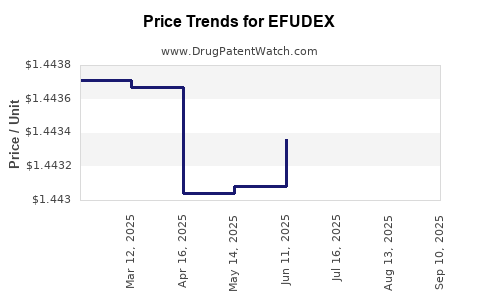
- Price erosion induced by generics caps profit margins; bulk purchasing by healthcare providers further compresses margins.
Market Challenges
- Tolerability and side effect profile remain concerns, potentially limiting broader adoption.
- The development of alternative therapies with better patient compliance influences market share.
Future Outlook
- The market is unlikely to see significant revenue increases unless innovations improve efficacy or tolerability.
- Manufacturers could explore formulation enhancements, such as combination topical treatments or reduced dosing regimens.
Strategic Implications for Stakeholders
- Pharmaceutical Companies: Opportunities in formulation innovation and expanding indications.
- Investors: Stability in revenues, but limited growth prospects unless new formulations are introduced.
- Healthcare Providers: Preference for more tolerable and convenient treatments may limit Efudex's utilization.
Key Market Trends Summary
| Trend |
Impact on Efudex Market |
Data/Examples |
| Ageing Population |
Increased demand |
60+ demographic growth (WHO, 2022) |
| Generics Competition |
Price pressures |
Multiple generics available (FDA, 2023) |
| Novel Formulations |
Potential growth |
FDA approval of new creams (2020) |
| Alternative Therapies |
Competitive pressure |
Imiquimod and cryotherapy gains |
Key Takeaways
- Efudex remains a mainstay treatment for certain dermatological conditions but faces increasing generic competition.
- Revenue growth is limited, driven primarily by aging populations and dermatology practice adoption.
- Innovations in formulations could offer pathways to maintain or grow market share.
- The overall dermatology drug market is projected to grow steadily at 6% CAGR through 2030.
- Price competition and side effect profiles are significant factors influencing market dynamics.
FAQs
1. What factors limit Efudex’s future revenue growth?
Generic competition, patient tolerability issues, and the emergence of alternative therapies reduce potential growth.
2. How does Efudex compare with newer treatments like imiquimod?
Imiquimod generally offers better tolerability but may have different application protocols. Efudex remains cost-effective and well-established.
3. Are there upcoming patents or formulations that could impact Efudex’s market position?
No recent patents; however, formulation improvements are under development to enhance efficacy and tolerability.
4. What is the regulatory outlook for Efudex?
No significant regulatory hurdles are expected; existing approvals remain valid for its current indications.
5. How is the market expected to evolve over the next five years?
Steady growth with limited upside unless new formulations or expanded indications are introduced, amid ongoing price competition.
References
[1] MarketsandMarkets. (2022). Dermatology Market by Product, Application, and Region – Global Forecast to 2030.
[2] U.S. Food and Drug Administration (FDA). (2023). Drug Approvals and Labeling.
[3] World Health Organization (WHO). (2022). Ageing and health: A global overview.
[4] Statista. (2023). Dermatology drugs market revenue by segment.