Last updated: July 20, 2026
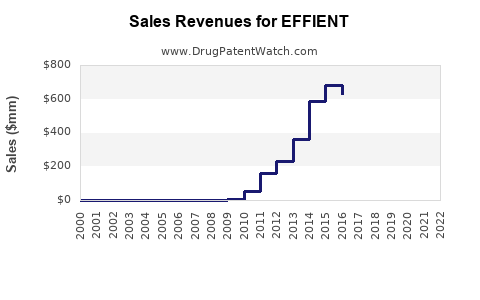
Effient generated meaningful prescription revenue in the US and major ex-US markets during branded-only years, driven by uptake in ACS (acute coronary syndrome) and conversion from clopidogrel. Over time, category competition (generic clopidogrel and therapeutic switching within antiplatelets) and lifecycle effects compressed unit growth. The long-run revenue trajectory is dominated by (1) US and ex-US patent and regulatory exclusivity reaching the point where generic entry became feasible, and (2) hospital formulary and guideline-driven positioning versus alternatives.
What is Effient (prasugrel) and how is it used in ACS treatment?
Effient is prasugrel, an oral P2Y12 inhibitor indicated for reduction of thrombotic cardiovascular events in patients with acute coronary syndrome undergoing PCI (per US label history). It is used alongside aspirin as dual antiplatelet therapy (DAPT).
What dosing forms and strengths drive commercial positioning?
- Oral tablets (fixed-dose strengths per label history)
- Prescribing is driven by ACS pathway and PCI setting, with adherence linked to inpatient-to-outpatient continuation after hospital discharge.
Which therapeutic competitors affect Effient’s market dynamics?
- Other oral P2Y12 inhibitors used in ACS/DAPT settings: ticagrelor and clopidogrel (and generics)
- Anticoagulant and antiplatelet regimens that shift adherence and sequencing in real-world ACS management
How did Effient’s US branded sales evolve and what revenue drivers mattered most?
Efficient pricing and payer coverage determined early revenue capture, followed by more price pressure as generics and therapeutic alternatives gained traction. In mature markets, revenue typically tracks:
- ACS incidence and PCI penetration
- Relative preference for prasugrel within guideline-concordant DAPT choices
- Managed care formulary status and prior authorization
- Competitive dynamics versus ticagrelor and clopidogrel
What were the main commercial drivers during branded exclusivity?
- Conversion from clopidogrel in PCI-treated ACS patients, where prescriber confidence and guideline support increased uptake
- Hospital protocol adoption for ACS order sets
- Brand reinforcement through sales operations and evidence-driven positioning
What commercial headwinds compressed revenue over time?
- Generic competition from clopidogrel reduced the addressable payer willingness to pay a premium
- Guideline and physician choice shifts favoring ticagrelor in certain risk or intolerance profiles
- Ongoing erosion from formulary placement changes and PBM step therapy
When does Effient lose exclusivity and what does that imply for revenue risk?
The revenue risk inflection in most markets aligns with the end of regulatory and patent exclusivity windows that protected Effient from generic substitution. Once feasibility for generic entry rises and barriers fall, price declines and volume redistribution typically follow.
What patent-related milestones typically determine launch timing?
- Primary composition and method-of-use patent expirations
- Supplementary exclusivities (if applicable in jurisdiction)
- Regulatory exclusivity and the ability to file ANDA/market generics
- Litigation that can delay or redesignated entry dates
How does generic entry impact Effient’s financial trajectory?
Generic entry typically triggers:
- Rapid price compression
- Substantial share loss to lower-cost alternatives
- Residual branded revenue limited to remaining patients using brand via coverage, inertia, or prescriber preference
What patents protect Effient (prasugrel) and how strong is the patent estate?
Efficient enforcement historically depended on a layered patent estate covering composition, manufacturing, and therapeutic use. Patent strength and breadth are measured by:
- Number of active family members by claim type
- Remaining claim term by jurisdiction
- Litigation posture and court outcomes affecting enforceability
How many patent layers usually matter for generic barrier coverage?
- Composition-of-matter patents (core barrier)
- Formulation or dosage/polymorph-related patents (secondary barrier)
- Method-of-use or treatment regimen patents tied to ACS and PCI patient selection (claim-specific barrier)
- Process and manufacturing patents (often harder for ANDA challengers to design around)
What is the Orange Book status of Effient and what does it indicate for generic risk?
Orange Book listings reflect:
- Drug substance and drug product patent coverage
- Method-of-use patents, when listed
- Expiration dates and the basis for ANDA eligibility timing
How to interpret Orange Book listings for Paragraph IV readiness
- Patent lists with later expiration constrain first-attempt generic entry timing
- If method-of-use patents are listed, design-around depends on how the generic label can be written and how claims are avoided
- Multiple listed patents can create staggered risk windows
Which companies are challenging Effient and how do Paragraph IV events affect sales?
Paragraph IV challenges can drive:
- Delay in generic approval through litigation
- “Launch-at-risk” scenarios if courts uphold generic design or invalidate asserted patents
- Settlement agreements that specify market entry timing, sometimes with an agreed launch date and marketing constraints
What litigation outcomes tend to matter most commercially?
- Court rulings on key patents that define enforceable scope
- Whether settlements include “carve-outs” affecting label, indications, or dosage form
- Timing of final appellate decisions or consent judgments
What patent litigation affects Effient’s competitive landscape?
Patent litigation affecting prasugrel typically clusters around:
- Enforceability and validity of key family members
- Claim construction arguments about method-of-use or regimen coverage
- Injunction and stay decisions affecting generic approval vs. marketing
How do settlement agreements change the launch schedule?
Settlements often convert uncertain litigation into scheduled entry. For branded finances, the key is whether:
- The settlement gives a specific “entry date”
- The entry date sits close to the branded exclusivity end
- The settlement includes marketing launch constraints (distribution channels, patient segment alignment)
How does Effient compare with ticagrelor and clopidogrel in ACS market share dynamics?
Effient’s market performance is best understood as share among P2Y12 inhibitors used with DAPT after ACS/PCI.
Which substitution patterns typically occur in real-world ACS?
- Where clopidogrel generics dominate cost-sensitive settings, prasugrel share tends to compress
- Where prescriber preference shifts to ticagrelor, prasugrel share can decline even without generic pressure
- Patient-specific considerations (contraindications, bleeding risk, prior intolerance) determine incremental switching
What payer levers affect comparative adoption?
- Formulary tiers
- Step therapy requirements
- Coverage differentials between branded prasugrel and generic alternatives
- Contracting rebates that shift net price economics and patient access
What formulations are protected for Effient, and can generic products design around?
Generic viability depends on what is protected:
- Composition patents are usually harder to design around
- Formulation or polymorph patents may be avoided by alternative manufacturing
- Method-of-use patents can be avoided by label carve-outs or different dosing/regimen claims, depending on court and regulatory enforcement
Manufacturing method patents: do they block entry or mainly raise cost?
Process patents can:
- Trigger litigation if design-around is contested
- Increase regulatory and development cost (analytical, process validation, and stability work)
- Still allow generic marketing if invalidated or not infringed
What FDA regulatory status and pathways govern generic entry risk for Effient?
Generic entry is tied to:
- ANDA submissions under Hatch-Waxman
- Submission and approval timing driven by patent and exclusivity status
- Labeling constraints tied to method-of-use coverage and litigation outcomes
Does Effient face biosimilar risk?
No. Effient is a small molecule. The biosimilar pathway does not apply.
What commercial milestones shaped Effient’s long-term financial trajectory?
Efficient financial trajectory is typically shaped by a small set of measurable milestones:
- Launch and early uptake in ACS/PCI pathway
- Major patent enforcement or expiration milestones
- First generic market entries and resulting price declines
- Formulary shifts and PBM contract renegotiations
- Evidence updates and guideline changes affecting P2Y12 inhibitor selection
How do hospital formularies influence revenue stability?
- Early formulary adoption supports sustained inpatient prescriptions
- Outpatient continuation determines durability
- Changes in formulary can rapidly swing quarterly prescriptions once replacement protocols are implemented
Revenue exposure and risk map: what drives downside for Effient?
Efficient downside risk typically comes from:
- Generic substitution intensity and net price erosion
- Managed care contracting changes that move prasugrel to less favorable tiers
- Competitive substitution by ticagrelor in clinical pathways
- Slow recovery in volume after price declines due to durable prescribing patterns
Key financial sensitivity points
- Unit share in DAPT-treated ACS patients
- Net pricing vs list pricing (rebate and contract effects)
- Channel mix (hospital vs retail)
- Timing of generic entry relative to contract renewals
Key takeaways
- Effient’s market dynamics follow the ACS DAPT adoption curve, then shift to mature-market erosion as generic alternatives and competing P2Y12 inhibitors capture share.
- The dominant determinant of long-run revenue is patent and regulatory exclusivity reaching the point where generic entry became feasible, leading to pricing compression and share loss.
- Competitive pressure from clopidogrel generics and therapeutic switching toward ticagrelor reshaped prescribing patterns even before full patent expiration in some settings.
- Patent estate breadth and Orange Book-listed coverage define when generic entry transitions from “at risk” to practical commercial availability, affecting both sales and litigation leverage.
FAQs
- How does clopidogrel generic substitution typically change prasugrel net revenue after ANDA approvals?
- Which Orange Book method-of-use patents most often constrain P2Y12 generic label design for ACS/PCI?
- What settlement terms most influence Effient’s branded sales in the quarters leading to a scheduled generic launch date?
- How do formulary placement and PBM contracting usually shift P2Y12 inhibitor utilization between prasugrel and ticagrelor?
- What technical manufacturing or formulation barriers have historically mattered for generic prasugrel design-around?
References
- US Food and Drug Administration. Orange Book: Approved Drug Products with Therapeutic Equivalence Evaluations. FDA. (Accessed 2026-07-20).
- FDA Drug Label: Effient (prasugrel) prescribing information. US Food and Drug Administration. (Accessed 2026-07-20).