You're using a free limited version of DrugPatentWatch: Upgrade for Complete Access

Last Updated: April 3, 2026

EDURANT Drug Patent Profile


✉ Email this page to a colleague

« Back to Dashboard


Which patents cover Edurant, and when can generic versions of Edurant launch?

Edurant is a drug marketed by Janssen Prods and is included in two NDAs. There is one patent protecting this drug.

The generic ingredient in EDURANT is rilpivirine hydrochloride. There are seven drug master file entries for this compound. Two suppliers are listed for this compound. Additional details are available on the rilpivirine hydrochloride profile page.

DrugPatentWatch® Litigation and Generic Entry Outlook for Edurant

A generic version of EDURANT was approved as rilpivirine hydrochloride by SOMERSET THERAPS LLC on January 29th, 2026.

  Start Trial

AI Deep Research
Questions you can ask:
  • What is the 5 year forecast for EDURANT?
  • What are the global sales for EDURANT?
  • What is Average Wholesale Price for EDURANT?
Drug patent expirations by year for EDURANT
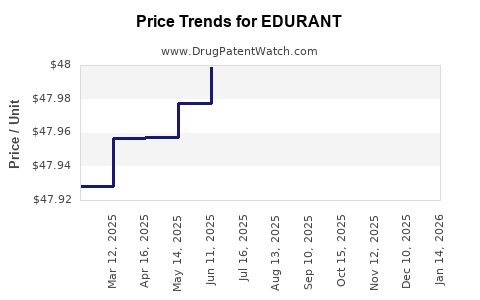
Drug Prices for EDURANT

See drug prices for EDURANT

Recent Clinical Trials for EDURANT

Identify potential brand extensions & 505(b)(2) entrants

SponsorPhase
Aptorum International LimitedPhase 1
National Institute of Allergy and Infectious Diseases (NIAID)Phase 1/Phase 2
ViiV HealthcarePhase 1/Phase 2

See all EDURANT clinical trials

US Patents and Regulatory Information for EDURANT

EDURANT is protected by zero US patents and two FDA Regulatory Exclusivities.

Applicant Tradename Generic Name Dosage NDA Approval Date TE Type RLD RS Patent No. Patent Expiration Product Substance Delist Req. Exclusivity Expiration
Janssen Prods EDURANT rilpivirine hydrochloride TABLET;ORAL 202022-001 May 20, 2011 AB RX Yes Yes ⤷  Start Trial ⤷  Start Trial ⤷  Start Trial
Janssen Prods EDURANT PED rilpivirine hydrochloride TABLET, FOR SUSPENSION;ORAL 219016-001 Mar 15, 2024 RX Yes Yes ⤷  Start Trial ⤷  Start Trial ⤷  Start Trial
Janssen Prods EDURANT rilpivirine hydrochloride TABLET;ORAL 202022-001 May 20, 2011 AB RX Yes Yes ⤷  Start Trial ⤷  Start Trial ⤷  Start Trial
Janssen Prods EDURANT PED rilpivirine hydrochloride TABLET, FOR SUSPENSION;ORAL 219016-001 Mar 15, 2024 RX Yes Yes 11,065,198 ⤷  Start Trial Y ⤷  Start Trial
Janssen Prods EDURANT PED rilpivirine hydrochloride TABLET, FOR SUSPENSION;ORAL 219016-001 Mar 15, 2024 RX Yes Yes ⤷  Start Trial ⤷  Start Trial ⤷  Start Trial
>Applicant >Tradename >Generic Name >Dosage >NDA >Approval Date >TE >Type >RLD >RS >Patent No. >Patent Expiration >Product >Substance >Delist Req. >Exclusivity Expiration

Expired US Patents for EDURANT

Applicant Tradename Generic Name Dosage NDA Approval Date Patent No. Patent Expiration
Janssen Prods EDURANT rilpivirine hydrochloride TABLET;ORAL 202022-001 May 20, 2011 6,838,464 ⤷  Start Trial
Janssen Prods EDURANT rilpivirine hydrochloride TABLET;ORAL 202022-001 May 20, 2011 8,101,629 ⤷  Start Trial
Janssen Prods EDURANT rilpivirine hydrochloride TABLET;ORAL 202022-001 May 20, 2011 7,067,522 ⤷  Start Trial
Janssen Prods EDURANT rilpivirine hydrochloride TABLET;ORAL 202022-001 May 20, 2011 8,080,551 ⤷  Start Trial
Janssen Prods EDURANT rilpivirine hydrochloride TABLET;ORAL 202022-001 May 20, 2011 7,638,522 ⤷  Start Trial
>Applicant >Tradename >Generic Name >Dosage >NDA >Approval Date >Patent No. >Patent Expiration

International Patents for EDURANT

See the table below for patents covering EDURANT around the world.

Country Patent Number Title Estimated Expiration
Croatia P20120499 ⤷  Start Trial
Eurasian Patent Organization 200700534 ФУМАРАТ 4-[[4-[[4-(2-ЦИАНОЭТЕНИЛ)-2,6-ДИМЕТИЛФЕНИЛ]АМИНО]-2-ПИРИМИДИНИЛ]АМИНО]БЕНЗОНИТРИЛА ⤷  Start Trial
South Korea 20070074555 HYDROCHLORIDE OF 4-((4-(4-(2-CYANOETHENYL)-2,6-DIMETHYLPHENYL)AMINO)-2-PYRIMIDINYL)AMINO)BENZONITRILE ⤷  Start Trial
Poland 368270 Pochodne pirymidyn hamujące wirusa HIV (HIV INHIBITING PYRIMIDINES DERIVATIVES) ⤷  Start Trial
Cyprus 1116565 ⤷  Start Trial
>Country >Patent Number >Title >Estimated Expiration

Supplementary Protection Certificates for EDURANT

Patent Number Supplementary Protection Certificate SPC Country SPC Expiration SPC Description
1663240 PA2016044 Lithuania ⤷  Start Trial PRODUCT NAME: RILPIVIRINAS + EMTRICITABINAS + TENOFOVIRO ALAFENAMIDAS; REGISTRATION NO/DATE: EU/1/16/1112 20160621
3808743 CR 2022 00035 Denmark ⤷  Start Trial PRODUCT NAME: KOMBINATION AF RILPIVIRIN ELLER ET FARMACEUTISK ACCEPTABELT ADDITIONSSALT AF RILPIVIRIN, HERUNDER RILPIVIRINHYDROCHLORID, OG EMTRICITABIN; REG. NO/DATE: EU/1/11/737/001-002 20111128
3808743 PA2022515,C3808743 Lithuania ⤷  Start Trial PRODUCT NAME: RILPIVIRINO ARBA FARMACINIU POZIURIU PRIIMTINOS PRIDETINES RILPIVIRINO DRUSKOS, ISKAITANT RILPIVIRINO HIDROCHLORIDO RUGSTIES DRUSKA, IR EMTRICITABINO DERINYS; REGISTRATION NO/DATE: EU/1/11/737/001-002 20111128
1419152 CA 2012 00021 Denmark ⤷  Start Trial
1663240 122015000088 Germany ⤷  Start Trial PRODUCT NAME: KOMBINATION VON RILPIVIRIN ODER EINEM PHARMAZEUTISCH VERTRAEGLICHEN SALZ VON RILPIVIRIN, EINSCHLIESSLICH DES HYDROCHLORIDSALZES VON RILPIVIRIN, TENOFOVIR, INSBESONDERE TENOFOVIRDISOPROXILFUMARAT, UND EMTRICITABIN; REGISTRATION NO/DATE: EU/1/11/737/001-002 20111128
>Patent Number >Supplementary Protection Certificate >SPC Country >SPC Expiration >SPC Description

EDURANT: Patent Expirations and Market Landscape

Last updated: February 19, 2026

Edurant (rilpivirine) is a non-nucleoside reverse transcriptase inhibitor (NNRTI) used in the treatment of human immunodeficiency virus type 1 (HIV-1) infection. Its patent exclusivity has significantly influenced its market penetration and competitive positioning.

What is Edurant's Current Patent Status and Projected Expiry?

Edurant's primary patents have either expired or are nearing expiration, impacting its market exclusivity. The key patents governing rilpivirine compositions of matter and methods of use have faced challenges and expirations, opening the door for generic competition.

  • Composition of Matter Patent: US Patent 7,351,828, covering the rilpivirine compound itself, was filed on December 22, 2004, and issued on April 1, 2008. Its initial term would have expired in 2028. However, patent term extensions (PTEs) and adjustments may alter the effective expiry date.
  • Method of Use Patents: Additional patents relate to specific uses and formulations of rilpivirine. For instance, patents covering combination therapies involving rilpivirine have also been critical.
  • Generic Entry: The expiration of foundational patents allows for the introduction of generic versions of rilpivirine. Data from regulatory filings and generic manufacturer applications indicate that multiple generic competitors have entered or are preparing to enter the market. For example, Teva Pharmaceutical Industries Ltd. and Viatris Inc. have been identified as entities with approved or pending Abbreviated New Drug Applications (ANDAs) for generic rilpivirine [1]. The specific dates of generic approval and launch vary by jurisdiction and patent challenge outcomes.
  • Data Exclusivity: Beyond patent protection, regulatory data exclusivity periods can also extend market protection. For Edurant, the initial period of market exclusivity granted by regulatory agencies (e.g., FDA in the U.S.) has largely elapsed for its initial indication.

How Has Edurant's Market Performance Evolved?

Edurant's market performance has been shaped by its therapeutic value, clinical trial data, and the competitive landscape of HIV treatment.

  • Sales Trajectory: Following its U.S. approval in January 2013, Edurant, primarily marketed by Janssen Pharmaceuticals (a subsidiary of Johnson & Johnson), experienced a period of growth. Global net sales for Edurant were reported by Johnson & Johnson in their financial statements. For instance, in 2021, Edurant reported global sales of approximately $593 million [2]. In 2022, this figure saw a decline, with reported global sales of approximately $466 million [3]. This downward trend is indicative of increased generic competition and market saturation.
  • Combination Products: Edurant is frequently used in fixed-dose combination therapies, such as Complera/Eviplera (with emtricitabine and tenofovir disoproxil fumarate) and Odefsey (with emtricitabine and tenofovir alafenamide). The sales performance of these combination products is intrinsically linked to Edurant's market share. The performance of these co-formulations has also seen shifts due to patent expirations and the introduction of newer, potentially more convenient or effective, combination regimens. For example, sales of Odefsey, which contains rilpivirine, were reported as approximately $1.12 billion in 2021 and $1.05 billion in 2022 [2, 3].
  • Prescription Trends: Prescription data from market analysis firms tracks the volume of prescriptions filled for Edurant and its combination products. These trends reflect physician prescribing patterns and patient adherence. Declining prescription volumes for standalone Edurant are a direct consequence of the availability of generic rilpivirine and the emergence of alternative treatment options with improved efficacy, tolerability, or dosing convenience.

What is the Competitive Environment for Rilpivirine and its Alternatives?

The market for HIV treatments is highly competitive, with continuous innovation leading to a dynamic landscape.

  • Generic Rilpivirine: The primary competitive pressure on Edurant comes from the availability of generic rilpivirine. These generic versions offer a lower price point, making them attractive to payers and healthcare systems focused on cost containment. The U.S. Food and Drug Administration (FDA) has approved multiple ANDAs for rilpivirine tablets, facilitating market entry for these lower-cost alternatives [1].
  • Fixed-Dose Combinations (FDCs): Edurant's utility is largely realized through FDCs. Competitors offer a range of FDCs that compete directly with Edurant-containing regimens. These include:
    • Integrase Strand Transfer Inhibitors (INSTIs): Regimens based on INSTIs, such as dolutegravir (e.g., Triumeq), bictegravir (e.g., Biktarvy), and cabotegravir (e.g., Cabenuva, a long-acting injectable), have become preferred first-line options for many patients due to their high efficacy, favorable tolerability profiles, and lower rates of drug resistance.
    • Other NNRTIs: While rilpivirine is an NNRTI, newer generations or different classes of antiretrovirals offer distinct advantages.
    • Long-Acting Injectables: The development of long-acting injectable HIV therapies, such as cabotegravir and rilpivirine (Cabenuva), represents a significant competitive advancement, offering an alternative to daily oral pills. Cabenuva, a combination of cabotegravir and rilpivirine, provides a monthly or every-other-month injection option [4]. This innovation directly competes with oral rilpivirine formulations by offering enhanced convenience and potentially improved adherence for select patient populations.
  • Market Share Shifts: Clinical guidelines from organizations like the U.S. Department of Health and Human Services (DHHS) often recommend newer drug classes like INSTIs as preferred initial therapy for HIV-1 infection. These recommendations, supported by robust clinical data demonstrating superior efficacy and safety profiles, contribute to market share shifts away from older drug classes, including older NNRTIs like rilpivirine. The market share of rilpivirine-based regimens has been impacted by the strong uptake of INSTI-based therapies and the advent of long-acting injectables.

What are the Financial Implications of Edurant's Market Dynamics?

The financial trajectory of Edurant is directly influenced by patent expirations, generic competition, and the evolving treatment paradigm in HIV.

  • Revenue Decline: With the advent of generic rilpivirine and the strong performance of newer antiretroviral agents, the revenue generated from Edurant, both as a standalone product and within FDCs, has been on a downward trend. Johnson & Johnson's financial reports reflect this decrease in sales for Edurant and its related products [2, 3].
  • Impact on R&D Investment: The declining revenue from older drugs like Edurant can influence future R&D investment strategies for pharmaceutical companies. Companies may shift focus towards developing novel therapeutics or next-generation FDCs that offer significant clinical advantages and command premium pricing.
  • Generic Manufacturer Opportunity: The expiration of Edurant's patents presents a significant opportunity for generic pharmaceutical manufacturers. These companies can leverage the established efficacy of rilpivirine and offer a cost-effective alternative, capturing a portion of the market previously held by the originator product. The profitability for generic manufacturers is typically driven by volume and lower cost of goods.
  • Payer Strategy: Payers, including government health programs and private insurers, are incentivized to promote the use of lower-cost generic alternatives and preferred newer agents based on cost-effectiveness and clinical outcomes. This strategy further compresses the market for the branded originator product.

What is the Future Outlook for Rilpivirine-Based Therapies?

The future of rilpivirine-based therapies will depend on its continued role in specific treatment niches and the performance of emerging formulations.

  • Niche Indications and Patient Populations: Rilpivirine may continue to be a viable option for certain patient populations, particularly those who have demonstrated tolerability and efficacy on the drug and where cost is a primary consideration. It remains an approved component of FDCs like Odefsey and in combination with tenofovir alafenamide.
  • Long-Acting Injectables: The long-acting injectable formulation of rilpivirine (in combination with cabotegravir) is a key driver for the drug's continued relevance. The success of Cabenuva in gaining market adoption will influence the demand for rilpivirine in an injectable form, potentially offsetting declines in oral formulations. Market penetration of long-acting injectables is expected to grow as healthcare systems adapt to this new modality of treatment [4].
  • Generic Market Share: Generic rilpivirine is expected to maintain a significant market share, particularly in markets where cost is a major determinant of treatment choice. The competition among generic manufacturers will likely lead to further price reductions.
  • Competition from Novel Agents: The ongoing development of new antiretroviral drugs and treatment strategies, including novel mechanisms of action and improved long-acting formulations, will continue to challenge the market position of all existing therapies, including rilpivirine.

Key Takeaways

  • Edurant's foundational patents have expired or are expiring, facilitating the entry of generic rilpivirine.
  • Global sales of Edurant have declined, reflecting increased generic competition and the shift towards newer HIV treatment regimens.
  • Rilpivirine's primary market utility is now largely within fixed-dose combinations and the long-acting injectable Cabenuva.
  • Integrase strand transfer inhibitors (INSTIs) and long-acting injectables represent significant competitive threats to older NNRTI-based therapies.
  • The financial future of rilpivirine is tied to the performance of its generic versions and its incorporation into novel delivery systems.

Frequently Asked Questions

  1. When did Edurant receive its initial FDA approval? Edurant received U.S. Food and Drug Administration approval in January 2013.
  2. What is the primary mechanism of action for Edurant? Edurant is a non-nucleoside reverse transcriptase inhibitor (NNRTI) that works by blocking the activity of reverse transcriptase, an enzyme HIV needs to replicate itself.
  3. Are there any pediatric indications for Edurant? As of recent approvals, Edurant is indicated for the treatment of HIV-1 infection in treatment-naïve adult patients, and in certain treatment-experienced adult patients. Specific pediatric approvals and their associated patent considerations would require a detailed review of regulatory filings.
  4. What are the main side effects associated with rilpivirine? Common side effects include rash, depression, insomnia, and elevated liver enzymes. More serious side effects can occur, and patient monitoring is essential.
  5. How does the long-acting injectable form of rilpivirine (Cabenuva) differ from oral Edurant? Cabenuva is a co-formulation of cabotegravir and rilpivirine administered via intramuscular injection, typically monthly or every other month, offering an alternative to daily oral dosing for eligible patients.

Citations

[1] U.S. Food and Drug Administration. (n.d.). Abbreviated New Drug Applications (ANDAs). Retrieved from FDA website. (Note: Specific ANDA numbers and approval dates would need to be accessed through FDA's public databases or specific product information.)

[2] Johnson & Johnson. (2022). 2021 Annual Report on Form 10-K. U.S. Securities and Exchange Commission.

[3] Johnson & Johnson. (2023). 2022 Annual Report on Form 10-K. U.S. Securities and Exchange Commission.

[4] ViiV Healthcare. (n.d.). Cabenuva Prescribing Information. Retrieved from ViiV Healthcare website. (Note: Specific product information and prescribing details are found in the official product labeling.)

More… ↓

⤷  Start Trial

Make Better Decisions: Try a trial or see plans & pricing

Drugs may be covered by multiple patents or regulatory protections. All trademarks and applicant names are the property of their respective owners or licensors. Although great care is taken in the proper and correct provision of this service, thinkBiotech LLC does not accept any responsibility for possible consequences of errors or omissions in the provided data. The data presented herein is for information purposes only. There is no warranty that the data contained herein is error free. We do not provide individual investment advice. This service is not registered with any financial regulatory agency. The information we publish is educational only and based on our opinions plus our models. By using DrugPatentWatch you acknowledge that we do not provide personalized recommendations or advice. thinkBiotech performs no independent verification of facts as provided by public sources nor are attempts made to provide legal or investing advice. Any reliance on data provided herein is done solely at the discretion of the user. Users of this service are advised to seek professional advice and independent confirmation before considering acting on any of the provided information. thinkBiotech LLC reserves the right to amend, extend or withdraw any part or all of the offered service without notice.