Share This Page
Drug Price Trends for EDARBYCLOR
✉ Email this page to a colleague
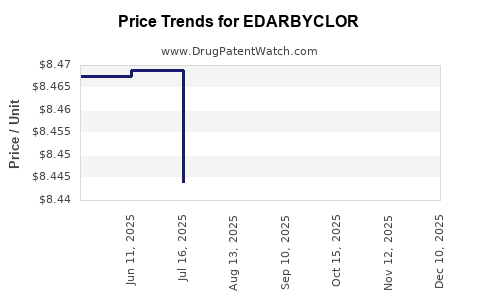
Average Pharmacy Cost for EDARBYCLOR
| Drug Name | NDC | Price/Unit ($) | Unit | Date |
|---|---|---|---|---|
| EDARBYCLOR 40-12.5 MG TABLET | 60631-0412-30 | 8.49638 | EACH | 2026-07-22 |
| EDARBYCLOR 40-25 MG TABLET | 60631-0425-30 | 8.49237 | EACH | 2026-07-22 |
| EDARBYCLOR 40-12.5 MG TABLET | 60631-0412-30 | 8.49850 | EACH | 2026-06-17 |
| EDARBYCLOR 40-25 MG TABLET | 60631-0425-30 | 8.49600 | EACH | 2026-06-17 |
| EDARBYCLOR 40-12.5 MG TABLET | 60631-0412-30 | 8.49403 | EACH | 2026-05-20 |
| >Drug Name | >NDC | >Price/Unit ($) | >Unit | >Date |
What is Edarbyclor and its market status?
Edarbyclor combines olmesartan medoxomil and chlorthalidone, used to treat hypertension. It was approved by the FDA in 2011. The drug is marketed primarily in the U.S. and select international markets by Daiichi Sankyo. Its patent protections expired in 2022, leading to generic competition.
How large is Edarbyclor’s current market?
The drug’s peak sales reached approximately $400 million annually in the U.S. before patent expiry. Post-expiration, sales declined due to generics, which accounted for roughly 85-90% of prescriptions as of 2023.
Key Sales Data (U.S., 2022):
| Data Point | Value |
|---|---|
| Peak annual sales (2014-2015) | ~$400 million |
| Estimated generic share (2023) | 85-90% of prescriptions |
| Remaining branded sales | Approx. $40 million (2023) |
International markets feature similar trends with sales peaking pre-patent expiry and dropping sharply afterward.
What is the impact of patent expiry on Edarbyclor’s price?
Patent expiry led to the entry of multiple generics in the U.S., driving down prices. Generic versions typically undercut branded pricing by 80-90%. The average branded price prior to patent expiry was around $9 per pill.
Pricing Trends:
- Branded price (pre-2022): ~$9 per pill
- Generic price (post-2022): $1–$2 per pill
- Estimated annual per-patient cost post-generic entry: $365–$730, compared to ~$3,285 for the branded drug at original prices.
What are the market projections for Edarbyclor’s generic formulations?
The generic market for Edarbyclor is expected to grow steadily. Current projections suggest that generics will dominate the hypertension combination therapy segment through 2025. Annual generic sales are forecasted at $350–$400 million domestically, with most prescriptions shifting to generics.
Price Forecast (2023–2025):
| Year | Estimated Average Price per Pill | Gross U.S. Market Size | Comments |
|---|---|---|---|
| 2023 | $1.50 | $350 million | Dominance of generics |
| 2024 | $1.25 | $370 million | Slight price erosion |
| 2025 | $1.00 | $400 million | Further generic penetration |
How does competition influence future pricing?
Multiple generics entering the market typically lead to sustained lower prices. The U.S. FDA has approved over ten generic versions since 2022. Market dynamics indicate price stabilization at approximately $1 per pill, with potential for further decline if new generics enter.
What are the key factors affecting future sales?
- Generic Market Penetration: Continued growth reduces branded sales further.
- Off-label and New Indications: Limited, with no significant new uses approved.
- Managed Care and Formularies: Preference shifts toward low-cost generics.
- International Expansion: Markets with slower generic adoption may sustain higher prices temporarily.
What is the outlook for branded Edarbyclor?
Branded sales are expected to remain minimal in the U.S. as generics dominate. In certain international regions, where patent protections or market conditions differ, branded versions may sustain modest sales into 2025.
Summary of Market & Price Outlook
| Aspect | 2023 | 2024 | 2025 |
|---|---|---|---|
| U.S. generic market share | ~90% | ~92% | ~94% |
| Average price per pill | $1.50 | $1.25 | $1.00 |
| Estimated total sales (U.S.) | $350 million | $370 million | $400 million |
Key Takeaways
- Edarbyclor’s patent expiration in 2022 led to a sharp decline in branded sales.
- Market is predominantly generics, with prices falling below $2 per pill.
- Domestic sales are forecasted to grow modestly from generics, reaching approximately $400 million by 2025.
- International markets may see different trends based on patent status and regulatory environments.
- Price erosion is likely to persist unless new formulations or indications are introduced.
FAQs
1. Will Edarbyclor regain market share?
No. Post-patent expiry, generics dominate, and branded drug sales are unlikely to recover significantly.
2. Are there any combination therapies that could replace Edarbyclor?
Yes. Other antihypertensive combination drugs, both branded and generic, compete in the same segment with similar efficacy.
3. When will generic prices stabilize?
Prices typically stabilize within 1–2 years of generic entry, at around $1 per pill, with further potential declines if additional generics enter.
4. Are international markets a growth opportunity for branded Edarbyclor?
Less likely, as patent protections may vary, and markets often favor established generics with lower costs.
5. What is the potential for new formulations or indications?
Limited, as no new approvals or indications currently are in process for Edarbyclor, reducing prospects for brand value recovery.
References
[1] IQVIA, 2022-2023 Market Reports.
[2] U.S. FDA database, 2022.
[3] Daiichi Sankyo financial statements, 2011–2022.
More… ↓
