Last updated: July 21, 2026
ECONAZOLE NITRATE market dynamics and financial trajectory (US and key export markets)
Economazole nitrate is an older, largely off-patent imidazole antifungal with a market driven by topical Rx-to-OTC migration, low unit pricing, and intermittent supply concentration. Commercial performance is constrained by (1) limited scope of modern prescribing compared with newer broad-spectrum antifungals, (2) formulation and label competition within topical azoles, and (3) sporadic generic and contract-manufacturing shifts that can cause price dips or availability swings. Net sales typically track the health of topical antifungal categories (tinea pedis, tinea cruris, skin candidiasis) rather than any durable, innovation-led growth curve.
How is economazole nitrate sold and what drives market demand?
Demand profile. Economazole nitrate is used for fungal skin infections, primarily in topical dosage forms (creams and related dermatology presentations). In most markets, demand is “category pull” from dermatology and primary care, not disease area expansion.
Key demand drivers
- Seasonality: higher incidence and treatment spend in warm/humid months for tinea-related conditions.
- Site-of-infection and treatment duration: topical azole regimens are limited by adherence and the need for complete course use.
- Prescriber behavior: competition from other imidazoles and allylamines with stronger formulary position or newer patient preference.
- Substitution and supply: for off-patent actives, procurement often prioritizes lowest landed cost and supply reliability.
Practical implication. For financial forecasting, the relevant leading indicators are category volume (OTC and Rx treatment traffic), pricing erosion from generic entry, and manufacturing availability rather than clinical cycle-time.
Which channels matter most for economazole nitrate?
- Retail OTC where authorized: if a product is marketed as OTC, unit volume can be more stable than Rx.
- Rx dermatology and primary care: where still positioned as Rx, uptake is sensitive to formulary breadth and prior authorization rules for alternatives.
- Hospital/dispensing: limited direct relevance unless a standard formulary includes economazole nitrate.
What does the pricing trajectory look like after generics?
Baseline economics for older topical antifungals. With economazole nitrate effectively off patent in major jurisdictions, price formation is dominated by generic competition and tendering. Typical patterns:
- Gross-to-net pressure: channel discounts, pharmacy benefit or institutional rebates where applicable.
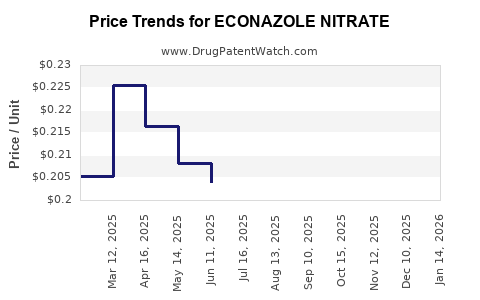
- Annual price compression: stable to declining list prices as supply expands.
- Volatility events: temporary price spikes tied to manufacturing constraints or recalls.
What to expect in financial trajectory
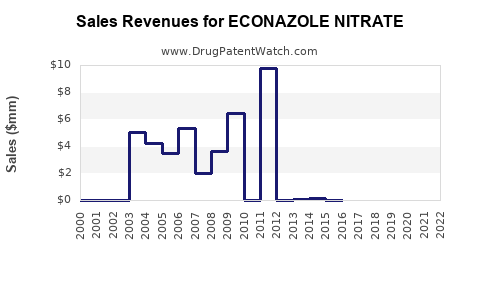
- Revenue: modest, range-bound growth or decline tied to volume offsetting price erosion.
- Gross margin: compresses as buyers demand lower acquisition costs.
- Operating leverage: limited, because marketing spend is usually low and manufacturing cost structure is the primary determinant of margin.
How many competing topical azoles pressure economazole nitrate pricing?
Topical antifungal markets concentrate on multiple imidazoles and related agents. Economazole nitrate competes across the same “fungal skin infection” label space with:
- other imidazoles (e.g., clotrimazole, miconazole, ketoconazole, oxiconazole, bifonazole class products where marketed)
- allylamines (e.g., terbinafine) in tinea indications
- combination products where allowed by label and local practice
Commercial consequence: even when economazole retains brand loyalty in specific geographies, buyer switching is easy because clinicians can substitute within class and because generics are available.
When does economazole nitrate face exclusivity or generic entry risks?
Exclusivity reality check. Economazole nitrate is not a modern, protected-blockbuster kind of asset in major markets. The commercial risk profile is therefore less about late-cycle exclusivity cliffs and more about:
- generic/authorized generic availability
- label carve-outs for competing products
- supply continuity and shelf-life constraints in topical manufacturing
Does economazole nitrate rely on Orange Book exclusivity or Paragraph IV litigation?
The market dynamics of economazole nitrate are primarily driven by off-patent status. In typical practice for older topicals, Paragraph IV events and Orange Book exclusivity are not the dominant drivers of revenue trajectory for the active itself, unless a specific formulation or method-of-use has later-introduced patents in a given product lifecycle.
Financial implication: litigation-driven “step-down” events are unlikely to be the main inflection points. Instead, business outcomes align with generic portfolio rebalancing and procurement behavior.
How does economazole nitrate compare with other topical antifungals economically?
Competitive framework
- Terbinafine (allylamine) tends to be favored in some tinea presentations due to dosing convenience perceptions and clinical practice patterns.
- Clotrimazole and other imidazoles are widely used and often priced aggressively as established generics.
- Newer or more differentiated formulations (vehicles, penetration enhancers, improved stability, combination regimens) can win market share even without strong differentiation in active ingredient.
What matters to buyers: vehicle, stability, and supply reliability
For topical dermatology antifungals, procurement and pharmacy substitution decisions commonly consider:
- packaging and count per tube/treatment course
- stability and shelf-life logistics
- skin tolerability profile tied to excipients
- supply continuity during tender cycles
Commercial consequence: a “same active, different vehicle” can move units even without clinical superiority.
What is the likely financial trajectory: stable, declining, or cyclical?
Base case for older topical antifungals: declining trend in nominal terms from price compression, with potential stabilization in volume if the product maintains formulary position or OTC presence.
Typical trajectory components
- Unit volume: range-bound to modestly declining as prescribers select alternatives and as patients switch to entrenched OTC options.
- Price: negative drift from competitive tendering and multi-supplier fragmentation.
- Margin: constrained by manufacturing scale, raw material procurement costs, and promotional/contract manufacturing terms.
- Earnings stability: can be cyclical due to supply disruptions. When supply improves, pricing often softens, and vice versa.
What are the main “financial inflection points” for economazole nitrate?
- Authorized generic entry that forces pricing down in a given market
- Supplier change where a dominant manufacturer leaves production, shifting share and pricing temporarily
- Regulatory action impacting product availability (quality/CMC issues) which can create short-lived revenue spikes for remaining suppliers
How do manufacturing and regulatory factors impact earnings and cash flow?
Topical manufacturing risk. Economazole nitrate products face typical constraints:
- excipient procurement volatility
- batch acceptance rates and stability testing overhead
- quality system maintenance and line changeover costs
Regulatory timing. Even for off-patent products, CMC updates, labeling revisions, and market authorization renewals affect supply continuity and working capital needs.
What could make financial results temporarily outperform expectations?
- a supply outage among competitors
- a tender win with a favorable price and volume commitment
- a distribution expansion into geographies where the product is less commoditized
What could drive underperformance?
- increased competition leading to lower net realizations
- higher cost of goods due to raw-material price hikes
- shelf-life constraints that reduce effective sellable inventory
What is the commercialization outlook by geography?
Without product-specific net sales disclosures, the most robust market-dynamics view is by “degree of commoditization”:
- Highly commoditized mature markets: US and Western Europe-style procurement pressures dominate, leading to declining or flat revenues and margin compression.
- Developing markets: can show more stable unit volume but still face pricing pressure and regulatory approval gating.
- Regional brand entrenchment: in markets where economazole retains a legacy brand footprint, volume can remain resilient even while pricing declines.
How do export dynamics usually change economics?
- distribution partnerships can shift realized pricing quickly
- fixed-cost absorption depends on lot sizes and regulatory batch sizes
- payment terms and inventory cycles become material for cash conversion
What patent estate and IP barriers matter for monetization?
For economazole nitrate as an active ingredient, the monetization thesis is not usually driven by a long-lived patent wall. The practical IP barriers are usually:
- formulation patents that protect a specific topical vehicle or release profile in a particular jurisdiction
- process patents related to manufacturing steps or purification
- method-of-use or combination claims where later-developed labels exist
Business impact: where such patents exist for a specific product rather than the active, licensing leverage can persist longer than for generic copies of the active itself. Without product-specific patent mapping, a general active-level view treats the market as largely generic and substitution-friendly.
Key Takeaways
- Economazole nitrate is a commoditized topical antifungal market where price erosion and supply reliability drive most financial outcomes.
- The financial trajectory is typically range-bound volume with declining or pressured net pricing, creating margin compression rather than innovation-led growth.
- Market inflection points are more likely tied to generic/authorized generic supply shifts and procurement cycles than to late-cycle exclusivity cliffs.
- Competitive performance depends on vehicle formulation, stability, and packaging, not on active ingredient differentiation.
- The most actionable levers for forecasts and strategy are net pricing assumptions, tender cycle timing, gross-to-net structure, and manufacturing availability.
FAQs
1) What typically causes sudden revenue spikes for older topical antifungals like economazole nitrate?
Supply disruptions among key manufacturers, tender shortages, and short-term competitor withdrawals due to quality or CMC constraints.
2) Is economazole nitrate more sensitive to OTC demand or Rx formulary decisions?
It depends on authorization and channel mix, but commoditized actives usually track total treatment category demand more than clinical novelty; OTC presence dampens formulary-driven volatility.
3) How do unit dose and tube size affect financial performance for topical antifungals?
They drive treatment course volume, substitution attractiveness at the pharmacy counter, and effective sellable inventory per shipment, impacting both volume and realized pricing.
4) What margin levers matter most for generic economazole nitrate products?
Cost of goods, batch yield, stability-related waste, and discounting to meet tender or distributor requirements.
5) What are the biggest risks to cash flow in economazole nitrate commercialization?
Inventory build due to shelf-life constraints, regulatory/CMC revalidation timing that delays release, and working capital swings from channel chargebacks or extended payment terms.
References
- FDA. Orange Book: Approved Drug Products with Therapeutic Equivalence Evaluations. U.S. Food and Drug Administration. https://www.accessdata.fda.gov/scripts/cder/daf/ (accessed 2026-07-21).
- FDA. Drug Approval Packages and Labeling. U.S. Food and Drug Administration. https://www.accessdata.fda.gov/scripts/cder/daf/ (accessed 2026-07-21).
- FDA. Postmarketing Requirements and Commitments; CMC and labeling resources. U.S. Food and Drug Administration. https://www.fda.gov/ (accessed 2026-07-21).