Last updated: August 7, 2026
DYANAVEL XR 10 mg/mL is a branded extended-release amphetamine oral suspension marketed by Tris Pharma for attention-deficit/hyperactivity disorder. Its commercial value comes from liquid delivery, flexible dose titration, and access to patients who have difficulty swallowing tablets or capsules. The product operates in a crowded stimulant market dominated by generic amphetamine and methylphenidate products, Vyvanse, and other branded liquid formulations.
Tris Pharma does not publicly disclose DYANAVEL XR product-level sales. The available evidence supports a product with a defensible niche, but not a major disclosed revenue franchise. Its financial trajectory depends on continued prescriber adoption, reliable controlled-substance supply, payer coverage, protection against generic liquid amphetamine products, and the ability to maintain pricing over the remaining patent period.
What is DYANAVEL XR 10 mg/mL?
DYANAVEL XR is an extended-release oral suspension containing amphetamine. The 10 mg/mL concentration allows patients to receive a prescribed dose in a smaller liquid volume than the original lower-concentration product.
| Attribute |
DYANAVEL XR 10 |
| Active ingredient |
Amphetamine, extended release |
| Dosage form |
Oral suspension |
| Concentration |
10 mg/mL |
| Therapeutic area |
ADHD |
| Sponsor and marketer |
Tris Pharma |
| FDA pathway |
New Drug Application 207946 |
| Approval |
FDA approval in 2015 for DYANAVEL XR |
| Drug class |
Central nervous system stimulant |
| Controlled-substance schedule |
Schedule II |
| Primary commercial use |
Pediatric and adult ADHD treatment |
| Biosimilar exposure |
None; DYANAVEL XR is a small-molecule drug |
| Main alternatives |
Generic amphetamine salts, Vyvanse, Adderall XR, Quillivant XR, Quillichew ER, Concerta, Jornay PM and Mydayis |
The FDA label identifies DYANAVEL XR as an extended-release amphetamine product for ADHD in patients age six and older. The product requires individualized titration because amphetamine exposure, appetite effects, cardiovascular effects and behavioral responses vary substantially among patients. (U.S. Food and Drug Administration, 2023a)
How large is the market for liquid ADHD stimulants?
The addressable market is the broader U.S. ADHD stimulant market, but DYANAVEL XR competes for a narrower segment requiring a liquid or flexible-dose formulation.
The main demand drivers are:
- Continued ADHD diagnosis and treatment among children and adults.
- Patients unable to swallow solid oral dosage forms.
- Need for dose titration below standard tablet or capsule strengths.
- Treatment switching caused by shortages, adverse effects or inadequate duration.
- Greater use of long-acting formulations to reduce school-day and workday dosing.
- Prescriber interest in formulations that provide smoother exposure than immediate-release products.
The market is structurally competitive. Generic mixed amphetamine salts and methylphenidate products set a low-price reference point. Branded products compete through duration, delivery technology, dose flexibility, tolerability, convenience and payer positioning.
DYANAVEL XR is differentiated from tablets and capsules by its liquid format. It also competes directly with Quillivant XR, a methylphenidate extended-release suspension marketed by NextWave Pharmaceuticals and later associated with Tris Pharma, and with liquid or chewable products such as Quillichew ER.
How does DYANAVEL XR 10 compare with competing ADHD drugs?
| Product |
Active ingredient |
Formulation |
Key commercial advantage |
Main competitive weakness |
| DYANAVEL XR 10 |
Amphetamine |
Extended-release liquid suspension |
Flexible liquid dosing and amphetamine efficacy |
Brand price and controlled-substance supply exposure |
| Quillivant XR |
Methylphenidate |
Extended-release liquid suspension |
Established liquid stimulant option |
Different stimulant class; methylphenidate response varies by patient |
| Quillichew ER |
Methylphenidate |
Extended-release chewable tablet |
No swallowing requirement |
Less flexible than liquid dosing |
| Vyvanse |
Lisdexamfetamine |
Capsule and chewable tablet |
Long-acting prodrug and strong brand recognition |
Higher cost; no liquid formulation |
| Adderall XR |
Mixed amphetamine salts |
Extended-release capsule |
Broad prescriber familiarity |
Limited liquid flexibility |
| Generic amphetamine salts |
Amphetamine salts |
Immediate- and extended-release tablets/capsules |
Low cost |
Less convenient for patients requiring liquid administration |
| Jornay PM |
Methylphenidate |
Delayed-release and extended-release capsule |
Evening dosing and morning coverage |
Premium price and more complex positioning |
DYANAVEL XR’s strongest competitive attribute is administration flexibility. Its weakest attribute is economic substitutability: many patients can be treated with cheaper generic amphetamine or methylphenidate products.
What is the FDA regulatory status of DYANAVEL XR 10?
DYANAVEL XR is FDA-approved under NDA 207946 for ADHD in patients age six and older. The product carries the standard stimulant warnings concerning abuse, misuse, addiction, increased blood pressure and heart rate, psychiatric effects, growth suppression and peripheral vasculopathy. (U.S. Food and Drug Administration, 2023a)
The product is not a biologic. Biosimilar approval pathways therefore do not apply. Competitive entry would occur through an abbreviated new drug application, or ANDA, if a manufacturer can demonstrate pharmaceutical equivalence, bioequivalence and compliance with applicable controlled-substance requirements.
Because DYANAVEL XR is a suspension with extended-release characteristics, a generic developer may face more complex development work than for a conventional immediate-release tablet. The challenge includes matching active-ingredient release, particle characteristics, physical stability, dose uniformity, container closure performance and labeling.
What patents protect DYANAVEL XR?
The product’s protection is based primarily on formulation and drug-delivery intellectual property rather than on a new chemical entity. Tris Pharma’s platform has included patents directed to liquid pharmaceutical compositions, extended-release amphetamine delivery and related formulation characteristics.
The FDA Orange Book is the controlling source for patents and regulatory exclusivity listed for NDA 207946. Patent scope and expiration should be reviewed by patent number, claims and any applicable patent-term adjustment rather than by relying on commercial database summaries. (U.S. Food and Drug Administration, 2024)
| Protection category |
Relevance to DYANAVEL XR 10 |
| Active pharmaceutical ingredient |
Amphetamine is an established active ingredient and does not provide new-chemical-entity exclusivity |
| Formulation patents |
Potentially important for suspension stability, release control and dose delivery |
| Method-of-use patents |
May cover treatment of ADHD or dosing approaches, but are generally more vulnerable to carve-outs |
| Regulatory exclusivity |
Original approval did not receive new-chemical-entity exclusivity because amphetamine was previously known |
| Pediatric exclusivity |
May extend listed patent protection if granted and applicable |
| Trade secrets |
Manufacturing process, particle engineering and quality-control methods may remain important after patent expiry |
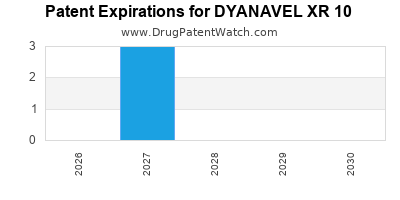
Public patent records identify Tris-related liquid amphetamine formulation patents with nominal terms extending into the early 2030s, subject to patent-term adjustment, terminal disclaimers, pediatric exclusivity and Orange Book listing status. The relevant commercial conclusion is that DYANAVEL XR has a multi-year branded window, but its strongest protection is formulation-specific rather than molecule-specific.
When does DYANAVEL XR lose exclusivity?
DYANAVEL XR does not have the long regulatory exclusivity period associated with a new chemical entity. The timing of generic risk is therefore driven by listed formulation patents and the timing of ANDA filings.
A generic applicant may submit a Paragraph IV certification asserting that an Orange Book-listed patent is invalid, unenforceable or will not be infringed. If the NDA holder sues within 45 days, FDA approval of the ANDA may be stayed for up to 30 months, subject to court decisions and statutory exceptions. (U.S. Food and Drug Administration, 2023b)
Generic entry scenarios
| Scenario |
Commercial timing |
Likely impact |
| No viable ANDA before patent expiry |
After listed patents expire |
Gradual price erosion and conversion to lower-cost liquid products |
| Paragraph IV challenge followed by litigation |
Before patent expiry, with possible 30-month stay |
Delayed launch and higher litigation expense |
| Settlement with an authorized generic or delayed-entry date |
Contract-specific |
May preserve some branded revenue while allowing controlled competition |
| Non-infringing alternative formulation |
Potentially before all listed patents expire |
Greater risk if formulation claims are narrow |
| Manufacturing or bioequivalence failure |
Delayed generic launch |
Extends practical commercial protection without changing patent term |
The exact loss-of-exclusivity date should be determined from the current Orange Book record, issued patents, pediatric extensions and any litigation settlement. A single patent expiration date is not sufficient to forecast entry.
Are there Paragraph IV challenges or patent litigation involving DYANAVEL XR?
No major publicly established DYANAVEL XR Paragraph IV litigation outcome is identifiable from the core FDA product record and widely cited public sources through the available reporting period. That does not eliminate future risk. Generic developers may challenge the product through a Paragraph IV certification without creating immediate public commercial visibility.
The most important litigation questions are:
- Whether an ANDA applicant targets the 10 mg/mL concentration specifically.
- Whether the applicant uses the same extended-release mechanism or designs around formulation claims.
- Whether Tris sues within the 45-day period.
- Whether the asserted patents cover the commercial product as sold, rather than only a broader formulation concept.
- Whether any settlement provides a delayed generic launch or authorized-generic arrangement.
Method-of-use patents are less likely to block a full-label generic if the applicant can use a section viii statement and omit patented indications or dosing instructions. Formulation patents are more commercially relevant because they can restrict the product architecture itself.
What are the main market dynamics affecting DYANAVEL XR sales?
Liquid-format demand
Liquid delivery creates a defined patient segment. Parents and adult patients may prefer a suspension when swallowing capsules is difficult or when titration requires doses between commercially available tablet strengths.
The 10 mg/mL concentration improves portability and reduces administration volume. That may help prescribers switch patients from lower-concentration liquid products, but it does not automatically expand the total stimulant market.
Generic substitution
Generic amphetamine products create a persistent pricing ceiling. A branded liquid product can retain patients when dosage flexibility or administration convenience matters, but payer formularies may require prior authorization, step therapy or documented failure of generic alternatives.
Controlled-substance shortages
Stimulant shortages can produce both upside and downside. Shortages of competing products may drive temporary switching into DYANAVEL XR. Shortages affecting amphetamine supply, manufacturing capacity or wholesaler allocation can constrain DYANAVEL XR prescriptions and weaken continuity of therapy.
The Drug Enforcement Administration controls annual production quotas for Schedule II stimulants. These quotas, active pharmaceutical ingredient availability and manufacturing capacity are material operating variables for Tris and its suppliers. (U.S. Drug Enforcement Administration, 2023)
Payer pressure
The product’s revenue quality depends on its net price after rebates, discounts, copay support and specialty-pharmacy or wholesaler economics. A branded stimulant with generic substitutes generally faces higher gross-to-net pressure than a product with no therapeutic alternatives.
Prescriber economics
Pediatric specialists, primary-care physicians and psychiatry practices are the key prescriber groups. Adoption is more likely where clinicians value liquid titration and less likely where treatment protocols default to generic tablets or capsules.
What is DYANAVEL XR’s financial trajectory?
Tris Pharma is privately held and does not publish audited, product-level DYANAVEL XR revenue, prescription volume, gross margin or operating-profit data. Public sources therefore do not support a precise historical revenue series or a reliable standalone valuation.
The most supportable financial assessment is directional:
| Period |
Financial interpretation |
| 2015-2018 |
Commercial buildout after FDA approval; awareness and formulary access were primary constraints |
| 2019-2021 |
Expansion of branded ADHD demand, with competition from established stimulants and liquid alternatives |
| 2022-2024 |
Greater opportunity from stimulant shortages, but also higher supply-chain volatility and payer scrutiny |
| 2025 onward |
Mature branded-product economics; growth depends on share retention, concentration adoption and patent-protected pricing |
Revenue upside factors
- Increased use of the 10 mg/mL concentration.
- New patient starts requiring liquid administration.
- Switching from unavailable or poorly tolerated stimulant products.
- Improved payer coverage.
- Continued protection from formulation patents.
- Expansion of adult ADHD prescribing.
Revenue downside factors
- Generic liquid amphetamine entry.
- Formulary exclusion or higher patient cost sharing.
- Competitor shortages being resolved.
- Supply disruption for amphetamine API.
- Reduced promotional spending or field-force coverage.
- Prescriber migration to Vyvanse, generic lisdexamfetamine or methylphenidate formulations.
- Patent litigation settlements that permit early generic entry.
A practical forecast should model DYANAVEL XR as a niche branded asset with moderate prescription resilience but limited pricing power. Revenue may grow through patient acquisition and mix improvement, while net price is likely to decline as payer concessions increase. The product’s value is higher if Tris can protect the liquid formulation from direct generic substitution than if it competes only on clinical efficacy.
How strong is the DYANAVEL XR patent estate?
The estate is moderately strong for a branded liquid formulation and weaker than a composition-of-matter estate for a novel chemical entity.
Strengths
- Formulation complexity can increase generic development costs.
- Liquid extended-release delivery provides claim differentiation from conventional tablets.
- Manufacturing know-how may create barriers that are not fully visible in issued-patent summaries.
- Schedule II manufacturing and distribution requirements raise operational complexity.
Weaknesses
- Amphetamine is an old and heavily competed active ingredient.
- Therapeutic substitution is extensive.
- Method-of-use claims may be avoidable through labeling strategies.
- Formulation claims can be vulnerable to invalidity or design-around arguments.
- Generic developers can target commercial demand with alternative liquid or modified-release architectures.
Patent strength should be assessed claim by claim. The key issue is whether the claims cover mandatory technical features of a commercially viable generic, not whether the patent title broadly refers to amphetamine or liquid formulations.
What geographic markets matter for DYANAVEL XR?
The United States is the primary commercial market because DYANAVEL XR’s approval, brand infrastructure and Orange Book protections are U.S.-specific.
International expansion faces several barriers:
- Separate regulatory approvals.
- Country-specific controlled-substance rules.
- Different ADHD diagnosis and treatment patterns.
- Local reimbursement constraints.
- Import and distribution controls.
- Potential absence of equivalent patent protection.
- Need for local stability, labeling and pharmacovigilance data.
The commercial case is therefore primarily domestic unless Tris has separately licensed or registered the formulation in other jurisdictions.
What licensing deals affect DYANAVEL XR?
No major publicly disclosed licensing transaction is required to explain DYANAVEL XR’s commercial position. Tris Pharma developed and markets the product, and public reporting does not establish a material third-party royalty burden for DYANAVEL XR.
Any private manufacturing, distribution, co-promotion or supply agreements could affect product economics without being visible in public filings. For valuation, the absence of disclosed product-level revenue and contract terms means DYANAVEL XR should not be assigned a precise standalone royalty or operating-margin assumption.
What generic launch risks exist?
The highest-risk launch pathway is a direct generic extended-release amphetamine suspension with equivalent concentration and comparable administration instructions. A competing liquid product with a different release mechanism could also pressure sales if it obtains favorable payer placement.
The likely commercial sequence is:
- ANDA filing and patent certification.
- Patent-holder litigation or non-litigation review.
- FDA review of formulation and bioequivalence data.
- Potential 30-month stay.
- Launch by the first approved generic or authorized generic.
- Rapid payer-driven substitution.
- Slower erosion among patients whose clinicians value the branded device, taste, dosing flexibility or established response.
Brand erosion would probably be faster in Medicaid and tightly managed commercial plans than in cash-pay or clinically specialized segments.
Key Takeaways
- DYANAVEL XR 10 is a 10 mg/mL extended-release amphetamine oral suspension for ADHD, marketed by Tris Pharma.
- Its principal differentiation is liquid administration and dose flexibility, not a novel active ingredient.
- The product competes with generic amphetamine, Vyvanse, Adderall XR, Quillivant XR and other long-acting ADHD formulations.
- Tris does not publicly disclose DYANAVEL XR-specific revenue, prescription volume or profit.
- The financial profile is best characterized as a niche branded product with moderate demand resilience and limited pricing power.
- Formulation patents and manufacturing know-how are more important than molecule-level exclusivity.
- Generic risk is tied to Paragraph IV challenges, formulation design-arounds, Orange Book patents and FDA approval timing.
- Biosimilar risk does not apply because DYANAVEL XR is a small-molecule drug.
- The 10 mg/mL concentration can improve convenience and patient retention but is unlikely by itself to create a large new market.
- Long-term value depends on liquid-formulation differentiation, supply reliability, payer access and the timing of direct generic entry.
FAQs About DYANAVEL XR 10
Is DYANAVEL XR 10 the same drug as Adderall XR?
No. Both contain amphetamine-based active ingredients, but DYANAVEL XR 10 is an extended-release oral suspension, while Adderall XR is an extended-release capsule containing mixed amphetamine salts.
Does DYANAVEL XR 10 have a biosimilar?
No. Biosimilars apply to biologic products. DYANAVEL XR is a small-molecule amphetamine drug and would face generic, not biosimilar, competition.
Can patients substitute generic amphetamine for DYANAVEL XR 10?
A clinician may prescribe an alternative amphetamine product, but substitution is not automatically equivalent because dosage form, release profile, concentration and administration volume differ.
Why might DYANAVEL XR 10 retain sales after generic entry?
Patients may remain on the branded product because of established clinical response, liquid-dose convenience, tolerability, insurance coverage or difficulty switching a controlled-substance regimen.
Is DYANAVEL XR 10 a high-revenue pharmaceutical product?
Public information does not establish that it is a high-revenue product. Tris Pharma does not disclose standalone sales, and the product competes in a price-sensitive ADHD market with extensive generic substitution.
References
-
U.S. Drug Enforcement Administration. (2023). Aggregate production quotas for schedule I and II controlled substances. https://www.federalregister.gov/
-
U.S. Food and Drug Administration. (2023a). DYANAVEL XR prescribing information. Tris Pharma, Inc. https://www.accessdata.fda.gov/
-
U.S. Food and Drug Administration. (2023b). Abbreviated new drug application approvals and patent certifications. https://www.fda.gov/drugs
-
U.S. Food and Drug Administration. (2024). Approved drug products with therapeutic equivalence evaluations: Orange Book. https://www.accessdata.fda.gov/scripts/cder/ob/
-
U.S. Food and Drug Administration. (2015). FDA approves DYANAVEL XR for the treatment of ADHD. https://www.fda.gov/、】【