DUOBRII Drug Patent Profile
✉ Email this page to a colleague
When do Duobrii patents expire, and what generic alternatives are available?
Duobrii is a drug marketed by Bausch and is included in one NDA. There are ten patents protecting this drug and one Paragraph IV challenge.
The generic ingredient in DUOBRII is halobetasol propionate; tazarotene. There is one drug master file entry for this compound. One supplier is listed for this compound. Additional details are available on the halobetasol propionate; tazarotene profile page.
DrugPatentWatch® Litigation and Generic Entry Outlook for Duobrii
A generic version of DUOBRII was approved as halobetasol propionate; tazarotene by SUN PHARMA CANADA on May 2nd, 2025.
AI Deep Research
Questions you can ask:
- What is the 5 year forecast for DUOBRII?
- What are the global sales for DUOBRII?
- What is Average Wholesale Price for DUOBRII?
Summary for DUOBRII
| US Patents: | 10 |
| Applicants: | 1 |
| NDAs: | 1 |
| Finished Product Suppliers / Packagers: | 1 |
| Clinical Trials: | 6 |
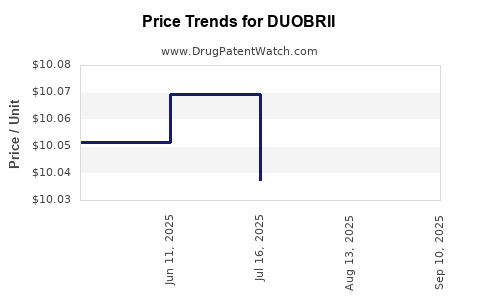
| Drug Prices: | Drug price information for DUOBRII |
| Patent Litigation and PTAB cases: | See patent lawsuits and PTAB cases for DUOBRII |
| What excipients (inactive ingredients) are in DUOBRII? | DUOBRII excipients list |
| DailyMed Link: | DUOBRII at DailyMed |
Recent Clinical Trials for DUOBRII
Identify potential brand extensions & 505(b)(2) entrants
| Sponsor | Phase |
|---|---|
| Dermatology Consulting Services, PLLC | Phase 4 |
| Icahn School of Medicine at Mount Sinai | Phase 3 |
| Bausch Health Americas, Inc. | Phase 3 |
Pharmacology for DUOBRII
| Drug Class | Corticosteroid Retinoid |
| Mechanism of Action | Corticosteroid Hormone Receptor Agonists |
Paragraph IV (Patent) Challenges for DUOBRII
| Tradename | Dosage | Ingredient | Strength | NDA | ANDAs Submitted | Submissiondate |
|---|---|---|---|---|---|---|
| DUOBRII | Lotion | halobetasol propionate; tazarotene | 0.01%/0.045% | 209354 | 1 | 2020-06-11 |
US Patents and Regulatory Information for DUOBRII
DUOBRII is protected by ten US patents.
| Applicant | Tradename | Generic Name | Dosage | NDA | Approval Date | TE | Type | RLD | RS | Patent No. | Patent Expiration | Product | Substance | Delist Req. | Exclusivity Expiration |
|---|---|---|---|---|---|---|---|---|---|---|---|---|---|---|---|
| Bausch | DUOBRII | halobetasol propionate; tazarotene | LOTION;TOPICAL | 209354-001 | Apr 25, 2019 | AB | RX | Yes | Yes | ⤷ Start Trial | ⤷ Start Trial | Y | ⤷ Start Trial | ||
| Bausch | DUOBRII | halobetasol propionate; tazarotene | LOTION;TOPICAL | 209354-001 | Apr 25, 2019 | AB | RX | Yes | Yes | ⤷ Start Trial | ⤷ Start Trial | Y | ⤷ Start Trial | ||
| Bausch | DUOBRII | halobetasol propionate; tazarotene | LOTION;TOPICAL | 209354-001 | Apr 25, 2019 | AB | RX | Yes | Yes | ⤷ Start Trial | ⤷ Start Trial | Y | ⤷ Start Trial | ||
| Bausch | DUOBRII | halobetasol propionate; tazarotene | LOTION;TOPICAL | 209354-001 | Apr 25, 2019 | AB | RX | Yes | Yes | ⤷ Start Trial | ⤷ Start Trial | Y | ⤷ Start Trial | ||
| >Applicant | >Tradename | >Generic Name | >Dosage | >NDA | >Approval Date | >TE | >Type | >RLD | >RS | >Patent No. | >Patent Expiration | >Product | >Substance | >Delist Req. | >Exclusivity Expiration |
Expired US Patents for DUOBRII
| Applicant | Tradename | Generic Name | Dosage | NDA | Approval Date | Patent No. | Patent Expiration |
|---|---|---|---|---|---|---|---|
| Bausch | DUOBRII | halobetasol propionate; tazarotene | LOTION;TOPICAL | 209354-001 | Apr 25, 2019 | ⤷ Start Trial | ⤷ Start Trial |
| >Applicant | >Tradename | >Generic Name | >Dosage | >NDA | >Approval Date | >Patent No. | >Patent Expiration |
International Patents for DUOBRII
When does loss-of-exclusivity occur for DUOBRII?
Based on analysis by DrugPatentWatch, the following patents block generic entry in the countries listed below:
Australia
Patent: 11345240
Estimated Expiration: ⤷ Start Trial
Brazil
Patent: 2013012476
Estimated Expiration: ⤷ Start Trial
Canada
Patent: 17524
Patent: FORMULATIONS PHARMACEUTIQUES CONTENANT DES CORTICOSTEROIDES POUR ADMINISTRATION TOPIQUE (PHARMACEUTICAL FORMULATIONS CONTAINING CORTICOSTEROIDS FOR TOPICAL ADMINISTRATION)
Estimated Expiration: ⤷ Start Trial
Patent: 55328
Patent: FORMULATIONS PHARMACEUTIQUES CONTENANT DES CORTICOSTEROIDES POUR ADMINISTRATION TOPIQUE (PHARMACEUTICAL FORMULATIONS CONTAINING CORTICOSTEROIDS FOR TOPICAL ADMINISTRATION)
Estimated Expiration: ⤷ Start Trial
China
Patent: 3228281
Patent: 用于局部施用的包含皮质类固醇的药物制剂 (Pharmaceutical formulations containing corticosteroids for topical administration)
Estimated Expiration: ⤷ Start Trial
Croatia
Patent: 0230032
Estimated Expiration: ⤷ Start Trial
European Patent Office
Patent: 43002
Patent: FORMULATIONS PHARMACEUTIQUES CONTENANT DES CORTICOSTÉROÏDES POUR ADMINISTRATION TOPIQUE (PHARMACEUTICAL FORMULATIONS CONTAINING CORTICOSTEROIDS FOR TOPICAL ADMINISTRATION)
Estimated Expiration: ⤷ Start Trial
Patent: 33838
Patent: FORMULATIONS PHARMACEUTIQUES CONTENANT DES CORTICOSTÉROÏDES POUR ADMINISTRATION TOPIQUE (PHARMACEUTICAL FORMULATIONS CONTAINING CORTICOSTEROIDS FOR TOPICAL ADMINISTRATION)
Estimated Expiration: ⤷ Start Trial
Hungary
Patent: 61270
Estimated Expiration: ⤷ Start Trial
Israel
Patent: 6398
Patent: פורמולציות רקחייות המכילות קורטיקוסטראוידים למתן על העור (Pharmaceutical formulations containing corticosteroids for topical administration)
Estimated Expiration: ⤷ Start Trial
Japan
Patent: 11007
Estimated Expiration: ⤷ Start Trial
Patent: 13542990
Patent: 局所投与用コルチコステロイド含有医薬製剤
Estimated Expiration: ⤷ Start Trial
Lithuania
Patent: 43002
Estimated Expiration: ⤷ Start Trial
Mexico
Patent: 6961
Patent: FORMULACIONES FARMACEUTICAS QUE CONTIENEN CORTICOSTEROIDES PARA LA ADMINISTRACION TOPICA. (PHARMACEUTICAL FORMULATIONS CONTAINING CORTICOSTEROIDS FOR TOPICAL ADMINISTRATION.)
Estimated Expiration: ⤷ Start Trial
Patent: 13005764
Patent: FORMULACIONES FARMACEUTICAS QUE CONTIENEN CORTICOSTEROIDES PARA LA ADMINISTRACION TOPICA. (PHARMACEUTICAL FORMULATIONS CONTAINING CORTICOSTEROIDS FOR TOPICAL ADMINISTRATION.)
Estimated Expiration: ⤷ Start Trial
New Zealand
Patent: 0659
Patent: Pharmaceutical formulations containing corticosteroids for topical administration
Estimated Expiration: ⤷ Start Trial
Poland
Patent: 43002
Estimated Expiration: ⤷ Start Trial
Portugal
Patent: 43002
Estimated Expiration: ⤷ Start Trial
Russian Federation
Patent: 68598
Patent: ФАРМАЦЕВТИЧЕСКИЕ СОСТАВЫ, СОДЕРЖАЩИЕ КОРТИКОСТЕРОИДЫ, ДЛЯ ТОПИКАЛЬНОГО ПРИМЕНЕНИЯ (PHARMACEUTICAL FORMULATIONS CONTAINING CORTICOSTEROIDS FOR TOPICAL APPLICATION)
Estimated Expiration: ⤷ Start Trial
Patent: 13128607
Patent: ФАРМАЦЕВТИЧЕСКИЕ СОСТАВЫ, СОДЕРЖАЩИЕ КОРТИКОСТЕРОИДЫ, ДЛЯ ТОПИКАЛЬНОГО ПРИМЕНЕНИЯ (PHARMACEUTICAL FORMULATIONS CONTAINING CORTICOSTEROIDS FOR TOPICAL APPLICATION)
Estimated Expiration: ⤷ Start Trial
Slovenia
Patent: 43002
Estimated Expiration: ⤷ Start Trial
South Korea
Patent: 1967121
Estimated Expiration: ⤷ Start Trial
Patent: 140043044
Patent: PHARMACEUTICAL FORMULATIONS CONTAINING CORTICOSTEROIDS FOR TOPICAL ADMINISTRATION
Estimated Expiration: ⤷ Start Trial
Patent: 180015281
Patent: 국소 투여를 위한 코르티코스테로이드 함유 약학 제형 (PHARMACEUTICAL FORMULATIONS CONTAINING CORTICOSTEROIDS FOR TOPICAL ADMINISTRATION)
Estimated Expiration: ⤷ Start Trial
Spain
Patent: 35814
Estimated Expiration: ⤷ Start Trial
Generics may enter earlier, or later, based on new patent filings, patent extensions, patent invalidation, early generic licensing, generic entry preferences, and other factors.
See the table below for additional patents covering DUOBRII around the world.
| Country | Patent Number | Title | Estimated Expiration |
|---|---|---|---|
| Australia | 2016279801 | ⤷ Start Trial | |
| Brazil | 112017027332 | ⤷ Start Trial | |
| Brazil | 112019023817 | ⤷ Start Trial | |
| Canada | 2988577 | ⤷ Start Trial | |
| >Country | >Patent Number | >Title | >Estimated Expiration |
Supplementary Protection Certificates for DUOBRII
| Patent Number | Supplementary Protection Certificate | SPC Country | SPC Expiration | SPC Description |
|---|---|---|---|---|
| 1304992 | C300617 | Netherlands | ⤷ Start Trial | PRODUCT NAME: COMBINATIE VAN CLINDAMYCINE, DESGEWENST IN DE VORM VAN CLINDAMYCINEFOSFAAT EN TRETINOINE; NAT. REGISTRATION NO/DATE: RVG 109745 20130626; FIRST REGISTRATION: PA1332/043/001 20130322 |
| 1304992 | PA2013025 | Lithuania | ⤷ Start Trial | PRODUCT NAME: CLINFAMYCINUM + TRETINOINUM; REGISTRATION NO/DATE: LT/1/13/3279/001, 2013 04 26 LT/1/13/3279/002, 2013 04 26 PA1332/043/001 20130323 |
| 1304992 | 1390049-3 | Sweden | ⤷ Start Trial | PRODUCT NAME: KLINDAMYCIN (SOM KLINDAMYCINFOSFAT) OCH TRETINOIN; NAT. REG. NO/DATE: MTNR 46193 20130503; FIRST REG.: IR PA1332/043/001 20130322 |
| 1304992 | 92401 | Luxembourg | ⤷ Start Trial | PRODUCT NAME: CLINDAMYCINE(EN TANT QUE PHOPSHATE DE CLINDAMYCINE)ET TRETINOINE |
| >Patent Number | >Supplementary Protection Certificate | >SPC Country | >SPC Expiration | >SPC Description |
DUOBRII (benzydamine hydrochloride and lidocaine) market dynamics and financial trajectory: sales, payer position, and exclusivity-driven competitive pressure
More… ↓
DrugChatter Q&A for DUOBRII
Make Better Decisions: Try a trial or see plans & pricing
Drugs may be covered by multiple patents or regulatory protections. All trademarks and applicant names are the property of their respective owners or licensors. Although great care is taken in the proper and correct provision of this service, thinkBiotech LLC does not accept any responsibility for possible consequences of errors or omissions in the provided data. The data presented herein is for information purposes only. There is no warranty that the data contained herein is error free. We do not provide individual investment advice. This service is not registered with any financial regulatory agency. The information we publish is educational only and based on our opinions plus our models. By using DrugPatentWatch you acknowledge that we do not provide personalized recommendations or advice. thinkBiotech performs no independent verification of facts as provided by public sources nor are attempts made to provide legal or investing advice. Any reliance on data provided herein is done solely at the discretion of the user. Users of this service are advised to seek professional advice and independent confirmation before considering acting on any of the provided information. thinkBiotech LLC reserves the right to amend, extend or withdraw any part or all of the offered service without notice.
ISSN: 2162-2639

Privacy and Cookies
Terms & Conditions
Site Map
DrugPatentWatch Alternatives
LOE / Major Patent Expirations 2026 - 2027
NCE-1 Patent Challenge Dates 2026 - 2027
Friedman, Yali. "DrugPatentWatch" DrugPatentWatch, thinkBiotech, 2026, www.DrugPatentWatch.com.
See Primary Research Papers Citing DrugPatentWatch