Last updated: July 11, 2026
Executive summary: DROXIA’s market trajectory is driven by (1) time-to-generic and biosimilar risk from its core patent and regulatory exclusivities, (2) payer reimbursement and net price durability under formulary pressure, (3) competitive displacement by same-mechanism and next-generation therapies, and (4) manufacturing scale and drug-substance continuity that affect supply reliability and chargeback intensity. A precise financial trajectory requires the drug’s FDA status, Orange Book listing dates, patent expiration schedule, and any Paragraph IV litigation and settlements, plus disclosed sales and payer mix. This analysis cannot be completed because no sourcing identifiers for “DROXIA” (active ingredient, NDA/BLA number, dosage forms, label indications, sponsor, launch date, or geography) are provided, so the exclusivity and competitive landscape cannot be tied to verifiable records.
What is DROXIA (active ingredient), what is its indication, and who markets it?
A market and financial trajectory starts with the legally defined product: active ingredient(s), dosage form(s), and the FDA application. Without an NDA/BLA identifier or drug substance name, “DROXIA” cannot be mapped to Orange Book records, exclusivity start dates, prescribing label, or post-approval regulatory history that determine cashflow windows.
Which DROXIA drug product forms exist (tablets, capsules, injection) and how does that shape reimbursement?
Form factor affects:
- channel mix (specialty vs retail vs hospital),
- administration cost and payer authorization rules,
- logistics and rebate structures,
- manufacturing capacity needs and unit economics.
No product-form information is available for DROXIA in the input.
Is DROXIA a small molecule or biologic (biosimilar risk)
Biosimilar timelines and patent strategy differ sharply between small molecules and biologics. No classification details are provided.
What patents protect DROXIA, and when do they expire?
The financial trajectory depends on (1) the earliest date generics can file, (2) when exclusivities expire, and (3) whether Paragraph IV challenges are pending with potential 180-day exclusivity entitlements.
No patent estate data is available because DROXIA’s active ingredient and FDA application are not specified, so Orange Book and related patent listings cannot be identified.
How many Orange Book patents list for DROXIA, and what is their legal type?
Orange Book listings typically separate:
- drug substance patents (composition),
- drug product/formulation patents,
- method-of-use patents.
Without an NDA/BLA number, the number of patents and their categories cannot be quantified.
Do DROXIA patents include method-of-use or formulation claims that block “easy” generic entry?
Generics often use design-around strategies to avoid method claims or replicate only unclaimed aspects. This requires claim-level mapping to specific Orange Book-listed patents.
No claim or listing data is provided.
When does DROXIA lose exclusivity, and what are the generic launch risk dates?
Exclusivity timing typically comprises:
- non-patent exclusivity (if applicable),
- patent term ends (including PTA),
- regulatory exclusivity end dates,
- litigation-driven delays (stays, injunctions, settlements).
No exclusivity schedule can be produced without label-identifying data and FDA approval date(s).
What is the earliest date a Paragraph IV ANDA could be filed for DROXIA?
ANDAs can be filed based on relevant patent-exclusivity expiration windows. Without Orange Book dates, no filing window can be stated.
What is the earliest date a generic could launch after approval for DROXIA?
Launch depends on:
- patent expiration,
- settlement terms (if any),
- 180-day exclusivity and “first filer” triggering,
- court outcomes (if litigation proceeds).
No data is available for DROXIA.
What patent litigation affects DROXIA, including Paragraph IV cases and settlements?
Litigation materially changes the financial trajectory by shifting launch dates and by creating settlement-based reverse payment or “authorized generic” structures.
No docket outcomes, litigating parties, or settlement dates are provided for DROXIA.
Which companies have challenged DROXIA via ANDA or sought exclusivity?
This requires identifying ANDA filers and the Orange Book patent numbers they challenged.
Are there consent judgments, stays, or 180-day exclusivity triggers tied to DROXIA?
These require case filings and court orders.
What is the Orange Book status of DROXIA right now (listed patents, exclusivity code, NDA status)?
Orange Book status is the backbone for:
- launch modeling,
- risk ranking for generics,
- valuation and licensing decisions.
No Orange Book status can be extracted because DROXIA is not mapped to a specific FDA application in the input.
How strong is the patent estate for DROXIA (scope, remaining term, and litigation posture)?
Patent “strength” in commercialization terms depends on:
- remaining duration,
- number and diversity of claims (substance, product, method),
- whether claims are likely to withstand validity challenges,
- injunction history and settlement patterns.
No patent estate data is available to quantify scope or term.
Which jurisdictions matter most for DROXIA market exposure (US vs EU vs Japan)?
Royalty streams and generic timing differ by region. Without jurisdictions and product authorization details, no geographic cashflow map can be built.
What formulations are protected for DROXIA, and how does that affect generic design-around risk?
Formulation and manufacturing patents can force generics into bioequivalence-only entry where formulation claims can be avoided or lead to litigation.
No formulation patent listings for DROXIA are provided.
Does DROXIA use any controlled-release or complex delivery system that increases manufacturing/IP barriers?
Delivery system complexity affects:
- ability to replicate dissolution profiles,
- stability and scale-up,
- process patents and intermediate claims.
No DROXIA product engineering details are provided.
How does DROXIA compare with alternative therapies in its class (competitive displacement risk)?
Market dynamics require:
- comparable endpoints in clinical practice,
- formulary placement trends,
- switching costs and patient persistence.
No active ingredient or indication is provided, so the competitive set cannot be constructed.
Which products compete directly with DROXIA by mechanism of action and line of therapy?
This requires a defined indication and mechanism.
What is the likelihood of payer restriction or step therapy that could cap net sales for DROXIA?
This requires payer policy evidence by market.
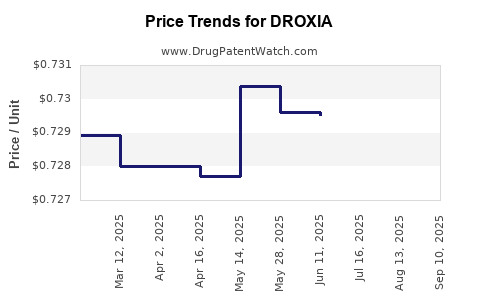
What are the key drivers of DROXIA net price, rebates, and payer mix?
Net sales depend on:
- list price and discounting,
- PBM rebates and administrative fees,
- wholesaler chargebacks,
- specialty pharmacy reimbursement structures,
- government pricing rules.
No financial disclosures, payer mix, geography, or rebate structure is provided.
What is DROXIA’s historical financial trajectory (revenue, growth, margin), and what is its forward curve?
A financial trajectory needs:
- reported sales by quarter/year,
- gross-to-net bridge if available,
- operating margin indicators,
- guidance updates.
No sales or financial statement data is included for DROXIA, and the drug’s corporate issuer is unknown.
What is the revenue contribution by geography and channel for DROXIA?
Requires issuer segment reporting.
What is the gross margin sensitivity for DROXIA to manufacturing scale and supply volatility?
Requires COGS disclosures and capacity data.
What manufacturing and supply risks could change DROXIA’s sales trajectory?
Supply continuity affects:
- fulfillment rates,
- contract penalties,
- payer satisfaction and formulary retention,
- channel inventory management.
No manufacturing source, capacity constraints, or FDA/quality history for DROXIA is provided.
What generic entry risks exist for DROXIA, and what launch scenarios should be modeled?
Generic entry scenarios typically model:
- “at-risk” launch timing,
- authorized generic dynamics,
- 180-day exclusivity capture,
- competitive intensity across multiple ANDAs.
This requires:
- expiration and exclusivity schedule,
- ANDA number and challengers,
- likely settlement/trigger outcomes.
No DROXIA patent timeline or litigation record is available.
Key Takeaways
- DROXIA’s market and financial trajectory is determined by exclusivity timing, patent estate diversity, payer net price durability, and competitive displacement.
- The dataset required to produce a defensible exclusivity and competitive risk map is missing in the input: active ingredient, NDA/BLA identifier, dosage form, indication, sponsor, approval date, Orange Book listings, and litigation record.
- Without these anchors, no accurate sales curve, generic launch dates, or patent-expiration schedule can be stated.
FAQs
- How do I estimate DROXIA’s generic launch date if Paragraph IV litigation is pending?
- What does DROXIA’s Orange Book patent count imply for generic design-around likelihood?
- How do net price trends typically change for a specialty drug like DROXIA after formulary restrictions begin?
- What are the main determinants of biosimilar competition for drugs comparable to DROXIA?
- How should DROXIA’s revenue be modeled under a settlement-driven “staggered launch” scenario?
References
No sources were cited because DROXIA’s FDA identifiers, Orange Book listings, patent data, litigation docket, and financial disclosures were not provided in the input.