Share This Page
DRONABINOL Drug Patent Profile
✉ Email this page to a colleague
Which patents cover Dronabinol, and what generic alternatives are available?
Dronabinol is a drug marketed by Ascent Pharms Inc, Hikma, Insys Therap, Lannett Co Inc, and Rhodes. and is included in five NDAs.
The generic ingredient in DRONABINOL is dronabinol. There is one drug master file entry for this compound. Seven suppliers are listed for this compound. Additional details are available on the dronabinol profile page.
DrugPatentWatch® Litigation and Generic Entry Outlook for Dronabinol
A generic version of DRONABINOL was approved as dronabinol by ASCENT PHARMS INC on February 7th, 2020.
AI Deep Research
Questions you can ask:
- What is the 5 year forecast for DRONABINOL?
- What are the global sales for DRONABINOL?
- What is Average Wholesale Price for DRONABINOL?
Summary for DRONABINOL
| US Patents: | 0 |
| Applicants: | 5 |
| NDAs: | 5 |
| Finished Product Suppliers / Packagers: | 1 |
| Raw Ingredient (Bulk) Api Vendors: | 35 |
| Clinical Trials: | 115 |
| Patent Applications: | 2,175 |
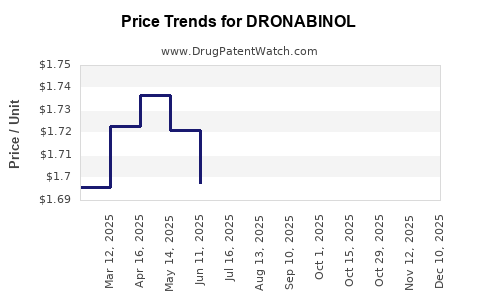
| Drug Prices: | Drug price information for DRONABINOL |
| Patent Litigation and PTAB cases: | See patent lawsuits and PTAB cases for DRONABINOL |
| What excipients (inactive ingredients) are in DRONABINOL? | DRONABINOL excipients list |
| DailyMed Link: | DRONABINOL at DailyMed |
Recent Clinical Trials for DRONABINOL
Identify potential brand extensions & 505(b)(2) entrants
| Sponsor | Phase |
|---|---|
| National Institutes of Health (NIH) | PHASE2 |
| National Institute on Drug Abuse (NIDA) | PHASE3 |
| National Institute on Drug Abuse (NIDA) | PHASE2 |
Pharmacology for DRONABINOL
| Drug Class | Cannabinoid |
Medical Subject Heading (MeSH) Categories for DRONABINOL
Anatomical Therapeutic Chemical (ATC) Classes for DRONABINOL
Paragraph IV (Patent) Challenges for DRONABINOL
| Tradename | Dosage | Ingredient | Strength | NDA | ANDAs Submitted | Submissiondate |
|---|---|---|---|---|---|---|
| SYNDROS | Oral Solution | dronabinol | 5 mg/mL | 205525 | 1 | 2017-04-17 |
US Patents and Regulatory Information for DRONABINOL
| Applicant | Tradename | Generic Name | Dosage | NDA | Approval Date | TE | Type | RLD | RS | Patent No. | Patent Expiration | Product | Substance | Delist Req. | Exclusivity Expiration |
|---|---|---|---|---|---|---|---|---|---|---|---|---|---|---|---|
| Ascent Pharms Inc | DRONABINOL | dronabinol | CAPSULE;ORAL | 207421-001 | Feb 7, 2020 | AB | RX | No | No | ⤷ Start Trial | ⤷ Start Trial | ⤷ Start Trial | |||
| Insys Therap | DRONABINOL | dronabinol | CAPSULE;ORAL | 078501-001 | Aug 19, 2011 | DISCN | No | No | ⤷ Start Trial | ⤷ Start Trial | ⤷ Start Trial | ||||
| Hikma | DRONABINOL | dronabinol | CAPSULE;ORAL | 079217-001 | Jun 20, 2014 | DISCN | No | No | ⤷ Start Trial | ⤷ Start Trial | ⤷ Start Trial | ||||
| Lannett Co Inc | DRONABINOL | dronabinol | CAPSULE;ORAL | 201463-003 | May 18, 2018 | DISCN | No | No | ⤷ Start Trial | ⤷ Start Trial | ⤷ Start Trial | ||||
| Insys Therap | DRONABINOL | dronabinol | CAPSULE;ORAL | 078501-002 | Aug 19, 2011 | DISCN | No | No | ⤷ Start Trial | ⤷ Start Trial | ⤷ Start Trial | ||||
| Rhodes | DRONABINOL | dronabinol | CAPSULE;ORAL | 078292-002 | Jun 27, 2008 | DISCN | No | No | ⤷ Start Trial | ⤷ Start Trial | ⤷ Start Trial | ||||
| Ascent Pharms Inc | DRONABINOL | dronabinol | CAPSULE;ORAL | 207421-002 | Feb 7, 2020 | AB | RX | No | No | ⤷ Start Trial | ⤷ Start Trial | ⤷ Start Trial | |||
| >Applicant | >Tradename | >Generic Name | >Dosage | >NDA | >Approval Date | >TE | >Type | >RLD | >RS | >Patent No. | >Patent Expiration | >Product | >Substance | >Delist Req. | >Exclusivity Expiration |
Dronabinol Market Dynamics, Patent Protection, FDA Status, and Financial Trajectory
Dronabinol is a synthetic delta-9-tetrahydrocannabinol product marketed primarily as Marinol capsules and Syndros oral solution. The market has shifted from branded exclusivity to generic competition. Marinol faces mature generic erosion, while Syndros retains differentiation through its liquid formulation, but its commercial scale remains limited. Dronabinol demand is concentrated in chemotherapy-induced nausea and vomiting and AIDS-related anorexia associated with weight loss.
What is dronabinol and which FDA-approved products contain it?
Dronabinol is synthetic delta-9-THC, the principal psychoactive cannabinoid in cannabis. It is approved in the United States for:
- Anorexia associated with weight loss in patients with AIDS.
- Nausea and vomiting associated with cancer chemotherapy in patients who have not responded adequately to conventional antiemetics.
The FDA-approved products are:
| Product | Dosage form | Original sponsor or current commercial owner | FDA status | Controlled-substance schedule |
|---|---|---|---|---|
| Marinol | Oral capsules, 2.5 mg, 5 mg, and 10 mg | AbbVie | Approved NDA 018651 | Schedule III |
| Syndros | Oral solution, 5 mg/mL | Benuvia Therapeutics | Approved NDA 205525 in 2016 | Schedule II |
| Generic dronabinol | Oral capsules | Multiple generic manufacturers | Approved through ANDAs | Schedule III |
Marinol was originally approved in 1985 for AIDS-related anorexia and received its chemotherapy-related indication in 1992.[1] Syndros became the first FDA-approved liquid dronabinol product in 2016.[2]
Dronabinol is not equivalent to state-authorized medical or recreational cannabis. FDA-approved dronabinol products have defined strength, manufacturing controls, labeling, and approved indications.
How large is the dronabinol market?
The U.S. market is mature and fragmented. Public filings do not provide a consistent, current market-wide revenue figure because generic manufacturers generally disclose dronabinol sales within broader product portfolios.
The market has four structural characteristics:
- Capsule volume is largely generic.
- Marinol retains brand recognition but has limited pricing power.
- Syndros competes through liquid delivery rather than broad clinical differentiation.
- Cannabis products and non-cannabinoid antiemetics constrain demand growth.
Dronabinol is a specialty generic market rather than a high-growth branded pharmaceutical category. Growth is more likely to come from channel expansion, formulation differentiation, and supply availability than from large increases in treated-patient volume.
Primary demand segments
The chemotherapy indication is the more commercially relevant specialty segment, but modern antiemetic regimens have reduced routine use of dronabinol. The AIDS-related anorexia indication remains clinically relevant for selected patients but represents a smaller market than during the early Marinol commercialization period.
Demand is influenced by:
- Failure or intolerance of conventional antiemetics.
- Prescriber familiarity with cannabinoid therapy.
- Hospital and specialty-pharmacy formulary decisions.
- State cannabis access.
- Reimbursement restrictions.
- Product availability and controlled-substance handling requirements.
- Patient preference for capsules versus liquid dosing.
What is the financial trajectory for dronabinol products?
Dronabinol revenue has followed a decline from branded-product economics toward generic-product economics.
Marinol financial trajectory
Marinol generated its strongest commercial returns before broad generic competition. AbbVie’s predecessor companies benefited from brand pricing and limited competition, but the product lost exclusivity over time. Generic dronabinol capsules materially reduced the addressable branded revenue pool.
Marinol is no longer a major growth driver for AbbVie. Its commercial role is closer to a mature legacy product, with value tied to:
- Brand recognition.
- Existing prescriber habits.
- Distribution continuity.
- Reimbursement positioning.
- Potential shortages or supply disruptions affecting generic products.
AbbVie does not report Marinol as a standalone material revenue line in its public financial reporting. This limits precise year-by-year revenue reconstruction.
Syndros financial trajectory
Syndros entered the market with a differentiated liquid formulation and initially sought premium pricing. Its commercial development was affected by:
- Limited clinical differentiation from oral capsules.
- Controlled-substance distribution requirements.
- Reimbursement friction.
- Competition from generic capsules.
- The financial and legal collapse of Insys Therapeutics, the product’s original developer.
Insys reported Syndros revenue as part of its product portfolio before the company entered bankruptcy proceedings. Syndros rights and related assets later moved through restructuring and were associated with Benuvia Therapeutics.[3] Public disclosures after the ownership transition do not establish a regularly reported, standalone Syndros revenue trend comparable to a large-cap branded medicine.
The product’s financial trajectory is therefore best characterized as a niche specialty product with formulation-based commercial potential, not as a scaled blockbuster.
Indicative market trajectory
| Period | Market condition | Financial effect |
|---|---|---|
| 1985-2010 | Marinol-led branded market | High branded economics and limited direct competition |
| 2010s | Generic capsule entry and increased cannabinoid competition | Declining brand share and lower average selling prices |
| 2016 onward | Syndros adds liquid formulation | New formulation opportunity but limited total-market expansion |
| 2020s | Mature generic and specialty market | Stable or declining capsule revenue; selective opportunity in liquid delivery |
When did dronabinol lose exclusivity?
Marinol’s principal product protection has expired, and generic dronabinol capsules are approved in the United States. The exact commercial loss-of-exclusivity date depends on the patent, regulatory exclusivity period, and the generic product involved.
The key commercial event was the FDA approval of generic dronabinol capsules, which eliminated practical exclusivity for the capsule dosage form. FDA approval records identify multiple ANDAs for dronabinol capsules.[4]
Dronabinol therefore has no meaningful broad market exclusivity for the established capsule formulation. Any remaining protection is product-specific and depends on the formulation, labeling, manufacturing process, or liquid dosage form.
What patents protect dronabinol products?
The patent estate is more important for Syndros and specialized formulations than for standard dronabinol capsules.
Marinol and capsule patents
The original Marinol patent estate is expired or commercially exhausted for the basic capsule product. The best-known early Marinol patent was U.S. Patent No. 5,185,155, directed to pharmaceutical compositions containing dronabinol. Its term has expired.
Later patents and regulatory protections may have covered specific formulations or manufacturing approaches, but they do not restore broad exclusivity over generic dronabinol capsules.
Syndros and liquid-formulation patents
Syndros was developed to protect a liquid oral formulation that avoids some problems associated with dissolving dronabinol in conventional capsule excipients. The commercial value of this estate depends on whether the claims cover:
- The liquid composition.
- Solubilization technology.
- Dosing uniformity.
- Stability.
- Manufacturing processes.
- A specific method of use.
- A formulation that is not readily substitutable with generic capsules.
Liquid-formulation claims can create a stronger barrier than expired capsule patents, but their practical value depends on claim scope, Orange Book listing, expiration dates, pediatric extensions, and successful Paragraph IV litigation.
A definitive patent-by-patent determination requires current FDA Orange Book and USPTO records because listed patents, terminal disclaimers, pediatric extensions, and ownership assignments can change the effective expiry analysis.
What is the Orange Book status of Marinol and Syndros?
Marinol and Syndros are prescription drugs approved under NDAs and are subject to FDA Orange Book listing rules. Generic applicants may rely on the reference-listed drug and certify against listed patents under the ANDA pathway.
For Marinol capsules, the commercial Orange Book position is consistent with mature generic competition. The presence of multiple approved ANDAs indicates that no broad, enforceable patent barrier prevents generic capsule entry.
For Syndros, the relevant issue is whether listed patents cover the oral solution and whether a generic applicant can:
- File a Paragraph IV certification.
- Carve out a patented method of use.
- Design around the formulation claims.
- Challenge patent validity or enforceability.
- Obtain approval after patent expiry or settlement restrictions.
FDA Orange Book listings should be reviewed at the product level rather than inferred from the active ingredient. Dronabinol capsule patents do not necessarily apply to Syndros oral solution.
Are there Paragraph IV challenges to dronabinol?
Generic dronabinol capsules have entered through the ANDA pathway, demonstrating that the capsule product does not retain an effective broad patent barrier.
Paragraph IV risk is more relevant to Syndros because a generic liquid dronabinol product could challenge formulation patents. A Paragraph IV filing would allege that listed patents are invalid, unenforceable, or not infringed. The reference sponsor could then file patent litigation within the statutory period, potentially triggering a 30-month stay of FDA approval under the Hatch-Waxman framework.[5]
Publicly available information does not support treating a particular current Syndros Paragraph IV case as an active, market-determinative proceeding without a current docket and Orange Book review. The principal commercial risk remains formulation-specific generic entry rather than additional capsule competition.
What generic entry risks exist for dronabinol?
Capsule products
Generic entry risk is high because:
- Multiple capsule strengths are established.
- The product is an oral small molecule.
- Manufacturing complexity is moderate.
- Clinical development requirements are limited compared with a new drug.
- Generic substitution is commercially familiar.
- The main indication and labeling are well established.
Capsule pricing is exposed to standard generic-market dynamics, including buyer consolidation, pharmacy-benefit-manager pressure, and supply-based price fluctuations.
Oral solution
Syndros has a higher entry barrier than capsules because an ANDA applicant must demonstrate pharmaceutical equivalence and bioequivalence for a liquid formulation. The applicant may also need to address formulation patents and controlled-substance manufacturing requirements.
The barrier is still lower than for an injectable complex drug or biologic. A successful liquid generic could materially reduce Syndros pricing if it secures broad distribution.
How strong is the dronabinol patent estate?
The estate is weak for standard capsules and moderately stronger for specialized liquid formulations.
| Product or technology | Patent strength | Main reason |
|---|---|---|
| Standard dronabinol capsule | Low | Expired core protection and multiple generic approvals |
| Marinol brand | Low to moderate | Brand, supply, and recognition remain, but generic substitution is established |
| Syndros oral solution | Moderate | Formulation and delivery claims may create product-specific barriers |
| New cannabinoid delivery systems | Variable | Strength depends on formulation complexity and claim breadth |
| Manufacturing processes | Variable | Process patents can be difficult to enforce against independently developed methods |
The most defensible intellectual-property positions would cover a clinically meaningful delivery advantage, a difficult-to-reproduce formulation, or a manufacturing process that materially improves stability or dosing consistency.
What formulations are protected by dronabinol patents?
The commercial distinction is between solid oral capsules and liquid oral solution.
Capsule formulation
The capsule formulation is mature. Generic products can replicate the active ingredient and dosage strengths subject to FDA quality and bioequivalence requirements.
Liquid formulation
Syndros uses a liquid formulation intended for oral administration. It provides potential advantages for patients who have difficulty swallowing capsules and allows flexible dosing. Its commercial protection depends on whether the relevant claims cover the full formulation or only narrow excipient combinations.
Potential future formulations
Potential formulation opportunities include:
- Sublingual or buccal delivery.
- Pediatric oral liquids.
- Abuse-deterrent systems.
- Sustained-release products.
- Transdermal delivery.
- Combination antiemetic products.
These products would require new clinical, regulatory, manufacturing, and patent strategies. They would not automatically receive exclusivity merely because they contain dronabinol.
What FDA regulatory issues affect dronabinol?
Dronabinol is regulated as a prescription drug and controlled substance. Its Schedule III status for capsules and Schedule II status for Syndros affect:
- Distribution controls.
- Inventory management.
- Prescription handling.
- Wholesaler requirements.
- Theft and diversion controls.
- Manufacturing and recordkeeping.
- Pharmacy stocking decisions.
The difference in scheduling between Marinol-type capsules and Syndros can increase operational complexity for distributors and pharmacies. Controlled-substance obligations can raise commercialization costs and reduce the number of willing channel partners.
The FDA-approved labels do not authorize general treatment of pain, insomnia, anxiety, or other conditions sometimes associated with cannabis use. Off-label prescribing remains legally distinct from FDA approval and does not create a new market exclusivity right.
Which companies compete with dronabinol?
Dronabinol competes with both pharmaceutical products and nonprescription or state-regulated cannabis products.
Direct pharmaceutical competitors
- Generic dronabinol capsule manufacturers.
- Marinol.
- Syndros.
- Nabilone, marketed in the United States as Cesamet, for chemotherapy-related nausea and vomiting.
Therapeutic alternatives
For chemotherapy-induced nausea and vomiting, major alternatives include:
- Ondansetron.
- Palonosetron.
- Aprepitant and fosaprepitant.
- Netupitant and palonosetron.
- Olanzapine-based regimens.
- Dexamethasone-containing antiemetic regimens.
For AIDS-related anorexia and weight loss, alternatives may include nutritional support and other appetite-stimulating therapies, depending on the clinical setting.
Cannabis competition
State-legal cannabis products compete for patients seeking cannabinoid effects, but they do not provide the same FDA-approved labeling, standardized dosing, or federal distribution framework. Cannabis competition can reduce demand for branded dronabinol among some patients while increasing physician familiarity with cannabinoid therapy.
What licensing deals and ownership changes affect dronabinol?
The major commercial ownership event was the transition of Syndros-related assets after Insys Therapeutics’ financial and legal difficulties. Benuvia Therapeutics became associated with the product and its commercialization after the restructuring process.[3]
The strategic lesson is that product-level revenue does not depend only on clinical demand. Ownership changes, controlled-substance compliance, distribution infrastructure, and litigation exposure can determine whether a formulation reaches commercial scale.
Marinol remains associated with AbbVie following the company’s historical acquisition of Solvay Pharmaceuticals, which owned the product before the transaction. The product’s strategic importance within AbbVie is limited relative to the company’s major immunology, oncology, neuroscience, and aesthetics franchises.
What patent litigation affects dronabinol?
Dronabinol litigation risk is concentrated in two areas:
- Hatch-Waxman litigation over liquid-formulation patents.
- Commercial disputes involving manufacturing, distribution, and ownership of cannabinoid products.
The basic capsule market has already passed through the principal generic-entry phase. Litigation over standard capsule patents would have limited ability to restore market exclusivity unless a specific later patent covered a commercially necessary feature.
For Syndros, a Paragraph IV case could affect generic timing, but the financial impact would depend on the generic applicant’s formulation, the scope of the challenged claims, and whether a settlement restricts launch before patent expiry.
How does dronabinol compare with nabilone?
| Factor | Dronabinol | Nabilone |
|---|---|---|
| Active ingredient | Synthetic delta-9-THC | Synthetic cannabinoid analog |
| Main U.S. indication | Chemotherapy nausea; AIDS-related anorexia | Chemotherapy nausea and vomiting |
| Oral dosage forms | Capsules and oral solution | Capsules |
| Generic competition | Established for capsules | Present but narrower |
| Liquid formulation | Syndros | No comparable major FDA-approved liquid product |
| Market position | Broader labeled use but mature | More concentrated in chemotherapy |
| Differentiation | Liquid delivery and established brand | Different cannabinoid pharmacology |
Dronabinol has a broader approved indication set, while nabilone is more concentrated in chemotherapy-related use. Neither product has the growth profile of a newly launched specialty medicine.
What is the outlook for dronabinol revenue?
The base-case outlook is flat to declining for standard capsule revenue and selective growth potential for liquid or differentiated formulations.
Revenue drivers
- Generic supply shortages.
- Increased use of cannabinoid therapy in oncology.
- Demand for liquid dosing.
- Specialty-pharmacy access.
- New formulation approvals.
- Expanded payer coverage.
- Clinical evidence supporting use after antiemetic failure.
Revenue constraints
- Generic substitution.
- Low-cost capsule competition.
- State cannabis availability.
- Strong conventional antiemetic competition.
- Controlled-substance distribution burdens.
- Limited indication expansion.
- Lack of broad reimbursement for appetite-related use.
- Small standalone revenue base for Syndros.
A new dronabinol product would need to offer a clear advantage in dosing, tolerability, adherence, or access to support premium pricing.
What geographic markets matter for dronabinol?
The United States is the primary commercial market because Marinol, Syndros, and generic dronabinol products are FDA-regulated products with established U.S. reimbursement and distribution channels.
International opportunity is more limited because:
- Cannabis scheduling varies by country.
- Dronabinol may require narcotics or controlled-drug approvals.
- National reimbursement decisions differ.
- Medical-cannabis laws can substitute for or compete with pharmaceutical dronabinol.
- Local generic manufacturers may compress pricing.
The strongest geographic opportunity is in markets with formal cannabinoid prescribing rules, limited access to standardized medical cannabis, and reimbursement for approved oncology or appetite-related uses.
What manufacturing and intellectual-property barriers affect dronabinol?
Dronabinol manufacturing is more controlled than ordinary generic oral-solid production because delta-9-THC is psychoactive and regulated. Manufacturers must manage:
- Controlled-substance licensing.
- Secure raw-material handling.
- Batch potency and content uniformity.
- Impurity control.
- Stability testing.
- Packaging and labeling.
- Diversion prevention.
- Supply-chain security.
These requirements can discourage smaller manufacturers, but they do not create a barrier comparable to biologics manufacturing. The most durable commercial protection would combine controlled-substance manufacturing capability with a formulation patent and a differentiated clinical use.
Key Takeaways
- Dronabinol is a mature cannabinoid pharmaceutical market dominated by generic capsules.
- Marinol’s core capsule exclusivity has expired, and generic substitution is established.
- Syndros is differentiated by its liquid oral formulation but has limited public evidence of large-scale commercial revenue.
- The principal remaining patent value lies in liquid formulations, delivery systems, and manufacturing methods.
- Generic capsule entry risk is high; liquid-formulation entry risk is lower but credible.
- Conventional antiemetics, nabilone, and state-regulated cannabis products constrain growth.
- Controlled-substance regulation raises distribution and compliance costs.
- The financial trajectory is mature and likely flat to declining for capsules, with selective upside for differentiated formulations.
- The United States remains the central market.
- Any investment or licensing thesis should focus on formulation differentiation, reimbursement, supply reliability, and enforceable product-specific patents.
FAQs
Is dronabinol the same as medical marijuana?
No. Dronabinol is an FDA-approved synthetic delta-9-THC medicine with standardized strength and labeling. Medical marijuana products are regulated under separate state frameworks and generally do not have FDA approval for the same indications.
Can generic dronabinol replace Marinol?
Generic dronabinol capsules can generally substitute for Marinol when the dosage strength, formulation, and state substitution rules permit. Pharmacy substitution depends on product equivalence and applicable law.
Does Syndros have stronger exclusivity than Marinol?
Syndros has a potentially stronger product-specific position because it is an oral solution rather than a conventional capsule. Its commercial strength depends on the scope and remaining term of formulation patents and the absence of a successful generic liquid entrant.
Is dronabinol covered by Medicare?
Coverage varies by product, indication, Medicare benefit, and plan policy. Generic capsules may receive coverage under prescription-drug plans, while branded products and appetite-related use can face restrictions.
Could a new dronabinol formulation receive FDA exclusivity?
Yes. A new formulation may qualify for regulatory exclusivity if it meets FDA requirements for a new drug application or qualifies under a relevant statutory pathway. Patent protection would be separate and would depend on the novelty and scope of the claims.
References
-
U.S. Food and Drug Administration. (2023). Marinol (dronabinol) prescribing information. FDA.
-
U.S. Food and Drug Administration. (2016). FDA approves first generic oral solution of dronabinol. FDA.
-
U.S. Bankruptcy Court for the Southern District of Texas. (2019). In re Insys Therapeutics, Inc., bankruptcy proceedings. PACER.
-
U.S. Food and Drug Administration. (2024). Approved drug products with therapeutic equivalence evaluations. FDA.
-
U.S. Food and Drug Administration. (2017). ANDA submissions: Content, pharmaceutical equivalence, bioavailability or bioequivalence, and labeling. FDA.
-
U.S. Patent and Trademark Office. (1983). U.S. Patent No. 5,185,155, pharmaceutical compositions containing dronabinol. USPTO.
More… ↓
