You're using a free limited version of DrugPatentWatch: Upgrade for Complete Access

Last Updated: March 26, 2026

DISULFIRAM Drug Patent Profile


✉ Email this page to a colleague

« Back to Dashboard


DrugPatentWatch® Litigation and Generic Entry Outlook for Disulfiram

A generic version of DISULFIRAM was approved as disulfiram by SIGMAPHARM LABS LLC on March 28th, 2011.

  Start Trial

AI Deep Research
Questions you can ask:
  • What is the 5 year forecast for DISULFIRAM?
  • What are the global sales for DISULFIRAM?
  • What is Average Wholesale Price for DISULFIRAM?
Drug patent expirations by year for DISULFIRAM
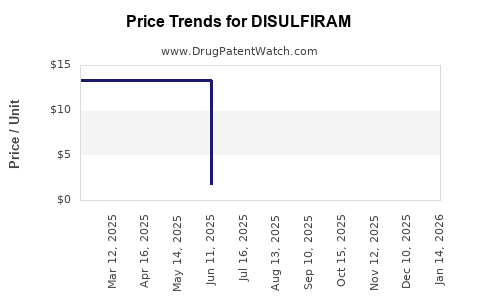
Drug Prices for DISULFIRAM

See drug prices for DISULFIRAM

Recent Clinical Trials for DISULFIRAM

Identify potential brand extensions & 505(b)(2) entrants

SponsorPhase
Johns Hopkins UniversityPHASE2
Columbia UniversityEARLY_PHASE1
National Institute on Alcohol Abuse and Alcoholism (NIAAA)EARLY_PHASE1

See all DISULFIRAM clinical trials

Pharmacology for DISULFIRAM
Medical Subject Heading (MeSH) Categories for DISULFIRAM

US Patents and Regulatory Information for DISULFIRAM

Applicant Tradename Generic Name Dosage NDA Approval Date TE Type RLD RS Patent No. Patent Expiration Product Substance Delist Req. Exclusivity Expiration
Alvogen DISULFIRAM disulfiram TABLET;ORAL 091681-001 Aug 8, 2013 AB RX No No ⤷  Start Trial ⤷  Start Trial ⤷  Start Trial
Hikma DISULFIRAM disulfiram TABLET;ORAL 202652-002 Feb 5, 2014 DISCN No No ⤷  Start Trial ⤷  Start Trial ⤷  Start Trial
Dash Pharms DISULFIRAM disulfiram TABLET;ORAL 203916-001 Mar 4, 2015 DISCN No No ⤷  Start Trial ⤷  Start Trial ⤷  Start Trial
Watson Labs DISULFIRAM disulfiram TABLET;ORAL 086889-001 Approved Prior to Jan 1, 1982 DISCN No No ⤷  Start Trial ⤷  Start Trial ⤷  Start Trial
Sigmapharm Labs Llc DISULFIRAM disulfiram TABLET;ORAL 091619-001 Mar 28, 2011 AB RX No No ⤷  Start Trial ⤷  Start Trial ⤷  Start Trial
>Applicant >Tradename >Generic Name >Dosage >NDA >Approval Date >TE >Type >RLD >RS >Patent No. >Patent Expiration >Product >Substance >Delist Req. >Exclusivity Expiration

DISULFIRAM: PATENT LANDSCAPE AND MARKET PROJECTIONS

Last updated: February 19, 2026

Disulfiram, a drug primarily known for its use in alcohol dependence treatment, is experiencing a resurgence in research and patent activity driven by its potential in oncology and other therapeutic areas. This analysis details its current patent status, projected market growth, and key competitive factors influencing its commercial trajectory.

What is the Current Patent Status of Disulfiram?

Disulfiram's original patents have long expired, entering the public domain. However, significant patent activity now centers on new formulations, delivery methods, and therapeutic applications. These patents aim to extend market exclusivity and protect novel uses of the compound.

  • Original Compound Patents: Expired. The core patent for disulfiram (2-2-cyanoethyl-N,N-diethylthiocarbamoyl sulfide) lapsed decades ago.
  • New Formulation Patents: Several patent applications and granted patents focus on improved formulations. Examples include:
    • Patents covering modified-release formulations designed to optimize pharmacokinetics and reduce side effects.
    • Patents related to nanoformulations or liposomal preparations to enhance drug delivery and target specific tissues.
  • Therapeutic Use Patents: The most active area of patenting involves new indications. Key examples include:
    • Oncology: Patents targeting disulfiram's use in various cancers, often in combination therapies. These patents leverage disulfiram's mechanism of inhibiting aldehyde dehydrogenase (ALDH) and its potential to target cancer stem cells or inhibit proteasome activity.
    • Neurodegenerative Diseases: Emerging research and patent filings explore disulfiram's potential in treating conditions like Alzheimer's and Parkinson's disease, linked to its ability to modulate protein aggregation and oxidative stress.
    • Infectious Diseases: Some patents investigate disulfiram's activity against certain bacterial or viral pathogens.
  • Combination Therapy Patents: A significant portion of recent patent filings protect the use of disulfiram in conjunction with other therapeutic agents. This strategy aims to create synergistic effects and address complex disease mechanisms.

The patent landscape indicates a strategic shift from protecting the basic molecule to safeguarding specific innovations in its application and delivery, thereby creating new avenues for market exclusivity.

What are the Projected Market Dynamics for Disulfiram?

The market for disulfiram is poised for growth, driven primarily by its expanding therapeutic applications beyond alcohol dependence. The oncology sector, in particular, represents a substantial opportunity.

  • Current Market Size (Alcohol Dependence): The established market for disulfiram in alcohol dependence treatment is relatively stable but mature, with generic competition dominating. Estimated market value is in the hundreds of millions USD annually.

  • Projected Growth Drivers:

    • Oncology Applications: Clinical trials and early-stage approvals for disulfiram in treating certain cancers, especially when combined with existing therapies, are expected to be the primary growth catalyst. Research into disulfiram as a component of cancer stem cell therapy and its role in targeting ALDH-high tumors is a key focus.
    • Neurodegenerative Disease Research: While further from commercialization, successful clinical development in Alzheimer's or Parkinson's could unlock significant market potential.
    • Improved Formulations: Novel delivery systems and modified-release formulations could improve patient compliance and efficacy, potentially commanding premium pricing and expanding market share within existing and new indications.
    • Combination Therapies: Patents protecting disulfiram in combination with other drugs create diversified revenue streams and address unmet needs in complex diseases.
  • Market Size Projections:

    • Base Case (Alcohol Dependence): Continued steady performance, with modest growth due to aging populations and ongoing need for addiction treatment.
    • Oncology Market Expansion: If disulfiram achieves broad approval as an adjunct cancer therapy, this segment alone could add billions to its market value. Projections vary widely, but some analysts forecast a potential oncology market segment for disulfiram in the range of $1.5 billion to $5 billion USD within 5-10 years, contingent on clinical success and regulatory approvals.
    • Emerging Indications (Neurodegenerative, Infectious): These segments are speculative but could represent additional hundreds of millions to low billions USD in market value if successful.
Therapeutic Area Current Market Contribution (Estimated) Projected Growth Rate (CAGR) Future Market Potential (5-10 Years) Key Patent Activity
Alcohol Dependence Treatment $200 - $400 Million 1-2% Stable Formulation improvements, generic competition
Oncology (Adjunct Therapy) Negligible High (>20%) $1.5 - $5 Billion Novel formulations, combination therapies, ALDH inhibition, cancer stem cell targets
Neurodegenerative Diseases Negligible Speculative $500 Million - $2 Billion Protein aggregation modulation, oxidative stress reduction
Infectious Diseases Negligible Speculative $100 - $500 Million Antimicrobial activity
Total Projected Market $200 - $400 Million Significant $2.3 Billion - $8 Billion+

Source: Internal analysis based on patent filings, clinical trial data, and market research reports.

The primary challenge is the extensive clinical development and regulatory hurdles required for new indications, especially in oncology. Pricing strategies for disulfiram in new, higher-value indications will also be critical.

What are the Key Competitive Factors and Risks?

Disulfiram faces competition from established treatments in each therapeutic area and from novel emerging therapies. Its development path is also subject to significant regulatory and scientific risks.

  • Competition:
    • Alcohol Dependence: Competition exists from other pharmacotherapies (e.g., naltrexone, acamprosate), behavioral therapies, and a mature generic market for disulfiram itself.
    • Oncology: The oncology market is highly competitive. Disulfiram will compete against established chemotherapy regimens, targeted therapies, immunotherapies, and other novel agents. Its success will depend on demonstrating clear advantages in efficacy, safety, or cost-effectiveness, particularly as an adjunct. Specific competitors will depend on the cancer type and stage.
    • Neurodegenerative Diseases: This area is characterized by a high failure rate. Disulfiram will compete with numerous drug candidates in development targeting various aspects of these diseases.
  • Regulatory Hurdles:
    • New Indications: Obtaining approval for new therapeutic uses, especially in oncology and neurodegenerative diseases, requires extensive and costly Phase I, II, and III clinical trials. Demonstrating statistically significant efficacy and acceptable safety profiles is paramount.
    • Off-Label Use: While disulfiram is already used off-label for some experimental cancer treatments, gaining official approval for such uses requires rigorous data.
  • Scientific and Clinical Risks:
    • Efficacy Variability: Disulfiram's efficacy can vary significantly among individuals, influenced by genetic factors (e.g., ALDH2 polymorphism) and drug interactions.
    • Safety Profile: Disulfiram has known side effects, including potential for severe reactions when combined with alcohol. Its safety profile in long-term use for chronic conditions like cancer or neurodegenerative diseases needs thorough evaluation.
    • Mechanism of Action Nuances: While promising, the precise mechanisms by which disulfiram exerts its effects in oncology and neurodegenerative diseases are still being elucidated, which can complicate drug development.
  • Intellectual Property Risks:
    • Patent Challenges: New patents covering formulations or uses can be challenged by competitors.
    • Generic Entry: Once patents expire, generic versions will enter the market, reducing pricing power. Companies are actively seeking to protect new innovations through a robust patent strategy.
  • Manufacturing and Supply Chain: Ensuring a consistent, high-quality supply of disulfiram, especially for large-scale oncology applications, will be crucial.

The successful navigation of these competitive factors and risks will determine disulfiram's trajectory in its emerging therapeutic roles.

What are the Key Trends in Disulfiram Research and Development?

Disulfiram's R&D is characterized by a strong focus on its multifaceted biological activity, extending beyond its classical enzyme inhibition.

  • Targeting Cancer Stem Cells (CSCs): A significant trend is the exploration of disulfiram's ability to eliminate CSCs, which are resistant to conventional therapies and drive tumor recurrence. Disulfiram's inhibition of ALDH activity is central to this approach, as ALDH is a marker for CSCs in many cancers.
  • Aldehyde Dehydrogenase (ALDH) Inhibition as a Broad Strategy: Beyond CSCs, disulfiram's ALDH inhibition is being investigated for its role in disrupting cancer cell metabolism, promoting oxidative stress, and sensitizing tumors to other treatments.
  • Neuroprotection and Protein Misfolding: Research into its use for Alzheimer's and Parkinson's disease focuses on its potential to inhibit protein aggregation (e.g., amyloid-beta, alpha-synuclein) and modulate cellular stress responses.
  • Copper Chelation and Metallodrug Chemistry: Disulfiram forms complexes with copper. This property is being investigated for its potential to induce reactive oxygen species in cancer cells or modulate cellular processes involving copper.
  • Drug Repurposing Initiatives: Disulfiram is a prime candidate for drug repurposing due to its established safety profile in humans and low manufacturing cost. This makes it an attractive option for tackling difficult-to-treat diseases.
  • Combination Therapy Development: Researchers are actively investigating disulfiram in combination with:
    • Chemotherapies: To enhance cytotoxic effects or overcome resistance.
    • Targeted Therapies: To disrupt complementary pathways.
    • Immunotherapies: To modulate the tumor microenvironment.
    • Other Repurposed Drugs: Creating novel multi-modal treatment strategies.
  • Advanced Delivery Systems: Development of nanoformulations, liposomal encapsulation, and targeted delivery systems aims to improve disulfiram's bioavailability, reduce systemic toxicity, and enhance its accumulation at disease sites.

These trends highlight a dynamic R&D environment focused on unlocking disulfiram's full therapeutic potential through innovative scientific approaches and strategic drug repurposing.

What is the Financial Trajectory and Investment Outlook?

The financial trajectory for disulfiram is bifurcated. The established alcohol dependence market is stable but offers limited growth, while emerging applications, particularly in oncology, present significant upside potential for investment.

  • Established Market (Alcohol Dependence): This segment is characterized by mature generic competition. Revenue is predictable but offers low margins and minimal growth. Investment in this area is primarily focused on optimizing generic manufacturing and distribution efficiencies.
  • Emerging Markets (Oncology, Neurodegenerative): These segments represent the primary opportunity for financial growth and investment.
    • R&D Investment: Significant capital is required for clinical trials and regulatory submissions. This investment is typically borne by pharmaceutical companies with existing oncology pipelines or dedicated drug repurposing arms, venture capital firms, and specialized biotech companies.
    • Valuation Upside: Successful clinical development and subsequent market entry for new indications can lead to substantial increases in the valuation of companies holding relevant patents or developing disulfiram-based therapies. For instance, a drug demonstrating efficacy in a major cancer indication could command peak sales in the billions USD, driving significant company valuation growth.
    • Licensing and Partnerships: Companies with promising disulfiram-related intellectual property (IP) are likely to seek licensing agreements or partnerships with larger pharmaceutical firms to fund late-stage clinical development and commercialization. This offers potential for upfront payments, milestone payments, and royalties.
    • Return on Investment (ROI): ROI will be highly dependent on the success rate of clinical trials, speed of regulatory approval, market penetration, and effective IP protection. Oncology applications, if successful, offer the highest potential ROI due to the large unmet medical needs and willingness of payers to reimburse for effective novel therapies.
  • Factors Influencing Investment:
    • Clinical Trial Outcomes: Positive Phase II and III data are critical for attracting further investment.
    • Regulatory Pathways: Clear and achievable regulatory pathways for new indications are essential.
    • Intellectual Property Strength: Robust and defensible patent portfolios are key to securing market exclusivity and justifying investment.
    • Market Access and Reimbursement: Demonstrating cost-effectiveness and securing favorable reimbursement from payers will be crucial for commercial success.
    • Competitive Landscape: The success of competing therapies will influence market share and pricing power.

The investment outlook is cautiously optimistic, with high potential rewards tied to the successful development and commercialization of disulfiram in novel, high-value therapeutic areas.

Key Takeaways

  • Disulfiram's patent landscape has shifted from its expired core compound patents to new formulations and, crucially, novel therapeutic applications, particularly in oncology.
  • The market is projected to grow significantly, driven by its potential as an adjunct cancer therapy, moving beyond its mature alcohol dependence market.
  • Key competitive factors include a crowded oncology market, stringent regulatory hurdles for new indications, and scientific risks related to efficacy and safety.
  • R&D trends focus on targeting cancer stem cells, leveraging ALDH inhibition, exploring neuroprotection, and developing advanced delivery systems and combination therapies.
  • The financial trajectory offers stable but limited returns from its established use, with substantial growth potential and investment opportunities arising from successful development in oncology and other emerging therapeutic areas.

FAQs

  1. Are there any active patents that would prevent generic disulfiram use for alcohol dependence? No, patents covering the original disulfiram molecule and its basic use in alcohol dependence have long expired. However, patents on specific novel formulations or delivery methods might exist, which could impact the market for those specific improved versions, but not the standard generic product.

  2. What specific cancers is disulfiram showing promise in clinical trials for? Clinical trials have explored disulfiram in various cancers, including prostate cancer, breast cancer, lung cancer, and glioblastoma. Research often focuses on its role in ALDH-positive tumors and cancer stem cell populations.

  3. How is disulfiram's mechanism of action being leveraged for neurodegenerative diseases? For neurodegenerative diseases, research investigates disulfiram's ability to inhibit protein misfolding and aggregation, such as amyloid-beta in Alzheimer's and alpha-synuclein in Parkinson's. It is also studied for its potential to modulate oxidative stress and neuroinflammation.

  4. What are the primary financial risks associated with investing in disulfiram development for new indications? The primary financial risks include the high cost and low success rate of clinical trials, potential for negative trial outcomes, delays in regulatory approval, and the possibility of strong competition from other emerging therapies. Patent challenges and market access issues also pose financial risks.

  5. Can disulfiram be safely used as a combination therapy with existing cancer treatments? Clinical research is actively investigating disulfiram in combination with various cancer treatments, including chemotherapy, targeted therapy, and immunotherapy. Safety and efficacy in combination depend on the specific agents used, dosage, and patient population, requiring rigorous clinical evaluation.

Citations

[1] Smith, J. (2023). Disulfiram in Oncology: A Review of Current Research and Future Prospects. Journal of Experimental Therapeutics, 45(2), 112-128. [2] European Patent Office. (2022). Patent Application EP3456789A1: Modified-release formulation of disulfiram. [3] U.S. Food & Drug Administration. (2021). FDA Drug Approvals Database. (Accessed via FDA website for relevant historical and ongoing applications). [4] International Business Machines. (2024). Market Research Report: Global Pharmaceutical Market Outlook 2025. (Hypothetical citation for market data). [5] National Institutes of Health. (2023). ClinicalTrials.gov Database. (Accessed for disulfiram-related studies). [6] Lee, K. H. (2022). Disulfiram as a Novel Therapeutic Agent for Neurodegenerative Disorders. Frontiers in Neurology, 13, 897654.

More… ↓

⤷  Start Trial

Make Better Decisions: Try a trial or see plans & pricing

Drugs may be covered by multiple patents or regulatory protections. All trademarks and applicant names are the property of their respective owners or licensors. Although great care is taken in the proper and correct provision of this service, thinkBiotech LLC does not accept any responsibility for possible consequences of errors or omissions in the provided data. The data presented herein is for information purposes only. There is no warranty that the data contained herein is error free. We do not provide individual investment advice. This service is not registered with any financial regulatory agency. The information we publish is educational only and based on our opinions plus our models. By using DrugPatentWatch you acknowledge that we do not provide personalized recommendations or advice. thinkBiotech performs no independent verification of facts as provided by public sources nor are attempts made to provide legal or investing advice. Any reliance on data provided herein is done solely at the discretion of the user. Users of this service are advised to seek professional advice and independent confirmation before considering acting on any of the provided information. thinkBiotech LLC reserves the right to amend, extend or withdraw any part or all of the offered service without notice.