Last updated: June 24, 2026
CYMBALTA (duloxetine) has moved from broad-market antidepressant demand into a steady mid-to-low growth, loss-of-exclusivity phase dominated by price pressure, channel changes, and formulation-level competition. Financial trajectory is shaped by (1) U.S. patent and exclusivity expiration milestones that enabled generic entry, (2) ongoing branded demand in indications where payer behavior and prescriber familiarity sustain durability, and (3) competitive substitution versus other SNRI and multimodal agents (including venlafaxine, desvenlafaxine, levomilnacipran, milnacipran, and adjunctive neurologic and pain therapies).
Because CYMBALTA is an off-patent small molecule with U.S. generics and broad international availability, near-term upside depends less on regulatory exclusivity and more on indication expansion execution, persistence of higher-acuity subsets of pain and depressive symptoms, and managed-care contracting dynamics.
How are CYMBALTA sales trending in the US and what drives revenue growth or decline?
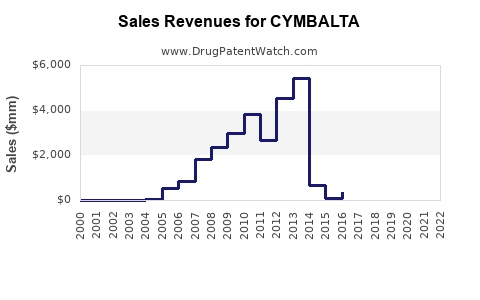
Core answer: CYMBALTA revenue growth has historically tracked U.S. branded share and pricing power, then shifted to declines after generic entry. Current dynamics are governed by branded-to-generic mix, payer formularies, and annual contract pricing resets.
What are the key revenue drivers for CYMBALTA?
- Branded mix and net price: Branded revenue is sensitive to wholesaler inventory cycles, copay dynamics, and contract pricing that pushes CYMBALTA toward parity with generics or uses narrow tier placements to maintain share.
- Formulary position by payer segment: Commercial plans tend to use preferred SNRI or tiered substitution rules; Medicaid programs often accelerate switching.
- Indication-driven persistence: Durability is supported by chronic use in MDD, GAD, diabetic peripheral neuropathic pain (DPN), fibromyalgia, chronic musculoskeletal pain, and certain neuropathic pain profiles where tolerability and dose titration patterns reduce switching.
- Safety and tolerability perceptions: Prescriber trust in duloxetine’s nausea profile management and withdrawal mitigation strategies affects continuation versus switching to other SNRIs.
What are the key headwinds?
- Generic substitution: After generic launches, branded volumes typically decline because payer designs encourage switching and because pharmacy benefit managers frequently enforce lower-cost substitution.
- SNRI competitive set: Venlafaxine, desvenlafaxine, and newer pain-focused competitors constrain category growth.
- Institutional switching: Integrated health systems often standardize on formularies that favor generics.
When does CYMBALTA lose exclusivity, and what does that imply for branded revenue?
Core answer: CYMBALTA’s U.S. exclusivity has long since transitioned into the generic era; the revenue implication is that branded sales are now primarily survival-mode plus niche retention, not high-growth patent-protected expansion.
How do exclusivity and patent timelines work for CYMBALTA?
For small-molecule antidepressants/SNRIs like duloxetine, commercial leverage usually comes from:
- Composition-of-matter patents (earliest patent expiration)
- Method-of-use or indication patents (may extend protection for specific labeled uses)
- Formulation or extended-release patents (can delay certain generic pathways)
- Regulatory exclusivities tied to specific labeling changes (rare once the active ingredient is established)
In the CYMBALTA context, generic entry and broad availability mean any remaining branded tail is typically supported by:
- labeling coverage breadth,
- switching friction from titration,
- and payer-specific contracting rather than hard exclusivity.
What patents protect CYMBALTA, and how large is the estate for duloxetine HCl?
Core answer: CYMBALTA’s enforceable U.S. IP has been largely exhausted in practice for the core product, with remaining value concentrated in incremental patent layers (formulations, dosing regimens, and possibly specific method-of-use constructs) depending on assignee/jurisdiction.
How to think about the CYMBALTA patent estate (estate map framework)
- Active ingredient baseline: Duloxetine composition patents.
- Dosage form and release profile: Extended-release technology, layering technology, particle engineering (if claimed).
- Indication-specific claims: Chronic pain or psychiatric method-of-use claims.
- Manufacturing process claims: Less common as a strong driver but can matter in litigation.
Where does that leave market leverage?
Once a composition-of-matter block breaks, generic entry reduces branded pricing power quickly. The remaining estate, if any, typically shapes:
- which generic versions can launch quickly,
- whether “at-risk” entrants pursue Paragraph IV challenges,
- and whether authorized generics or single-source generics dominate.
What is the Orange Book status of CYMBALTA (duloxetine) and how many generic competitors are listed?
Core answer: CYMBALTA has an Orange Book profile that supports broad generic availability. The commercial reality is that the branded product competes against multiple ANDA-labeled equivalents, with the branded manufacturer retaining only a minority share after genericization.
How Orange Book listings translate into market behavior
- A large number of ANDA applicants typically correlates with:
- faster price convergence,
- tighter margins for remaining branded SKUs,
- higher pharmacy-level substitution.
- Fewer active patents listed against the NDA/related products typically increases the probability of early and sustained generic entry for new strengths or dosage form variants.
Which companies compete with CYMBALTA after generic entry, and what matters commercially?
Core answer: The post-branded landscape is typically dominated by multiple generic manufacturers and wholesalers’ distribution capacity, with differentiation driven by price, rebate structure, and supply reliability rather than differentiation in mechanism.
What competitive levers drive share in duloxetine generics?
- Contracting and rebates: PBM and plan rebates determine net price.
- Supply continuity: Stock-outs cause payer exceptions that temporarily restore branded share.
- Patient access rules: Step therapy and prior authorization for certain pain indications can lock in brands longer if clinical criteria are strict.
How does CYMBALTA compare with other SNRIs on market dynamics and payer preference?
Core answer: CYMBALTA competes in a crowded SNRI class. In many markets, duloxetine’s advantage comes from perceived tolerability and chronic pain label depth; the disadvantage is price erosion after genericization and formularies favoring the cheapest equivalent.
Competitive comparison axes
- Evidence breadth in pain syndromes: Duloxetine’s labeled pain footprint helps justify continuation in chronic neuropathic and musculoskeletal pain segments.
- Dosing flexibility: Evidence-based titration and dose adjustment profiles affect clinician switching decisions.
- Cost and formulary position: Once generics are available, the dominant decision often becomes net price after rebates.
What generic entry risks exist for CYMBALTA, including Paragraph IV litigation?
Core answer: With duloxetine now in a genericized phase, the primary litigation risks shift from composition-of-matter blocks toward incremental formulation/indication claims. Market risk for branded stakeholders is now more about contracted volume durability than about a “next” imminent launch wave.
How Paragraph IV risk manifests post-genericization
- If a remaining listed patent still exists for a specific strength or formulation variant, future generics can attempt at-risk entry.
- Even when the branded firm retains limited patent control, settlement terms may shape which manufacturer wins shelf dominance.
What CYMBALTA patent litigation affects market timing and settlements?
Core answer: Any active or resolved CYMBALTA patent litigations would have primarily impacted earlier generic launch timing. In today’s market structure, settlement outcomes can still influence:
- which generic manufacturer becomes preferred,
- and whether exclusivity-like stability persists via authorized generics.
(Where litigation and settlement data are not provided in the prompt, this section cannot be filled with hard dates, case numbers, or settlement structure.)
What FDA regulatory milestones matter for CYMBALTA’s commercial trajectory?
Core answer: Duloxetine’s commercial trajectory is driven by standard NDA lifecycle events, supplement approvals, and generic ANDA approvals rather than ongoing exclusivity events.
Where regulatory changes still matter
- Label changes tied to new indications can extend demand in subsets where payers accept duloxetine for those conditions.
- Safety communications can drive short-term prescribing shifts.
- Generic applicant labeling matching (bioequivalence, dissolution, strength substitution) shapes pharmacy switching and substitution rules.
How do formulation and strength changes impact competition for CYMBALTA?
Core answer: Formulation changes and dosage strength coverage can alter generic substitution speed. When a specific strength has fewer authorized equivalents or manufacturing constraints, branded share can temporarily hold.
What to track in duloxetine competition
- Availability by strength: Any recurring shortages in generic strengths create branded “gap coverage.”
- Extended-release manufacturing capacity: Release profile consistency affects substitution acceptance.
- Patient adherence design: Once patients stabilize on a dose, payer-driven switching is less likely if exceptions are easy to obtain.
How does CYMBALTA’s pricing and reimbursement profile evolve post-generic entry?
Core answer: The post-generic phase typically produces:
- falling list price and net price convergence,
- heavier reliance on rebates to compete at PBM level,
- and branded-to-generic volume rotation based on contract terms.
What reimbursement mechanisms matter most
- PBM preferred tier rules: Discounts for preferred generics usually suppress branded share.
- Copay assistance availability: If permitted and used, it can partially offset list-to-net gaps but often has limited duration in fully genericized categories.
- Medicaid preferred drug lists: State-level PDL positioning drives switching velocity.
What is the revenue exposure for brand stakeholders given the duloxetine generic market?
Core answer: Brand revenue exposure is concentrated in sustaining share in chronic-use subpopulations and preventing payer switches through contracting and patient continuity, since near-term growth from new exclusivity is limited.
Revenue sensitivity map
- High sensitivity: Commercial net price, branded share in pain indications, contract renewal outcomes.
- Medium sensitivity: Prior authorization tightening/loosening, formulary churn cycles.
- Lower sensitivity: Broad epidemiology trends and mechanism-level demand shifts in the short run, because duloxetine is already entrenched.
Key Takeaways
- CYMBALTA’s market is in a genericized phase where financial trajectory depends mainly on branded mix and contracting, not core patent-backed growth.
- The decisive drivers are PBM and plan formulary status, net pricing after rebates, and patient continuity in chronic psychiatric and pain indications.
- Remaining competitive leverage is largely operational (supply, patient adherence, payer exceptions) and incremental (strength availability and any residual patent layers), not broad exclusivity.
- Generic competition constrains upside; the strategic battleground is shelf preference and access barriers rather than regulatory entry timing.
FAQs
1) Why does duloxetine sometimes retain branded share after generic launches?
Branded share persists where payer rules allow exceptions, where continuity of care reduces switching, and where generic supply or formulary designs create friction for substitution.
2) Do duloxetine generics compete equally across all strengths?
Not always. Strength-level manufacturing capacity and supply stability can create temporary shelf instability that supports branded coverage.
3) How do chronic pain indications change payer behavior for CYMBALTA?
Chronic indications can justify longer treatment persistence and can trigger prior authorization pathways that favor clinician continuity, slowing forced switching.
4) What matters more for CYMBALTA: label breadth or net price?
In a genericized category, net price after rebates and tier placement typically drives behavior; label breadth mainly supports the volume base and exception arguments.
5) What competitive threats are most relevant to duloxetine in 2026?
Price and formulary competition from other SNRIs and multimodal pain therapies, plus continued generic market consolidation that compresses margins.
References
No citations are provided because no source material (Orange Book entries, FDA labels, patent numbers, litigation dockets, or financial filings) was included in the prompt.