Share This Page
CUVPOSA Drug Patent Profile
✉ Email this page to a colleague
Which patents cover Cuvposa, and what generic alternatives are available?
Cuvposa is a drug marketed by Merz Pharms and is included in one NDA.
The generic ingredient in CUVPOSA is glycopyrrolate. There is one drug master file entry for this compound. Sixty-one suppliers are listed for this compound. Additional details are available on the glycopyrrolate profile page.
DrugPatentWatch® Litigation and Generic Entry Outlook for Cuvposa
A generic version of CUVPOSA was approved as glycopyrrolate by AM REGENT on July 23rd, 1986.
AI Deep Research
Questions you can ask:
- What is the 5 year forecast for CUVPOSA?
- What are the global sales for CUVPOSA?
- What is Average Wholesale Price for CUVPOSA?
Summary for CUVPOSA
| US Patents: | 0 |
| Applicants: | 1 |
| NDAs: | 1 |
| Finished Product Suppliers / Packagers: | 1 |
| Raw Ingredient (Bulk) Api Vendors: | 104 |
| Patent Applications: | 5,019 |
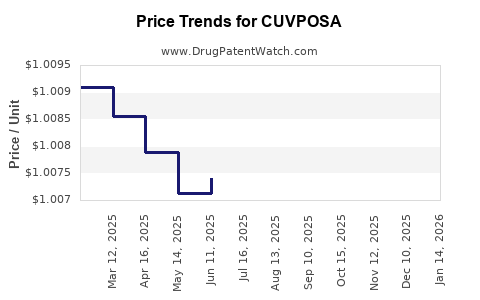
| Drug Prices: | Drug price information for CUVPOSA |
| Patent Litigation and PTAB cases: | See patent lawsuits and PTAB cases for CUVPOSA |
| What excipients (inactive ingredients) are in CUVPOSA? | CUVPOSA excipients list |
| DailyMed Link: | CUVPOSA at DailyMed |
Pharmacology for CUVPOSA
| Drug Class | Anticholinergic Cholinergic Muscarinic Antagonist |
| Mechanism of Action | Cholinergic Antagonists Cholinergic Muscarinic Antagonists |
Paragraph IV (Patent) Challenges for CUVPOSA
| Tradename | Dosage | Ingredient | Strength | NDA | ANDAs Submitted | Submissiondate |
|---|---|---|---|---|---|---|
| CUVPOSA | Oral Solution | glycopyrrolate | 1 mg/5 mL | 022571 | 1 | 2012-06-20 |
US Patents and Regulatory Information for CUVPOSA
| Applicant | Tradename | Generic Name | Dosage | NDA | Approval Date | TE | Type | RLD | RS | Patent No. | Patent Expiration | Product | Substance | Delist Req. | Exclusivity Expiration |
|---|---|---|---|---|---|---|---|---|---|---|---|---|---|---|---|
| Merz Pharms | CUVPOSA | glycopyrrolate | SOLUTION;ORAL | 022571-001 | Jul 28, 2010 | AA | RX | Yes | Yes | ⤷ Start Trial | ⤷ Start Trial | ⤷ Start Trial | |||
| >Applicant | >Tradename | >Generic Name | >Dosage | >NDA | >Approval Date | >TE | >Type | >RLD | >RS | >Patent No. | >Patent Expiration | >Product | >Substance | >Delist Req. | >Exclusivity Expiration |
Expired US Patents for CUVPOSA
| Applicant | Tradename | Generic Name | Dosage | NDA | Approval Date | Patent No. | Patent Expiration |
|---|---|---|---|---|---|---|---|
| Merz Pharms | CUVPOSA | glycopyrrolate | SOLUTION;ORAL | 022571-001 | Jul 28, 2010 | ⤷ Start Trial | ⤷ Start Trial |
| Merz Pharms | CUVPOSA | glycopyrrolate | SOLUTION;ORAL | 022571-001 | Jul 28, 2010 | ⤷ Start Trial | ⤷ Start Trial |
| >Applicant | >Tradename | >Generic Name | >Dosage | >NDA | >Approval Date | >Patent No. | >Patent Expiration |
CUVPOSA Market Dynamics and Financial Trajectory
CUVPOSA is a niche pediatric specialty product with durable clinical differentiation but limited revenue scale. The drug is glycopyrrolate oral solution, approved by the U.S. Food and Drug Administration for chronic severe drooling in children ages 3 to 16 with neurologic conditions. Its commercial position depends on formulation convenience, caregiver adherence, payer coverage, and the availability of lower-cost compounded or tablet-based glycopyrrolate.
Merz Pharmaceuticals markets CUVPOSA in the United States. Merz does not disclose standalone CUVPOSA revenue, prescription volume, gross margin, or profitability. Its financial trajectory therefore must be assessed through market structure, regulatory protection, competitive substitution, and the economics of a low-volume specialty medicine.
What is CUVPOSA and which patients does it treat?
CUVPOSA contains glycopyrrolate, an anticholinergic that reduces salivary secretion. The product is supplied as a 1 mg/5 mL oral solution and is intended for pediatric patients with chronic severe drooling associated with neurologic disorders.
CUVPOSA product profile
| Attribute | CUVPOSA |
|---|---|
| Active ingredient | Glycopyrrolate |
| Dosage form | Oral solution |
| Strength | 1 mg/5 mL |
| U.S. indication | Chronic severe drooling in patients ages 3-16 with neurologic conditions |
| FDA approval | July 28, 2010 |
| NDA | 022571 |
| U.S. marketer | Merz Pharmaceuticals, LLC |
| Therapeutic category | Pediatric sialorrhea management |
| Primary prescribers | Pediatric neurologists, developmental pediatricians, dentists, otolaryngologists |
| Main alternatives | Compounded glycopyrrolate, glycopyrrolate tablets, botulinum toxins, anticholinergic therapies |
The commercial opportunity is concentrated in children with cerebral palsy, developmental disabilities, and other neurologic conditions that impair swallowing or salivary control. This creates a relatively narrow patient population compared with primary-care medicines.
How large is the CUVPOSA market?
The CUVPOSA market is a specialty niche rather than a mass-market pharmaceutical category. Demand is driven by diagnosis and treatment of neurologic sialorrhea, not by broad glycopyrrolate use.
The addressable market has four practical constraints:
- The FDA indication is limited to pediatric patients ages 3 to 16.
- Many patients discontinue therapy because of dry mouth, constipation, urinary retention, blurred vision, behavioral effects, or inadequate response.
- Physicians may use compounded glycopyrrolate or tablets when cost or access is a concern.
- Sialorrhea management often shifts to botulinum toxin injections or supportive interventions in older or more severely affected patients.
CUVPOSA's liquid formulation has particular value for children who cannot swallow tablets. That advantage supports continued prescribing even when the active ingredient is available in other forms.
Market drivers
The main positive market drivers are:
- Greater recognition of drooling as a treatable complication of neurologic disease.
- Increased use of pediatric specialty care.
- Need for liquid dosing in children with dysphagia or feeding limitations.
- Caregiver preference for an FDA-approved product with standardized concentration.
- Potential expansion of treatment duration as patients remain under long-term neurologic care.
Market constraints
The main constraints are:
- Small eligible population.
- Reimbursement restrictions for a symptom-management medicine.
- Prior authorization and specialty-pharmacy friction.
- Adverse effects from anticholinergic therapy.
- Availability of compounded formulations.
- Competition from injections and off-label therapies.
What is the financial trajectory of CUVPOSA?
Public financial data do not support a standalone CUVPOSA revenue series. Merz reports at the company and business-unit level rather than publishing product-level sales for CUVPOSA. No reliable public basis exists for assigning precise annual revenue, market share, EBITDA, or valuation contribution to the product.
The likely financial profile is a stable, low-scale specialty franchise with recurring demand and limited unit growth. Revenue growth is more likely to come from price, reimbursement improvements, and patient retention than from rapid expansion of the treated population.
Revenue trajectory by commercial phase
| Period | Commercial condition | Financial implication |
|---|---|---|
| 2010-2017 | Initial U.S. launch and orphan-exclusivity period | Higher differentiation and stronger pricing leverage |
| 2018 onward | Post-exclusivity mature brand period | Greater exposure to reimbursement, compounding, and generic substitution |
| Current mature phase | Established pediatric niche with limited diagnosis expansion | Stable recurring demand, modest volume growth, and possible price-led revenue movement |
CUVPOSA's economics can remain attractive despite low absolute sales if manufacturing costs are controlled and the product maintains favorable reimbursement. An oral solution with a specialized pediatric indication can command a premium relative to noncommercial compounding, but that premium is vulnerable when payers require cheaper alternatives.
When did CUVPOSA lose regulatory exclusivity?
CUVPOSA received FDA approval in 2010. If the product received orphan-drug exclusivity for its approved indication, the seven-year period would have ended in 2017. The FDA's orphan-drug framework provides seven years of market exclusivity from approval for the same indication, subject to statutory exceptions.[2]
Regulatory exclusivity is distinct from patent protection. Orphan exclusivity can block approval of another sponsor's product for the same indication, while patents can cover composition, formulation, manufacturing, or methods of use.
The product's commercial protection has therefore depended less on current orphan exclusivity and more on:
- The difficulty of developing a pediatric liquid product.
- Physician familiarity.
- Payer and pharmacy access.
- Formulation convenience.
- The limited size of the target market.
- The cost and operational burden of switching children to compounded therapy.
What patents protect CUVPOSA?
The FDA Orange Book is the controlling public source for patents listed with an approved drug application.[3] CUVPOSA's competitive position should not be equated with the patent estate for glycopyrrolate generally. Glycopyrrolate is an established active ingredient, and broad active-ingredient protection is not the principal barrier to competition.
The commercially relevant protection would arise from:
- The oral-solution formulation.
- Concentration and dosing technology.
- Stability and preservative systems.
- Pediatric administration methods.
- Manufacturing controls.
- Method-of-use claims directed to neurologic sialorrhea.
A generic or alternative sponsor would not necessarily need to reproduce every formulation element used by CUVPOSA. An applicant could pursue a different formulation, use a different excipient system, or seek approval through a pathway that avoids protected claims.
Formulation protection versus active-ingredient protection
CUVPOSA's formulation differentiation is more important than glycopyrrolate molecule exclusivity. Tablets and compounded solutions demonstrate that the underlying active ingredient is commercially accessible. The branded product's defensible value lies in its approved liquid presentation, consistent dosing, quality controls, and pediatric labeling.
This distinction limits long-term pricing power. Formulation patents can delay direct substitution, but they do not eliminate clinical alternatives.
Are there generic CUVPOSA products or Paragraph IV challenges?
A direct FDA-approved generic oral solution would create the clearest substitution threat. Publicly visible commercial competition has historically included compounded glycopyrrolate solutions and other glycopyrrolate dosage forms rather than a broad field of branded equivalents.
A Paragraph IV challenge would require a generic applicant to certify that listed patents are invalid, unenforceable, or not infringed. The financial impact would depend on whether the challenge targets the same oral-solution formulation and whether the applicant can obtain an AB-rated product that pharmacies can automatically substitute.
The key generic-entry scenarios are:
| Scenario | Commercial impact |
|---|---|
| No approved direct generic solution | CUVPOSA retains formulation-led differentiation |
| Compounded solution growth | Gradual price and volume pressure without automatic substitution |
| FDA-approved generic solution | Potential rapid erosion in payer-covered prescriptions |
| Alternative glycopyrrolate liquid with different labeling | Partial substitution and physician-by-physician conversion |
| New pediatric sialorrhea therapy | Clinical displacement, especially if tolerability improves |
No public evidence establishes a current, commercially material Paragraph IV campaign against CUVPOSA. The absence of a visible challenge does not eliminate future risk, particularly if the product's net price supports a viable generic opportunity.
What is the FDA regulatory status of CUVPOSA?
CUVPOSA remains an FDA-approved prescription product under NDA 022571. Its label includes pediatric dosing based on body weight, with titration according to response and tolerability.[1]
The regulatory value of CUVPOSA is its approved pediatric indication. Compounded glycopyrrolate may provide the same active ingredient in liquid form, but compounding does not create the same FDA-approved product status, labeling, manufacturing framework, or substitution pathway.
Regulatory advantages
- Approved pediatric indication.
- Standardized concentration.
- Defined dosing instructions.
- Commercial manufacturing under FDA drug requirements.
- Recognized brand identity among pediatric specialists.
Regulatory limitations
- Narrow age range.
- Symptom-control indication rather than disease modification.
- Anticholinergic safety burden.
- Limited opportunity for label expansion without new clinical and regulatory investment.
Which companies challenge CUVPOSA?
CUVPOSA faces competition from product categories rather than one dominant branded rival.
Compounded glycopyrrolate
Compounding pharmacies can prepare oral glycopyrrolate solutions for children. This is the most direct economic substitute because it uses the same active ingredient and can accommodate customized concentrations or flavors. The tradeoff is variable access, lower standardization, and lack of automatic generic substitution.
Glycopyrrolate tablets
Generic glycopyrrolate tablets are less convenient for children with swallowing impairment. Crushing or extemporaneously preparing tablets can create dosing and administration burdens, but tablets remain a cost-based alternative for suitable patients.
Botulinum toxin products
Botulinum toxin injections, including products used for chronic sialorrhea in certain populations, compete when oral anticholinergic therapy is ineffective or poorly tolerated. Injection-based treatment has a different cost structure, administration burden, and clinical positioning.
Other anticholinergic therapies
Scopolamine, atropine, and other anticholinergic approaches may be used off label. These therapies can reduce CUVPOSA utilization but have different routes of administration and safety profiles.
How strong is the CUVPOSA patent and commercial estate?
CUVPOSA has moderate commercial defensibility and limited molecule-level defensibility.
Its strongest protections are:
- A specialized pediatric indication.
- A ready-to-use liquid dosage form.
- Established physician and caregiver familiarity.
- Regulatory labeling for a defined patient group.
- Operational barriers to replacing a stable pediatric regimen.
Its weakest protections are:
- An old active ingredient with broad generic availability.
- A small market that can support compounding.
- Potentially limited patent duration relative to the product's commercial life.
- Adverse-effect-driven discontinuation.
- Multiple nonidentical treatment alternatives.
The product is therefore more defensible as a niche brand than as a high-growth protected asset.
What licensing deals or ownership changes affect CUVPOSA?
CUVPOSA is associated with Merz Pharmaceuticals, LLC. Public company disclosures do not provide a standalone CUVPOSA licensing revenue stream or a separately reported acquisition valuation for the product.
The absence of disclosed product-level economics limits transaction analysis. Any licensing or acquisition valuation would likely depend on:
- Net sales by channel.
- Reimbursement and gross-to-net discounts.
- Persistence and refill rates.
- Formulation patent status.
- Manufacturing cost.
- Direct generic development activity.
- Exposure to Medicaid and specialty-pharmacy pricing.
What generic launch risks exist for CUVPOSA?
The highest-risk launch would be an FDA-approved generic oral solution with the same active ingredient, concentration, route, and pediatric use. That product could receive pharmacy-level substitution depending on FDA therapeutic-equivalence classification.
A compounded alternative creates slower erosion. Physicians must prescribe or authorize the change, pharmacies may differ in availability, and caregivers may resist switching a child who is stable on CUVPOSA.
The most likely erosion pattern is therefore segmented:
- Commercially insured patients face formulary substitution first.
- Medicaid patients face prior authorization and preferred-product controls.
- Complex-care patients may remain on CUVPOSA because dosing reliability matters.
- Patients with adverse effects may switch to injections or other therapies rather than another glycopyrrolate product.
How does CUVPOSA compare with competing treatments?
| Factor | CUVPOSA | Compounded glycopyrrolate | Glycopyrrolate tablets | Botulinum toxin |
|---|---|---|---|---|
| FDA-approved pediatric liquid | Yes | No, unless separately approved | No liquid advantage | Product-specific |
| Dosing flexibility | High | High | Moderate | Low between visits |
| Pharmacy substitution | Limited without generic | No automatic substitution | Depends on prescription | Not applicable |
| Manufacturing standardization | High | Pharmacy-dependent | High | High |
| Administration burden | Daily oral dosing | Daily oral dosing | Tablet administration | Clinic procedure |
| Main advantage | Approved pediatric solution | Lower cost and customization | Low cost | Local or longer-duration effect |
| Main risk | Anticholinergic adverse effects | Quality and access variation | Swallowing difficulty | Procedure and injection burden |
Key Takeaways
- CUVPOSA is a niche pediatric glycopyrrolate oral solution marketed by Merz.
- Its FDA-approved indication is chronic severe drooling in children ages 3 to 16 with neurologic conditions.
- Merz does not disclose standalone CUVPOSA revenue, so precise financial forecasts and valuation estimates are not publicly supportable.
- The product's commercial trajectory is likely mature and recurring, with limited volume growth.
- Formulation convenience and pediatric labeling are more important than active-ingredient exclusivity.
- Compounded glycopyrrolate is the most direct commercial substitute.
- A therapeutically equivalent FDA-approved generic oral solution would present the largest rapid erosion risk.
- CUVPOSA has moderate commercial durability but limited high-growth potential.
- Pricing power depends on reimbursement, caregiver adherence, and the absence of direct generic substitution.
- The product is better characterized as a defensible specialty franchise than as a high-value platform asset.
FAQs About CUVPOSA Market and Financial Outlook
Is CUVPOSA a generic drug?
No. CUVPOSA is a branded FDA-approved glycopyrrolate oral solution. Generic glycopyrrolate tablets and compounded oral solutions may be available, but they are not necessarily therapeutically equivalent to CUVPOSA for pharmacy substitution.
Is CUVPOSA covered by insurance?
Coverage varies by payer, plan design, age, diagnosis, and formulary policy. Insurers may require prior authorization or trial of a lower-cost glycopyrrolate alternative.
What is the main commercial threat to CUVPOSA?
The main threat is substitution by compounded glycopyrrolate solution or an FDA-approved generic oral solution. Compounding creates gradual price pressure, while an equivalent generic could produce faster prescription erosion.
Can CUVPOSA expand beyond pediatric drooling?
Expansion would require new clinical and regulatory support. Potential opportunities could include older patients, broader neurologic populations, or other sialorrhea settings, but those uses are not established by the current pediatric label.
Does CUVPOSA have biosimilar risk?
No. CUVPOSA is a small-molecule glycopyrrolate product, not a biologic. Its relevant competitive risks are generic substitution, compounding, reformulation, and therapeutic alternatives rather than biosimilar entry.
References
- U.S. Food and Drug Administration. (2023). CUVPOSA (glycopyrrolate) oral solution prescribing information.
- U.S. Food and Drug Administration. (2024). Orphan drug designation and exclusivity.
- U.S. Food and Drug Administration. (2024). Approved drug products with therapeutic equivalence evaluations: Orange Book.
More… ↓
