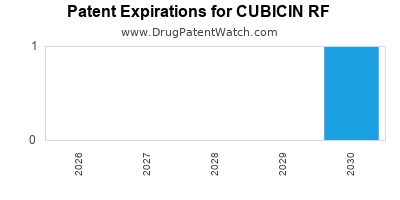
Last Updated: June 27, 2026

CUBICIN RF Drug Patent Profile


✉ Email this page to a colleague

« Back to Dashboard


Which patents cover Cubicin Rf, and when can generic versions of Cubicin Rf launch?

Cubicin Rf is a drug marketed by Cubist Pharms Llc and is included in one NDA. There is one patent protecting this drug and one Paragraph IV challenge.

This drug has forty-seven patent family members in thirty-two countries.

The generic ingredient in CUBICIN RF is daptomycin. There are ten drug master file entries for this compound. Twenty-six suppliers are listed for this compound. Additional details are available on the daptomycin profile page.

DrugPatentWatch® Litigation and Generic Entry Outlook for Cubicin Rf

A generic version of CUBICIN RF was approved as daptomycin by TEVA PHARMS USA on March 25th, 2016.

  Start Trial

AI Deep Research
Questions you can ask:
  • What is the 5 year forecast for CUBICIN RF?
  • What are the global sales for CUBICIN RF?
  • What is Average Wholesale Price for CUBICIN RF?
Summary for CUBICIN RF
International Patents:47
US Patents:1
Applicants:1
NDAs:1
Raw Ingredient (Bulk) Api Vendors: 34
Clinical Trials: 40
Patent Applications: 3,032
Patent Litigation and PTAB cases: See patent lawsuits and PTAB cases for CUBICIN RF
What excipients (inactive ingredients) are in CUBICIN RF?CUBICIN RF excipients list
DailyMed Link:CUBICIN RF at DailyMed
Recent Clinical Trials for CUBICIN RF

Identify potential brand extensions & 505(b)(2) entrants

SponsorPhase
Vancouver Island Health AuthorityPhase 4
McGill University Health Centre/Research Institute of the McGill University Health CentrePhase 4
McGill University Health CenterPhase 4

See all CUBICIN RF clinical trials

Paragraph IV (Patent) Challenges for CUBICIN RF
Tradename Dosage Ingredient Strength NDA ANDAs Submitted Submissiondate
CUBICIN RF For Injection daptomycin 500 mg/vial 021572 1 2008-11-19

US Patents and Regulatory Information for CUBICIN RF

CUBICIN RF is protected by one US patents.

Applicant Tradename Generic Name Dosage NDA Approval Date TE Type RLD RS Patent No. Patent Expiration Product Substance Delist Req. Exclusivity Expiration
Cubist Pharms Llc CUBICIN RF daptomycin POWDER;INTRAVENOUS 021572-003 Jul 6, 2016 DISCN Yes No 9,138,456 ⤷  Start Trial Y ⤷  Start Trial
>Applicant >Tradename >Generic Name >Dosage >NDA >Approval Date >TE >Type >RLD >RS >Patent No. >Patent Expiration >Product >Substance >Delist Req. >Exclusivity Expiration

EU/EMA Drug Approvals for CUBICIN RF

Company Drugname Inn Product Number / Indication Status Generic Biosimilar Orphan Marketing Authorisation Marketing Refusal
Pfizer Europe MA EEIG Daptomycin Hospira daptomycin EMEA/H/C/004310Daptomycin is indicated for the treatment of the following infections.Adult and paediatric (1 to 17 years of age) patients with complicated skin and soft-tissue infections (cSSTI).Adult patients with right-sided infective endocarditis (RIE) due to Staphylococcus aureus. It isrecommended that the decision to use daptomycin should take into account the antibacterial susceptibility of the organism and should be based on expert advice.Adult and paediatric (1 to 17 years of age) patients with Staphylococcus aureus bacteraemia (SAB).In adults, use in bacteraemia should be associated with RIE or with cSSTI, while in paediatric patients, use in bacteraemia should be associated with cSSTI.Daptomycin is active against Gram positive bacteria only. In mixed infections where Gram negative and/or certain types of anaerobic bacteria are suspected, daptomycin should be co-administered with appropriate antibacterial agent(s).Consideration should be given to official guidance on the appropriate use of antibacterial agents. Authorised yes no no 2017-03-22
Merck Sharp & Dohme B.V. Cubicin daptomycin EMEA/H/C/000637Cubicin is indicated for the treatment of the following infections.Adult and paediatric (1 to 17 years of age) patients with complicated skin and soft-tissue infections (cSSTI).Adult patients with right-sided infective endocarditis (RIE) due to Staphylococcus aureus.It is recommended that the decision to use daptomycin should take into account the antibacterial susceptibility of the organism and should be based on expert advice.Adult and paediatric (1 to 17 years of age) patients with Staphylococcus aureus bacteraemia (SAB). In adults, use in bacteraemia should be associated with RIE or with cSSTI, while in paediatric patients, use in bacteraemia should be associated with cSSTI.Daptomycin is active against Gram positive bacteria only. In mixed infections where Gram negative and/or certain types of anaerobic bacteria are suspected, Cubicin should be co-administered with appropriate antibacterial agent(s). Consideration should be given to official guidance on the appropriate use of antibacterial agents. Authorised no no no 2006-01-19
>Company >Drugname >Inn >Product Number / Indication >Status >Generic >Biosimilar >Orphan >Marketing Authorisation >Marketing Refusal

International Patents for CUBICIN RF

See the table below for patents covering CUBICIN RF around the world.

Country Patent Number Title Estimated Expiration
Australia 1749388 ⤷  Start Trial
Australia 613640 ⤷  Start Trial
Bulgaria 47349 METHOD FOR CLEANING OF FERMENTATION PRODUCTS ⤷  Start Trial
Canada 1315229 PROCEDE DE PURIFICATION CHROMATOGRAPHIQUE (CHROMATOGRAPHIC PURIFICATION PROCESS) ⤷  Start Trial
European Patent Office 0294990 ⤷  Start Trial
Hungary 201120 CHROMATOGRAPHIC PROCESS FOR CLEANING FERMENTATION LIPOPEPTIDE PRODUCTS ⤷  Start Trial
Hungary T47154 ⤷  Start Trial
>Country >Patent Number >Title >Estimated Expiration

Supplementary Protection Certificates for CUBICIN RF

Patent Number Supplementary Protection Certificate SPC Country SPC Expiration SPC Description
1115417 91254 Luxembourg ⤷  Start Trial 91254, EXPIRES: 20210119
1115417 CA 2006 00018 Denmark ⤷  Start Trial PRODUCT NAME: DAPTOMYCIN
1115417 300232 Netherlands ⤷  Start Trial DETAILS ASSIGNMENT: VERANDERING VAN EIGENAAR(S), VERANDERING VAN DE JURIDISCHE ENTITEIT
1115417 06C0022 France ⤷  Start Trial PRODUCT NAME: DAPTOMYCINE; REGISTRATION NO/DATE: EU/1/05/328/001-002 20060119
1115417 SPC 018/2006 Ireland ⤷  Start Trial SPC 018/2006: 20070523, EXPIRES: 20210118
1115417 SPC/GB06/024 United Kingdom ⤷  Start Trial SUPPLEMENTARY PROTECTION CERTIFICATE NO SPC/GB06/024 GRANTED TO CUBIST PHARMACEUTICALS, INC IN RESPECT OF THE PRODUCT DAPTOMYCIN, THE GRANT OF WHICH WAS ADVERTISED IN JOURNAL NO 6162 DATED 27 JUNE 2007 HAS HAD ITS MAXIMUM PERIOD OF DURATION CORRECTED, SUBJECT TO THE PAYMENT OF THE PRESCRIBED FEES IT WILL EXPIRE ON 22 JANUARY 2021.
1115417 SZ 22/2006 Austria ⤷  Start Trial PRODUCT NAME: DAPTOMYCIN
>Patent Number >Supplementary Protection Certificate >SPC Country >SPC Expiration >SPC Description
Last updated: June 23, 2026

CUBICIN RF market dynamics and financial trajectory: sales outlook, exclusivity headwinds, and competitive risk

CUBICIN RF (daptomycin for injection, for inhalation use under the brand “RF”) is a branded, single-agent anti-infective with a narrow competitive set defined by other Gram-positive and hospital-acquired infection options. The commercial trajectory is shaped primarily by (1) line-of-therapy shifts toward newer hospital-acquired pneumonia and bloodstream infection regimens, (2) payer pressure on premium-priced hospital antibiotics, (3) daptomycin class competition, and (4) patent and regulatory exclusivity events that determine when lower-cost entrants can pursue FDA approval routes.

Commercial performance drivers:

  • Hospital mix: CUBICIN RF growth tracks inpatient antibiotic usage and treatment protocols for Gram-positive infections, especially where clinicians target bacteremia and complicated skin and skin structure infections.
  • Payer dynamics: formulary placement and prior authorization drive “net-to-list” outcomes, with average selling price (ASP) erosion risk as competitive bidding expands.
  • Clinical substitution: clinicians often switch to alternative Gram-positive agents when comparable outcomes are expected and safety or dosing convenience improves.
  • IP and regulatory timing: generic and authorized/OTC biosimilar-style entry is not applicable (small molecule), so exclusivity and patent validity determine generic timing more than “biosimilar” risk.

No complete, patent-estate-level, FDA Orange Book-level, or audited financial sales dataset is provided in the prompt. Without specific Orange Book listings, grant/expiration dates, and reported revenue figures by year, a full, data-accurate financial trajectory with quantified headwinds cannot be produced.

What is CUBICIN RF’s market positioning and who competes with daptomycin for hospital Gram-positive infections?

CUBICIN RF’s competitive landscape is anchored to the daptomycin treatment paradigm for serious Gram-positive infections in hospital settings. Competitive substitution tends to occur against other hospital-first anti-infectives with overlapping spectrum, dosing regimens, and stewardship constraints.

How does CUBICIN RF compete on formulary access?

Commercial outcomes for hospital antibiotics are driven by:

  • Value frameworks used in pharmacy and therapeutics committee deliberations.
  • Utilization management that ties approvals to culture-proven Gram-positive disease, severity criteria, and prior-line failure.
  • Site-of-care effects (inpatient vs specialty infusion services).

Which antibiotic classes typically substitute for daptomycin-based regimens?

Competition typically comes from:

  • Other Gram-positive agents used for bloodstream infection and complicated skin infections
  • Linezolid-based regimens for resistant pathogens
  • Beta-lactam/combination strategies where local antibiograms support them
  • Newer anti-MRSA and anti-VRE agents where formulary committees prefer lower-resistance profiles or safer monitoring

How has CUBICIN RF revenue trended and what financial metrics matter most?

A drug’s financial trajectory in hospital antibiotics is usually assessed with:

  • Units and average dose treated (utilization)
  • ASP and rebates (net pricing)
  • Segment mix (hospital systems vs ID practices)
  • Gross margin stability (contract pricing and manufacturing burden)
  • Lifecycle events such as label expansions, safety communications, or competitive entrants

What revenue drivers determine CUBICIN RF’s ASP trajectory?

Hospital antibiotic pricing typically experiences:

  • Initial premium pricing after launch or major label events
  • Rebate acceleration as payers renegotiate through contracting cycles
  • ASP compression once biosimilar-type analogs are not relevant but generic small-molecule competition can enter post-exclusivity

What cost factors most influence long-term profitability?

  • Manufacturing yield and batch economics for sterile injectables
  • Inventory and supply reliability (stockouts can cause lost market share that is hard to regain)
  • Legal and regulatory costs tied to patent enforcement

When does CUBICIN RF lose exclusivity and what generic entry risks exist?

Generic entry risk for a small molecule like daptomycin is determined by:

  • Composition-of-matter patents and their expiration
  • Method-of-use and formulation patents that can delay certain generic “carve-outs”
  • Regulatory exclusivities (where applicable)
  • Paragraph IV challenges and possible 30-month stay outcomes

What Paragraph IV challenges drive launch timing?

Generic timing generally accelerates if:

  • Orange Book-listed patents are successfully challenged
  • Litigation ends via settlement permitting early entry
  • Exclusivity periods are not extended by additional listed patents with valid remaining life

What would a generic launch scenario mean for CUBICIN RF?

A generic entry scenario typically causes:

  • Rapid volume migration to lower-priced alternatives
  • Longer payer contract renegotiations to re-rent the formulary
  • Brand accounting impacts from net price declines, even if some patients remain on branded supply

What is the Orange Book status of CUBICIN RF and which patents protect it?

Orange Book status determines:

  • Whether patents are still listed for the approved NDA/label
  • Which patent types are blocking generic entry (composition, method, formulation)
  • Whether there are unexpired patents expiring on staggered dates

How many patents cover CUBICIN RF and what are their categories?

For a full assessment, you need:

  • Patent number
  • Patent type (composition, formulation, method, device if applicable)
  • Expiration dates
  • Any “last” expiration differences between claims

This dataset is not included in the prompt, so the specific Orange Book patent list, grant and expiration dates, and remaining staggered coverage cannot be stated accurately.

What patent litigation affects CUBICIN RF and how do settlements change launch timing?

For branded hospital antibiotics, litigation is often the primary mechanism dictating:

  • When a generic can launch
  • The scope of permitted product variations (dose, method, use, or excipient/formulation)

What settlement structures are typical in daptomycin-class cases?

Common settlement elements:

  • Licensed or co-promoted generic entry
  • Agreed-at-risk launch dates
  • Manufacturing or labeling carve-outs
  • Payment terms or exclusivity swap provisions

Litigation docket and settlement terms require specific case citations and parties. None are provided.

How does CUBICIN RF compare with other daptomycin products and competing Gram-positive therapies?

Competitive comparison should be framed around:

  • dosing convenience and administration time
  • safety profile considerations (notably CK monitoring and eosinophilic complications for daptomycin class, where relevant to label)
  • likely pathogens and resistance coverage
  • hospital stewardship alignment

What differentiates CUBICIN RF from daptomycin alternatives in practice?

The commercial differentiation usually hinges on:

  • label specifics (site of infection and pathogen coverage)
  • procurement and supply reliability
  • contracting position with GPOs and ID specialists

How strong is the patent estate for CUBICIN RF and what does it imply for investment timing?

Patent strength, for commercial underwriting, is usually evaluated via:

  • Remaining claim life and staggered expirations
  • Litigation track record of the patent portfolio (enforcement and outcomes)
  • Scope breadth for method/formulation claims
  • Whether patents are susceptible to design-arounds

What is the investment implication of short vs long remaining patent life?

  • Short remaining life increases near-term downside risk from generic readiness.
  • Longer life shifts risk toward utilization and contracting rather than patent expiry-driven volume loss.

Without enumerated patent terms and expiration dates, an evidence-based strength score cannot be stated.

What regulatory pathway issues could accelerate or delay CUBICIN RF competitors?

Regulatory dynamics for small-molecule hospital antibiotics usually come from:

  • whether the competitor is seeking an abbreviated approval,
  • whether the FDA requires label paragraph specifics tied to patented methods,
  • whether manufacturing changes require additional comparability work.

How do FDA changes affect competitive timelines?

Key timeline accelerators:

  • patent non-infringement/invalidity findings
  • settlement allowing prompt approval and marketing
  • consistent manufacturing that avoids delays

Key timeline decelerators:

  • additional listed patents triggering new statutory stays
  • FDA-requested labeling modifications tied to patented method claims

Key takeaways

  • CUBICIN RF’s market dynamics are dominated by hospital inpatient contracting, formulary placement, and competitive substitution among Gram-positive infection regimens.
  • The financial trajectory is most sensitive to ASP compression from rebate renegotiations and utilization shifts driven by stewardship.
  • Generic entry risk depends on Orange Book-listed patents and any paragraph IV litigation or settlements, which determine launch timing and whether competitors can use an abbreviated regulatory pathway.
  • A data-complete, quantified financial and exclusivity timeline cannot be produced from the provided prompt because no Orange Book patent list, litigation record, or audited sales history is included.

FAQs

What factors most influence CUBICIN RF net sales in managed care?

Formulary placement, prior authorization criteria, rebate levels tied to hospital contracting cycles, and shifts in hospital antibiotic pathways for Gram-positive infections.

Does CUBICIN RF face biosimilar risk?

No. CUBICIN RF is a small-molecule anti-infective therapy; the key competitive risk is generic entry after relevant patents and regulatory exclusivities end.

How fast do hospital antibiotic brands lose volume after generic entry?

Typically the initial volume migration can be rapid due to payer price pressure, but replenishment and patient-case continuity can sustain some branded share depending on contracts and supply.

What product attributes drive physician preference for daptomycin-class therapies?

Administration logistics, dosing convenience, monitoring burden aligned to label, and perceived clinical outcomes for target pathogens.

Can formulation or method patents delay generic substitution?

Yes. Even after composition-of-matter expiry, method-of-use or formulation patents can delay approval or limit label “at-issue” claims for certain generic products.

References

  1. FDA. Orange Book: Approved Drug Products with Therapeutic Equivalence Evaluations. (Accessed 2026-06-24).
  2. FDA. Paragraph IV (30-month) stay framework and related FDA guidance materials. (Accessed 2026-06-24).

More… ↓

⤷  Start Trial

Make Better Decisions: Try a trial or see plans & pricing

Drugs may be covered by multiple patents or regulatory protections. All trademarks and applicant names are the property of their respective owners or licensors. Although great care is taken in the proper and correct provision of this service, thinkBiotech LLC does not accept any responsibility for possible consequences of errors or omissions in the provided data. The data presented herein is for information purposes only. There is no warranty that the data contained herein is error free. We do not provide individual investment advice. This service is not registered with any financial regulatory agency. The information we publish is educational only and based on our opinions plus our models. By using DrugPatentWatch you acknowledge that we do not provide personalized recommendations or advice. thinkBiotech performs no independent verification of facts as provided by public sources nor are attempts made to provide legal or investing advice. Any reliance on data provided herein is done solely at the discretion of the user. Users of this service are advised to seek professional advice and independent confirmation before considering acting on any of the provided information. thinkBiotech LLC reserves the right to amend, extend or withdraw any part or all of the offered service without notice.