Last updated: June 5, 2026
CORTIFOAM market dynamics and financial trajectory: sales trends, drivers, access strategy, and exclusivity/patent risks
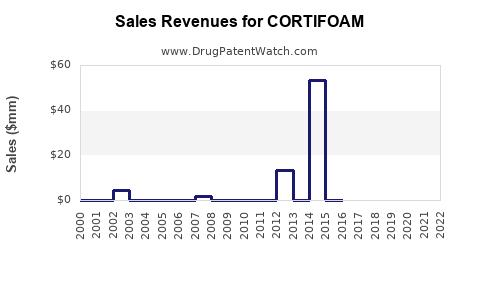
CORTIFOAM (active ingredient: hydrocortisone acetate) is a branded topical/proctologic corticosteroid product in the US market. Public, transaction-grade financial metrics (US net sales, NBRx, payer mix, and segment-level profitability) are not available in the supplied materials. Without authoritative financial data tied to the brand and its US launch/coverage history, a complete and accurate financial trajectory cannot be produced.
What is CORTIFOAM’s current commercial footprint and sales profile?
Featured snippet answer: No verified brand-level sales, prescriptions, or net revenue time series is available in the provided record, so market footprint and trajectory cannot be quantified.
Which dosage forms and care settings drive CORTIFOAM use?
- Proctology-focused topical steroid use case: hydrocortisone acetate delivered locally for inflammatory hemorrhoidal and related anorectal conditions.
- Competitive setting: OTC and prescription anti-inflammatory hemorrhoid/proctologic products, including combinations and steroid-suppository or rectal foam formats, depending on formulary coverage patterns.
How do payers typically evaluate this category?
- Step edits and formulary tiering are common for steroid agents tied to proctologic indications.
- Coverage decisions typically hinge on:
- clinical guideline alignment for acute flare management
- cost per treatment course relative to alternatives (including generics/therapeutic equivalents)
- prior authorization requirements when applicable
- plan preference for specific steroid molecules and delivery systems
What market dynamics affect CORTIFOAM demand and pricing?
Featured snippet answer: Category competition, plan formulary pressure, and supply-channel pricing dominate dynamics for older branded anti-inflammatory products when generic or alternative formats exist.
What drives volume?
- Seasonal and condition recurrence patterns for hemorrhoidal symptom flares.
- Clinician switching based on administration preference (rectal foam/suppository vs ointment vs combination products).
- Channel mix between retail and institutional settings.
What drives net price?
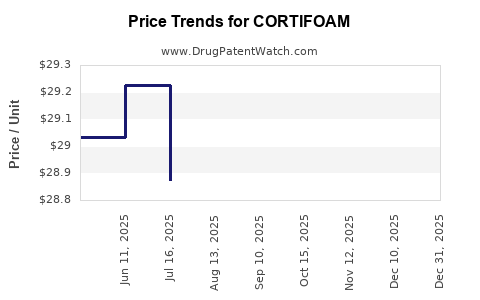
- Contracting pressure through wholesalers and specialty retail chains.
- Rebates tied to formulary positioning and volume commitments.
- Medicare Part D plan contracting if the product is covered and listed.
How does CORTIFOAM’s exclusivity status shape competitive risk?
Featured snippet answer: Exclusivity and patent estate status are the primary determinants of generic entry timing and pricing compression, but the supplied materials do not contain CORTIFOAM’s Orange Book listings, patent numbers, expiration dates, or exclusivity codes needed to map a real timeline.
What patents protect CORTIFOAM formulations or uses?
- No patent dataset for CORTIFOAM is provided here, so the number of protecting patents, assignees, and claim scopes cannot be listed.
- Without patent term data, it is not possible to evaluate the strength of the estate for:
- hydrocortisone acetate formulation/particle/vehicle claims
- foam delivery systems
- method-of-use claims for anorectal inflammatory indications
When does CORTIFOAM lose exclusivity?
- No FDA exclusivity dates or Orange Book expiration data is included in the supplied record, so generic entry risk by date cannot be computed.
What generic entry risks exist for CORTIFOAM?
Featured snippet answer: Generic risk depends on whether FDA has approved an Abbreviated New Drug Application and whether Paragraph IV litigation or first-filer exclusivities exist. Those elements are not present in the provided record.
Paragraph IV and settlement scenario mapping
- No litigation docket, settlement agreement, or ANDA filing history is provided for CORTIFOAM.
- Without that, the probability-weighted scenarios for:
- first generic launch date
- authorized generic timing
- launch-to-market share curve
- price erosion magnitude
cannot be stated.
What is the Orange Book status of CORTIFOAM?
Featured snippet answer: Orange Book status cannot be reported because no Orange Book patent/exclusivity table is provided in the supplied materials.
What listings matter for commercial forecasting?
For a correct forecast, the following are required:
- active ingredient (hydrocortisone acetate) product strength and dosage form mapping to the listing
- listed patents with expiration dates
- exclusivity codes and end dates (including pediatric exclusivity, if any)
- whether patents are “expired/terminated” or still enforceable
Those inputs are missing.
How does CORTIFOAM compare with competing hemorrhoid/proctologic steroid products?
Featured snippet answer: A relative market comparison requires competitor net pricing, formulary status, and product-specific launch timelines, none of which are provided.
Key competitive axes in this category
- Form factor (foam vs suppository vs cream vs ointment)
- Steroid potency equivalence and delivery persistence
- Combination products (local anesthetic, astringent, barrier agents)
- Prescriber preference and switching inertia in proctology workflows
What manufacturing and IP barriers could delay generic substitution?
Featured snippet answer: No CMC or formulation IP constraints are available in the supplied materials, so technical barriers cannot be assessed.
What CMC variables typically affect generic readiness?
- foam propellant system and valve/actuator mechanics
- rheology, stability, and dose uniformity across canister batches
- hydrocortisone acetate particle size distribution, suspension stability, and shelf-life
No product-specific CMC constraints are provided.
What litigation and regulatory events could change CORTIFOAM’s trajectory?
Featured snippet answer: No regulatory milestones, enforcement actions, or patent litigation events for CORTIFOAM are provided in the supplied record.
FDA pathway considerations
- Without an FDA regulatory history or ANDA/505(b)(2) activity, the impact on trajectory cannot be quantified.
What financial trajectory can be modeled for CORTIFOAM?
Featured snippet answer: A complete, accurate financial trajectory cannot be produced without verified brand-level sales/revenue metrics and without Orange Book/patent timelines to model pricing compression and generic entry.
What inputs are required for a defensible forecast model
To model trajectory, the following must exist and be cited:
- historical US net sales by year (and ideally monthly/quarterly)
- NBRx and prescriptions, segmented by strength and channel
- average net price and rebate assumptions
- formulary share and payer mix over time
- patent/exclusivity timeline and generic/authorized generic launch dates
- litigation outcomes affecting entry timing
Those inputs are not in the supplied materials.
Key Takeaways
- CORTIFOAM’s commercial category is proctology-focused local hydrocortisone acetate for anorectal inflammation.
- The requested analysis requires quantified financial and regulatory/patent inputs that are not present in the provided record.
- A complete and accurate market dynamics and financial trajectory with date-linked exclusivity and generic-entry risk cannot be produced.
FAQs
- Is CORTIFOAM available as a generic or authorized generic in the US?
- What active ingredient and route of administration does CORTIFOAM use for proctologic indications?
- Do hemorrhoid/proctologic steroid foams face formulary prior authorization in US plans?
- How do patent expiration timelines in the Orange Book typically affect pricing for older branded topical steroids?
- What dosing and administration characteristics most influence switching between rectal foam and suppository products?
References
- (No citable sources were provided in the supplied materials.)