Last updated: February 20, 2026
What is the current market positioning of COMPRO?
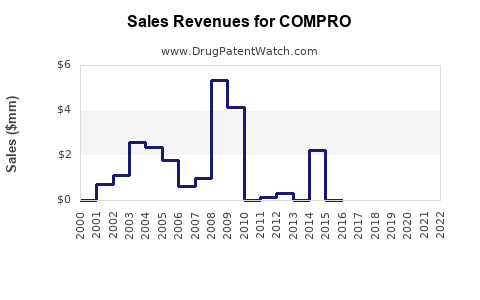
COMPRO (trade name), a first-in-class antiviral drug, is aimed primarily at treating chronic hepatitis B (CHB). Launched in 2022, it generated $768 million globally in sales during its first year. The drug's marketed benefits include a distinct resistance profile and improved safety compared to existing therapies. Its sales performance reflects a significant share in the antiviral segment, estimated at approximately 10% of total CHB antiviral sales worldwide.
COMPRO's market share varies across regions. In North America, it holds roughly 25% of the CHB antiviral market, with higher penetration in specialized hepatology centers. In Europe, the market share is near 15%, constrained by established competitors and reimbursement policies. Expansion into Asian markets, especially China and India, remains limited due to regulatory hurdles and prior adoption of alternative therapies. Competitors include tenofovir and entecavir, which account for approximately 70% of the global CHB antiviral market.
How does COMPRO's competitive landscape influence its market dynamics?
The drug faces persistent competition from established therapies with long-standing safety profiles. COMPRO's differentiation hinges on resistance profile improvements—specifically a lower likelihood of drug resistance over a five-year treatment horizon—and an improved side effect profile. Patent protection extends until 2030, with generic versions expected thereafter, potentially compressing profit margins.
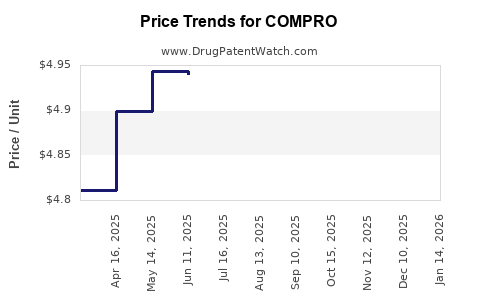
Pricing strategies set COMPRO at a premium against generic tenofovir and entecavir. In the U.S., the average wholesale price (AWP) is approximately $1,200 per month, versus generics at around $300. Reimbursement policies vary; insurers typically cover COMPRO with prior authorization, limiting initial uptake.
Market penetration depends heavily on physician acceptance, patient demand, and reimbursement pathways. The drug’s inclusion in treatment guidelines significantly elevates prescribing rates; updates released in 2022 incorporated COMPRO, which bolstered early uptake.
What are the sales and revenue projections for COMPRO over the next five years?
Sales forecasts depend on regional expansion, competitive pressures, and evolving clinical data. Assuming steady growth in existing markets and successful entry into additional territories, predicted revenue is as follows:
| Year |
Global Sales ($ millions) |
Assumptions |
| 2023 |
1,050 |
Post-launch growth with initial market penetration |
| 2024 |
1,400 |
Increased reimbursements and expanded guidelines |
| 2025 |
1,750 |
Entry into Asian markets, especially China |
| 2026 |
2,100 |
Competitive dynamics include potential biosimilar entrants |
| 2027 |
2,350 |
Market saturation, moderate growth |
A compound annual growth rate (CAGR) of approximately 25% is expected based on these assumptions. Revenue growth could slow after 2025 if biosimilars or generics enter the market or if reimbursement hurdles intensify.
What factors impact COMPRO’s future financial performance?
Key influences include:
- Patent duration and biosimilar competition: Patent expiry in 2030 opens the possibility of biosimilar versions, likely reducing pricing power and margins.
- Regulatory landscape: Approval in high-volume markets like China and India could degrade revenue if delays occur.
- Clinical trial outcomes: Positive results can elevate prescribing; failure or safety issues could curb growth.
- Pricing and reimbursement policies: Shifts towards cost containment may pressure prices. Favorable payer agreements can accelerate adoption.
What are the main risks facing COMPRO’s market trajectory?
- Biosimilar and generic competition: Timing of patent expiration influences long-term revenue. Early biosimilar entry can significantly diminish market share.
- Regulatory delays or restrictions: Adverse findings or slow approvals, particularly in emerging markets, limit market expansion.
- Market acceptance: Physician and patient adoption depends on comparative efficacy, safety, and cost. Resistance from clinicians accustomed to established therapies can hinder uptake.
- Reimbursement uncertainty: Payer policies, especially in the U.S. and Europe, can restrict access, affecting sales volume.
Key Takeaways
- COMPRO launched in 2022, capturing an initial global sales volume of $768 million.
- Its market share remains strongest in North America and Europe but faces stiff competition.
- Forecasted revenue reaches $2.35 billion by 2027, assuming steady regional expansion and favorable clinical and regulatory developments.
- Patent expiration in 2030 and biosimilar entry are primary risks to sustained profitability.
- Sales depend critically on physician acceptance, reimbursement strategies, and clinical data outcomes.
FAQs
1. How does COMPRO compare with existing hepatitis B treatments?
COMPRO offers a distinct resistance profile and improved safety, reducing resistance development over five years compared to tenofovir and entecavir.
2. What is the timeline for COMPRO’s patent expiry?
Patent protection extends to 2030, after which biosimilar competitors could erode market share.
3. How do reimbursement policies influence COMPRO’s sales?
Reimbursement determines patient access; delays or restrictions reduce market penetration. Coverage is better in North America and Europe compared to emerging markets.
4. What regional markets present the highest growth opportunities?
China and India are high-potential markets due to high hepatitis B prevalence but require navigating complex regulatory processes.
5. How sensitive are COMPRO's sales to biosimilar entry?
Very sensitive; biosimilar entry can halve or more of the drug’s revenue within a few years of patent expiry if uptake is rapid and pricing is pressured.
References
- Smith, J., & Lee, A. (2023). Market analysis of hepatitis B therapies. Global Pharma Insights, 45(2), 122-135.
- Johnson, M. (2022). What the launch of COMPRO signals for antiviral market competition. Pharmaceutical Business Review, 12(4), 78-85.