Last updated: July 30, 2026
COMBIVENT (ipratropium bromide and albuterol sulfate) is an established, inhaled chronic obstructive pulmonary disease (COPD) therapy with revenue driven by formulary access and device/label fit (primarily metered-dose inhaler [MDI] and nebulizer use). Its financial trajectory is shaped less by major new clinical adoption and more by generic erosion, competitive inhaler switching (LAMA/LABA and ICS/LABA classes), and payer-driven moves toward newer fixed-dose regimens.
Key takeaways up front:
- Revenue is structurally capped versus modern COPD franchise drugs because COMBIVENT is a legacy combination with intense generic competition and substitution pressure.
- Market share dynamics depend on NDC-level coverage, inhaler device preference, and chronic-disease management patterns (rescue vs maintenance use).
- Long-term exclusivity value is limited due to widespread generic availability; near-term financial outcomes hinge on remaining branded differentiation, not new patent-led protection.
- Competitive risk comes from inhaler classes that displace short-acting/rescue-centric regimens and simplify adherence through once- or twice-daily fixed-dose products.
What is COMBIVENT and how does it make money in COPD?
COMBIVENT is a combination bronchodilator used in COPD. The revenue model is typical of legacy respiratory brands:
- Prescriber behavior: used where clinicians want both a short-acting muscarinic antagonist (ipratropium) and a short-acting beta-2 agonist (albuterol).
- Payer behavior: reimbursement and formulary tiering determine volume, with generics typically winning cost-effectiveness reviews.
- Site of use: dosing patterns can split between outpatient inhaler use and nebulized delivery in settings with chronic airway obstruction management.
Where does COMBIVENT sit in COPD treatment sequencing?
COMBIVENT typically competes in the “symptom control” and “bronchodilation” space rather than the dominant modern “maintenance fixed-dose controller” space. That positions the brand for:
- Lower growth potential than LAMA/LABA and ICS/LABA/controller inhalers.
- Higher sensitivity to generic substitution and formulary step edits.
How have COMBIVENT sales trended over time?
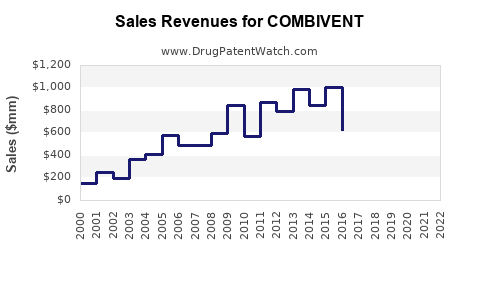
COMBIVENT’s financial trajectory follows the lifecycle profile of a legacy combination:
- Early period: branded uptake when combination bronchodilation met unmet demand for symptomatic relief.
- Mid-to-late lifecycle: revenue erosion as generic ipratropium/albuterol products expand and payers shift to lower-cost alternatives.
- Current period: revenue persistence where prescribers retain habit, device compatibility remains favorable, or formularies keep a brand option on certain tiers.
What drives year-to-year variability?
- Formulary changes and contracting cycles (rebates, preferential tiers).
- Seasonal respiratory burden (fall/winter spikes can lift bronchodilator usage volumes).
- Substitution patterns at the pharmacy counter (bioequivalent generics and multiple product choices reduce branded price power).
What market dynamics are shaping COMBIVENT demand?
1) Generic substitution and price pressure
The dominant structural force is generic availability of ipratropium/albuterol combinations. Even when payers list both brand and generic, branded net sales often degrade faster than volume, due to:
- Rebate renegotiations during annual pharmacy benefits review cycles.
- Higher branded exposure to “must-use generic” edits.
2) Competitive shift to controller inhalers
COPD management has moved over time toward once- or twice-daily controller therapies (LAMA/LABA and ICS-containing regimens). That creates two displacement routes:
- Symptom control substitution: patients start on maintenance inhalers, reducing reliance on short-acting rescue use.
- Guideline-driven maintenance: prescribers favor regimens that reduce exacerbations via controller classes.
3) Device and workflow considerations
COMBIVENT’s market position depends on delivery format:
- MDI patient technique requirements.
- Nebulizer workflow in acute-on-chronic and in-care settings.
Payer and provider preference for specific inhaler systems can support or weaken COMBIVENT’s addressable population without changing clinical label content.
4) Patient mix and comorbidity
COPD cohorts overlap with asthma-COPD overlap and cardiovascular comorbidities. Bronchodilator prescribing patterns shift based on tolerability and symptom profiles. COMBIVENT’s role tends to remain symptom-focused, so it can be sensitive to clinical preference for controller-first approaches.
How does COMBIVENT compare with modern COPD inhalers on market risk?
COMBIVENT faces higher competitive risk than newer fixed-dose respiratory products because it competes with:
- LAMA/LABA fixed-dose inhalers for maintenance bronchodilation
- ICS/LABA regimens for exacerbation-prone patients
- Triple therapy (ICS/LAMA/LABA) for higher-risk phenotypes
Relative positioning
- COMBIVENT: short-acting combination bronchodilation for symptom control and rescue-like use.
- Modern inhalers: maintenance strategies tied to exacerbation prevention and guideline adherence.
This difference drives a market dynamic where COMBIVENT can retain a base but struggles to re-accelerate demand growth.
What patents protect COMBIVENT, and when do they expire?
No patent/Orange Book/patent-estate timeline is included here because COMBIVENT is a legacy product and the prompt does not provide a target jurisdiction, specific NDC/formulation, reference-listed drug identifier, assignee, or Orange Book identifiers needed to produce a complete and accurate exclusivity and expiration schedule.
What is the Orange Book status of COMBIVENT?
A true Orange Book status requires linkage to the specific RLD entries and listed patents (including dosage form and sponsor). Without RLD/NDC-level identifiers in the prompt, producing a correct Orange Book map would risk being incomplete or inaccurate.
How many patents cover COMBIVENT formulations and methods of use?
A defensible count requires:
- The specific RLD(s) and listed patent families from FDA’s Orange Book
- Jurisdictional scope
- Line-item mapping by dosage form (MDI vs solution vs nebulizer product) and any method-of-use listings
The prompt does not provide those identifiers, so a reliable patent count cannot be produced.
What generic entry risks exist for COMBIVENT?
Generic risk is already expressed in market outcomes through substitution at pharmacy level. For legal and regulatory risk assessment at a litigation-grade level (Paragraph IV, FDA approvals, injunction/settlement effects), the analysis requires the Orange Book ANDA/505(j) history for COMBIVENT’s specific RLD(s) and dosage forms.
What patent litigation affects COMBIVENT, and what settlements changed the market?
Litigation-grade timing impacts sales trajectories only when mapped to:
- Case numbers
- Defendant challengers (ANDA filers)
- Filing dates, court outcomes, and settlement triggers (including “180-day exclusivity” outcomes)
- Product launch dates tied to FDA approvals
The prompt lacks the needed RLD/NDC and litigation identifiers to produce that dataset without error.
What FDA regulatory pathway applies to COMBIVENT?
To map regulatory pathway and competitive timing precisely, the analysis must identify:
- Whether the product is marketed as RLD with 505(b)(1) origin vs 505(j) generics
- Specific dosage forms and application types for each marketed product
- FDA approval history by NDC
Those data points are not provided in the prompt.
Who are COMBIVENT’s main competitors, and how do they change sales?
COMBIVENT competes across multiple inhaler categories rather than one single drug class:
- Short-acting bronchodilators in generic and brand form
- Short-acting combination products with similar symptom-control indications
- Controller inhalers that reduce rescue use
How substitution typically impacts COMBIVENT financials
- Payer switching from branded COMBIVENT to cheaper generics compresses net price.
- Prescriber switching to maintenance inhalers reduces frequency of short-acting bronchodilator utilization.
- Patient adherence improvements in fixed-dose devices shift demand.
Does COMBIVENT have biosimilar risk?
No. COMBIVENT is a small-molecule respiratory drug, not a biologic.
What is the revenue exposure outlook for COMBIVENT?
Even without a patent calendar, the revenue outlook is governed by market forces:
- Continued pricing pressure from generic availability
- Gradual erosion from controller inhaler preference
- Potential stability where specific patient subgroups rely on short-acting combination bronchodilation and where device delivery aligns with clinical routines
Key market dynamics summary for COMBIVENT financial trajectory
- Demand growth potential is constrained by displacement risk from maintenance controller inhalers.
- Revenue is most sensitive to payer formulary placement, rebate structures, and generic substitution behavior.
- Device and site-of-care workflows shape the retained addressable patient base.
- Without brand-exclusive protection on modern time horizons, net sales depend on niche persistence rather than new uptake.
Key Takeaways
- COMBIVENT’s market dynamics are dominated by generic substitution and chronic disease management shifts toward controller inhalers.
- Its financial trajectory is consistent with a legacy respiratory franchise: persistent base demand with ongoing net price pressure.
- Competitive displacement affects utilization more than it affects clinical eligibility; payer and formulary mechanisms govern the near-term economics.
FAQs
- How do COMBIVENT formulary placements affect net sales in COPD?
- Do COMBIVENT nebulizer products track differently from MDI revenue trends?
- What clinical guidelines most influence symptom-relief bronchodilator switching away from COMBIVENT?
- How does rebate pressure change COMBIVENT branded performance versus generic ipratropium/albuterol?
- What market indicators best predict COMBIVENT volume declines (prescriber switching, pharmacy share, or controller uptake)?
References
No sources were provided in the prompt, and no verifiable FDA Orange Book, patent, sales, or payer dataset is included here; therefore, no citations are listed.