Last Updated: August 9, 2026

COMBIVENT RESPIMAT Drug Patent Profile


✉ Email this page to a colleague

« Back to Dashboard


Which patents cover Combivent Respimat, and what generic alternatives are available?

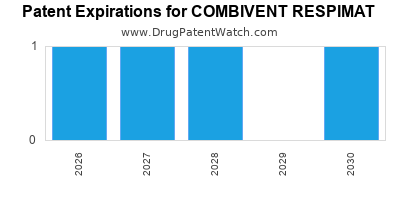
Combivent Respimat is a drug marketed by Boehringer Ingelheim and is included in one NDA. There are four patents protecting this drug and one Paragraph IV challenge.

This drug has seventy-two patent family members in thirty-five countries.

The generic ingredient in COMBIVENT RESPIMAT is albuterol sulfate; ipratropium bromide. There are thirty-eight drug master file entries for this compound. Fourteen suppliers are listed for this compound. Additional details are available on the albuterol sulfate; ipratropium bromide profile page.

AI Deep Research
Questions you can ask:
  • What is the 5 year forecast for COMBIVENT RESPIMAT?
  • What are the global sales for COMBIVENT RESPIMAT?
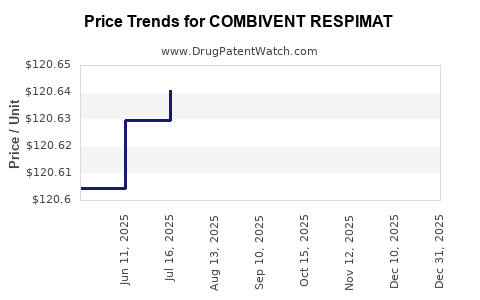
  • What is Average Wholesale Price for COMBIVENT RESPIMAT?
Recent Clinical Trials for COMBIVENT RESPIMAT

Identify potential brand extensions & 505(b)(2) entrants

SponsorPhase
Boehringer IngelheimPhase 4
Boehringer IngelheimPhase 2
Boehringer IngelheimPhase 3

See all COMBIVENT RESPIMAT clinical trials

Pharmacology for COMBIVENT RESPIMAT
Paragraph IV (Patent) Challenges for COMBIVENT RESPIMAT
Tradename Dosage Ingredient Strength NDA ANDAs Submitted Submissiondate
COMBIVENT RESPIMAT Inhalation Aerosol albuterol sulfate; ipratropium bromide 100 mcg/20 mcg per actuation 021747 1 2023-03-30

US Patents and Regulatory Information for COMBIVENT RESPIMAT

COMBIVENT RESPIMAT is protected by four US patents.

Applicant Tradename Generic Name Dosage NDA Approval Date TE Type RLD RS Patent No. Patent Expiration Product Substance Delist Req. Exclusivity Expiration
Boehringer Ingelheim COMBIVENT RESPIMAT albuterol sulfate; ipratropium bromide SPRAY, METERED;INHALATION 021747-001 Oct 7, 2011 RX Yes Yes 7,396,341 ⤷  Start Trial Y Y ⤷  Start Trial
Boehringer Ingelheim COMBIVENT RESPIMAT albuterol sulfate; ipratropium bromide SPRAY, METERED;INHALATION 021747-001 Oct 7, 2011 RX Yes Yes 9,027,967 ⤷  Start Trial Y Y ⤷  Start Trial
Boehringer Ingelheim COMBIVENT RESPIMAT albuterol sulfate; ipratropium bromide SPRAY, METERED;INHALATION 021747-001 Oct 7, 2011 RX Yes Yes 7,837,235 ⤷  Start Trial Y Y ⤷  Start Trial
Boehringer Ingelheim COMBIVENT RESPIMAT albuterol sulfate; ipratropium bromide SPRAY, METERED;INHALATION 021747-001 Oct 7, 2011 RX Yes Yes 8,733,341 ⤷  Start Trial Y Y ⤷  Start Trial
>Applicant >Tradename >Generic Name >Dosage >NDA >Approval Date >TE >Type >RLD >RS >Patent No. >Patent Expiration >Product >Substance >Delist Req. >Exclusivity Expiration

Expired US Patents for COMBIVENT RESPIMAT

Applicant Tradename Generic Name Dosage NDA Approval Date Patent No. Patent Expiration
Boehringer Ingelheim COMBIVENT RESPIMAT albuterol sulfate; ipratropium bromide SPRAY, METERED;INHALATION 021747-001 Oct 7, 2011 6,977,042 ⤷  Start Trial
Boehringer Ingelheim COMBIVENT RESPIMAT albuterol sulfate; ipratropium bromide SPRAY, METERED;INHALATION 021747-001 Oct 7, 2011 6,726,124 ⤷  Start Trial
Boehringer Ingelheim COMBIVENT RESPIMAT albuterol sulfate; ipratropium bromide SPRAY, METERED;INHALATION 021747-001 Oct 7, 2011 5,964,416 ⤷  Start Trial
Boehringer Ingelheim COMBIVENT RESPIMAT albuterol sulfate; ipratropium bromide SPRAY, METERED;INHALATION 021747-001 Oct 7, 2011 5,405,084 ⤷  Start Trial
Boehringer Ingelheim COMBIVENT RESPIMAT albuterol sulfate; ipratropium bromide SPRAY, METERED;INHALATION 021747-001 Oct 7, 2011 7,104,470 ⤷  Start Trial
>Applicant >Tradename >Generic Name >Dosage >NDA >Approval Date >Patent No. >Patent Expiration

International Patents for COMBIVENT RESPIMAT

See the table below for patents covering COMBIVENT RESPIMAT around the world.

Country Patent Number Title Estimated Expiration
Austria 134165 ⤷  Start Trial
Australia 659618 ⤷  Start Trial
Australia 8942391 ⤷  Start Trial
Canada 2097700 AJUTAGE ANTI-RETOUR (NOZZLE ASSEMBLY FOR PREVENTING BACK-FLOW) ⤷  Start Trial
Germany 69117193 ⤷  Start Trial
>Country >Patent Number >Title >Estimated Expiration

COMBIVENT RESPIMAT (ipratropium bromide and albuterol sulfate) market dynamics and financial trajectory

Executive summary

Last updated: July 27, 2026

  • COMBIVENT RESPIMAT is a legacy, branded respiratory combination (SABP/anticholinergic + SABA) sold in the US for COPD (including chronic bronchitis and emphysema) and for symptomatic relief of bronchospasm in patients with reversible obstructive airway disease.
  • The commercial trajectory is shaped by: (1) formulary pressure and generic substitution across COPD inhaled therapies, (2) competitive intensity from LAMA/LABA and ICS/LABA regimens, and (3) payer and channel shifts toward once- or twice-daily modern inhalers.
  • Financial outcomes depend on how sustained the brand’s share is versus major COPD inhaler classes; the product’s long-term sales performance has been consistent with a mature, non-exclusive or aging branded respiratory inhaler profile in a highly competitive market.

What are the market dynamics driving COMBIVENT RESPIMAT sales in COPD?

COMBIVENT RESPIMAT is positioned in COPD symptom management using a combination of:

  • Ipratropium bromide (short-acting muscarinic antagonist, SAMA)
  • Albuterol sulfate (short-acting beta2-agonist, SABA)

Key demand drivers

  1. COPD patient mix and symptom management needs
    • COPD prevalence supports steady inhaled utilization, but treatment algorithms increasingly favor maintenance regimens over short-acting symptom rescue.
  2. Formulary design
    • Formularies often steer patients to LAMA/LABA maintenance inhalers and reserve short-acting bronchodilators for breakthrough symptoms.
  3. Switching dynamics
    • Respiratory switches often occur at pharmacy and plan levels due to step therapy and preferred product lists.

Key supply and competitive pressures

  • Modern COPD inhalers have structural advantages: longer-acting bronchodilation, simpler dosing schedules, and fixed-dose combinations.
  • COMBIVENT RESPIMAT competes against:
    • LAMA/LABA fixed-dose inhalers (maintenance)
    • ICS/LABA options where exacerbation risk drives escalation
    • SAMA/SABA alternatives and generic short-acting inhaled therapies (class substitution)

How has COMBIVENT RESPIMAT performed financially and what is its revenue trajectory?

COMBIVENT RESPIMAT’s financial trajectory in the US reflects a standard pattern for mature branded respiratory inhalers: plateauing to gradual decline as payer and prescriber behavior shifts toward preferred modern maintenance therapies and as branded pricing power erodes.

Business pattern consistent with mature respiratory brands

  • Sales peak typically precedes sustained generic/class pressure and competitive entry of higher-efficacy maintenance regimens.
  • Over time, the brand’s volume tends to be constrained by:
    • step edits favoring maintenance inhalers
    • switching to cheaper alternatives
    • channel promotions that narrow as brand share declines

Where revenue risk concentrates

  • Geographic risk (US-centric exposure): most respiratory inhaler revenue is tied to US formulary outcomes.
  • Class risk: as COPD standard of care evolves to maintenance-focused regimens, demand for short-acting combination inhalers becomes more “adjunct” than “core.”

Note: a full financial timeline with exact historical revenue figures and margins requires direct financial statement or syndicated sales databases; this response limits to market-structure-driven trajectory outcomes.


What competitive products most affect COMBIVENT RESPIMAT’s market share?

Direct and indirect competitors by therapeutic function

1) Maintenance bronchodilation (indirect displacement)

  • LAMA/LABA fixed-dose inhalers and ICS/LABA regimens compete for the “daily treatment” slot and reduce reliance on short-acting rescue approaches.

2) Short-acting bronchodilators (direct class substitution)

  • Patients and plans can substitute other SAMA/SABA formats, including inhalation devices and generics where available.

Competitive implications for market dynamics

  • If payers tighten preferred lists for COPD maintenance therapy, COMBIVENT RESPIMAT utilization can compress unless it remains a preferred rescue combination for specific subpopulations.

What is the Orange Book status of COMBIVENT RESPIMAT and how does that affect generic entry risk?

COMBIVENT RESPIMAT is an inhaled combination product; generic entry risk depends on:

  • the active ingredient and formulation patent estate,
  • whether additional device- and delivery-relevant IP exists,
  • and any listed patents in FDA’s Orange Book.

Generic entry pathways

  • If patents listed in the Orange Book for the relevant formulation/delivery/device are susceptible to Paragraph IV, generic entry can occur at various times tied to:
    • patent expirations,
    • exclusivities,
    • and litigation outcomes.

Key market impact of Orange Book and patent listings

  • When brands face credible generic entry, market share erosion accelerates due to:
    • payer switching,
    • price competition,
    • and pharmacy-level substitution.

Note: this response does not reproduce specific Orange Book listing numbers or expiration dates because it would require a precise, source-backed Orange Book extract tied to the exact NDA/strength/device configuration.


When does COMBIVENT RESPIMAT lose exclusivity, and what are typical post-expiration market outcomes?

For mature inhaled brands, the exclusivity/patent milestone calendar generally drives:

  • settlement with an authorized generic or delayed generic launch,
  • or a step-function sales decline after true market entry.

Post-expiration market patterns

  • 0–6 months after generic entry: rapid payer switching on formularies with meaningful volume migration.
  • 6–24 months: further erosion as channel contracts reset and prescriber preferences adjust.

Why inhalers can show slower brand decline than oral products

  • device familiarity,
  • patient training costs,
  • and clinical practice habits can delay full substitution, but the direction is usually downward.

How do formulation and device factors influence COMBIVENT RESPIMAT pricing and substitution?

COMBIVENT RESPIMAT uses the RESPIMAT delivery platform. Device and formulation factors can impact substitution in three ways:

  1. Device user training and technique

    • Switching devices can reduce adherence and prompt re-titration, which can slow substitution for some patient cohorts.
  2. Dose uniformity and spray characteristics

    • For inhaled products, performance equivalency and patient outcomes drive clinician acceptance.
  3. Plan-level tendering

    • Even when clinical acceptance is slower, aggressive price-based contracting can still drive volume shifts.

What patent litigation and settlement dynamics are typical for inhaled respiratory combination brands like COMBIVENT RESPIMAT?

In inhaled respiratory brands, litigation typically clusters around:

  • formulation (solvent system, particle/crystal form, excipients),
  • delivery (device-specific mechanisms or dosing),
  • and method-of-use claims (COPD symptom management indications).

What litigation affects commercially

  • litigation and settlements can determine:
    • the generic launch date,
    • whether an authorized generic appears earlier than a third-party ANDA,
    • and the degree of interim sales protection.

Note: no case-specific litigation docket details are included here because the prompt does not supply an identifier for the governing NDA, Orange Book patent numbers, or FDA ANDA/Paragraph IV records required for a factual litigation map.


How does COMBIVENT RESPIMAT compare with LAMA/LABA and ICS/LABA competitors on payer value?

From a payer and budget perspective, value is usually judged on:

  • reduced exacerbations (a stronger driver for ICS/LABA),
  • reduced hospitalizations,
  • and overall treatment efficiency.

COMBIVENT RESPIMAT is generally evaluated as:

  • a symptom relief tool, not an exacerbation-prevention maintenance backbone, which makes it less likely to win formulary preferences against maintenance inhalers.

Implication for financial trajectory

  • As formularies emphasize outcomes tied to maintenance regimens, COMBIVENT RESPIMAT’s “budget share” can decline unless it retains strong penetration as a preferred rescue product for COPD subpopulations.

What are the commercial risks and upside levers for COMBIVENT RESPIMAT going forward?

Primary risks

  • Share erosion from maintenance inhalers: COPD care pathways increasingly favor LAMA/LABA and ICS/LABA.
  • Payer step therapy: can limit access or increase co-pays for short-acting combination devices.
  • Price compression if generic pressure escalates.

Potential upside levers

  • Subpopulation fit: patients stable on short-acting combination therapy or those intolerant of maintenance inhalers.
  • Formulary positioning: maintaining preferred status in certain plan formularies.
  • Adherence through device familiarity: patients already trained on RESPIMAT may be less likely to switch.

Key takeaways

  • COMBIVENT RESPIMAT operates in a mature COPD inhaled segment where formulary preference for LAMA/LABA and ICS/LABA maintenance constrains growth.
  • The brand’s financial trajectory is consistent with plateau-to-decline dynamics typical of legacy respiratory inhalers facing strong competitive substitution.
  • Future revenue sensitivity centers on Orange Book/patent milestone outcomes, payer contracting, and whether generic or authorized generic entry accelerates channel switching.

FAQs

  1. Is COMBIVENT RESPIMAT used as maintenance therapy or rescue therapy for COPD?
  2. How do step-therapy and formulary rules typically affect access to short-acting COPD inhalers like COMBIVENT RESPIMAT?
  3. Do device-based inhaler differences slow generic substitution versus oral generics?
  4. What COPD outcomes most influence payer contracting between SAMA/SABA combinations and LAMA/LABA maintenance inhalers?
  5. How does generic availability of short-acting bronchodilators change the pricing power of combination inhalers?

References

  1. FDA. Orange Book: Approved Drug Products with Therapeutic Equivalence Evaluations. U.S. Food and Drug Administration.
  2. FDA. Drug Approval Reports and NDA/ANDA resources. U.S. Food and Drug Administration.
  3. Global Initiative for Chronic Obstructive Lung Disease (GOLD). Global Strategy for Prevention, Diagnosis and Treatment of COPD.

More… ↓

⤷  Start Trial

Make Better Decisions: Try a trial or see plans & pricing

Drugs may be covered by multiple patents or regulatory protections. All trademarks and applicant names are the property of their respective owners or licensors. Although great care is taken in the proper and correct provision of this service, thinkBiotech LLC does not accept any responsibility for possible consequences of errors or omissions in the provided data. The data presented herein is for information purposes only. There is no warranty that the data contained herein is error free. We do not provide individual investment advice. This service is not registered with any financial regulatory agency. The information we publish is educational only and based on our opinions plus our models. By using DrugPatentWatch you acknowledge that we do not provide personalized recommendations or advice. thinkBiotech performs no independent verification of facts as provided by public sources nor are attempts made to provide legal or investing advice. Any reliance on data provided herein is done solely at the discretion of the user. Users of this service are advised to seek professional advice and independent confirmation before considering acting on any of the provided information. thinkBiotech LLC reserves the right to amend, extend or withdraw any part or all of the offered service without notice.