Share This Page
CLOZARIL Drug Patent Profile
✉ Email this page to a colleague
When do Clozaril patents expire, and what generic alternatives are available?
Clozaril is a drug marketed by Heritage Life and is included in one NDA.
The generic ingredient in CLOZARIL is clozapine. There is one drug master file entry for this compound. Thirteen suppliers are listed for this compound. Additional details are available on the clozapine profile page.
DrugPatentWatch® Litigation and Generic Entry Outlook for Clozaril
A generic version of CLOZARIL was approved as clozapine by IVAX SUB TEVA PHARMS on November 26th, 1997.
AI Deep Research
Questions you can ask:
- What is the 5 year forecast for CLOZARIL?
- What are the global sales for CLOZARIL?
- What is Average Wholesale Price for CLOZARIL?
Summary for CLOZARIL
| US Patents: | 0 |
| Applicants: | 1 |
| NDAs: | 1 |
| Finished Product Suppliers / Packagers: | 1 |
| Raw Ingredient (Bulk) Api Vendors: | 113 |
| Clinical Trials: | 21 |
| Patent Applications: | 5,411 |
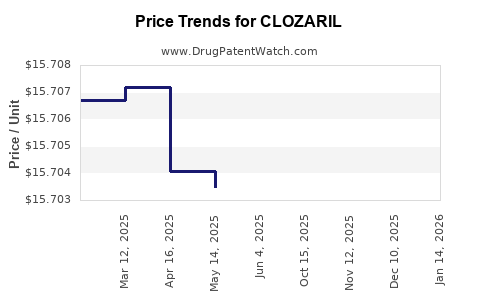
| Drug Prices: | Drug price information for CLOZARIL |
| What excipients (inactive ingredients) are in CLOZARIL? | CLOZARIL excipients list |
| DailyMed Link: | CLOZARIL at DailyMed |
Recent Clinical Trials for CLOZARIL
Identify potential brand extensions & 505(b)(2) entrants
| Sponsor | Phase |
|---|---|
| New York State Psychiatric Institute | Phase 4 |
| University of Georgia | Phase 4 |
| Beth Israel Deaconess Medical Center | Phase 4 |
Pharmacology for CLOZARIL
| Drug Class | Atypical Antipsychotic |
US Patents and Regulatory Information for CLOZARIL
| Applicant | Tradename | Generic Name | Dosage | NDA | Approval Date | TE | Type | RLD | RS | Patent No. | Patent Expiration | Product | Substance | Delist Req. | Exclusivity Expiration |
|---|---|---|---|---|---|---|---|---|---|---|---|---|---|---|---|
| Heritage Life | CLOZARIL | clozapine | TABLET;ORAL | 019758-001 | Sep 26, 1989 | AB | RX | Yes | No | ⤷ Start Trial | ⤷ Start Trial | ⤷ Start Trial | |||
| Heritage Life | CLOZARIL | clozapine | TABLET;ORAL | 019758-004 | May 20, 2019 | DISCN | Yes | No | ⤷ Start Trial | ⤷ Start Trial | ⤷ Start Trial | ||||
| Heritage Life | CLOZARIL | clozapine | TABLET;ORAL | 019758-003 | May 20, 2019 | DISCN | Yes | No | ⤷ Start Trial | ⤷ Start Trial | ⤷ Start Trial | ||||
| Heritage Life | CLOZARIL | clozapine | TABLET;ORAL | 019758-002 | Sep 26, 1989 | AB | RX | Yes | Yes | ⤷ Start Trial | ⤷ Start Trial | ⤷ Start Trial | |||
| >Applicant | >Tradename | >Generic Name | >Dosage | >NDA | >Approval Date | >TE | >Type | >RLD | >RS | >Patent No. | >Patent Expiration | >Product | >Substance | >Delist Req. | >Exclusivity Expiration |
Clozaril Market Dynamics, Patent Exclusivity, Generic Competition, and Financial Trajectory
Clozaril is the branded formulation of clozapine, an atypical antipsychotic used primarily for treatment-resistant schizophrenia and for reducing recurrent suicidal behavior in patients with schizophrenia or schizoaffective disorder. Its commercial profile is defined by a small but durable specialty market, generic price competition, mandatory safety monitoring, and limited public disclosure of brand-level revenue.
Clozapine has no meaningful remaining composition-of-matter exclusivity in the United States. The original brand market has been exposed to generic competition for decades. Commercial value now depends on prescribing persistence, manufacturing reliability, patient-monitoring infrastructure, supply continuity, and local brand loyalty rather than patent protection.
What is Clozaril and how is it used?
Clozaril contains clozapine, an oral antipsychotic available primarily as tablets. It is reserved for patients with schizophrenia who have failed to respond adequately to standard antipsychotic treatment. The FDA also approves clozapine to reduce the risk of recurrent suicidal behavior in patients with schizophrenia or schizoaffective disorder.
Clozapine is clinically differentiated by efficacy in treatment-resistant schizophrenia. Its use is constrained by potentially severe adverse effects, including agranulocytosis, seizures, myocarditis, cardiomyopathy, constipation-related gastrointestinal complications, metabolic effects, and orthostatic hypotension.
The US label historically required regular absolute neutrophil count monitoring through the Clozapine Risk Evaluation and Mitigation Strategy, or REMS. The FDA removed the mandatory REMS program in February 2022 after determining that the operational burden and reporting requirements were disrupting access, although it continued to recommend ANC monitoring consistent with prescribing information. The change reduced administrative friction but did not eliminate clinical monitoring requirements.[1]
Key product characteristics
| Item | Clozaril profile |
|---|---|
| Active ingredient | Clozapine |
| Drug class | Atypical antipsychotic |
| Primary indication | Treatment-resistant schizophrenia |
| Additional FDA indication | Reduction of recurrent suicidal behavior in schizophrenia or schizoaffective disorder |
| Dosage form | Oral tablets |
| Original US approval | 1989 |
| US reference sponsor history | Novartis historically; US commercial rights transferred to HLS Therapeutics |
| Patent position | Core patent exclusivity expired |
| Generic status | Generic clozapine products available |
| Biosimilar exposure | Not applicable; clozapine is a small molecule |
| Main commercial constraint | Monitoring, adverse-event management, and limited eligible population |
When did Clozaril lose patent exclusivity?
Clozapine’s original US patent protection expired in the 1990s. The key composition-of-matter patent, US Patent No. 4,196,196, was issued to Sandoz, the predecessor of Novartis, and covered clozapine-related compounds. The patent term expired before the current market period, allowing generic clozapine entry.
Clozaril therefore does not have a current US patent-based exclusivity period comparable to newer branded antipsychotics. Any remaining commercial protection is operational rather than legal. These protections include manufacturing know-how, regulatory familiarity, distribution relationships, clinician confidence, and the difficulty of maintaining reliable supply for a tightly monitored medicine.
Patent and exclusivity summary
| Protection category | Current commercial effect |
|---|---|
| Original compound patent | Expired |
| Core formulation exclusivity | Expired or commercially irrelevant |
| FDA new chemical entity exclusivity | Expired |
| Orphan-drug exclusivity | Not the basis of current Clozaril protection |
| Pediatric exclusivity | Expired |
| Orange Book patent leverage | No material basis for blocking generic entry |
| Method-of-use patents | Do not provide meaningful control over the broad US clozapine market |
| Manufacturing know-how | Potential operational advantage |
| Brand trademark | Protects the name, not the active ingredient |
What is the Orange Book status of Clozaril?
Clozaril’s Orange Book position is commercially weak because generic clozapine products have long been approved. An Orange Book listing can protect a specific active patent or approved use, but it does not prevent generic competition once relevant patents and exclusivities expire.
Generic applicants for clozapine generally compete through abbreviated new drug applications rather than through a biosimilar pathway. A generic applicant must demonstrate pharmaceutical equivalence and bioequivalence to the reference product, together with compliance with applicable safety and manufacturing requirements.
The principal regulatory issue is not whether generic entry is legally available. It is whether manufacturers can maintain supply, meet quality standards, and support the monitoring and distribution infrastructure required for clozapine.
How strong is the Clozaril patent estate?
The current Clozaril patent estate is weak as a barrier to entry. The original compound patent expired long ago, and generic products are established in the US and other major markets.
A residual patent strategy could theoretically involve specific formulations, dosing regimens, delivery technologies, or manufacturing processes. These rights would have narrower scope than a compound patent and would not ordinarily prevent physicians from prescribing generic clozapine tablets for the same clinical use.
The absence of meaningful patent protection changes the commercial analysis:
- Brand pricing cannot be defended through patent litigation.
- Generic substitution is structurally available.
- Revenue depends on prescription retention and supply reliability.
- Manufacturing failures can affect the entire category because the patient population is clinically dependent on continuity.
- Any market advantage from Clozaril must come from service, availability, formulation familiarity, or institutional contracting.
What generic competition affects Clozaril?
Generic clozapine competition has existed for many years. The relevant competitors have included products from major generic manufacturers such as Teva, Mylan or Viatris, and other approved suppliers depending on jurisdiction and product presentation.
Generic competition affects Clozaril in four ways.
First, it compresses unit pricing. Second, it limits the brand’s ability to increase price without losing formulary or pharmacy support. Third, it creates substitution risk in retail and institutional channels. Fourth, it can create supply volatility when a manufacturer exits, experiences a shortage, or reduces production because of low margins.
Clozapine has a smaller supplier base than many high-volume oral medicines. That reduces the benefit of generic competition for buyers when shortages occur. Pharmacies and health systems may retain access to multiple suppliers but still prefer a recognized brand when continuity, patient stability, or product-specific dispensing procedures are important.
What is the financial trajectory of Clozaril?
Clozaril’s financial trajectory is mature, defensive, and volume-dependent rather than growth-oriented. Brand-level revenue is not consistently disclosed by Novartis in current financial reporting, and public company reports generally aggregate products within larger business segments. HLS Therapeutics has reported Clozaril as part of its commercial portfolio, but the level of product-specific detail varies by reporting period.[2]
The product’s economic profile has several features:
| Financial driver | Effect on Clozaril |
|---|---|
| Generic substitution | Reduces brand volume and price |
| Treatment-resistant schizophrenia | Supports persistent demand |
| Monitoring burden | Limits new starts and increases service costs |
| Clinical differentiation | Supports continued use in refractory patients |
| Low patient turnover | Creates recurring demand among established users |
| Supply continuity | Can preserve or damage institutional preference |
| Reimbursement pressure | Limits pricing power |
| Safety-related discontinuation | Constrains addressable volume |
| Patent expiry | Removes premium exclusivity economics |
Clozaril is unlikely to return to blockbuster economics. Its value is closer to that of a specialty maintenance product with a stable but narrow installed base. Revenue can remain durable because patients who respond to clozapine may continue treatment for extended periods. At the same time, growth is constrained by the number of treatment-resistant patients, adverse-event monitoring, clinician reluctance, and competition from generic clozapine.
Revenue exposure for HLS Therapeutics
HLS acquired US commercial rights to Clozaril from Novartis in 2015. The transaction gave HLS an established branded medicine with a specialized prescriber base and a differentiated clinical role. The product’s value to HLS is not based on patent exclusivity. It is based on recurring prescriptions, brand recognition, and the cost of switching stable patients.[3]
For HLS, the main financial risks are:
- Declining branded market share;
- Generic price competition;
- Product shortages or manufacturing interruptions;
- Lower diagnosis and treatment rates for treatment-resistant schizophrenia;
- Changes in pharmacy or hospital purchasing behavior;
- Adverse safety events affecting prescribing;
- Increased use of competing generic suppliers.
The main stabilizing factors are chronic treatment duration, limited therapeutic substitutes for some patients, and the clinical consequences of destabilizing an effective clozapine regimen.
What FDA regulatory issues affect Clozaril?
The FDA’s 2022 decision to remove the Clozapine REMS reduced reporting and administrative requirements. It did not eliminate the need for ANC monitoring or the clinical duty to evaluate neutropenia risk.
The regulatory change can improve access by reducing enrollment and reporting burdens for prescribers, pharmacies, and laboratories. It may also reduce the operational difference between brand and generic products because all clozapine suppliers operate under the same broad labeling framework.
Regulatory risks remain material. Clozapine manufacturers must meet current good manufacturing practice requirements, maintain consistent tablet quality, manage supply, and comply with labeling requirements for serious adverse reactions. Product recalls or shortages can have disproportionate clinical effects because abrupt interruption may cause psychiatric relapse or withdrawal-related complications.[1]
What manufacturing and intellectual-property barriers protect Clozaril?
Manufacturing barriers are more important than patent barriers. Clozapine production requires control of active pharmaceutical ingredient quality, impurity profiles, tablet uniformity, packaging, stability, and distribution. Manufacturers also need systems capable of supporting prescriptions in a medicine with a history of intensive blood-monitoring requirements.
The principal barriers are:
- Validation of the active pharmaceutical ingredient;
- Consistent tablet dissolution and content uniformity;
- Regulatory approval of manufacturing sites;
- Reliable supply of active ingredient and finished dosage forms;
- Management of recalls and shortages;
- Pharmacy and wholesaler distribution;
- Clinical education and monitoring support.
These barriers can protect a commercial position temporarily, but they do not create durable legal exclusivity. A competitor that satisfies FDA requirements can enter or expand without negotiating a patent license.
How does Clozaril compare with newer antipsychotics?
Clozaril has a weaker patent position but a stronger clinical niche than many newer antipsychotics.
| Factor | Clozaril | Newer branded antipsychotics |
|---|---|---|
| Patent protection | Expired | Often active or recently expired |
| Generic exposure | High | Varies by product |
| Clinical positioning | Treatment-resistant schizophrenia | Broad schizophrenia and bipolar indications |
| Monitoring burden | High | Usually lower |
| Price premium | Limited by generics | Often supported before patent expiry |
| Patient persistence | Potentially high among responders | Varies |
| Revenue growth potential | Low | Higher before loss of exclusivity |
| Main competitive advantage | Efficacy in refractory disease | Convenience, tolerability, delivery systems, or broader labeling |
Long-acting injectable antipsychotics compete for adherence and relapse prevention, but they do not fully replace clozapine in treatment-resistant schizophrenia. The relevant commercial market is therefore segmented rather than purely substitutive.
What generic launch scenarios exist for Clozaril?
The most likely market scenario is continued generic dominance with a residual branded segment. Generic share can rise as prescribers become more comfortable with post-REMS monitoring procedures and as payers increase substitution controls.
A second scenario is a stable dual market in which generic clozapine captures price-sensitive prescriptions while Clozaril retains some patients, institutions, or prescribers that prefer the branded product.
A third scenario is supply-driven brand resilience. If one or more generic suppliers experience shortages, Clozaril may retain or regain volume temporarily. This would be a distribution effect, not a patent effect.
A fourth scenario is broader clozapine adoption after the removal of REMS administrative requirements. That could increase total clozapine use, but the incremental volume would benefit generic suppliers as well as the brand.
What patent litigation and settlement agreements affect Clozaril?
Clozaril is not principally exposed to current Paragraph IV litigation. The product’s core patents expired decades ago, and generic clozapine is already established. There is no current patent-based settlement structure comparable to that seen for recently launched medicines with active composition, formulation, or method-of-use patents.
Litigation risk is more likely to involve product liability, manufacturing quality, supply interruption, labeling, or commercial contracting than patent infringement. Any future patent dispute involving a narrowly claimed formulation or manufacturing process would have limited ability to block ordinary generic clozapine tablets.
Key Takeaways
- Clozaril is the branded version of clozapine, a specialized medicine for treatment-resistant schizophrenia.
- Its core US patent protection expired in the 1990s.
- Generic clozapine has been available for decades, eliminating compound-level exclusivity.
- The product has no biosimilar issue because clozapine is a small molecule.
- Its commercial value comes from clinical differentiation, patient persistence, and supply reliability.
- FDA removal of the Clozapine REMS in 2022 reduced administrative barriers but did not remove ANC monitoring expectations.
- Public filings do not consistently disclose standalone Clozaril revenue, limiting precise product-level financial modeling.
- The brand’s revenue trajectory is mature and defensive, with generic erosion offset by recurring use among established responders.
- Manufacturing, quality, and distribution capabilities are more important than patents in determining competitive strength.
- Current legal risk is more likely to involve product quality, supply, or liability than Paragraph IV patent litigation.
FAQs
Does Clozaril still have patent protection?
Clozaril does not have meaningful remaining US compound-patent protection. Its original clozapine patent expired in the 1990s.
Is generic clozapine interchangeable with Clozaril?
Generic clozapine products are approved as therapeutically equivalent under applicable FDA standards, but physicians may manage switching carefully because treatment continuity and blood-count monitoring are clinically important.
Did the FDA eliminate clozapine blood testing?
No. The FDA removed the mandatory REMS reporting and enrollment program in 2022. ANC monitoring remains part of clozapine safety management and prescribing practice.
Can a new patent block generic clozapine?
A narrow patent covering a specific formulation or manufacturing process could create litigation risk, but it would not ordinarily restore broad exclusivity over conventional clozapine tablets.
Is Clozaril a growth product for HLS Therapeutics?
Clozaril is primarily a mature specialty product. Its financial contribution depends on recurring demand, retention of branded prescriptions, supply reliability, and management of generic competition rather than rapid market expansion.
References
- U.S. Food and Drug Administration. (2022). FDA modifies REMS for clozapine products. https://www.fda.gov
- HLS Therapeutics Inc. (2024). Annual report and management’s discussion and analysis. https://www.hlstherapeutics.com
- HLS Therapeutics Inc. (2015). HLS Therapeutics acquires U.S. rights to Clozaril from Novartis. https://www.hlstherapeutics.com
- U.S. Food and Drug Administration. (2024). Drugs@FDA: Clozaril and clozapine products. https://www.accessdata.fda.gov
- National Institute for Health and Care Excellence. (2014). Psychosis and schizophrenia in adults: Prevention and management. NICE guideline CG178. https://www.nice.org.uk
More… ↓
