Last updated: February 15, 2026
CLOZARIL, marketed as Clozapine, is an atypical antipsychotic medication primarily prescribed for treatment-resistant schizophrenia and schizoaffective disorders. It holds a unique position due to its efficacy in patients unresponsive to other antipsychotics but requires careful management due to risks like agranulocytosis.
Market Size and Trends
Global Market Value
The global antipsychotic drugs market was valued at approximately USD 9.5 billion in 2022. Clozapine accounts for a significant segment due to its niche therapeutic role, representing roughly 8-10% of the total antipsychotic market.
Market Growth Drivers
- Rising prevalence of schizophrenia and treatment-resistant cases.
- Increasing awareness of mental health conditions.
- Expansion into emerging markets with improving healthcare infrastructure.
- Evolving regulatory environments favoring personalized medicine approaches.
Segmentation and Key Players
Major competitors include Risperdal (risperidone), Zyprexa (olanzapine), and Aripiprazole (Abilify). However, Clozapine retains exclusivity due to its specific indication profile.
Regulatory and Distribution Landscape
Regulatory Status
- Approved in over 50 countries, including US, EU, Japan, and Canada.
- Specific monitoring programs are mandated for safety (e.g., REMS in the US).
Distribution Channels
- Prescription-based primarily through specialized psychiatric clinics.
- Distribution controlled due to safety concerns and monitoring requirements.
Pricing Structure and Trends
Current Pricing Dynamics
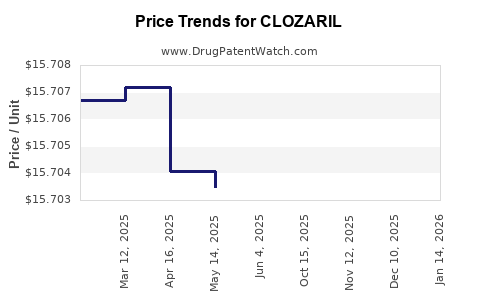
- US: The wholesale acquisition cost (WAC) averages USD 10-15 per tablet (typically 25 mg).
- Europe: Prices vary; in the UK, retail price ranges from GBP 8-12 per 25 mg tablet.
- Developing markets: Significantly lower, USD 2-8 per tablet, due to generic availability.
Factors Influencing Price
- Patent Status: Clozapine patents expired decades ago. No patent protection is active, leading to multiple generics.
- Generic Competition: Dominates the market, driving prices downward.
- Monitoring Costs: Additional costs for safety monitoring and management offset base drug prices.
- Formulation and Dosage: Prices change with dosage form (tablet, suspension) and strength.
Typical Cost Trajectory (Historical)
- Pre-generic period (before 2005): USD 12-20 per tablet.
- Post-patent expiry: Prices declined to USD 4-8 per tablet within 2-3 years.
- Current generic market: Marginal prices stabilize at USD 2-4 per tablet in most regions.
Pricing Projections
Short-term (Next 2-3 Years)
Prices are expected to remain stable due to sustained demand and generic competition. The emergence of biosimilars or new formulations could marginally impact costs.
Medium to Long-term (3-10 Years)
- No significant price increase expected; continued price pressure from generics.
- Potential for price reductions if patent protections are re-established through reformulations or new delivery systems.
- Costs may slightly increase with innovations aimed at reducing monitoring burdens, such as point-of-care testing devices.
Market Challenges and Opportunities
Challenges
- Safety concerns necessitate extensive monitoring, raising costs.
- Stigma associated with schizophrenia drugs limits market growth.
- Regulatory restrictions in certain countries impede access.
Opportunities
- Development of safer formulations could broaden use.
- Inclusion in broader mental health treatment programs.
- Potential for digital health tools to optimize monitoring and adherence.
Key Takeaways
- The global market for Clozapine is significant but constrained by safety monitoring and generic competition.
- Prices have declined substantially since patent expiry, averaging USD 2-4 per tablet in most regions.
- Future pricing stability expected, barring technological innovations or regulatory changes.
- Market growth hinges on increasing diagnosis and treatment of resistant schizophrenia.
- Diversification into improved formulations could create value margins for developers and manufacturers.
FAQs
1. Why is Clozapine priced lower than other antipsychotics?
Due to patent expiration and competition from multiple generics, prices have declined. Safety monitoring costs are factored into pricing but do not offset the high volume.
2. Are there premium versions of Clozapine?
No, all Clozapine products are generics. However, research into formulations with reduced monitoring requirements is ongoing.
3. How does the safety monitoring impact overall costs?
Monitoring programs, such as REMS in the US, increase administration and healthcare costs but are essential for safe use.
4. Will new formulations increase Clozapine prices?
Potentially, if they reduce monitoring burdens or improve safety profiles, manufacturers may set higher prices to recoup R&D costs.
5. What markets show the most growth potential for Clozapine?
Emerging markets with growing mental health awareness and improving healthcare access.
References
[1] MarketWatch. "Antipsychotic drugs market size." 2022.
[2] IQVIA. "Global Pharmaceutical Pricing & Market Trends." 2022.
[3] U.S. Food & Drug Administration. "Clozapine REMS program." 2022.
[4] GlobalData. "Psychiatric Drugs Market Analysis." 2023.
[5] European Medicines Agency. "Market Authorization for Clozapine." 2022.