Last updated: April 7, 2026
What Is the Current Market Size and Growth for Clomid?
Clomid (clomiphene citrate) is a widely prescribed ovulation stimulant primarily used in infertility treatments. The global market for fertility drugs, including Clomid, was valued at approximately USD 2.8 billion in 2022. It is projected to grow at a compound annual growth rate (CAGR) of around 4.2% from 2023 to 2030. This growth is driven by increasing infertility prevalence, expanding treatment options, and regulatory approvals.
Market Segmentation
| Segment |
Market Share (2022) |
Growth Drivers |
| Fertility clinics |
60% |
Rising infertility cases, technological advancements |
| Hospital pharmacies |
25% |
Established healthcare infrastructure |
| Retail pharmacies |
15% |
Over-the-counter availability (region-dependent) |
Geographic Distribution
| Region |
Market Share (2022) |
Key Factors |
| North America |
45% |
High infertility rates, favorable reimbursement policies |
| Europe |
25% |
Growing awareness, increased outpatient treatments |
| Asia-Pacific |
20% |
Expanding healthcare facilities, socio-economic shifts |
| Rest of World |
10% |
Limited access, emerging markets |
What Are the Main Drivers Influencing Clomid's Financial Trajectory?
-
Rising Incidence of Infertility: Approximately 15% of couples worldwide face infertility issues, with age-related decline in ovarian function elevating demand for ovulation stimulants like Clomid (WHO, 2021).
-
Availability and Cost-Effectiveness: Clomid remains one of the most affordable fertility drugs, with generic formulations available since the 2000s, enabling widespread adoption in low- and middle-income countries.
-
Regulatory Approvals: Clomid received approval from major regulatory agencies like the FDA in 1960s, and its patent expired in 2003, leading to generic competition.
-
Combination Therapy Trends: Use with other fertility treatments (e.g., intrauterine insemination) sustains demand, though newer ovulation induction agents have entered the market.
-
Reproductive Tourism: Countries like India, Mexico, and Turkey observe high demand from patients seeking affordable fertility options, increasing regional market size.
How Do Patent and Regulatory Statuses Affect Market Dynamics?
Clomid's patent expiration in 2003 led to a proliferation of generic versions, reducing manufacturing costs and increasing supply. Regulatory policies have generally supported continued use, with no recent major restrictions. However, newer alternatives like letrozole and gonadotropins have gained favor in certain clinical settings due to differing efficacy profiles, impacting Clomid's market share marginally.
What Are the Competitive and Market Risks?
-
Emergence of Alternative Therapies: Medications like letrozole are increasingly prescribed due to evidence of better pregnancy outcomes in some patient populations. This trend poses a risk to Clomid's market dominance.
-
Side Effect Profile: Potential adverse effects, including ovarian hyperstimulation and visual disturbances, limit Clomid's use in specific cases, particularly when newer drugs are better tolerated.
-
Regulatory Shifts: Stricter regulations on off-label use or safety concerns could influence market access.
-
Generic Market Saturation: Price competition from multiple generic producers reduces profit margins for pharmaceutical companies.
What Are the Revenue and Profitability Trends?
Given generics' dominance, profit margins for Clomid manufacturers are slim. Estimated global sales reach approximately USD 150 million annually. Major players such as Sanofi-Aventis, TEVA, and Sandoz hold significant share, with a combined market share exceeding 80%.
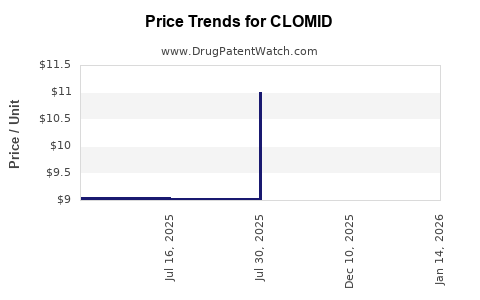
Pricing strategies are aggressive, with unit costs as low as USD 0.10 to USD 0.50 per tablet in some regions. Sales volume increases are driven primarily by rising infertility treatment rates rather than price increases.
What Are Future Market Outlooks and Key Opportunities?
-
Product Innovation: Developing formulations with improved safety profiles or extended-release options may provide differentiation.
-
Market Expansion: Increasing infertility in emerging markets offers long-term growth prospects, particularly where access to affordable treatments is expanding.
-
Combination and Adjunct Therapies: Creating new drug combinations involving Clomid to target specific patient populations could open additional revenue streams.
-
Educational Initiatives: Raising awareness about infertility treatments may sustain or boost demand.
Summary of Competitive Landscape and Key Market Players
| Player |
Market Share |
Key Strategies |
| Sanofi-Aventis |
~45% |
Branding, broad distribution, global reach |
| TEVA Pharmaceuticals |
~20% |
Cost leadership, extensive generics portfolio |
| Sandoz |
~15% |
Focus on emerging markets, regulatory engagement |
| Others |
~20% |
Regional players, niche marketing |
Key Takeaways
- The Clomid market currently sustains steady growth driven by global infertility prevalence.
- Patent expiry and generic competition have limited profit margins but ensure widespread access.
- Emerging alternatives like letrozole are gradually impacting Clomid's market share.
- Growth opportunities lie in developing new formulations, expanding into emerging markets, and combining therapies.
- Pricing strategies aim for volume-driven revenue rather than high-margin sales.
FAQs
1. How does Clomid's patent status influence its market?
The patent expiration in 2003 enabled generic manufacturers to produce low-cost versions, increasing supply and lowering prices, which sustains broad accessibility but constrains profit margins.
2. What are the main competitors to Clomid in fertility treatments?
Letrozole and gonadotropins are the primary alternatives, often preferred for specific patient groups or side effect profiles.
3. Which regions are experiencing the fastest growth for Clomid?
Emerging markets in Asia-Pacific and Latin America exhibit the highest growth rates due to expanding healthcare infrastructure and affordability.
4. How do safety concerns impact Clomid's market?
Adverse effects can limit use in certain populations, encouraging prescribers to select newer agents with more favorable safety profiles.
5. What future trends could affect Clomid's market?
Advancements in fertility technologies, regulatory changes, and shifts toward personalized medicine may influence demand and product development strategies.
References
[1] World Health Organization. (2021). Infertility trends and treatment worldwide. Geneva: WHO.