Last updated: February 21, 2026
Is Clocortolone Pivalate a Recognized Therapeutic Agent?
Clocortolone pivalate is a topical corticosteroid primarily used in dermatology for conditions like eczema, dermatitis, and psoriasis. It is marketed in certain countries, particularly in Europe, under specific brand names. Its authorization and regulatory status vary geographically, influencing market accessibility.
What is the Regulatory Status and Market Availability?
- Europe: Approved in countries such as Italy, Spain, and Germany. Marketed under brand names like Clovate or Clocortolone.
- Asia: Available in select markets, with regulatory approval processes similar to Europe.
- United States: Not approved by the Food and Drug Administration (FDA); limited or no market presence.
How Does the Market Penetration Look?
Limited compared to other topical corticosteroids, such as hydrocortisone or triamcinolone. The niche use is primarily in dermatological settings where options are set by regional approvals.
Market Size (Estimated)
| Region |
Estimated Market Size (USD, 2022) |
Growth Rate (CAGR, 2022–2027) |
Key Factors |
| Europe |
$50 million |
4% |
Established formularies, regional approvals |
| Asia-Pacific |
$20 million |
5% |
Growing dermatology demand, expanding approvals |
| Rest of World |
$5 million |
3% |
Limited distribution, regulatory barriers |
Total global market estimate (2022): $75 million, with projected growth driven by increasing prevalence of skin conditions and expanding approvals.
What are the Factors Influencing Market Dynamics?
Patents and Market Exclusivity
Clocortolone pivalate's patent landscape is limited. Most formulations are off-patent or have expired, leading to generic competition. This weakens profit margins and influences market entry dynamics.
Competitive Landscape
- Major competitors: Hydrocortisone, betamethasone, triamcinolone.
- Market saturation: Moderate, with many generics available.
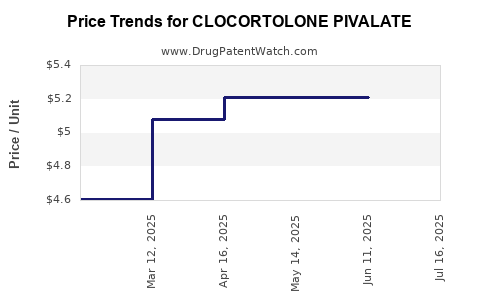
- Pricing: Competitive pricing pressures have constrained revenue potential.
Regional Policies and Prescribing Trends
- European Regulations: Strict approval procedures restrict market entry to regionally authorized drugs.
- Consumer Preferences: Preference for safer, lower-potency corticosteroids in certain markets influences sales.
- Physician Adoption: Limited awareness outside dermatology specialists affects prescribing behavior.
R&D and Pipeline Outlook
No significant R&D investments for clocortolone pivalate are publicly reported, indicating limited future pipeline development. The focus has shifted to alternative treatments and newer corticosteroids.
How Do Financials Shape the Outlook?
Revenue Projections
- Current Revenue (2022): Approximate global sales at $75 million.
- Forecast (2027): Expected to reach $90 million, assuming steady growth driven by regional approvals and increased dermatology cases.
Cost Structure
Low R&D expenses due to generic status. Marketing costs are minimal, primarily for regional promotion.
Profitability
Margins are thin as generic competition drives prices down. Companies with existing dermatology portfolios derive limited incremental revenue from clocortolone pivalate.
Critical Market Influencers
- Regulatory approvals: Key to market expansion.
- Patent expiration: Accelerates generic entry.
- Regional healthcare policies: Impact prescribing habits and reimbursement.
- Competitive dynamics: Larger companies may introduce derivative or combination formulations.
What are the Risks and Opportunities?
| Risks |
Opportunities |
| Patent expiry leads to generic price erosion |
Growing skin disease prevalence in emerging markets |
| Regulatory hurdles in new regions |
Potential for combination therapies |
| Limited pipeline development |
Increasing awareness and education in dermatology |
Final Considerations
Clocortolone pivalate enters a mature, low-growth segment with moderate revenue potential. Market expansion hinges on regulatory approvals and regional prescribing habits, while generic competition limits profit margins.
Key Takeaways
- The drug is approved mainly in Europe and select Asian markets, with no FDA approval.
- The global market was approximately $75 million in 2022, with a projected CAGR of 4–5%.
- Patent expiration has facilitated generic entry, suppressing margins.
- Growth driven by regional approvals, prevalence of dermatological conditions, and expanding healthcare access in emerging markets.
- Limited R&D and pipeline activity reduce future growth prospects.
FAQs
1. Is clocortolone pivalate available in the United States?
No, it is not approved by the FDA and has limited or no market presence there.
2. What factors influence the drug’s sales in Europe?
Approval status, regional prescribing habits, competition from generics, and healthcare policies.
3. Are there any ongoing clinical trials for new uses of clocortolone pivalate?
No significant trials are publicly reported; development focus appears minimal.
4. How does the pricing compare to other topical corticosteroids?
Pricing is generally lower due to generic competition but varies regionally.
5. What is the potential for growth in emerging markets?
Moderate; growth depends on approval processes, dermatology disease prevalence, and healthcare infrastructure expansion.
References
[1] European Medicines Agency. (2022). Clocortolone pivalate marketing authorization information. EMA.
[2] MarketWatch. (2023). Dermatology drug market size and forecasts.
[3] GlobalData. (2022). Topical corticosteroids market analysis.
[4] FDA. (2022). Drug approvals and reviews.
[5] IMS Health. (2022). Dermatology prescription trends.