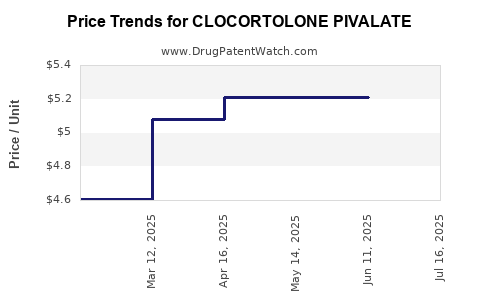
Last updated: September 9, 2026
Clocortolone pivalate is a mature, low-to-moderate potency topical corticosteroid marketed primarily as Cloderm Cream 0.1% and through generic equivalents. Its commercial profile is defined by long-established clinical use, limited regulatory exclusivity, generic substitution, and a narrow opportunity for premium pricing. Drug-specific revenue is not publicly disclosed, but the available regulatory and market evidence supports a mature, largely generic market rather than a high-growth pharmaceutical asset.
What is clocortolone pivalate used for?
Clocortolone pivalate is a topical corticosteroid indicated for corticosteroid-responsive dermatoses, including inflammatory and pruritic skin conditions. Cloderm Cream contains clocortolone pivalate at a 0.1% concentration and is applied topically to affected skin areas [1].
The product competes with a broad range of topical corticosteroids, including:
- Hydrocortisone and hydrocortisone valerate
- Desonide
- Triamcinolone acetonide
- Mometasone furoate
- Betamethasone dipropionate
- Fluocinonide
- Fluticasone propionate
Clocortolone pivalate is generally positioned above low-potency hydrocortisone products and below the strongest topical corticosteroids in potency. Its commercial value depends on formulation, prescriber familiarity, payer coverage, and substitution rules rather than on novel pharmacology.
What dosage forms and strengths are marketed?
The principal U.S. dosage form is a 0.1% topical cream. The commercial product is Cloderm Cream. Public FDA labeling identifies the drug as a topical cream rather than an oral, injectable, or biologic product [1].
The product is not a systemic medicine and does not have a biosimilar market. Competition comes from generic topical corticosteroids and generic clocortolone pivalate cream.
What is the FDA regulatory status of clocortolone pivalate?
Clocortolone pivalate was approved in the United States decades ago and is regulated as a conventional small-molecule prescription drug. The reference product is associated with Cloderm Cream 0.1%, historically held by Coria Laboratories and later commercialized by Crown Laboratories [1, 2].
| Regulatory factor |
Status |
| Active ingredient |
Clocortolone pivalate |
| Primary U.S. brand |
Cloderm Cream 0.1% |
| Dosage form |
Topical cream |
| FDA pathway |
Original NDA and subsequent ANDA generic pathway |
| NCE exclusivity |
Expired |
| Orphan-drug exclusivity |
None identified |
| Biosimilar pathway |
Not applicable |
| Generic competition |
Available |
| Current commercial profile |
Mature branded and generic topical drug |
The drug’s original regulatory exclusivity has no practical commercial relevance. Any current barrier to competition would have to arise from formulation, manufacturing, labeling, or market-access factors rather than new-chemical-entity exclusivity.
What patents protect clocortolone pivalate?
The original composition and product patents associated with clocortolone pivalate are expired or commercially exhausted. The drug’s principal U.S. commercial asset is not protected by a currently meaningful composition-of-matter patent estate.
The Orange Book is the primary FDA source for patents and exclusivity associated with approved drugs. Clocortolone pivalate cream does not have the patent profile of a recently approved branded product with active composition, formulation, or method-of-use listings that could materially delay ANDA approval [2].
How many patents cover clocortolone pivalate?
No material unexpired U.S. patent estate is generally associated with the active ingredient itself. The original steroid chemistry dates to an early generation of corticosteroid development, placing any basic compound protection far beyond the normal 20-year patent term measured from the relevant filing date.
Potentially relevant patent categories include:
- Original compound patents covering clocortolone or related corticosteroid structures.
- Formulation patents covering cream composition, excipients, or manufacturing processes.
- Labeling or method-of-use patents covering particular dermatoses.
- Device or packaging patents, if a product is commercialized in a specialized delivery system.
None of these categories presently appears to create a broad blocking position for ordinary clocortolone pivalate 0.1% cream. A company seeking market entry would still need to evaluate formulation-specific patents, FDA reference-product requirements, and freedom-to-operate issues independently.
When does clocortolone pivalate lose exclusivity?
Clocortolone pivalate lost meaningful exclusivity long ago. The relevant commercial milestones are:
| Event |
Approximate timing or status |
| Original clocortolone pivalate development |
Mid-20th-century corticosteroid era |
| U.S. approval of Cloderm Cream |
Early 1980s |
| NCE exclusivity |
Expired decades ago |
| Original composition patent protection |
Expired |
| Generic entry |
Established |
| Current exclusivity |
No meaningful regulatory exclusivity |
Because the product has been available for many years, the market no longer turns on a single patent expiry date. Competition is determined by the number of approved generic suppliers, reimbursement terms, pharmacy substitution, and whether the branded manufacturer maintains payer coverage.
Are there Paragraph IV challenges to clocortolone pivalate?
Paragraph IV litigation is generally associated with active Orange Book patents. Since clocortolone pivalate cream lacks a commercially significant unexpired patent estate, a conventional Paragraph IV challenge is not the primary entry mechanism.
Generic applicants can pursue an ANDA referencing the listed reference drug and may use paragraph III or paragraph IV certifications depending on the Orange Book record. Where no blocking patent remains, an ANDA applicant can proceed without waiting for patent litigation to resolve, subject to FDA review and approval requirements [2, 3].
The competitive question is therefore not whether a Paragraph IV case will unlock the market. It is whether additional generic suppliers can obtain approval and secure profitable reimbursement.
What is the Orange Book status of clocortolone pivalate?
The FDA Orange Book identifies approved drug products and, where applicable, associated patents and exclusivity. Clocortolone pivalate cream is a conventional genericized topical product with no active NCE exclusivity and no apparent patent listing capable of preserving a broad branded monopoly [2].
Orange Book analysis should distinguish between:
- The active ingredient, clocortolone pivalate.
- The reference product, Cloderm Cream 0.1%.
- Individual generic products approved through ANDAs.
- Any formulation-specific listing tied to a particular manufacturer.
An Orange Book listing does not guarantee commercial success for a generic applicant. Topical products can face bioequivalence and formulation-comparability issues that are less straightforward than those for simple immediate-release tablets.
How strong is the patent estate for clocortolone pivalate?
The patent estate is weak from an exclusivity and litigation perspective.
| Patent category |
Commercial strength |
| Active ingredient |
Very low; historical protection expired |
| Basic topical cream |
Low |
| Manufacturing process |
Potentially relevant but unlikely to block ordinary entry broadly |
| Method of use |
Low unless tied to a narrow, enforceable claim |
| Delivery device |
Not central to the established cream market |
| Trade dress and branding |
Relevant only to brand differentiation |
| Regulatory exclusivity |
None of commercial significance |
The main defensible assets are likely to be brand recognition, prescriber familiarity, formulation know-how, supply reliability, and payer positioning. Those assets can support a branded business but do not prevent generic substitution.
What market dynamics affect clocortolone pivalate?
Clocortolone pivalate operates in a highly competitive topical dermatology market. The main commercial forces are generic price erosion, formulary control, pharmacy substitution, and competition from therapeutically interchangeable corticosteroids.
Generic substitution
Generic clocortolone pivalate cream can reduce the price premium available to Cloderm. Once multiple suppliers are approved, wholesalers and pharmacy benefit managers can shift volume toward the lowest-cost source.
Topical dermatology products often retain some brand demand when physicians believe that vehicle characteristics, tolerability, cosmetic acceptability, or patient adherence differ between products. Those differences can support a residual branded market, but they rarely sustain monopoly pricing.
Formulation economics
For topical corticosteroids, the vehicle is commercially important. Patients and prescribers may distinguish among creams based on:
- Spreadability
- Greasiness
- Absorption
- Skin feel
- Irritation
- Cosmetic acceptability
- Stability
- Packaging convenience
A manufacturer with a well-accepted vehicle may preserve some demand even after generic entry. This is a formulation and commercial advantage, not a substitute for patent protection.
Payer pressure
Commercial insurers and pharmacy benefit managers usually favor low-cost generic topical corticosteroids. Brand coverage can require prior authorization, step therapy, or documented failure of generic alternatives.
The product’s reimbursement trajectory is therefore likely to show:
- Higher price and stronger brand retention before generic entry.
- Rapid unit-price pressure after generic approval.
- Continued volume in selected payer and prescriber segments.
- Lower net revenue as rebates and discounts rise.
- Stable or declining total market value despite continued prescription demand.
How does clocortolone pivalate compare with competing topical steroids?
| Product |
Typical commercial position |
Competitive impact |
| Hydrocortisone |
Low potency, low cost, widely available |
Strong first-line price competitor |
| Desonide |
Low potency, often used in sensitive areas |
Competes where tolerability and low potency matter |
| Triamcinolone acetonide |
Broadly used mid-potency generic |
Major volume competitor |
| Mometasone furoate |
Potent, widely recognized generic |
Competes in inflammatory dermatoses |
| Betamethasone dipropionate |
High potency |
Competes where stronger treatment is needed |
| Fluocinonide |
High potency |
Competes for more severe disease |
| Clocortolone pivalate |
Mid-market topical corticosteroid |
Differentiates mainly through brand, vehicle, and prescribing familiarity |
Clocortolone pivalate does not have a unique mechanism or disease-specific positioning that would isolate it from this competitive set. Its use is determined by potency selection, body site, disease severity, clinician preference, and insurance coverage.
What is the financial trajectory for clocortolone pivalate?
Drug-specific sales for clocortolone pivalate are not separately disclosed in the public filings of its commercial sponsors. Crown Laboratories is privately held, and public sources do not provide a reliable standalone revenue series for Cloderm.
The financial trajectory can be characterized as follows:
| Period |
Financial profile |
| Pre-generic commercialization |
Brand-led revenue with pricing power |
| Early generic competition |
Declining average selling price and market-share pressure |
| Mature generic period |
Lower unit economics and fragmented supply |
| Current market |
Stable clinical demand but limited growth and weak exclusivity |
| Long-term outlook |
Low-growth or declining branded revenue; generic volume may remain durable |
Revenue exposure is likely concentrated in the branded product’s residual prescriptions rather than in market expansion. A reasonable commercial model would assume:
- Low prescription growth.
- Continued generic substitution.
- Declining branded net price.
- Rising payer concessions.
- Limited opportunity for premium price increases.
- Greater value in portfolio bundling than in the individual molecule.
The product may still contribute strategically to a dermatology portfolio by supporting physician relationships, pharmacy distribution, and cross-selling. Its standalone valuation should reflect mature genericized-drug economics rather than the valuation of a protected specialty pharmaceutical.
What manufacturing and intellectual-property barriers exist?
Manufacturing barriers are moderate but not prohibitive. A generic manufacturer must demonstrate product quality, stability, content uniformity, microbiological control, and appropriate equivalence to the reference cream.
Topical semisolid products can require more development work than standard tablets because performance depends on the formulation and physical characteristics of the product. Relevant development factors include:
- Particle size and active dispersion
- Rheology and viscosity
- Emulsion stability
- Preservative system
- Microbial limits
- Container compatibility
- In-use stability
- Release and permeation performance
These requirements can slow generic development and raise development costs. They do not create a durable monopoly when multiple manufacturers can replicate the product and FDA approval is available through the ANDA pathway.
Which companies are competing in the clocortolone pivalate market?
Crown Laboratories is the principal branded commercial company associated with Cloderm. Generic competition is supplied through ANDA holders and contract manufacturers operating in topical dermatology.
The relevant competitive groups are:
- The Cloderm brand owner and its distribution partners.
- Generic dermatology companies.
- Large diversified generic manufacturers.
- Contract development and manufacturing organizations.
- Manufacturers of alternative topical corticosteroids.
The market is more fragmented than the original branded market. Competitive advantage depends on manufacturing cost, FDA compliance, channel access, inventory reliability, and payer contracting.
What litigation and settlement risks affect clocortolone pivalate?
There is no apparent current patent dispute that materially constrains ordinary U.S. generic entry for clocortolone pivalate cream. The litigation risk is more likely to involve:
- Product liability claims involving topical corticosteroid adverse effects.
- Manufacturing or quality disputes.
- Trademark or trade-dress issues involving Cloderm.
- Contract disputes with distributors or suppliers.
- Regulatory enforcement related to labeling, promotion, or manufacturing.
Settlement agreements would have the greatest commercial significance if they involved a later entrant, a formulation patent, or an exclusivity arrangement. No widely reported settlement appears to preserve a broad patent-based delay to generic competition.
What generic launch scenarios exist?
Three commercial scenarios are plausible for the established market.
Scenario 1: Continued generic price erosion
Multiple suppliers compete for pharmacy and wholesaler volume. The branded product retains a smaller premium segment, while generic prices decline. This is the most likely base case.
Scenario 2: Brand-supported niche stability
The brand maintains prescriptions among dermatologists who value the established vehicle, patient familiarity, or perceived tolerability. Revenue declines gradually rather than collapsing, but the product remains exposed to formulary restrictions.
Scenario 3: Supply disruption or supplier exit
If one or more generic manufacturers exit because of low margins, temporary shortages could support higher prices or restore some branded demand. Such an outcome would depend on manufacturing capacity and FDA shortage conditions, not patent rights.
Does clocortolone pivalate have biosimilar risk?
No. Clocortolone pivalate is a small-molecule topical corticosteroid, not a biologic. Biosimilar regulation under the Public Health Service Act does not apply. Its competitive risk comes from generic drugs approved under the Federal Food, Drug, and Cosmetic Act, along with therapeutically substitutable topical corticosteroids [3].
Key Takeaways
- Clocortolone pivalate is a mature topical corticosteroid marketed primarily as Cloderm Cream 0.1%.
- The drug has no meaningful remaining NCE or composition-of-matter exclusivity.
- Generic competition is established, and the commercial market is driven by price, formulary access, and formulation preference.
- The Orange Book does not present an apparent active patent barrier to ordinary generic entry.
- Paragraph IV litigation is not the central market-access issue because the relevant patent protection is historically expired or commercially weak.
- The product has no biosimilar exposure.
- Public companies do not separately report reliable Cloderm revenue, and Crown Laboratories is privately held.
- The likely financial trajectory is mature or declining branded revenue, with durable but low-margin generic demand.
- The strongest residual assets are brand recognition, vehicle familiarity, manufacturing capability, and dermatology distribution rather than patent exclusivity.
FAQs About Clocortolone Pivalate Commercialization
Is clocortolone pivalate still a profitable drug?
It can remain profitable as part of a dermatology portfolio, but its standalone economics are constrained by generic competition, payer pressure, and the absence of active exclusivity.
Is Cloderm Cream still protected by patents?
The original product and compound protection are not expected to provide a current broad market barrier. Any analysis of a specific formulation or packaging claim would require a separate patent-by-patent review.
Can a new company launch generic clocortolone pivalate cream?
Yes, subject to FDA approval of an ANDA, satisfactory product development, manufacturing compliance, and commercial access to wholesalers and payers.
Why might physicians prescribe clocortolone pivalate instead of triamcinolone?
Prescribers may select it based on potency, prior patient response, vehicle characteristics, tolerability, body-site considerations, or familiarity with Cloderm. Price and formulary status can override those preferences.
Is clocortolone pivalate a high-growth dermatology opportunity?
No. It is a mature, genericized topical corticosteroid. Growth would most likely require a differentiated formulation, a new delivery system, a new indication, or a portfolio strategy rather than the existing cream alone.
References
-
U.S. Food and Drug Administration. (n.d.). Cloderm: Clocortolone pivalate cream, 0.1% prescribing information. Drugs@FDA.
-
U.S. Food and Drug Administration. (n.d.). Approved drug products with therapeutic equivalence evaluations: Orange Book. https://www.fda.gov/drugs/drug-approvals-and-databases/orange-book
-
U.S. Food and Drug Administration. (n.d.). Abbreviated new drug application (ANDA) process. https://www.fda.gov/drugs/types-applications/abbreviated-new-drug-application-anda/abbreviated-new-drug-application-anda-generics